
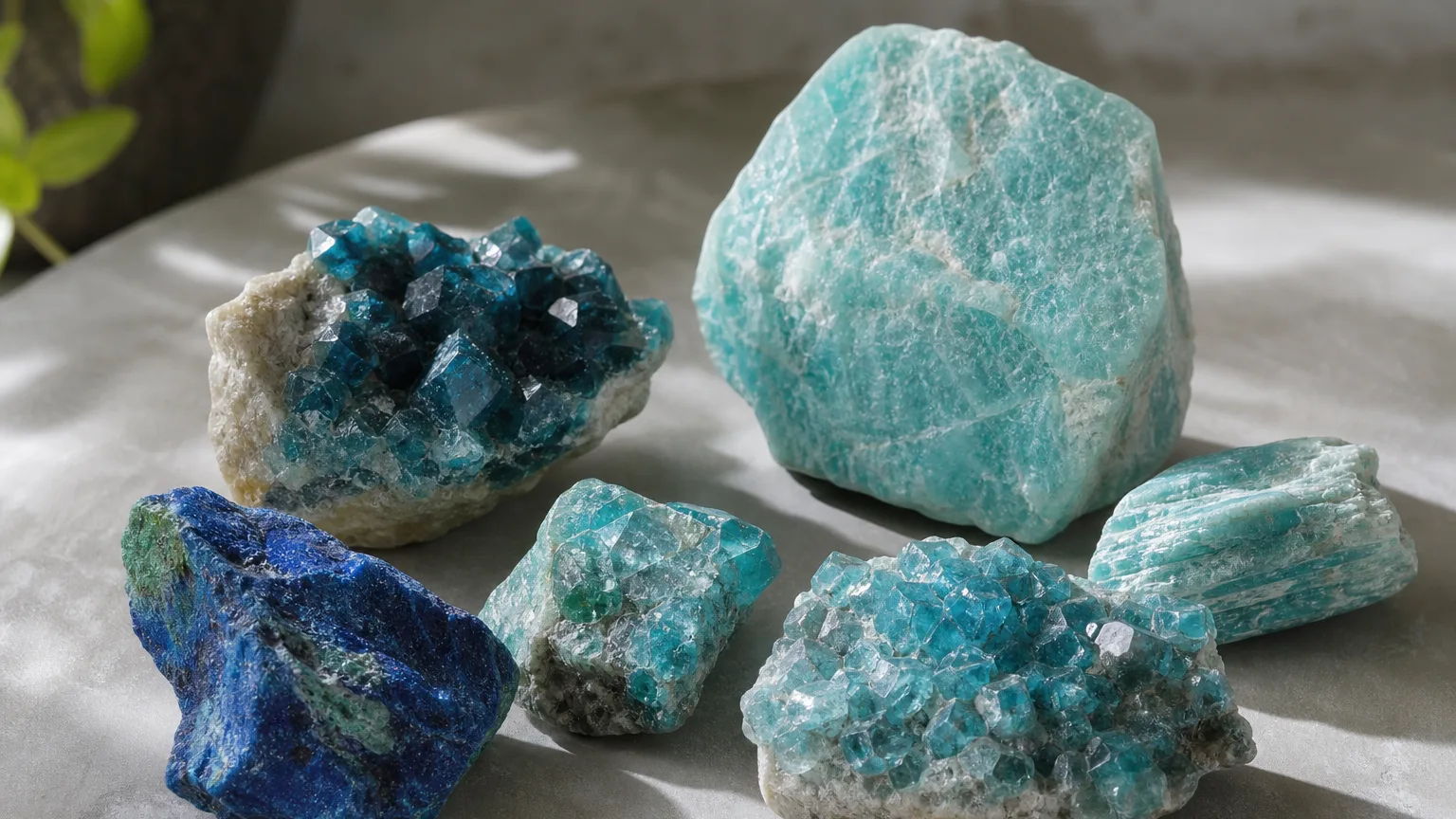
Best Blue-Green Crystals: Names, Meanings, Properties & Uses
Quick Answer: Best Crystals for Blue-Green
The best crystals for Blue-Green include Amazonite, Apatite, ajoite, traditionally used in mindfulness and spiritual practices. Crystal properties are complementary wellness tools, not medical treatments.
Understanding Blue-Green Crystals
Blue-green sits between two powerful symbolic zones. Blue carries calm, distance, and clear thinking. Green carries the heart, growth, and gentle feeling. Where they meet, you get a color often tied to transformation, flow, and truth — the shade of water moving over stone, of things shifting slowly and finding their level.
That blend matters in practice. People drawn to blue-green often describe a tension between what they think and what they feel. The throat wants to speak; the heart wants to stay soft. Blue-green crystals are traditionally used as a bridge between the two, supporting honest expression that doesn’t turn sharp.
Culturally, this color has long been valued for protection and exchange. Ancient Egyptian faience, Chinese jade, Persian turquoise, and the Amazon River basin stones that gave Amazonite its name all share this watery green-blue. Across very different traditions, the color was associated with safe passage, fair speech, and emotional balance — and carried as a talisman before hard conversations or travel.
Modern color psychology echoes this. Soft blue-green tones are widely used in spaces meant to lower stress and encourage openness. In crystal practice, the same hue is often paired with the throat and heart centers as a focus for steady breathing, journaling, and speaking from a calmer place.
Quick facts: Symbolism: Transformation, flow, truth. Psychology: Calm communication, emotional release. Associated chakra: Throat/Heart, element: Water/Air.
Not sure which color is right for you? Try the Crystal Quiz ↗
How to Identify Blue-Green Crystals
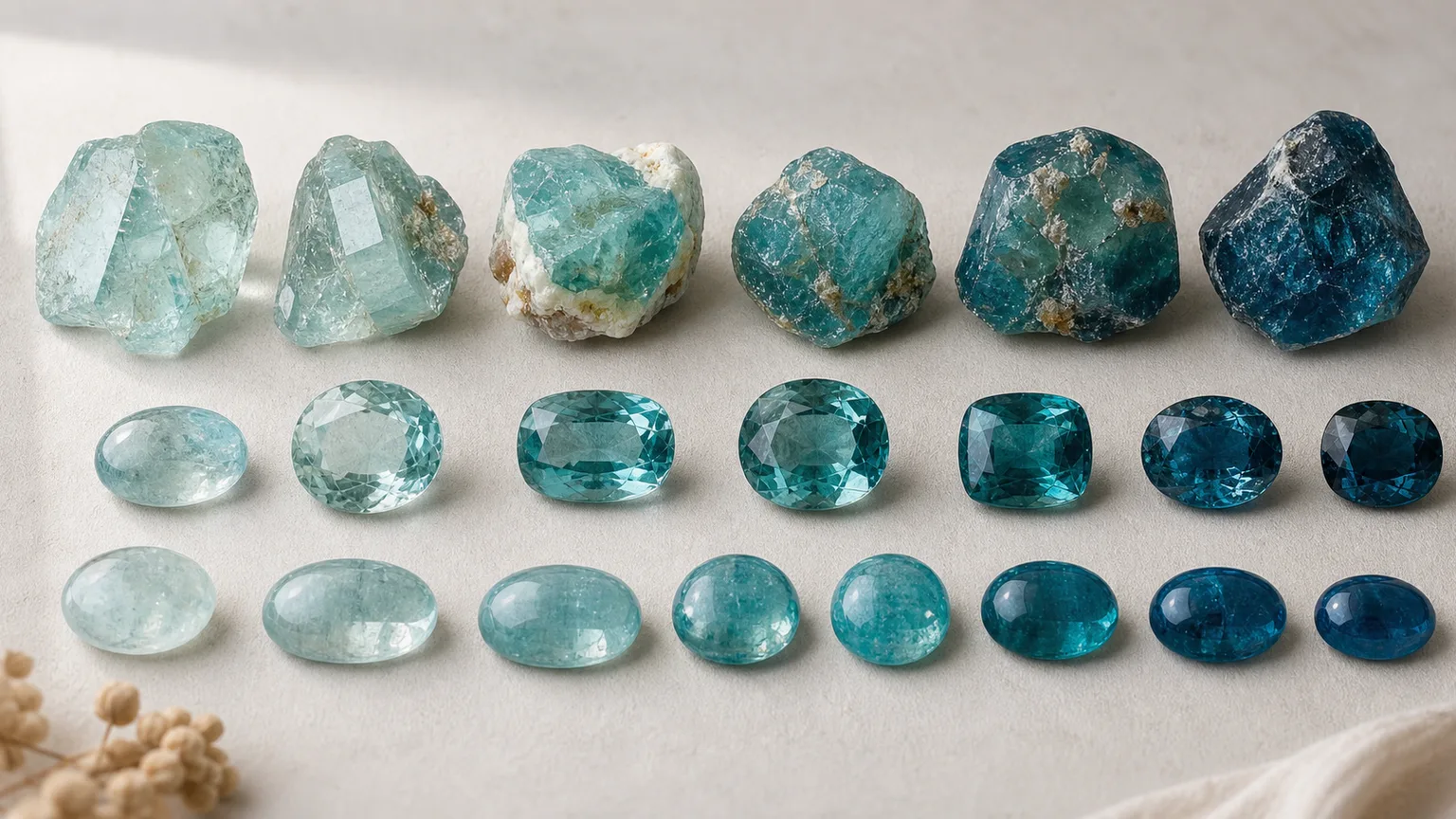
Blue-green is one of the trickier color bands to pin down, because it shifts with hue, lighting, and the underlying mineral. A good approach is to read hue, texture, and texture under light together rather than relying on a single photo.
Hue: The family runs from pale sky-blue leaning green (aquamarine, blue jade) through balanced turquoise (Amazonite) to deep teal and dark green-blue (cornetite, grandidierite). Some stones are translucent and let light pass through — aquamarine and apatite often glow at the edges. Others are opaque and quiet, like Amazonite and jade, with a soft surface rather than a deep one.
Texture and surface: Amazonite has a glassy to slightly waxy look with white banding. Turquoise feels more waxy and chalky, usually opaque. Apatite can be glassy and bright. The green copper minerals — aurichalcite, caledonite, cornetite, ajoite — often form as delicate fibrous or crusty coatings on rock, sometimes only a thin blue-green fuzz over a matrix.
Common confusions: Amazonite vs Turquoise is the classic one. Amazonite is harder, glassier, and usually shows striated white lines; Turquoise is softer, waxier, and more even. Dyed howlite or magnesite is often sold as Turquoise or Aquamarine — check for color that pools in cracks or looks too uniform. Apatite can resemble tourmaline, but apatite is softer and lighter. Dyed quartz is sometimes passed off as aquamarine; natural aquamarine has a cooler, more washed blue-green rather than a saturated one.
Under different light: Blue-green stones change noticeably between daylight and warm indoor light. Grandidierite is strongly pleochroic — it can look blue-green from one angle and near colorless or greenish from another. Aquamarine looks bluer in cool daylight and slightly greener in warm light. Always check a stone in natural daylight before buying, and view it from more than one angle.
9 Best Crystals for Blue-Green
Amazonite
Color: Blue-green, turquoise-green
Meaning: Transformation, flow, truth
Best for: Communication, Calm, Honesty
Chakra: Heart, Throat
Element: Water
Best way to use: Wear as jewelry
Affirmation: I speak my truth with a calm and steady heart.
Amazonite is a microcline feldspar (KAlSi₃O₈) whose blue-green comes from trace lead and water in its crystal structure, often shown in soft white banding. The color reads as cool and even on the skin, which is one reason it has long been carried before difficult conversations — a steady surface that invites a steady voice. In crystal practice it is often associated with the throat and heart, used as a focus for honest speech that stays kind. Hold one between meetings, or place it near your journal when you need to write something true but hard to say. Many people use it to soften the inner critic long enough to actually hear what they feel.
Apatite
Color: Blue-green, blue, green, yellow, violet
Meaning: Transformation, flow, truth
Best for: Motivation, Creative work, Expression
Chakra: Throat, Third Eye
Element: Fire
Best way to use: Wear as jewelry
Affirmation: I move from idea to action with clear intent.
Apatite is a phosphate mineral found in a wide blue-green range; the bright teal variety is often called “nautilus” or paraiba-style apatite. Glassy and translucent, it carries an alert, awake quality rather than a soothing one — which is why it is traditionally linked to motivation and getting unstuck. The throat and third eye association makes it a stone people reach for when they know what they want but keep losing the thread. Keep one on the desk when starting a stalled project, or hold it for a few breaths before voicing an idea you keep second-guessing. It may support a sense of clearer focus as a complement to ordinary effort, not a replacement for it.
ajoite
Color: Blue-green, pale blue-green
Meaning: Transformation, flow, truth
Best for: Peace, Gentle Expression, Heart
Chakra: Heart, Throat
Element: Water
Best way to use: Wear as jewelry
Affirmation: I let my words carry kindness, not defense.
Ajoite is a rare copper silicate that usually appears as a soft blue-green coating included inside quartz, giving stones a misted, sea-glass quality rather than a solid color. Mineralogically delicate, it is found in only a few localities, which is part of its quiet appeal. In practice ajoite is often associated with the heart and throat as a pair — a stone for the moment you want to say something tender without bracing for impact. Many people use it in meditation to soften old self-protection and make room for more open feeling. It is a gentle companion for slow evening reflection, not a stone for pushing through.
aurichalcite
Color: Blue-green, green, pale blue
Meaning: Transformation, flow, truth
Best for: Balance, Compassion, Gentleness
Chakra: Heart, Throat
Element: Water
Best way to use: Wear, carry, or place in your space
Affirmation: I meet friction with a soft and steady breath.
Aurichalcite is a zinc and copper carbonate that forms thin, fibrous blue-green blades on rock matrix — it looks like pale sea-grass frozen in stone. It is fragile and usually kept as a display piece rather than cut into jewelry, which suits its quiet character. Crystal practice often pairs aurichalcite with the heart and throat for calming tension and encouraging compassion, especially where two people keep talking past each other. Place one on a shared desk or bedside when a relationship feels strained. As a mindfulness cue it may support a softer response to stress, used alongside honest conversation rather than in place of it.
Read full aurichalcite meaning →
caledonite
Color: Blue-green, dark green
Meaning: Transformation, flow, truth
Best for: Heart, Calm Communication, Clarity
Chakra: Heart, Throat
Element: Water
Best way to use: Place in your space
Affirmation: I stay clear and kind, even when I disagree.
Caledonite is a rare lead copper sulfate carbonate that forms tiny blue-green to dark green crystals, often as drusy crusts on matrix. Its color is deeper and more muted than Amazonite, with a quiet, grounded quality. Traditionally associated with the heart and throat, it is used as a focus for calm communication when emotions have cooled but the issue remains. Keep one in a workspace where difficult conversations happen, or beside a letter you are drafting carefully. Many people use caledonite to hold steady ground — to say what needs saying without escalating, and to listen without rehearsing a reply.
Read full caledonite meaning →
aquamarine
Color: Pale blue to blue-green
Meaning: Transformation, flow, truth
Best for: Communication, Courage, Soothing tension
Chakra: Throat
Element: Water
Best way to use: Wear as jewelry
Affirmation: I speak clearly, even when my voice shakes.
Aquamarine is the blue-green variety of beryl (Be₃Al₂Si₆O₁₈), colored by trace iron, and its name means “seawater.” Its color ranges from almost pure pale blue to a greener teal, and finer stones are often heat-treated to shift the green toward blue. Glassy, translucent, and cool to the touch, it has long been carried by sailors as a talisman and by anyone speaking in front of others. In crystal practice it is the throat stone people reach for most — worn as a pendant near the voice, or held during a few slow breaths before a hard conversation. Many use it to steady the voice and soften tension, alongside ordinary preparation.
Read full aquamarine meaning →
blue-jade
Color: Soft blue to blue-green
Meaning: Transformation, flow, truth
Best for: Serenity, Quiet mind, Calm speech
Chakra: Throat, Third Eye, Crown
Element: Water / Air
Best way to use: Wear as jewelry
Affirmation: I rest in a quiet mind and let my words follow.
Blue jade is a rare color form of either nephrite or jadeite (both are chain silicates), with its soft blue-green tone coming from trace minerals rather than a single pigment. Jade is exceptionally tough — fibrous and dense — which is why it has been carved for tools and talismans for thousands of years. The blue-green form is often associated with serenity and steady, even-minded speech. Held or worn close to the throat and brow, it is used as a focus for slowing racing thoughts before speaking. Many people keep a piece at the bedside for the kind of quiet that makes restful sleep and calmer mornings more likely.
cornetite
Color: Deep blue-green, dark green
Meaning: Transformation, flow, truth
Best for: Heart, Growth, Renewal
Chakra: Heart
Element: Water
>Best way to use: Place in your spaceAffirmation: I make room for new growth, one steady breath at a time.
Cornetite is a rare copper phosphate that forms small, deep blue-green to dark green crystals — richer and darker than most stones in this family. It is a collector’s mineral, found in only a few localities, and usually kept as a specimen rather than cut. In crystal practice cornetite is associated with the heart and with renewal, a stone for the slow work of regrowing after a hard season. Place one in a quiet corner where you sit to think or meditate. Many people use it as a focus for patient self-care, to mark the shift from endurance back toward feeling — a complementary practice, not a cure.
grandidierite
Color: Blue-green to teal (pleochroic)
Meaning: Transformation, flow, truth
Best for: Clear speech, Even mind, Clear perception
Chakra: Throat, Heart, Third Eye
Element: Water / Air
Best way to use: Wear as jewelry
Affirmation: I see clearly, speak truly, and stay at ease.
Grandidierite is a rare magnesium iron borosilicate first identified in Madagascar, and it is strongly pleochroic — meaning it can show different colors from different angles, often shifting between blue-green, green, and near colorless. That visual shift is part of its character: it asks you to look from more than one direction before deciding. Crystal practice associates grandidierite with the throat, heart, and third eye as a set, used as a focus for clear perception and even-handed speech. Worn as a ring or pendant, it serves as a reminder to pause and see a situation fully before reacting, supporting steadier judgment as a complement to honest reflection.
Read full grandidierite meaning →
How to Choose Blue-Green Crystals by Intention
| Intention | Best Crystals | Why |
|---|---|---|
| Honest communication | Amazonite, Aquamarine, Caledonite | All three sit at the throat–heart line and are traditionally used to support clear, kind speech. |
| Motivation & creative focus | Apatite | Brighter and more alert than the others; associated with moving from idea to action. |
| Emotional soothing | Ajoite, Blue Jade, Aurichalcite | Soft, gentle stones often used to calm tension and quiet racing thoughts. |
| Heart renewal after a hard season | Cornetite, Grandidierite | Deeper green-blue tones linked with patient growth and seeing things whole. |
| Courage to speak up | Aquamarine, Apatite | Stones with a cooler, more awake feel, traditionally carried before speaking in front of others. |
| Steadiness under stress | Blue Jade, Caledonite | Dense or quiet stones used to hold an even mind when emotions run high. |
How to Use Blue-Green Crystals
Blue-green stones are made for the bridge between throat and heart, so the practices below lean into communication, reflection, and steady breathing rather than a generic checklist. A few focused methods suit this color better than seven scattered ones.
1. Throat–heart meditation (the core practice). Sit somewhere quiet and place one blue-green stone at the base of your throat and another over your sternum, the center of your chest. Close your eyes and breathe slowly for five to ten minutes, noticing where your breath feels open and where it catches. This placement is used to gently connect what you think with what you feel. Amazonite, ajoite, and aquamarine are the classic choices here.
2. Journaling for emotional communication. Keep a blue-green stone next to your journal and hold it for a few breaths before you write. Use it as a cue for the hardest line on the page — the thing you have been avoiding saying, even to yourself. Many people find apatite or caledonite helps them move from circling a feeling to actually naming it.
3. Bedside reflection. Place blue jade or cornetite on your nightstand. Spend two minutes holding it before sleep, letting the day settle. The aim is not to solve anything, only to close the loop on unfinished conversations so the mind can rest. Blue-green is often associated with this quiet transition space.
4. A short communication ritual before a hard talk. Hold an aquamarine or amazonite in both hands, breathe out slowly three times, and silently name the one thing you most want the other person to understand. Then set the stone aside and speak. This is a mindfulness practice, not magic — it works by steadying you, not by changing anyone else.
Quick notes: Wear aquamarine or amazonite as a pendant near the throat for everyday support. Carry apatite in a pocket when you need to stay motivated. For home placement, the bedroom and the desk where hard conversations happen are the two best spots.
Blue-Green Crystals for Emotional Communication
Emotional communication is the heart of what blue-green does best. It is the practice of saying what you actually feel — clearly, and without turning it into an attack or hiding it behind a wall. Most people find this harder than it sounds. The throat tightens, the heart braces, and the message comes out either too sharp or not at all. Blue-green stones are traditionally used right at that junction, and they work best when paired with a concrete habit rather than carried as a vague good-luck charm.
A morning desk ritual. Before the day’s messages start arriving, sit at your desk for three minutes with an amazonite or aquamarine in your palm. Breathe slowly and set one intention for how you want to communicate today — patient, direct, warm, whatever fits. Place the stone where you can see it. When a tense email or message comes in later, the stone is your cue to pause and breathe before you reply. It is a small anchor, and that is the point.
A bedside reflection for unfinished conversations. At night, hold a piece of blue jade or ajoite and bring to mind one exchange from the day that did not land well. Without rehearsing a comeback, simply name what you felt and what you wish you had said. Then set the stone down and let it go. Over a few weeks this practice often softens the pressure that builds around difficult people and topics.
The stones themselves do not speak for you. What they offer is a tactile focus — something cool and steady in your hand at the exact moment you would otherwise react. Used that way, as a complement to honest effort and, where needed, professional support, blue-green crystals can become a quiet part of how you say the hard things more kindly.
Blue-Green Crystals at a Glance
| Crystal | Best for | Chakra | Best way to use |
|---|---|---|---|
| Amazonite | Honest, calm communication | Heart, Throat | Wear as a pendant near the throat |
| Apatite | Motivation & moving from idea to action | Throat, Third Eye | Hold before starting a stalled task |
| Ajoite | Gentle expression of tender feelings | Heart, Throat | Evening meditation or quiet reflection |
| Aurichalcite | Softening tension between people | Heart, Throat | Place in a shared space |
| Caledonite | Calm, clear communication when it matters | Heart, Throat | Keep beside important writing or talks |
| Aquamarine | Courage and a steady voice | Throat | Wear near the throat; hold before speaking |
| Blue Jade | Quiet mind, serene speech | Throat, Third Eye, Crown | Bedside piece for evenings |
| Cornetite | Patient renewal after a hard season | Heart | Place in a calm corner for reflection |
| Grandidierite | Clear perception before reacting | Throat, Heart, Third Eye | Wear as a ring or pendant |
Shop Crystals for This Guide
Explore crystal jewelry and stones from our current collection.


Apatite Tower


Apatite Heart


Apatite Sphere with Tripod


Apatite Worry Stone
FAQ
What are blue-green crystals good for? They are traditionally associated with communication, emotional balance, and steady self-expression. In practice, people use them as a focus for honest conversations, journaling, and calming stress — as a complement to ordinary effort, not a medical treatment.
What does a blue-green crystal mean? Across many traditions this color band symbolizes transformation, flow, and truth — the meeting point of clear thinking (blue) and feeling (green). It is often tied to the throat and heart together.
What is the most powerful blue-green crystal? “Powerful” is subjective and no crystal is more effective than another in a measurable sense. Aquamarine and Amazonite are simply the most commonly used and easiest to find, which makes them popular starting points.
What is the rarest blue-green crystal? Grandidierite, ajoite, cornetite, and caledonite are all considered rare collector stones, found in only a few localities and seldom cut into commercial jewelry. Grandidierite is among the rarest of gem-quality blue-green minerals.
What crystal is blue-green or turquoise in color? Amazonite is the classic opaque turquoise-green stone. Aquamarine gives a translucent pale blue-green. Apatite can be a brighter teal, and ajoite, aurichalcite, and caledonite appear as softer blue-green coatings on rock matrix.
How can I tell Amazonite from Turquoise? Amazonite is harder and glassier, usually with white striated banding. Turquoise is softer, waxier, and more even in color. If the color looks too uniform or pools in cracks, it may be dyed howlite or magnesite sold as turquoise.
Are blue-green crystals scientifically proven to work? No. Crystal properties are traditional and spiritual, not established by science. Any calming effect you notice is more plausibly explained by the mindfulness practice — slow breathing, focused attention, a tactile cue — that usually goes with using them. They are a complementary wellness tool, not a treatment for any condition.
How do I cleanse blue-green crystals? Rinse harder stones like aquamarine, amazonite, and jade briefly under cool running water and dry them gently. Keep softer or fibrous minerals — ajoite, aurichalcite, caledonite, cornetite — dry; use smoke, sound, or simply set them on a windowsill out of direct sun. Avoid prolonged sun for deeply colored stones, which can fade.