Best Grey Crystals: Names, Meanings, Properties & Uses
Quick Answer: Best Crystals for Grey
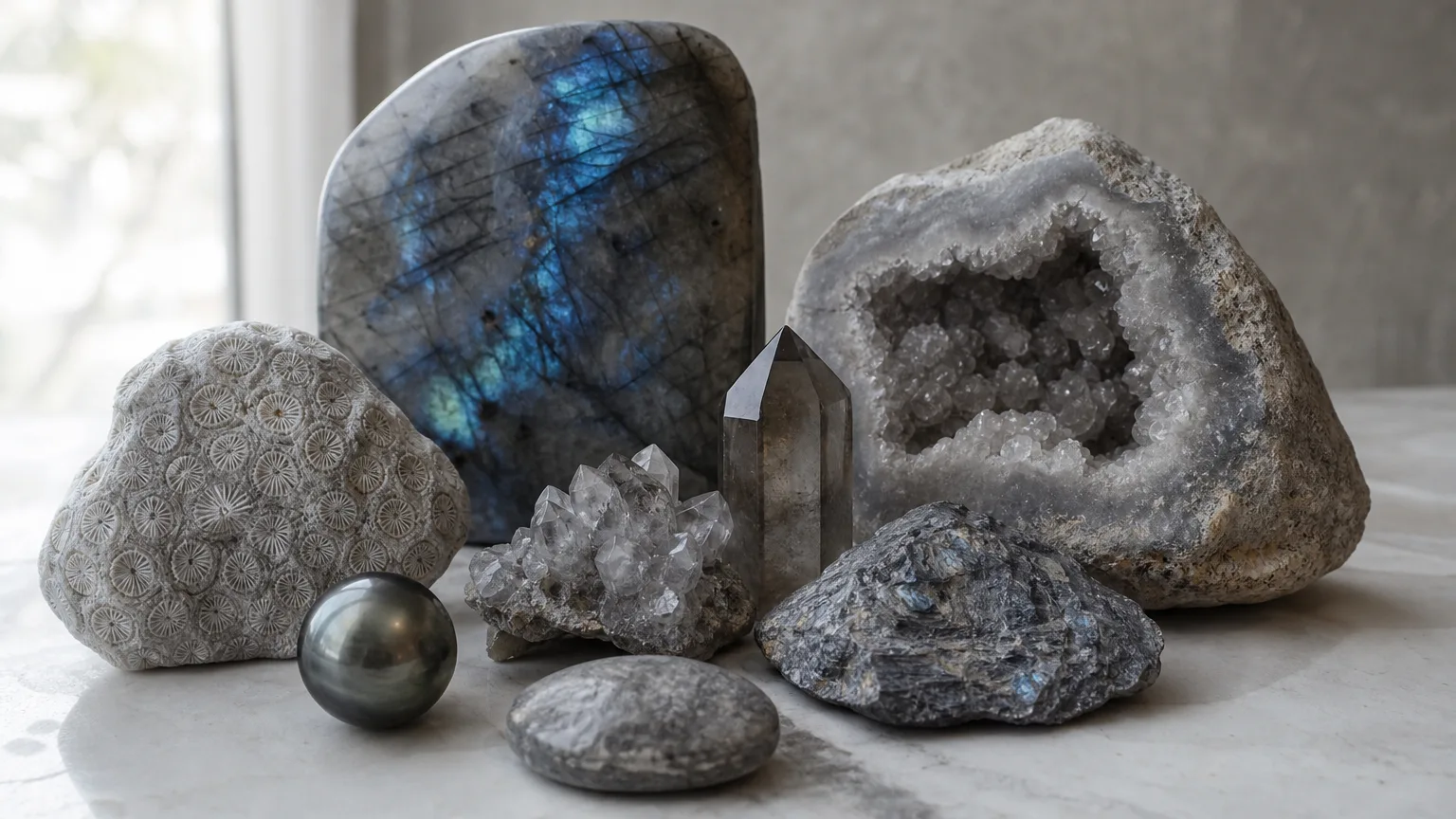
The best crystals for Grey include Labradorite, agatized-coral, black-pearl, traditionally used in mindfulness and spiritual practices. Crystal properties are complementary wellness tools, not medical treatments.
Understanding Grey Crystals
Grey sits between black and white, and that in-between quality is exactly what makes these stones so useful. Where red pushes and yellow brightens, grey holds steady. It absorbs light rather than shouting for it, which is why grey minerals have long been associated with neutrality, quiet reflection, and the kind of steady attention that does not swing between moods.
Culturally, grey has carried dual meanings for centuries. In some East Asian traditions grey carries the dignity of age and stone, woven into ink painting and temple rock where subtlety outranks brilliance. In the West it has sometimes been read as plain or serious, yet the same seriousness is what makes grey the colour of focus, craft, and the long view. Think of the monk’s robe, the philosopher’s slate, the gravestone that outlasts generations.
On a psychological level, grey tends to lower the volume. Many people find that looking at soft greys slows racing thoughts and creates a small pocket of detachment, the feeling of stepping back before deciding. Modern colour psychology often links grey to composure and balanced judgment rather than any single emotion, which is why these stones are popular during changes, hard conversations, or any moment that asks for a clear head. Grey does not promise excitement. It offers a calm surface to rest on while the rest of the picture comes into focus.
Quick facts: Symbolism: Neutrality, calm, introspection. Psychology: Detachment, balance, quiet reflection. Associated chakra: Neutral, element: Air/Metal.
Not sure which color is right for you? Try the Crystal Quiz ↗
How to Identify Grey Crystals
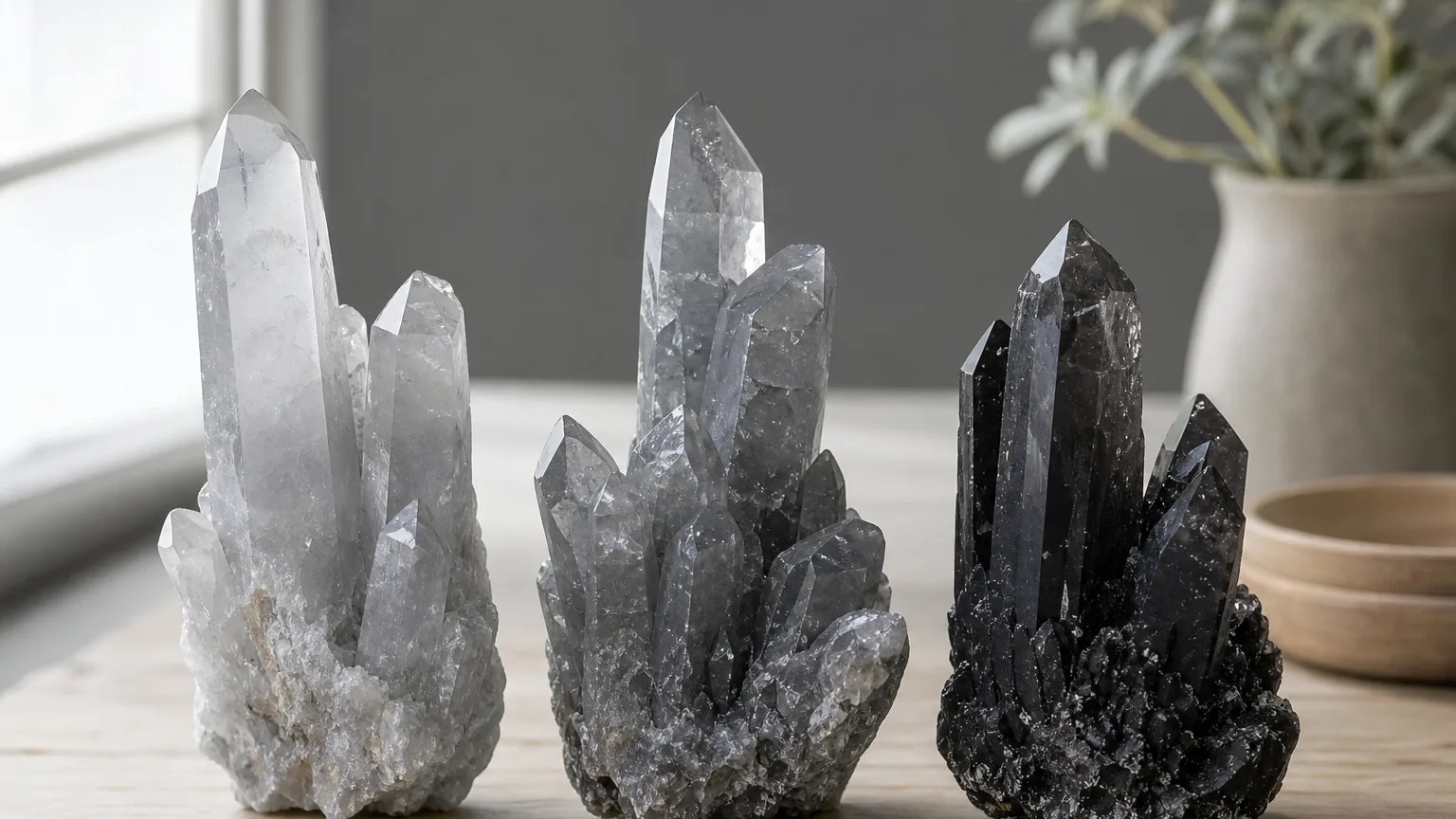
Grey crystals rarely look the same under every light, and learning to read them takes a little patience. Start with the body tone: light grey stones like polished granite or pale k2-stone can appear almost white in sunlight, while deep grey specimens such as meteorite or black-pearl lean toward charcoal or near-black indoors. Hold the stone under daylight, then warm indoor light, and notice how the hue shifts, blue-greys often warm up, and silvery greys lose their flash.
Texture matters as much as tone. Labradorite looks plain grey until it catches the light and throws blue or gold flash across its surface, a play-of-colour caused by thin internal layers. Agatized coral often feels glassy and waxy, with a translucency that granite and kimberlite, both opaque and granular, never have. Petoskey stone shows a distinctive hexagonal fossil pattern when polished, unlike the speckled look of true granite or the banded layers of rhyolite.
A few pairs are easy to confuse. Labradorite is sometimes sold as rainbow moonstone, but labradorite’s flash sits in flat sheets while moonstone glows from within. Grey agate and agatized coral can look similar, yet coral often keeps a branching or porous shape under its polish. K2-stone is the obvious one to spot: grey-white granite dotted with bright blue azurite circles, unlike any other grey mineral. When in doubt, check the streak on unglazed porcelain and watch how the surface behaves as you turn it, real identity lives in the texture and the way light moves.
9 Best Crystals for Grey
Labradorite
Color: Grey-black body with blue/gold/green flash
Meaning: Neutrality, calm, introspection
Best for: Change, Intuition, Creativity
Chakra: Throat, Third Eye
Element: Water
Best way to use: Wear as jewelry
Affirmation: I move through change with steady intuition.
A feldspar mineral prized for its labradorescence, labradorite shows a grey-black body that suddenly throws blue, gold, or green light when turned. That flash comes from thin internal layers scattering light, a quirk of its slow cooling deep in the earth. The colour itself, soft grey shifting to luminous colour, has long made it a symbol of periods when the ordinary starts to glow with new meaning. Traditionally associated with the throat and third eye centres, it is often used as a companion during transitions and creative blocks. Many people hold it when they need to stay calm and curious at once, letting the mind rest while it quietly finds a new path forward.
Read full Labradorite meaning →
agatized-coral
Color: Grey, brown, pink, red, yellow (natural/dyed)
Meaning: Neutrality, calm, introspection
Best for: Patience, Longevity, Grounding
Chakra: Root, Sacral, Heart
Element: Earth, Water
Best way to use: Wear as jewelry
Affirmation: I trust the slow work of time.
Agatized coral began as a living reef, then over millions of years silica (SiO₂) replaced each cell, leaving grey, brown, and soft pink banding in the shape of the original coral. It is technically chalcedony with a fossil’s history, glassy and cool to the touch. The grey tones carry the same neutral steadiness found in other agates, while the fossil origin has long linked the stone to patience and the long view. Traditionally associated with the root and heart, it is often used as a grounding reminder that meaningful growth is rarely fast. Many people keep it close when a project or relationship asks them to stay steady and let things take their own time.
Read full agatized-coral meaning →
black-pearl
Color: Grey, silver, black, green, blue, purple
Meaning: Neutrality, calm, introspection
Best for: Calm, Composure, Wisdom
Chakra: Throat, Third Eye, Crown
Element: Water
Best way to use: Wear as jewelry
Affirmation: I meet each day with quiet composure.
Black pearl is an organic gem formed inside certain molluscs when nacre, mostly aragonite layered with a protein called conchiolin, builds up in thin sheets. The grey-silver overtones come from the way those layers reflect light, shifting toward green, blue, or purple as the pearl turns. Cooler and softer to the touch than any mineral, pearls carry the calm of deep, still water. Long associated with the throat and crown centres, black pearl is traditionally used as a stone of composure and quiet wisdom. Many people wear it when they want to speak evenly, stay poised under pressure, and let reactions settle before they speak.
Read full black-pearl meaning →
granite
Color: Grey, pink, white, black (speckled)
Meaning: Neutrality, calm, introspection
Best for: Grounding, Stability, Stress relief
Chakra: Root
Element: Erde
Best way to use: Carry or hold in meditation
Affirmation: I stand firm, grounded, and unhurried.
Granite is an igneous rock made of interlocking quartz, feldspar, and mica crystals, giving it the speckled grey, pink, and black pattern most people recognise from kitchen counters and mountain faces alike. Cool, dense, and slightly rough in its natural state, it carries the literal weight of cooled magma hardened over millions of years. That unyielding quality has long made granite a symbol of stability and endurance. Traditionally associated with the root, it is often used as a grounding stone when life feels scattered or overstimulating. Many people hold a small piece to settle racing thoughts and feel their feet firmly back on the ground.
rhyolite
Color: Grey, brown, red, pink, often banded
Meaning: Neutrality, calm, introspection
Best for: Forward movement, Creative thinking, Rooted energy
Chakra: Root, Sacral, Solar Plexus
Element: Fire / Earth
Best way to use: Wear as jewelry
Affirmation: I move forward, rooted and creative.
Rhyolite is a volcanic rock, the fine-grained cousin of granite, formed from rapidly cooled silica-rich lava. Its grey, brown, and sometimes banded patterns record the flow of that ancient lava, often speckled with crystal pockets. Smooth when tumbled and warm to the hand, it carries both the heat of its fiery origin and the steadiness of earth. Because it holds both fire and earth qualities, rhyolite has long been linked to balanced forward movement and creative thinking. Traditionally associated with the lower chakras, it is often used as a companion when someone wants to act without losing their ground, turning ideas into steady, rooted progress rather than a rush.
k2-stone
Color: Grey-white granite with blue spots
Meaning: Neutrality, calm, introspection
Best for: Rooted intuition, Earth-sky balance, Honest expression
Chakra: Root, Third Eye, Throat
Element: Erde
Best way to use: Carry or hold in meditation
Affirmation: I trust both my grounding and my insight.
K2 stone is a rare combination of grey-white granite spotted with bright blue azurite circles, mined near the base of K2, the world’s second-highest mountain. The grey matrix grounds it firmly in earth, while the blue spots add a sudden note of sky. That pairing, stone and colour, low and high, has made k2-stone a favourite for people who want intuition without losing their footing. Traditionally associated with the root, third eye, and throat, it is often used as a bridge between grounded common sense and clearer insight, helping someone express what they actually see rather than what they think they should say.
kimberlite
Color: Grey-blue, grey-green, speckled
Meaning: Neutrality, calm, introspection
Best for: Hidden Potential, Transformation, Grounding
Chakra: Root
Element: Earth (deep mantle)
Best way to use: Wear, carry, or place in your space
Affirmation: I trust the value hidden within me.
Kimberlite is the volcanic rock that carries diamonds from deep in the earth’s mantle to the surface, recognisable by its grey-blue, speckled, sometimes brecciated look. It forms in vertical pipe structures over hundreds of millions of years, which is why a plain grey exterior can hold one of the hardest, clearest gems inside. That contrast, ordinary outside, extraordinary within, has long made kimberlite a symbol of hidden potential and slow transformation. Traditionally associated with the root, it is often used as a reminder that growth and value are not always visible from the outside, and that steady inner work brings its own kind of depth to the surface over time.
Read full kimberlite meaning →
meteorite
Color: Dark grey, metallic black
Meaning: Neutrality, calm, introspection
Best for: Perspective, Change, Grounding
Chakra: Third Eye, Crown, Root
Element: Éther (cosmos)
Best way to use: Wear as jewelry
Affirmation: I hold both earth and cosmos in steady balance.
Meteorite is genuine extraterrestrial material, fragments of asteroid or planetary core that travelled through space before landing on earth. Iron meteorites show a dark grey, metallic surface and, when etched, reveal crosshatched Widmanstätten patterns that took millions of years of slow cooling to form, patterns that cannot be made on earth. Heavy and cool, with a strange gravity in the hand, meteorite carries both cosmic distance and surprising weight. Traditionally associated with the root and crown together, it is often used as a stone of perspective, a reminder of how small a single worry looks against the scale of time and space.
petoskey-stone
Color: Grey-brown (hexagonal pattern when polished)
Meaning: Neutrality, calm, introspection
Best for: Perspective, Grounding, Patience
Chakra: Third Eye, Root
Element: Water
Best way to use: Carry or hold in meditation
Affirmation: I hold steady through deep time and change.
Petoskey stone is a fossilised coral, Hexagonaria percarinata, around 350 million years old, found mainly on the shores of Lake Michigan. In its raw state it looks like an ordinary grey-brown pebble, but when polished and wet its surface reveals a clear hexagonal pattern, the skeletons of ancient reef colonies. Smooth and softly cool, it carries the patience of deep geological time. Traditionally associated with the third eye and root, Petoskey stone is often used as a grounding reminder of perspective, the kind of long view that makes a present difficulty feel less urgent and easier to meet with steady patience.
Read full petoskey-stone meaning →
How to Choose Grey Crystals by Intention
Grey stones overlap in tone but each one leans toward a slightly different need. Use this matrix to match your intention to the right crystal.
| Intention | Best Crystals | Why |
|---|---|---|
| Moving through change or transition | Labradorite, Meteorite, Kimberlite | All three carry stories of transformation, light emerging from grey, diamonds rising from depth, cosmic distance lending perspective. |
| Grounding and stability | Granite, Petoskey stone, K2-stone | Dense, earthy, and literally ancient, these stones bring attention down into the body and the present moment. |
| Calm composure and balanced speech | Black-pearl, K2-stone, Labradorite | Soft, reflective tones linked to the throat centre, helping reactions settle before they become words. |
| Patience and the long view | Agatized coral, Petoskey stone, Kimberlite | Fossils and deep-mantle stones that carry millions of years of slow formation, a steady counterweight to hurry. |
| Creative, rooted action | Rhyolite, K2-stone, Labradorite | Volcanic and flash-bearing stones that pair grounded energy with fresh insight, supporting movement without losing footing. |
| Perspective on stress or overthinking | Meteorite, Petoskey stone, Granite | Heavy, deep-time stones that shrink a single worry against the scale of geological or cosmic time. |
How to Use Grey Crystals
Grey crystals work best when you build small, repeatable rituals around them rather than reaching for them only in a crisis. Their strength is steadiness, so they reward daily touchpoints.
Transition rituals. This is where grey stones shine. Keep a labradorite or k2-stone by your door and hold it for thirty seconds when you leave for work or return home, a small physical cue that lets you shift gears between roles. The neutral tone helps you set down the day’s noise before you walk into a new space.
On your desk. Place a granite slab, a piece of kimberlite, or a polished petoskey stone where you can see it while you work. Grey does not distract, so it supports calm-focus practice during long tasks. When attention scatters, pick it up, feel its weight, and return to the page. Many people find this works as well as a fidget tool and feels more grounded.
Meditation. Hold a grey stone in your receiving hand or rest it on your lap for a few minutes of seated breathing. For a calm-focus practice, try gazing softly at the surface of a labradorite and watching for its flash as you settle, a gentle anchor that gives the eyes something neutral to rest on. Meteorite suits longer reflection sessions when you want a wider perspective on a problem.
Wear it for composure. Black-pearl, labradorite, and rhyolite work well as everyday jewelry. A grey piece near the throat or wrist acts as a discreet reminder to pause and respond evenly, useful before hard conversations or busy meetings. Touch it as a private cue when you feel stress rising.
Cleanse gently. Most grey stones clean well with cool running water and a soft cloth, then a few hours on a windowsill in indirect light. Avoid salt water and long sun for organic stones like pearl and agatized coral, and keep k2-stone dry to protect its blue azurite spots.
Grey Crystals for Transition, Neutrality, and Calm Focus
Grey is the colour of the in-between, the moment after one thing ends and before the next begins. That is exactly why these stones are so useful for transitions: a new job, a move, a shift in a relationship, the slow re-entry after a hard season. They do not push you forward or hold you back. They help you stand still long enough to see clearly.
Try this morning desk ritual when you are between phases. Before opening your laptop, place a labradorite or k2-stone in front of you, close your eyes, and take three slow breaths while resting a hand on the stone. Set one small, honest intention for the day, not a goal, just a quality you want to carry, such as steadiness or honesty. Let the stone’s neutral tone be the container for that intention while you work.
For a bedside reflection in the evening, hold a petoskey stone or piece of granite and recall one thing that went well and one thing that felt uncertain. The stone’s weight gives your hand something to do while your mind settles, and many people find this simple pause helps them close the day without carrying it into sleep. During big decisions, a meteorite or kimberlite on the desk can offer a wider lens, a quiet physical reminder that the choice in front of you is one chapter in a much longer story.
Neutrality is not the same as numbness. Used this way, grey crystals become small anchors that help you stay present with change instead of bracing against it, calm enough to focus, neutral enough to choose well.
Grey Crystals at a Glance
| Crystal | Am besten geeignet für | Chakra | Best way to use |
|---|---|---|---|
| Labradorite | Change and intuition | Throat, Third Eye | Wear as jewelry; gaze at the flash in meditation |
| Agatized coral | Patience and longevity | Root, Sacral, Heart | Wear as jewelry; hold during slow projects |
| Black-pearl | Composure and calm speech | Throat, Third Eye, Crown | Wear near the throat for steady expression |
| Granite | Grounding and stress relief | Root | Carry in pocket; hold to settle racing thoughts |
| Rhyolite | Creative, rooted action | Root, Sacral, Solar Plexus | Wear as jewelry during new projects |
| K2-stone | Rooted intuition and honest expression | Root, Third Eye, Throat | Hold in meditation to bridge insight and words |
| Kimberlite | Hidden potential and transformation | Root | Place in your space as a depth reminder |
| Meteorite | Perspective and big-picture thinking | Third Eye, Crown, Root | Wear as jewelry; hold during long reflection |
| Petoskey stone | Patience and long-view grounding | Third Eye, Root | Carry or hold; bedside evening reflection |
Kaufen Sie Kristalle für diesen Leitfaden
Entdecken Sie Kristallschmuck und Edelsteine aus unserer aktuellen Kollektion.


Labradorite Anklet

 Gold
Gold
 Silber
 Roségold
Labradorite Gold or Silver Bracelet


Labradorite Blue Flame Sphere with Tripod


Labradorite Ganesh
FAQ
What are grey crystals good for?
Grey crystals are most often used for calm focus, neutrality, and steady support during change. Many people reach for them to settle racing thoughts, find composure before a hard conversation, or stay grounded through a transition. They are complementary wellness tools, not medical treatments.
What does a grey crystal mean spiritually?
Spiritually, grey is read as the colour between black and white, so grey stones tend to symbolise balance, detachment, and quiet reflection. They are traditionally associated with neutrality, patience, and the ability to step back before deciding, rather than any single strong emotion.
What is the most powerful grey crystal?
Power is subjective, but labradorite is one of the most popular grey stones because of its striking flash and long association with intuition and change. Meteorite is another favourite for people seeking perspective, since it is genuine extraterrestrial material. Choose by what you want to support, not by strength alone.
What is the rarest grey crystal or stone?
K2-stone is among the rarer grey stones, mined only near its namesake mountain. Genuine meteorite is also scarce, especially etched iron meteorites that show their Widmanstätten patterns. Kimberlite is common as a rock but valued because it is the ore that carries diamonds to the surface.
What crystal is grey with blue spots?
That is almost certainly k2-stone, a grey-white granite dotted with bright blue azurite circles. Nothing else in the grey family shares that spotted look. Labradorite can show blue, but its colour appears as a moving flash across flat sheets, not as round spots.
What crystal is dark grey and metallic?
Iron meteorite is the classic dark grey, metallic stone, heavy in the hand with a dark surface that can show crosshatched patterns when etched. Some polished hematite and lodestone also look dark grey-metallic, but they are denser and lack meteorite’s Widmanstätten structure.
What crystal is grey with a hexagonal pattern?
That is Petoskey stone, a 350-million-year-old fossilised coral. When polished and slightly wet, its grey-brown surface shows clear six-sided hexagons, the skeletons of ancient reef colonies. No other grey stone has this pattern.
Are grey crystals scientifically proven to heal?
No. There is no scientific evidence that grey crystals cure or treat any medical condition. Their value is cultural and personal: many people use them as mindfulness anchors, tactile objects that help with focus, calm, and reflection. Think of them as complementary tools that support wellbeing practices, not as medicine.