
Black Opal Meaning: Healing Properties & Uses
Black opal is the dark-bodied, color-flashing variety of precious opal — the rarest and most prized kind of opal, long tied to mystery, passion, and a sense of light found within the dark. Hold it, set it where you reflect; the pages ahead cover what black opal means, what it’s made of, and how people work with it. Crystal meanings reflect tradition and personal practice, not medical advice.
What Is Black Opal Meaning?
At its simplest, black opal means depth, passion, and light found within the dark. On a dark body color its play-of-color flashes brighter than in any other opal — color that seems to glow out of shadow. Across traditions it’s been called a stone of mystery, intensity, and quiet inner strength, and a stone that some believe holds and reflects deep feeling.
For many people that’s the appeal: a single stone where vivid color burns against a dark ground. You don’t need any belief about energy to use it — the value often comes from choosing the piece, giving it a job (“help me find the light in this”), and letting its glow pull you toward steadiness when things feel heavy. In that sense black opal is a cue for inner strength more than anything else.
Black Opal Meaning and Symbolism
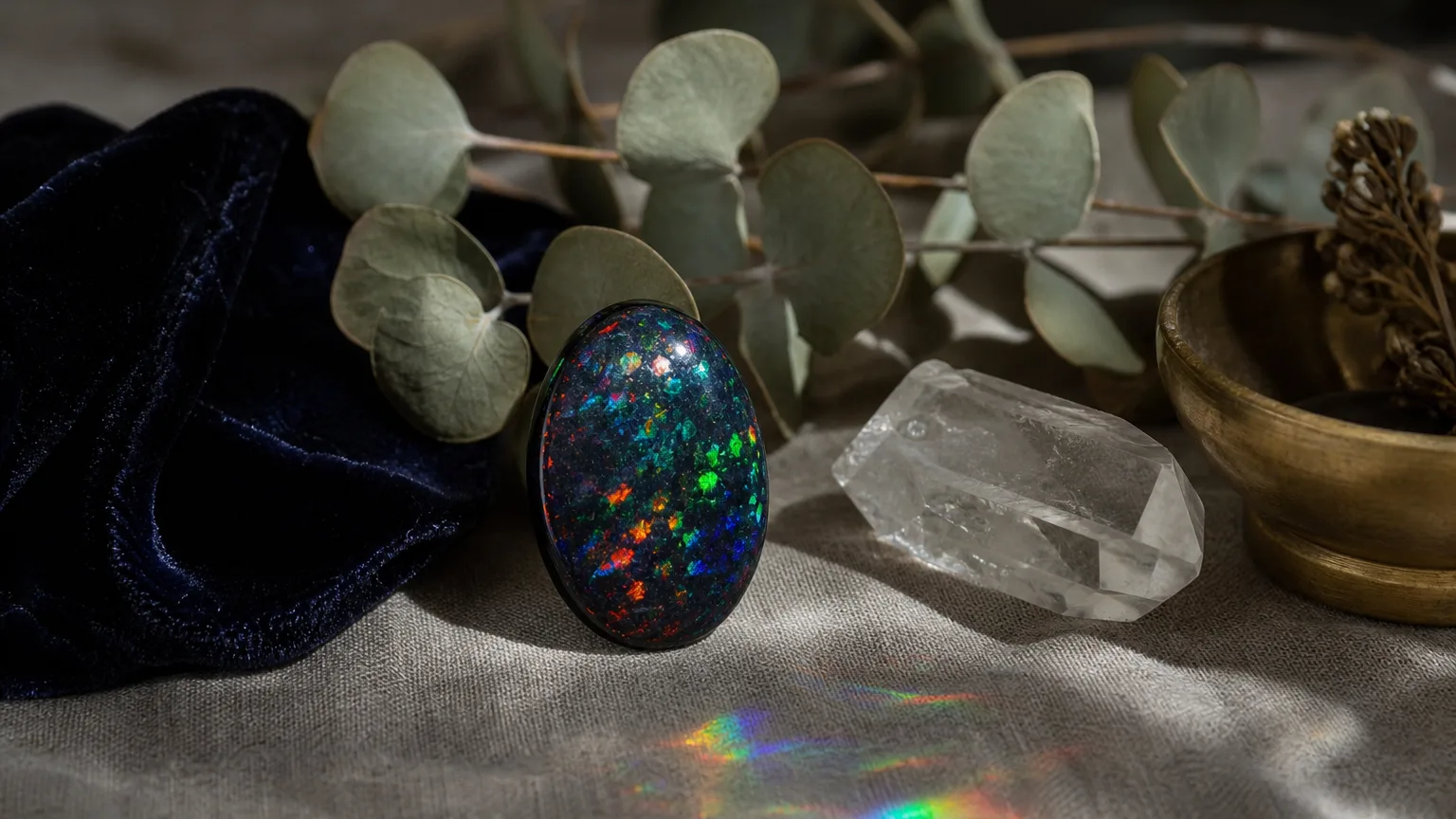
What sets black opal apart is its dark ground. Where white opal sits on a pale, milky body, black opal sits on a dark one — deep grey, blue, or green — and that darkness makes every flash of color burn brighter. That single visual is where most of its meaning lives: vivid light held within shadow.
The stone’s story is tied to a place: Lightning Ridge, in New South Wales, Australia. Black opal was found there in the late 1800s and first worked commercially in the early 1900s, and Lightning Ridge has been the world’s black opal capital ever since. Before that, the deep-bodied opals were almost unknown in the gem trade, so black opal’s “tradition” is younger and more local than stones known since antiquity — but it grew into a strong modern identity as the most prized and intense form of opal.
The consistent thread today is mystery, passion, and inner strength. People reach for black opal when they want a stone that reads as deep and intense rather than light and airy — something that speaks to passion, to holding steady through hard stretches, to the idea that vivid life can glow even from a dark place. How much of that lands for you is honestly up to you. To explore more stones, browse the full Crystal Guide.
Black Opal Properties

The Science
Black opal is the same mineral as every other precious opal — hydrated silicon dioxide, SiO₂·nH₂O — and it’s amorphous, a mineraloid with no crystal lattice. What makes it “black” is body tone, not chemistry: it sits on a dark background (graded N1 to N4 on the opal body-tone scale, where N1 is darkest), created by fine trace impurities and the way its microscopic pores scatter light. That dark ground is the whole point, because the play-of-color — the moving flashes of spectral color — comes from regular layers of silica nanospheres diffracting light, exactly as in white opal, but the dark body makes those flashes stand out far more sharply. It’s softer than quartz at Mohs 5.5–6.5, holds water (3–21% by weight), and can crack through “crazing” if it dries out or hits sudden heat. The classic source is Lightning Ridge, Australia; Ethiopia also produces dark-bodied opal. It’s the rarest and most valuable form of opal.
Traditional Meaning
Tradition ties black opal to mystery, passion, and inner strength. It’s linked to the root and crown centers, and many believe it holds and reflects deep feeling — supporting intensity, courage, and a steady sense of self through hard stretches. The dark ground with color glowing through it is read as a symbol of light within darkness, and some carry it during change as a stone of protection and quiet resilience. These associations come from spiritual tradition and personal practice rather than clinical study.
Mindfulness & Psychology
From a psychological angle, black opal’s gift is its core image — vivid color held in shadow — and its weight as a cue for steadiness. Dark colors read in color psychology as depth and containment, and the play of bright light against that dark is a natural anchor for reflection: you turn the stone, the color shifts, and the small act pulls you into the present. Choosing it for a single intention (“help me hold steady”) turns it into a quiet reminder that vivid life can glow even when the background is hard. These effects come from tradition and personal practice, not clinical research. Crystals complement — but never replace — professional care.
Black Opal Benefits

People who work with black opal usually describe it in terms of depth, intensity, and a steadier sense of inner strength, not light or airy shifts. It shows up in the heavier moments — the hard stretch, the deep creative pull, the quiet reflection at the end of a long day. A few of the benefits people mention most:
A deeper focus for reflection
Turning a black opal and watching the color shift out of darkness gives a restless mind one vivid thing to settle on — a cue for slower, deeper thought.
A sense of inner strength
Held on a hard day, its image of light within the dark becomes a reminder that vivid life can keep glowing even when the background is heavy.
Quiet passion and intensity
Chosen for creative or feeling-led work, black opal reads as deep and intense — a focus for passion that runs below the surface.
A steadying presence in change
Carried through a transition, its old link to protection and resilience becomes a small grounding cue to hold steady through the shift.
The pattern underneath all of it is the same: black opal isn’t steadying you by magic — it gives your day a cue toward depth and quiet resilience. If you’re exploring stones for specific needs, see our guide to crystals for anxiety.
Black Opal Chakra, Zodiac, and Element Associations
In traditional systems, black opal is linked to the root and crown centers — the foundation of grounding and steadiness, paired with insight and a sense of connection. Astrologers often pair it with Scorpio (sometimes Cancer). Its element is usually given as Water, which fits a stone that holds water and reads as deep, fluid, and intense. For related stones, see more crystals in the guide.
These are correspondences built up through spiritual tradition, not rules carved in stone. If your own sense of black opal points to a different center or element, that’s completely fine — many people work with stones by feel rather than by a textbook chart, and there’s a long history of practitioners doing exactly that.
How to Use Black Opal

Black opal is softer than most gems (Mohs 5.5–6.5) and holds water, so it asks for care — keep it out of direct sun, away from heat, and away from knocks. As always, the key is consistency: a stone you actually see and touch works better than one stored away.
Hold it for reflection. Turn a polished piece slowly and watch the color shift out of the dark — a vivid cue for slower, deeper thought during a quiet moment.
Wear it. A cabochon pendant or bezel ring keeps the glow with you through the day. Choose a setting that wraps the edges, since opal is softer than many gems.
Meditate with it. Rest a piece in your palm or near your base while you sit, and let its weight and glow give your attention one vivid thing to rest on.
Set it where you reflect. On a bedside table or a quiet shelf, a black opal is both décor and a cue for the deeper, slower kind of attention.
Which Black Opal Form Is Right for You?

| Form | Best for | Choose it if |
|---|---|---|
| Solid cabochon | Jewelry, daily wearing | You want one natural piece of dark opal with vivid color |
| Bezel ring | Personal jewelry | You prefer a protective setting that wraps a softer stone’s edges |
| Pendant | Daily wearing, meditation | You want the dark glow visible near you through the day |
| Doublet / Triplet | Budget-friendly pieces | You want black opal’s look at lower cost (note: a layered composite, not solid) |
| Earrings | Light occasional wear | You want a small, vivid flash of dark-ground color |
| Freeform specimen | Display, intention work | You like a natural, uncut-looking piece for a shelf or altar |
How to Tell Real Black Opal from Fakes
Black opal is the most valuable form of opal, so it draws more imitations than most stones. The two big things to know are body tone and the solid-versus-assembled question:
- Know what “black” means. Black opal isn’t pure black — it has a dark body tone (graded N1–N4), usually deep grey, blue, or green. If the dark color looks painted on or sits only in a thin layer, look closer.
- Solid vs. doublet or triplet. This is the most common issue. A solid black opal is one natural piece. A doublet is a thin slice of opal glued to a dark backing; a triplet adds a clear dome on top. Both can look like black opal face-on, but the side profile shows a seam. They’re real opal, just assembled — and far cheaper than solid.
- Synthetic opal. Lab opals (Gilson and others) show real play-of-color but a too-regular, “lizard-skin” or columnar pattern. Natural black opal flashes in irregular, organic patches.
- Body tone and fire. Value follows how dark the body is and how vivid the play-of-color. A stone sold as “black opal” with a fairly light body may really be a dark or light opal, which is less rare.
- Origin. Lightning Ridge, Australia is the classic source of true black opal. Ethiopian opal can be dark too, and can be genuine — ask the seller for origin and any treatment.
How to Cleanse and Charge Black Opal
In crystal practice, “cleansing” clears accumulated energy and “charging” refreshes the stone. Like all opal, black opal holds water, so the practical side matters: keep its moisture steady and avoid heat and sudden change.
- Moonlight. A night under the moon is the gentlest method — no heat, no moisture, no risk.
- Smoke or sound. Passing it through sage or palo santo smoke, or using a singing bowl nearby, is a no-contact reset many prefer.
- Brief water only. A quick rinse under cool water is fine. Avoid long soaks, hot water, salt water, and never use steam or ultrasonic cleaners — the heat and motion can crack the stone.
- Other crystals. Resting it on a selenite plate overnight is a popular gentle method.
Avoid: prolonged direct sun and heat (they dry the stone and can fade color), sudden temperature swings (a common cause of crazing), and harsh chemicals. Store black opal in a soft pouch, away from harder stones that could scratch it. For the full routine, see our guide to cleansing crystals.
Best Crystals to Pair With Black Opal
Pairing is about layering intentions — stones whose qualities complement rather than compete. A few combinations that work well with black opal’s deep, intense energy:
- Black Opal + White Opal — two faces of the same stone, dark and light; a pairing some use to balance depth with hope.
- Black Opal + Labradorite — two stones of shifting color and mystery; a pairing many reach for reflection and depth.
- Black Opal + Obsidian — deep meets protective; a heavier, grounding-forward combination for hard stretches.
- Black Opal + Amatista — depth meets calm; a balanced pairing for steady, clear reflection.
The logic here is about complementary intentions, not strict rules. Pick what matches what you’re working on, and trust your own sense of balance.
Who Should Use Black Opal?
Black opal suits people who want a stone of depth, passion, and quiet inner strength — anyone drawn to its dark, glowing intensity, people working through change, or those who feel more aligned with a deep, intense stone than a light, airy one. It’s a statement stone that asks for some care in wear but rewards it with color like little else.
A few honest expectations. Black opal isn’t a treatment for low mood, fear, or any condition — for anything persistent, a healthcare professional is the right call, and the stone can be a comfort alongside that. It’s softer and more water-sensitive than most gems, so it isn’t the best choice for rough daily wear. And its intensity can feel heavy on a fragile day; if you want a lighter, more hopeful stone, white opal or rose quartz may fit better. Its value comes from the intention and routine you build around it.
FAQ About Black Opal Meaning
What makes black opal different from white opal?
Body tone. Black opal sits on a dark background (N1–N4), which makes its play-of-color flash more sharply. White opal sits on a pale, milky body. Black opal is rarer and more valuable.
Is black opal actually black?
Not pure black. “Black” refers to a dark body tone — usually deep grey, blue, or green. The dark ground is what makes the moving color stand out so brightly.
Can black opal go in water?
Briefly, yes — a quick rinse is fine. But avoid long soaks, hot water, salt water, steam, and ultrasonic cleaners. Opal holds water, and sudden heat or soaking can cause cracking.
What chakra is black opal?
Traditionally the root and crown centers — grounding and steadiness paired with insight and a sense of connection.
Why is black opal so expensive?
It’s the rarest form of opal. The dark body makes its play-of-color flash the most sharply of any opal, and true black opal comes mainly from Lightning Ridge, Australia, in limited supply.
How do I tell a solid black opal from a doublet?
Look at the side profile. A solid opal is one piece; a doublet or triplet shows a seam where a thin slice of opal meets a dark backing (and a clear dome, in a triplet). Assembled stones are far cheaper than solid.
Is black opal good for protection?
Tradition links it to protection and inner strength — the image of light within the dark. That’s a symbolic reading, not a measured effect.
Final Thoughts on Black Opal
Black opal earns its place as a stone of mystery, passion, and inner strength — and it earns it again each time vivid color burns out of its dark ground. The simplest start is one piece you’ll actually look at, paired with a small daily moment to notice the glow. You don’t need the largest stone or the rarest pattern; you need one that catches your eye often enough to do its quiet work.
From there, black opal tends to offer depth — a steadier sense of self, a quieter courage, a habit of finding the light within the dark. For more, explore the Crystal Guide or browse black opal pieces.