
Larimar Meaning: Healing Properties & Uses
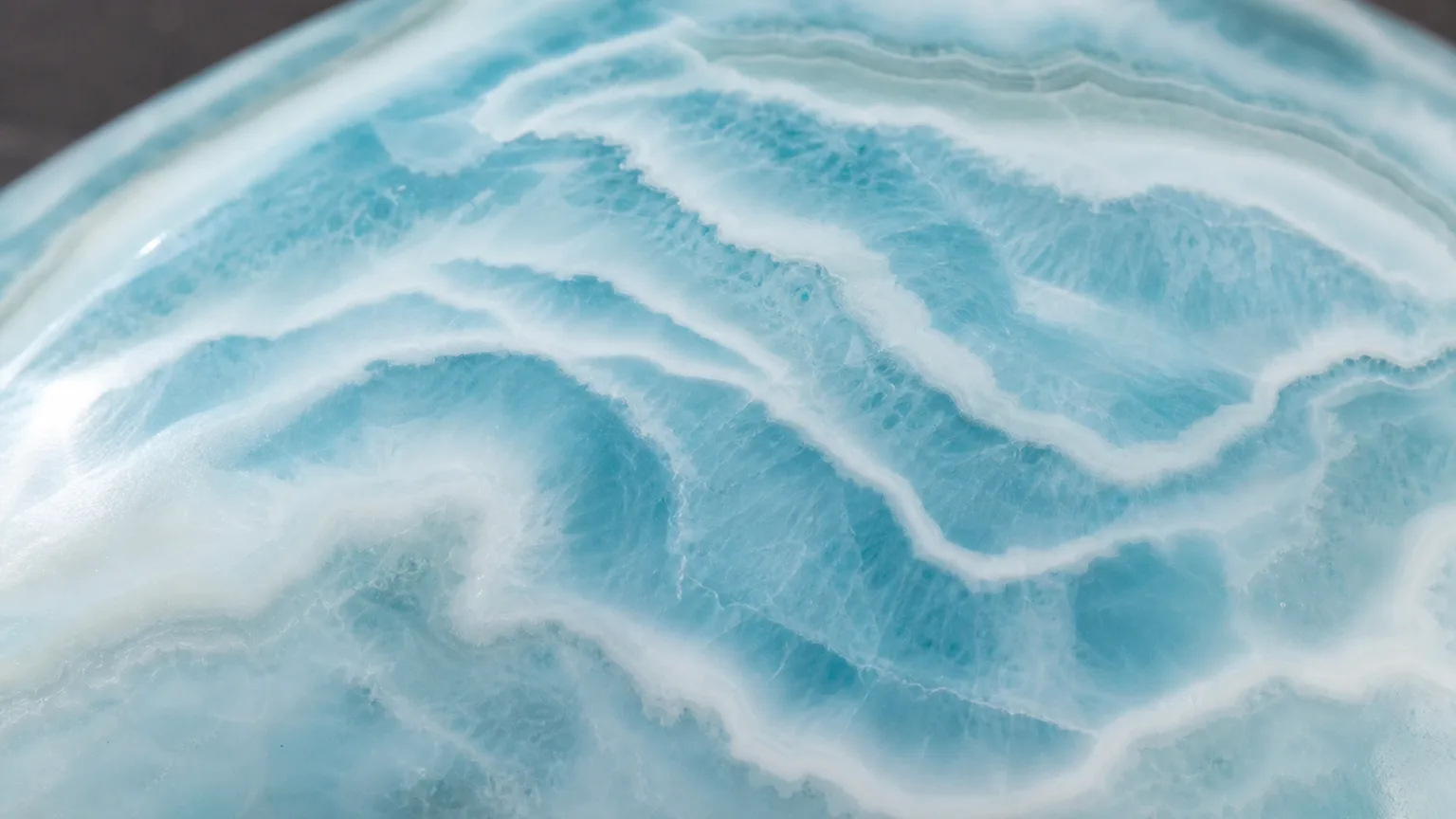
Larimar is a rare blue variety of pectolite found only in the Dominican Republic, patterned with white and ocean-blue waves. Often called the “Caribbean” or “dolphin” stone, it’s tied to calm, emotional ease, and clear communication. It’s also one of the newest named gemstones, with no ancient tradition behind it. This guide covers what larimar is, what it means, and how people work with it. Crystal meanings reflect tradition and personal practice, not medical advice.
What Is Larimar Meaning?
At its simplest, larimar means calm, emotional ease, and clear communication. With its soft blue and white wave patterns, it’s often described as a stone of the sea — a gentle presence for people who want to feel more relaxed, emotionally balanced, and able to speak from a calm place.
For many, that’s the whole draw: a stone that feels cool and soothing in the hand and nudges you toward calm. You don’t need to hold any specific belief to get something from it — the value often comes from choosing, holding, or placing the stone as a cue to return to a more relaxed baseline.
Larimar Meaning and Symbolism

Unlike most blue stones, larimar has a short, well-documented story. It was known to locals for years as simply “the blue stone” before being named larimar in 1974 — a blend of Larissa (the daughter of one of the men who introduced it to the wider market) and mar, the Spanish word for sea. So this is a thoroughly modern stone, and its meaning comes from recent crystal practice rather than ancient tradition.
In that modern practice, larimar is most often tied to the sea, to calm, emotional balance, and clear, heartfelt communication. Its wave-like blue and white patterns invite comparisons to water and the Caribbean coast, which is where it comes from. Some sellers call it the “dolphin” or “Atlantis” stone and pile on grander claims, but those are marketing names rather than anything historical. How much of the calm you feel is up to you. To explore more stones, browse the full Crystal Guide.
Larimar Properties
The Science
Larimar is a blue variety of pectolite (NaCa₂Si₃O₈(OH)), a sodium calcium silicate — meaning it’s the same mineral as ordinary white pectolite, just colored. The blue comes from trace elements; copper and vanadium have both been suggested, likely interacting with the mineral structure and light, though the exact mechanism is still debated. It forms in volcanic cavities and is found in only one small area of the Dominican Republic, which is why it’s both rare and relatively pricey. It’s a soft stone, about 4.5–5 on the Mohs scale, semi-translucent to opaque, with a glassy-to-silky shine that takes a smooth cabochon polish. None of this is mystical — it’s mineralogy, and the softness is exactly why it needs gentle care.
Traditional Meaning
Because larimar was only named in 1974, its “tradition” is entirely modern crystal practice. It’s tied to the throat and heart centers and described as a stone of calm, emotional balance, and clear, heartfelt communication — many believe it helps you relax, process feelings, and speak gently and honestly. The ocean-blue color naturally connects it to water, the sea, and emotional flow. Across the crystal community it’s carried as a soothing talisman for stress or emotional turbulence. These associations come from modern practice and personal experience rather than any historical use.
Mindfulness & Psychology
From a psychological angle, larimar works as a tactile anchor — a cool, smooth cabochon to hold when you want to calm down or gather yourself before a charged conversation. The act of choosing and carrying a stone can support intention-setting: you decide it stands for “stay calm” or “speak gently,” and the feel of it draws you back. Soft blue reads as calm and expansive in color psychology, and the simple ritual of noticing the stone creates a brief pause to breathe. These effects come from tradition and personal practice, not clinical research. Crystals complement — but never replace — professional care.
Larimar Benefits

People who work with larimar usually describe it in terms of feeling calmer and more emotionally settled, not dramatic changes. The stone tends to show up in moments of stress — a slow breath during a tense day, the cool weight of it when emotions run high, the glance at a wrist before a hard conversation. A few benefits people mention most:
A calmer baseline
Holding larimar gives a racing, tense mind somewhere to settle, which makes it easier to feel steady instead of swept along by stress or emotion.
Emotional balance
Many keep a piece nearby during turbulent stretches as a cue to pause, breathe, and respond to feelings instead of being hijacked by them.
Gentler communication
Carried as a reminder, it nudges you toward speaking from a calm place rather than reacting sharply — useful in close relationships.
A focus point for meditation
Held during a sit, its cool smooth surface gives your hand something to notice, which can quiet a restless mind and bring you into the moment.
The pattern underneath is the same: the stone isn’t doing the work for you, but it gives your day a small structure that makes calm more likely. If you’re exploring stones for specific needs, see our guides to crystals for anxiety and crystals for emotional healing.
Larimar Chakra, Zodiac, and Element Associations
In traditional systems, larimar is most often linked to the throat and heart centers — the throat for clear communication, the heart for emotional ease. It’s commonly paired with Leo and Pisces, and its element is almost always given as Water. For related stones, see throat chakra crystals.
These are correspondences built up through modern crystal practice, not fixed rules. Because larimar is a newer stone, its associations are still forming — and if your own sense of a piece points somewhere else, that’s completely fine. Many people work with stones intuitively, following what feels right rather than a chart.
How to Use Larimar

Larimar is flexible — there’s no single right way, only what fits your routine. The key is consistency: a stone you actually see and hold each day does far more than one that sits in a drawer.
Wear it. A cabochon pendant or beaded bracelet keeps the stone with you through the day. Pair one piece with a specific intention each morning — “stay calm,” “speak gently.”
Meditate with it. Hold a tumbled stone in your palm or rest it on your throat while you sit. Its cool, smooth surface gives your attention somewhere to rest; a few focused minutes count.
Place it at home. A polished free-form or sphere on a desk or shelf works as décor and a visual cue. The soft blue brings a calm, coastal feel to a room.
Carry a worry stone. Larimar’s smooth polish makes it a natural worry stone — something to hold or rub when stress builds and you need to reset.
Which Larimar Form Is Right for You?

| Form | Best for | Choose it if |
|---|---|---|
| Cabochon pendant | Daily wearing, communication | You want a polished stone worn near the throat |
| Bracelet | Daily wearing | You want a visible, wearable reminder through the day |
| Earrings | Subtle everyday jewelry | You prefer a smaller stone worn near the face |
| Tumbled stone | Pocket or meditation | You want something small, smooth, and easy to hold |
| Polished free-form | Desk or shelf display | You want a calming shape as a room anchor |
| Sphere | Room display | You want a balanced, smooth piece as a focal point |
How to Tell Real Larimar from Fakes
Because genuine larimar is rare and found in only one place, the market has imitations — dyed howlite, dyed quartz, glass, and other blue stones sold as larimar. A few checks help before you buy:
- The pattern. Real larimar has a distinctive white-and-blue “wave” or “thread” pattern, never perfectly even. The blue varies from pale sky to deep volcanic blue in the same piece. Perfectly uniform blue suggests dye or glass.
- Color quality. The most valued larimar shows vivid volcanic blue, but natural pieces include softer blues and white. Neon or flat, single-tone blue is usually dyed.
- Hardness. At about Mohs 4.5–5, real larimar is soft — it won’t scratch glass and can be marked by a steel knife. Harder stones sold as larimar are something else.
- Temperature and inclusions. Real larimar feels cool and often shows natural patterning and slight texture. Glass feels lighter and warms fast.
- Price and seller. Deep-blue, large, flawless pieces at very low prices are usually too good to be true. Buy from sellers who confirm it’s Dominican larimar.
A note on origin. Genuine larimar comes only from one region of the Dominican Republic. If a seller can’t confirm Dominican origin, or the price seems too low for the quality, it’s worth questioning.
How to Cleanse and Charge Larimar
In crystal practice, “cleansing” clears accumulated energy and “charging” refreshes the stone. Because larimar is soft and its blue can fade, it needs gentler care than harder stones. A few safe methods:
- Moonlight. Leave it out overnight under a full moon — the gentlest, most-recommended option for this light-sensitive stone.
- Smoke. Pass it through sage or palo santo smoke and let it drift over every side.
- Sound. A singing bowl or bell near the stone. At minimum, it’s a mindful pause.
- Other crystals. Resting it on a selenite plate or clear quartz cluster is popular for an overnight reset.
Things to avoid: prolonged direct sunlight, which can fade larimar’s blue over time — it’s known to be light-sensitive, so keep it out of bright, constant sun. Avoid acids, harsh chemicals, and ultrasonic cleaners, and don’t soak it; a brief wipe with a damp soft cloth is enough. For the full routine, see our guide to cleansing crystals.
Best Crystals to Pair With Larimar
Pairing is about layering intentions — picking stones whose qualities complement rather than compete. A few combinations that work well with larimar’s calm, watery energy:
- Larimar + Cuarzo rosa — calm meets warmth. A heart-centered pairing many reach for emotional ease and self-kindness.
- Larimar + Amatista — two calming stones layered for a deeper sense of relaxation and a steadier mind.
- Larimar + Sodalite — two blue stones tied to clear, calm communication and a settled mind.
The logic of pairing is about complementary intentions, not strict rules. Pick combinations that match what you’re actually working on, and trust your own sense of what feels balanced.
Who Should Use Larimar?
Larimar suits people who want a calming, emotionally balancing presence — anyone who feels stressed, overwhelmed, or emotionally turbulent and wants a gentle reminder to relax and speak from a calm place. Its soft blue also makes it a favorite for people who simply love the ocean look as jewelry.
A few honest expectations: larimar isn’t a treatment for anxiety, depression, or any condition — if you’re dealing with something persistent, a healthcare professional is the right call, and the stone can be a comfort alongside that. It won’t “do” anything on its own; its value comes from the intention and routine you build around it. If you go in expecting a stone to fix things for you, you’ll be let down. If you go in expecting a quiet support for your own practice, it tends to fit well.
FAQ About Larimar Meaning
Where does larimar come from?
Only one place: a small region of the Dominican Republic in the Caribbean. That single-source rarity is a big part of why genuine larimar costs more than many stones.
Can larimar go in water?
A brief wipe with a damp cloth is fine, but avoid soaking it. Larimar is soft (Mohs 4.5–5) and sensitive to acids and harsh chemicals, so keep it dry and clean it gently.
Does larimar fade in sunlight?
Yes — larimar is known to be light-sensitive, and prolonged direct sun can fade its blue. Store and display it out of strong, constant light.
What chakra is larimar linked to?
Mostly the throat and heart centers — the throat for clear, calm communication, the heart for emotional ease.
How can I tell if my larimar is real?
Look for the natural white-and-blue wave pattern (never uniform), softness (it won’t scratch glass), and Dominican origin confirmed by the seller. Perfectly uniform blue is usually dyed.
Is larimar really a “dolphin” or “Atlantis” stone?
Those are marketing nicknames, not historical names. Larimar was named in 1974, so it has no ancient tradition — the dolphin and Atlantis labels are modern seller stories.
Is larimar good for beginners?
Yes, with one note: it needs gentle, light-protected care. It’s beautiful, calming, and meaningful — just keep it out of strong sun and harsh chemicals.
Final Thoughts on Larimar
Larimar has earned its place as a stone of calm and clear communication — and it earns it again for each person who picks up a piece and gives it a job to do. If you’re curious, the simplest start is one piece, one intention, and a small daily moment to notice it. You don’t need the deepest volcanic blue; you need a stone you’ll actually see and hold. Let the routine do the work, and let the stone be the steady reminder that brings you back.
From there, larimar tends to open a door — to a calmer afternoon, a gentler reply, or simply a habit of pausing to breathe. For more, explore the Crystal Guide or browse larimar jewelry and crystals.