
ISFP Tarot Card: Birth Card Meaning & Crystals
ISFP Tarot Card: Birth Card Meaning & Crystals
Intro
You tested ISFP, and somewhere between reading “The Adventurer” and the umpteenth article describing you as the quiet artist, the question underneath the question surfaced: what does it actually mean to be wired to hold immense inner force gently — and where does holding-gently turn into holding-back, until the force that wanted to move through you stays unfelt by anyone else?
Tarot answers that question differently than personality tests do. Where MBTI sorts you into one of sixteen boxes based on self-reported preferences, a birth card asks which archetype your cognitive wiring keeps returning to. For ISFP, that pattern has a name, a woman, a lion, and a long association with the gentle kind of strength that nobody sees until it has to act.
This article maps ISFP to Strength as your primary birth card and The Star as your growth card, walks through what each illuminates about your cognitive stack (Fi · Se · Ni · Te), and suggests three crystals that serve distinct functions — the overall companion, the upright ally, and the growth invitation.
> MBTI is a registered trademark of The Myers-Briggs Company. This article is an independent framework based on Jungian cognitive functions (Ni/Ne/Si/Se/Ti/Te/Fi/Fe), offered for self-reflection and creative exploration — not affiliated with, endorsed by, or sponsored by The Myers-Briggs Company. Mapping decisions are our own editorial interpretation and do not represent official MBTI doctrine.
ISFP at a Glance: The Adventurer
ISFP sits in the Explorers group, alongside ISTP, ESTP, and ESFP. Your four-letter code is Introverted · Sensing · Feeling · Perceiving, but the letters are the surface. The deeper structure is your cognitive stack:
- Dominant: Fi (introverted feeling) — the function that holds a vast inner landscape of value, feeling, and meaning, the quiet center where your strongest convictions live
- Auxiliary: Se (extraverted sensing) — present-moment sensory engagement with the physical world, the function that gives you your eye for beauty, texture, and the felt quality of this moment
- Tertiary: Ni (introverted intuition) — the long-arc pattern recognition, which when mature lets you see the trajectory beneath the surface
- Inferior: Te (extraverted thinking) — the function of structure and execution, your developmental edge — the part of you that either matures into “bring the inner force into the world” or avoids the world entirely
The nickname “The Adventurer” is shorthand for someone who moves through the world attending to its felt quality, holding strong inner values, and expressing what they perceive through the body, the art, the gesture — not the manifesto. The question a tarot birth card answers is which archetype this cognitive configuration keeps returning to — and for ISFP, that archetype is the woman who tames the lion without violence, hand on its forehead, infinity symbol above her head.
Your Birth Card: Strength
Strength’s archetype is The Gentle Power. In the Rider-Waite image, a woman stands before a lion, her hand on its forehead, her other hand holding the lion’s mouth gently open. An infinity symbol hovers above her head. A garland of flowers connects them. The lion isn’t decoration — it’s the load-bearing image. The woman is not defeating the lion; she is tending it, and the tending is what makes the lion’s force available rather than destructive.
Here is where most “ISFP tarot card” articles get it wrong. They map ISFP to Strength because “both are gentle,” and stop there. The pairing is where the work begins. The question isn’t whether ISFP maps to Strength; it’s why this card and not another, and what the alignment reveals about your specific cognitive wiring.
Why Strength Aligns with ISFP’s Fi-Se Dominance
Your dominant Fi is the function that holds immense inner force — a vast landscape of feeling, value, and conviction. The force is real; it just isn’t loud. Your auxiliary Se gives you your present-moment body — the felt quality of this moment, the eye for what’s actually here. Strength’s woman tending the lion is the image for exactly this: the inner force (Fi) held gently by present-moment attunement (Se), so that the force becomes available rather than destructive.
This is why your gentleness isn’t the same as weakness, even though outsiders often conflate the two. Strength’s psychological lens for ISFP is emotional regulation — the discipline of holding immense inner force without either repressing it (which makes it turn rancid) or dumping it (which makes it wound). ISFPs live this distinction viscerally in the Fi-Te axis. Your quiet isn’t timidity; it’s the woman’s hand on the lion’s forehead, steady, present, available.
An Anonymous Client Vignette (Illustrative, Not Predictive)
N., 29, an ISFP and a ceramicist, sat with Strength after a critic at her first gallery show dismissed her work as “pretty but slight.” She was genuinely holding, in that moment, an immense wave of feeling — grief, rage, the old conviction that what she made mattered — and, in the same breath, aware that she had said “thank you for coming” and walked away, that the wave had never made it into the room, and that the pattern was becoming her reputation. Both facts were true at once. Strength wasn’t forecasting whether her work would succeed — it was naming the gap between the inner force held faithfully and the outer translation that lets the force land, the gap Fi-Se dominance naturally creates when Te hasn’t yet done its expression work. The work wasn’t to predict; it was to ask the question she’d been circling for years: what would it mean to let the lion’s force into the room, gently, before the moment passed?
That’s what a birth card does. It doesn’t tell you what will happen. It names the shape of the tension you keep returning to, so you can work with it consciously rather than reenact it blindly.
Three Concrete Manifestations of Strength Energy in ISFP
- You hold immense inner force quietly. Where others broadcast, you attend. The conviction is real; the volume is low. The woman’s hand on the forehead, steady.
- You respond to the present moment with your body, not your argument. The art, the gesture, the meal cooked, the room rearranged — your expression comes through Se, through what you make present, not what you declare.
- You retreat to tend the force. Under stress, your instinct isn’t to argue — it’s to walk, make, move, let the lion settle under the hand. This is Strength doing its work, the woman and the lion in private.
Your Growth Card: The Star
The Star’s archetype is The Hopeful — the figure who kneels by the water after the tower has fallen, pouring from two vessels, one into the pool and one onto the land. Where Strength holds the force gently, The Star pours one true thing from the force into the world.
For ISFP, The Star is the growth card — the archetype your Ni and Te reach toward when Strength energy has over-matured into private holding. The mapping logic is precise: where Fi (dominant) holds the inner force and Se (auxiliary) attends the present moment, Ni (tertiary) eventually sees the trajectory the force wants to take, and Te (inferior) eventually builds the structure that lets it land. The Star’s two vessels are the image for exactly this — the inner vessel (the held force) and the outer vessel (the expressed offering), and the growth invitation is to pour both, even when the force feels inarticulate.
The growth invitation surfaces when you’ve over-invested in Strength’s private holding. ISFPs under stress — particularly in a Fi-Ni loop — can stay in the workshop long after the work has wanted to ship. The Star appears at that moment with a quiet prompt: the force has been tended. Now pour one true thing into the world.
Three Concrete Growth Steps (Next 7–30 Days)
- Pour one true thing into a public form this week. Not the whole force — one piece, in a form someone else can receive (a piece shipped, a sentence said, a post published). The Star’s vessel doesn’t require the whole water; it requires some water, poured.
- Name one structure you’ve been avoiding. ISFPs under Strength overload tend to underbuild structure, because structure feels like it would constrain the force. Star energy asks you to invent one small structure that holds one piece of the force — a daily studio hour, a shipped series, a project with a deadline.
- Have the conversation that lets the lion’s force land. The force has been held for years; the room hasn’t received it. Bring one conviction across into shared language with one person who needs to hear it.
The growth card isn’t a destination. It’s the direction of travel when the primary card’s shadow has been sitting too long in the driver’s seat.
The Shadow Side: Reversed Strength
Strength reversed, in an ISFP reading, points to three distinct shapes of reversal — not a single “bad” meaning, but three specific patterns to recognize.
Shape 1: Fi-Ni Loop (The Inner Struggle)
When Fi and Ni loop without Se’s present-moment check, you can slide into an inner struggle where the same force recombines with the same long-arc worry, and the loop has no outlet in either body or world. The felt sense is “I’m holding so much,” but the cognitive mechanism is the holding has become the entire mode, with no expression. The growth invitation isn’t to feel less; it’s to let Se back into the loop — the walk, the making, the present moment that grounds the force.
Shape 2: “I’m Just Private” as Expression-Avoidance
Te is your inferior function, which means putting your force into shared form — shipping, declaring, building — is developmentally expensive. The shadow move is to use “I’m just private” as cover for avoiding the act of letting the lion be seen. Strength’s woman, in this shape, isn’t tending — she’s hiding the lion.
Shape 3: The Aesthete’s Withdrawal
This is the shadow where Strength’s holding has hardened into a worldview — “the world doesn’t get it, my force is mine, I’m better off in the studio.” The growth edge here isn’t to become loud; it’s to notice when the withdrawal is protecting a fear that the force, expressed, wouldn’t survive contact with the world rather than serving the integrity.
The reversed reading is not a bad omen. It’s the card’s way of asking whether the held force is still serving your life or has started substituting for it. The integration path runs straight into The Star’s domain — the act of pouring one true thing into a form the world can receive.
ISFP in Relationships
In intimate relationships, ISFPs bring the same quiet depth they bring to art — which is the gift and the friction. Your alone time isn’t negotiable; it’s where the force settles, the work happens, and you stay whole. A partner who reads your quiet as needing-nothing will trigger your aesthete’s withdrawal (shadow shape 3); a partner who reads it as the rhythm that makes your presence trustworthy gets the fullness of what you offer.
Three patterns to notice:
- You communicate through presence and gesture, not declaration, which can feel opaque to a partner who needs words. Naming this rhythm early (“I show up with my body; ask me what I made today if you want to know what I’m feeling”) prevents months of misread silence.
- You hold high standards for authenticity, which can land as withdrawal if your partner doesn’t know how to read you. The same depth that improves a connection can wound a partner if it stays entirely private.
- You express care through presence and making — the meal cooked, the room arranged, the gift chosen with present-moment attention. This is genuine love in ISFP dialect; learning to also say what you feel, in words, is the growth work.
None of this predicts whether a specific relationship will succeed. It names the shape of the dynamic so you can choose it consciously.
ISFP at Work
The workplace is where ISFP cognitive wiring is most often deeply generative — and most often quietly frustrated. Your Fi-Se combination is built for work that requires aesthetic presence, present-moment attention, and value-driven craft. You thrive in roles that give you autonomy, real materials, and work worth your full attention.
Three patterns to notice:
- You see the felt quality of the work before the org chart does. This means you’ll often spot the beauty gap, the value misalignment, the moment where the work has lost its truth. The growth work is translating that seeing into Te-checkable structure — what would it take to actually ship this?
- You prefer depth over breadth in your work. A role that asks you to produce many shallow outputs will drain you faster than one deep project three times as long.
- You lead through presence and craft — making what’s beautiful, holding the standard through what you do, attending to the moment. This is honest leadership; the growth edge is learning that some chapters need structure and shipping, not just presence.
This isn’t a forecast for your career. It’s a description of how your type tends to interact with work — so you can choose roles and environments that fit your wiring rather than fight it.
ISFP on the Growth Path
The growth path for ISFP is, in many ways, the integration of the inferior Te — the function that brings the held force into the world in a form others can receive. This isn’t about becoming loud. It’s about completing the cognitive stack so the force you tend in solitude actually reaches the people it could move.
Three threads of growth work:
- Expression practices. Anything that puts one inner thing into an outer form — daily art, writing, structured conversations. Te develops through being used.
- Trajectory practices. Taking one Ni-seen pattern per week and acting on it. Ni develops through being trusted.
- Embodied presence. Taking one present-moment practice per day that grounds the force in the body — the walk, the making, the time in nature. Se develops through being used, not bypassed.
The growth path isn’t linear. It’s about rounding out the stack so Strength’s holding and The Star’s pouring work together rather than in sequence.
Crystals for ISFP
Three crystals map to the ISFP birth card configuration, each serving a distinct function. These are not “lucky stones for your type” — they are tactile anchors for specific cognitive moves, chosen because their traditional associations align with the work each part of your stack is doing.
Rose Quartz — The Overall Companion (Fi × Strength Compassion)
Rose Quartz carries the gentle heart-quality Strength’s woman demands in mineral form. For ISFP, it aligns with dominant Fi — the function that holds the inner force with compassion rather than violence. The traditional heart-chakra association map to exactly the kind of gentle holding the woman performs with the lion.
How to use it: Hold Rose Quartz for five minutes before tending the force — a quiet sit, a studio session, a hard moment. It’s a physical reminder of which cognitive mode you’re choosing — gentle holding, not suppression or dumping.
Tienda: Rose Quartz meaning · Shop search
Carnelian — The Upright Ally (Se × Creative Courage)
Carnelian supports the Se-driven creative courage that your auxiliary Se brings when it’s time to make the work present. Where Rose Quartz supports the holding, Carnelian supports the making — the present-moment act of bringing the inner force into material form.
How to use it: Carry Carnelian on the day you’ve scheduled making — the studio hour, the shipped piece, the present-moment act of creation. It’s not an “enhancement”; it’s a tactile cue to let Se bring the force into form rather than staying in Fi’s holding loop.
Tienda: Carnelian meaning · Shop search
Sunstone — The Growth Invitation (Te × Star Expression)
Sunstone supports the Te-driven expression that your inferior Te tends to avoid — and aligns with The Star growth card’s invitation to pour one true thing into the world. Where the first two crystals support the holding and the making, Sunstone is the one that asks what gets shipped today, in a form others can receive.
How to use it: Wear or carry Sunstone on the day you’ve scheduled a Star move — the post published, the conversation where you say what you mean, the work shipped. It’s a tactile reminder that the force, tended, is complete enough to pour.
Tienda: Sunstone meaning · Shop search
ISFP: An Eastern Lens
The Tibetan Buddhist tradition has a name for what healthy ISFPs do when they tend the lion. It’s called (tiáofú — “to tame, to subdue,” used in the contemplative literature for the taming of the mind and the emotions), and it refers not to defeating the wild force but to bringing it into conscious relationship through gentle, sustained presence. The monk taming his anger isn’t repressing it; he’s putting his hand on its forehead, steady, until the force becomes available rather than destructive.
This is the Eastern frame that resolves the gentle-vs-quiet tension at the heart of ISFP and Strength. Your gentleness isn’t weakness; it’s a recognized contemplative practice with a name , a lineage, and an expression clause (the Star’s pour). The question isn’t whether to hold gently — it’s whether your holding has a structure that lets the force reach the world, or whether it has hardened into a private holding with no return.
The crystal tradition aligns here too. Rose Quartz across lineages is the stone of the heart, of the love that holds without violence — not because it “attracts love” in the marketing sense, but because its cool weight in the hand is the perceptual metaphor for holding force gently, the way the woman holds the lion. When an ISFP holds Rose Quartz before tending the force, the stone isn’t changing the mind; it’s anchoring the question “can I hold this without either suppressing or dumping?” — the question Strength asks.
The Chan principle (píngcháng xīn shì dào — “the ordinary mind is the Way”) adds one more. ISFPs who hold this don’t try to make their force extraordinary; they recognize that the force, tended and expressed in ordinary present-moment making, is itself the Way — and that the extraordinary happens through the ordinary, not against it.
None of this is “Eastern traditions view crystals as energy amplifiers” — that’s the universal filler sentence. The actual Eastern frame for ISFP is specific: your gentleness is a recognized practice with a name , a soft-shapes-hard principle , an ordinary-mind principle , and an expression clause (the Star’s pour). The crystals are anchors, not engines.
Shop Crystals for This Guide
Explore crystal jewelry and stones from our current collection.


Om Mani Padme Hum Copper Ring


Om Namah Shivay Mantra Copper Bangle


Fair Trade Astamangala Copper Bangle
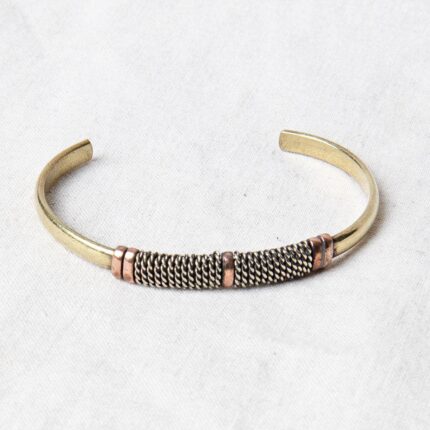

Tibetan Handcrafted Copper Bracelet
FAQ: ISFP Tarot Card
1. What tarot card is ISFP?
ISFP’s primary birth card is Strength — the archetype of The Gentle Power whose woman tends the lion without violence. The mapping aligns ISFP’s dominant Fi (introverted feeling) and auxiliary Se (extraverted sensing) with Strength’s psychological lens of emotional regulation. ISFP’s growth card is The Star, which represents the Te-driven expression that the held force eventually requires.
2. Why is Strength the birth card for ISFP?
The alignment runs deeper than “both are gentle.” ISFP’s dominant Fi holds immense inner force — a vast landscape of feeling, value, and conviction; auxiliary Se gives you present-moment body-attunement. Strength’s woman tending the lion is the image for exactly this — the inner force held gently by present-moment presence, so the force becomes available rather than destructive.
3. What is the growth card for ISFP?
The Star. The logic: where Fi (dominant) holds the force and Se (auxiliary) attends the present, Ni (tertiary) eventually sees the trajectory the force wants to take, and Te (inferior) eventually builds the structure that lets it land. The Star’s two vessels are the image for exactly this. The growth invitation surfaces when Strength holding has over-matured into private non-expression.
4. What does reversed Strength mean for ISFP?
In an ISFP reading, reversed Strength isn’t a bad omen — it points to three specific patterns: Fi-Ni loop (inner struggle without Se’s present check), “I’m just private” as expression-avoidance (Te inferior delay), and the aesthete’s withdrawal (gentleness hardened into “the world doesn’t get it”). The growth invitation is to notice whether the held force is still serving your life or substituting for it.
5. Which Jungian archetype is ISFP?
ISFP aligns with the Gentle Power/Lover archetype (Strength) on the primary axis and the Hopeful/Seeker (Star) on the growth axis. Jung’s framework of cognitive functions — which MBTI is built on — describes Fi as introverted feeling, the judging function that holds a vast inner landscape of value and conviction.
6. What are the best crystals for ISFP?
Three crystals serve distinct ISFP functions: Cuarzo rosa (overall companion, supporting Fi’s gentle holding), Carnelian (upright ally, supporting Se’s creative courage), and Sunstone (growth invitation, supporting Te’s expression). These are anchors for specific cognitive moves, not “lucky stones.”
7. How does the Eastern perspective view ISFP?
The Tibetan Buddhist tradition recognizes ISFP-style gentleness as tiáofú, taming the mind through gentle presence — bringing wild force into conscious relationship, not defeating it. Taoism’s the softest thing rides over the hardest describes the mature form: gentleness that shapes the stone. The Chan principle the ordinary mind is the Way honors the force expressed through ordinary present-moment making.
8. Is the ISFP tarot mapping official MBTI?
No. MBTI is a registered trademark of The Myers-Briggs Company, and this mapping is our independent editorial interpretation based on Jungian cognitive functions (Fi/Se/Ni/Te). It is not affiliated with, endorsed by, or sponsored by The Myers-Briggs Company, and does not represent official MBTI doctrine. The mapping is offered as a self-reflection framework, not a personality diagnosis.
Explore More
- Tarot card meanings: Strength · The Star
- Related Explorers types: INFP · ISTP · ESFP (same Fi/Se axes / Explorers group)
- Crystal meanings: Cuarzo rosa · Carnelian · Sunstone
- Find your own MBTI birth card: MBTI Tarot Tool
- All MBTI × Tarot articles: MBTI Tarot Hub
> Tarot birth cards and crystals are mirrors for self-reflection, not personality diagnoses or fixed forecasts. The cards name the shape of the patterns your cognitive wiring keeps returning to — what you do with that naming is your free will.