Best Orange Crystals: Names, Meanings, Properties & Uses
Quick Answer: Best Crystals for Orange
The best crystals for Orange include Carnelian, sunstone, carnelian-agate, traditionally used in mindfulness and spiritual practices. Crystal properties are complementary wellness tools, not medical treatments.
Understanding Orange Crystals
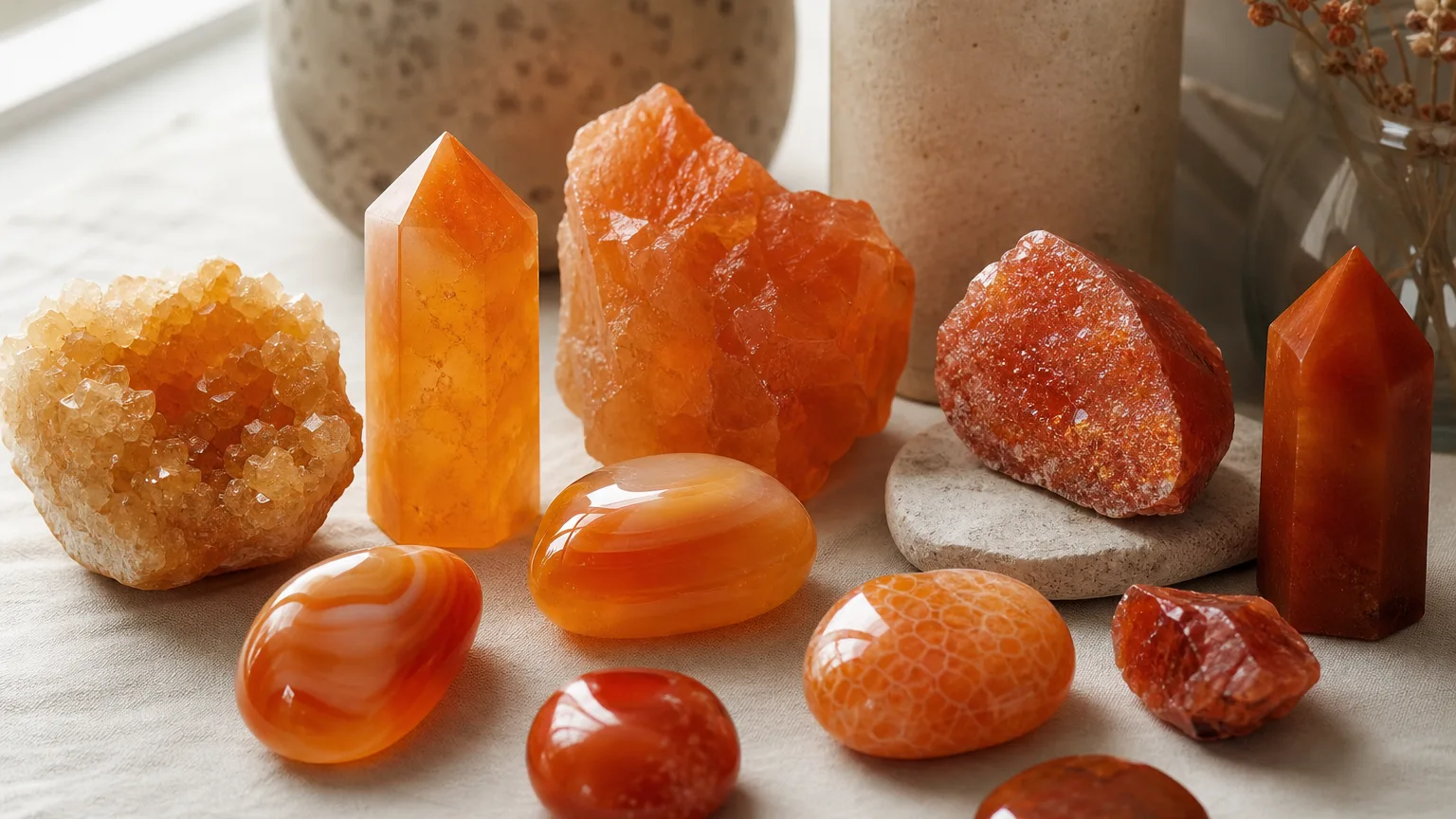
Orange sits between red and yellow on the spectrum, and orange stones carry something of both. From red they borrow warmth and vitality; from yellow they take brightness and lift. What makes a crystal orange is usually trace iron — tiny amounts of the same element that rusts metal and paints cliffsides — distributed through quartz, topaz, or sapphire as they form. Some orange stones get their color a different way: chrome in crocoite, copper platelets in sunstone, or natural irradiation deep in the earth.
Across cultures, orange has pointed to the same handful of ideas: the fire at the hearth, the ripening fruit, the second sunrise of the day. In ancient Egypt, carnelian was carved into amulets and placed with the dead as a symbol of returning warmth and continuing life. Greek and Roman soldiers wore it before battle. In Ayurvedic and yogic traditions, orange is the color of the sacral center — Svadhisthana — the seat of creativity, emotion, and relationships.
Modern color psychology tracks closely with these older readings. Orange is typically described as a social, energizing color: associated in studies with enthusiasm, approachability, and physical activity. It is the color most often chosen to signal movement — on safety cones, sports uniforms, and call-to-action buttons — because it draws the eye without the urgency of pure red. Many people reach for orange crystals when life feels flat, stuck, or emotionally cool, using them as a tactile reminder to re-engage with creative work and with other people.
Quick facts: Symbolism: Creativity, joy, warmth. Psychology: Enthusiasm, social warmth, creative spark. Associated chakra: Sacral, element: Fire/Water.
Not sure which color is right for you? Try the Crystal Quiz ↗
How to Identify Orange Crystals
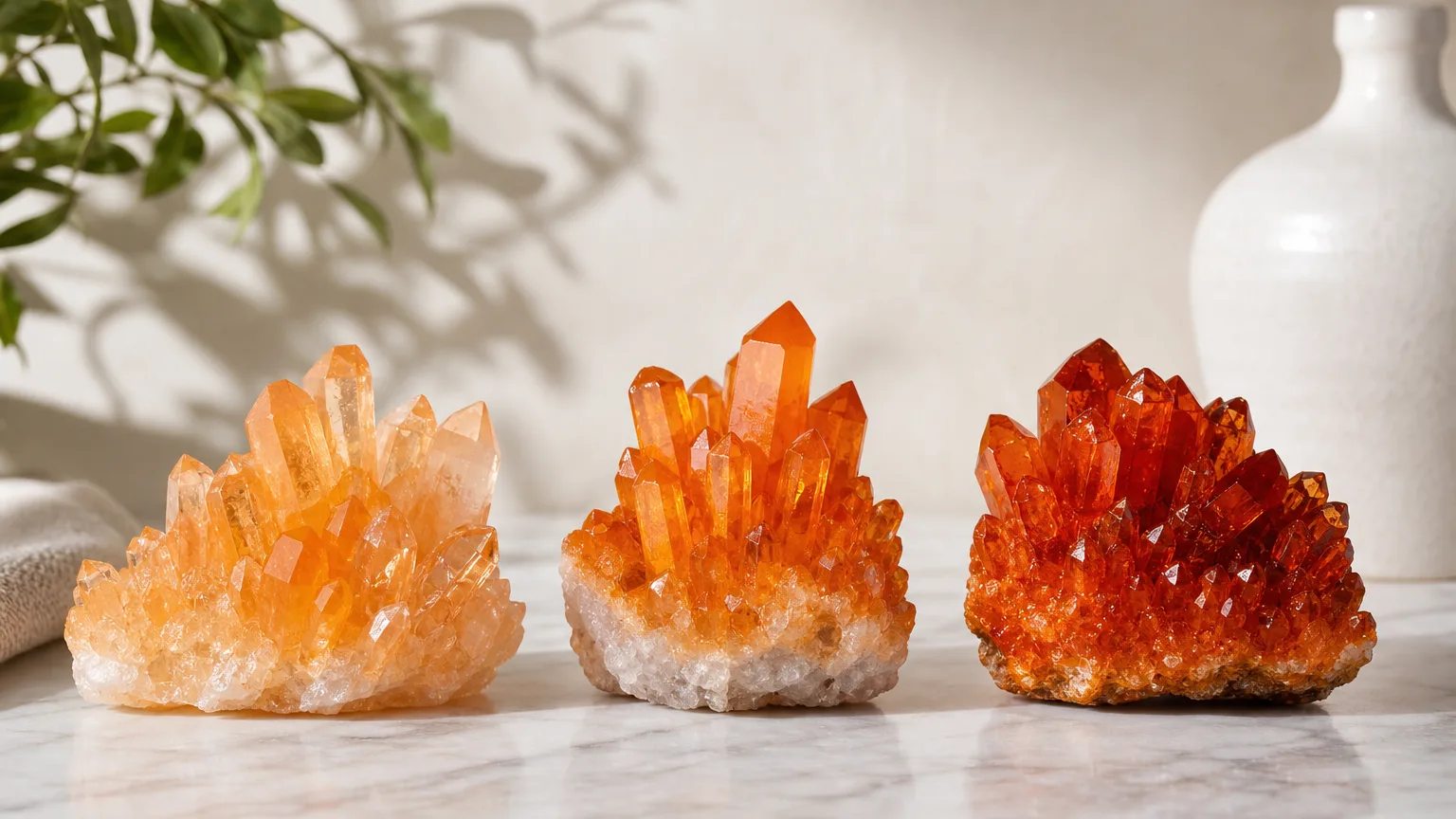
Orange stones range across a wide band, so the first thing to look at is the exact hue and how it behaves in light. Light orange tends toward peach or salmon (padparadscha sapphire, pale sunstone). Deep orange pushes into burnt orange and amber tones (carnelian, sherry topaz). Translucent orange — where light passes through the stone — is common in carnelian, topaz, and jacinth. Opaque orange, where light stays at the surface, you will see in crocoite chunks and dense carnelian-agate bands.
Texture and luster help separate look-alikes. Carnelian has a smooth, glassy (vitreous) surface and a waxy glow when polished. Sunstone is also glassy but flashes with moving sparkles called aventurescence — tiny reflective platelets that shift as you turn the stone. Carnelian-agate shows distinct bands of lighter and darker orange running through it. Crocoite and wulfenite often have a resinous to adamantine (almost diamond-like) shine on their crystal faces, with crocoite forming long thin prisms and wulfenite forming thin square tablets.
A few stones get confused. Amazonite vs Turquoise comes up in turquoise-blue territory, not orange, so skip that pairing here. The real orange look-alikes: orange calcite is often sold as budget carnelian, but calcite is softer (scratches with a coin) and milky rather than glassy; dyed agate can mimic carnelian-agate, so look for color that is too uniform or pools in cracks. Orange sapphire and padparadscha sapphire overlap — true padparadscha shows a delicate pink-orange that shifts between salmon and lotus in different light, while ordinary orange sapphire stays more uniformly orange. Note that some orange stones shift slightly under warm vs cool light bulbs: sherry topaz can look browner under warm light and more golden under daylight.
8 Best Crystals for Orange
Carnelian
Color: Orange, red-orange, reddish-brown
Meaning: Creativity, joy, warmth
Best for: Confidence, Starting projects, Creative work
Chakra: Sacral, Solar Plexus, Root
Element: Fire
Best way to use: Wear as jewelry
Affirmation: I create with warmth and steady courage.
Carnelian is a chalcedony quartz (SiO₂), and its orange comes from trace ferric iron — the same compound that rusts iron — concentrated as the stone grows. The color ranges from pale peach to deep burnt orange, and polished pieces have a smooth, slightly waxy luster that warms quickly in the hand. In mineral terms, chalcedony is microcrystalline, so the surface feels glassy but never faceted-bright. Traditionally associated with the sacral and solar plexus centers, carnelian is often used in mindfulness practice as a focus stone for beginning new work — many people place one on the desk at the start of a project, or wear it at the wrist when they want to feel more outgoing. Psychologically, holding a smooth, warm-toned object can serve as a grounding cue: a tactile anchor that brings attention back to the body during overthinking.
sunstone
Color: Orange, Red, Yellow
Meaning: Creativity, joy, warmth
Best for: Confidence, Mood, Motivation
Chakra: Sacral, Solar Plexus
Element: Fire
Best way to use: Wear as jewelry
Affirmation: I carry my own warmth and light.
Sunstone is a feldspar, and its orange is fired through with thousands of tiny reflective platelets — usually hematite, copper, or native copper — that catch the light and flash as the stone moves. Mineralogists call this effect aventurescence, and it is what separates sunstone from any other orange stone: turn a good piece in sunlight and the surface glitters like flecks of captured sun. The body color ranges from pale champagne to deep orange-red. Linked to the sacral and solar plexus centers, sunstone is traditionally associated with optimism and self-worth, and many people use it during darker months or low moods as a sensory reminder of warmth. As a self-care cue, simply noticing the flash of light becomes a small, repeatable act of attention.
carnelian-agate
Color: Banded red-orange
Meaning: Creativity, joy, warmth
Best for: Drive, Confidence, Action
Chakra: Sacral, Solar Plexus
Element: Fire
Best way to use: Wear as jewelry
Affirmation: I move forward with steady, layered strength.
Carnelian-agate is banded chalcedony — the same SiO₂ family as carnelian, but layered. As the stone forms over time, changing amounts of iron-rich fluid produce alternating bands of orange, red-orange, and cream, so every cut slice shows a different pattern. The luster is glassy and smooth like carnelian, but the banding gives each piece a graphic, almost topographic look. Traditionally associated with the sacral and solar plexus centers, banded agate is often used as a companion stone for sustained effort rather than quick starts — many people keep one on the work desk when a project needs persistence. The visible layering also works as a mindfulness cue: a reminder that steady, repeated action builds something over time.
Read full carnelian-agate meaning →
padparadscha-sapphire
Color: Pink-orange, salmon, lotus
Meaning: Creativity, joy, warmth
Best for: Creativity, Balance, Clear Judgment
Chakra: Sacral, Heart
Element: Fire, Water
Best way to use: Wear as jewelry
Affirmation: I balance warmth and gentleness in every choice.
Padparadscha sapphire is corundum (Al₂O₃) — the same mineral as ruby and blue sapphire — colored by a delicate mix of trace chromium and iron that produces a rare pink-orange tone named after the lotus blossom (padmaraga in Sanskrit). The color is unusually light-sensitive: in daylight it reads as salmon or sunset peach, under warm bulbs it deepens toward orange, and a true padparadscha always shows both pink and orange at once rather than one dominating. It is one of the rarest and most prized sapphires, with a hard, glassy brilliance that holds facets sharply. Traditionally associated with the sacral and heart centers, it is often used to symbolize a balance between creative fire and emotional tenderness, and worn as a quiet daily reminder to hold both.
Read full padparadscha-sapphire meaning →
sherry-topaz
Color: Yellow-brown to brownish-orange (sherry)
Meaning: Creativity, joy, warmth
Best for: Daily wear, Confidence, Self-worth
Chakra: Solar Plexus, Sacral
Element: Fire
Best way to use: Wear as jewelry
Affirmation: I trust my own quiet worth.
Sherry topaz is true topaz — aluminum fluorosilicate, Al₂SiO₄(F,OH)₂ — colored by a combination of trace chromium and color centers formed when the crystal is exposed to natural radiation deep in the earth. The result is a warm brownish-orange, like a glass of sherry held to the light, with a glassy luster and high hardness that takes a clean, bright polish. (Much of what is sold as smoky or golden topaz is actually heated or irradiated to deepen the color.) Traditionally associated with the solar plexus and sacral centers, sherry topaz is often used as a steady, less flashy alternative to brighter orange stones — many people choose it for everyday wear when they want warmth without showiness, as a tactile cue to value quiet confidence over performance.
Read full sherry-topaz meaning →
wulfenite
Color: Vivid orange, yellow-orange, red-orange, yellow
Meaning: Creativity, joy, warmth
Best for: Vitality, Creativity, Confidence
Chakra: Sacral, Solar Plexus
Element: Fire
Best way to use: Wear, carry, or place in your space
Affirmation: I feel awake, alive, and ready.
Wulfenite is lead molybdate (PbMoO₄), and it forms some of the most striking orange crystals in the mineral world: thin, square tablets that stack and fan out from a matrix, with a vivid orange to yellow-orange color and a resinous to almost adamantine shine. The crystal shapes are so distinctive that collectors can often identify wulfenite on sight. It is soft and brittle, so it is more often displayed than worn in everyday jewelry. Traditionally associated with the sacral and solar plexus centers, wulfenite is often used in a display role — placed on a shelf or desk as a visual focal point for creative vitality — and many people use it simply as a striking object that re-energizes a room and draws attention back to creative intent.
crocoite
Color: Vivid orange-red, red
Meaning: Creativity, joy, warmth
Best for: Vitality, Creativity, Awakening
Chakra: Sacral, Solar Plexus
Element: Fire
Best way to use: Wear, carry, or place in your space
Affirmation: I welcome vivid, forward-moving energy.
Crocoite is lead chromate (PbCrO₄), and its color is among the most intense in nature: a vivid, almost electric orange-red produced by trace chromium. It forms long, slender prismatic crystals that often grow in spiky clusters, with a bright adamantine luster that makes each crystal catch the light like a hot coal. (The same chromium compound was once used to make the artist pigment chrome orange.) Crocoite is soft and sensitive, so it is best as a specimen rather than daily-wear jewelry. Traditionally associated with the sacral and solar plexus centers, crocoite is often used as a visual catalyst — a single striking piece placed where creative work happens — and many people keep one on a shelf simply for the way it re-energizes a space.
jacinth
Color: Red-orange to honey-brown
Meaning: Creativity, joy, warmth
Best for: Steady judgment, Travel, Confidence
Chakra: Root, Sacral, Crown
Element: Fire
Best way to use: Wear as jewelry
Affirmation: I move through the world with steady confidence.
Jacinth (also called hyacinth) is the traditional name for orange to reddish-brown zircon — zirconium silicate, ZrSiO₄ — colored by trace iron and natural radiation over geological time. The color sits between red-orange and warm honey-brown, with a glassy to adamantine luster and a high refractive index that gives well-cut stones a lively, fiery sparkle. Zircon is one of the oldest minerals on earth, with some crystals dated over four billion years old. Traditionally associated with the root, sacral, and crown centers, jacinth has a long history as a traveler’s amulet, and many people today wear it as a quiet everyday piece — a tactile reminder to move through new situations with steady judgment rather than reactivity.
How to Choose Orange Crystals by Intention
| Intention | Best Orange Crystals | ¿Por qué? |
|---|---|---|
| Starting a creative project | Carnelian, carnelian-agate, sunstone | Warm, activating stones traditionally used as focus cues to break inertia and begin new work. |
| Confidence and self-worth | Sunstone, sherry topaz, carnelian | Orange tones linked to the solar plexus and approachability; a quiet tactile anchor for low-mood days. |
| Motivation and drive | Carnelian-agate, wulfenite, crocoite | Vivid, high-energy stones often used as visual catalysts when sustained effort is needed. |
| Balance and clear judgment | Padparadscha sapphire, jacinth | Pink-orange and honey tones that pair warmth with steadiness; traditionally used for considered choices. |
| Daily warmth without showiness | Sherry topaz, carnelian, jacinth | Muted, glassy stones suited to everyday jewelry and gentle self-care cues. |
| Re-energizing a space | Crocoite, wulfenite | Striking specimen stones used as visual focal points in a studio or desk area. |
How to Use Orange Crystals
Orange stones suit active, embodied practices better than still, contemplative ones. The four approaches below match where orange energy tends to help most.
1. In your creative workspace
This is the strongest use for orange. Place one or two stones within view of where you make things — carnelian and carnelian-agate on the desk for starting work, a piece of wulfenite or crocoite as a visual catalyst when energy dips. The point is not magic; it is a visual and tactile cue that redirects attention back to the work each time your eyes land on it. A single striking piece works better than a clutter of stones.
2. Worn as jewelry
Carnelian, sunstone, padparadscha sapphire, sherry topaz, and jacinth are all hard enough for rings, bracelets, and pendants. Wear orange at the wrist or over the lower belly (sacral and solar plexus area) when you want to feel more outgoing or creatively switched on. For durable daily wear, carnelian and topaz are the most practical choices; save softer specimen stones like crocoite and wulfenite for display.
3. Sacral meditation
For a short seated practice, lie down and place an orange stone — sunstone or carnelian works well — about two fingers below the navel, over the sacral center. Breathe slowly for five to ten minutes, letting the warmth of the stone be a physical anchor for attention. This pairs well with creative visualization or with simply resting. Avoid long sessions if you feel restless; orange energy tends to suit shorter, more active practice.
4. With movement
Orange responds well to motion, so pair it with walking, dancing, yoga, or any free-movement practice rather than only still meditation. Hold a stone in the hand, or wear it at the wrist, while moving. Sunstone’s aventurescence is especially satisfying in motion, as the flash of light shifts with each gesture — a small sensory reward that keeps attention in the body.
Other uses: carry a small tumbled carnelian in a pocket as a tactile worry stone; place a cluster on a sunny windowsill (brief morning light only — see the note on fading below); gift orange stones to mark a new beginning.
Orange Crystals for Creativity and Emotional Warmth
Of all the colors, orange is the one most tied to making things and to feeling close to other people. Two short rituals make the most of this.
A morning desk ritual for creative work
Before you start work, pick one orange stone — carnelian for a clean start, carnelian-agate for a long session, sunstone if your mood is low. Hold it for a few breaths, set one specific intention for the next hour (not the whole project, just the next step), and place it where you can see it. Each time attention drifts, let the stone be the cue to return. At the end of the session, put it away. Repeating this simple loop builds a habit of returning to creative work rather than waiting for inspiration.
A bedside reflection for emotional warmth
Orange is not only about doing — it also softens emotional coolness and distance. In the evening, sit with a warm-toned stone such as padparadscha sapphire, sherry topaz, or jacinth, and name one moment from the day when you felt genuinely connected to someone, and one moment when you withdrew. There is no need to fix anything; the practice is simply to notice the difference. Over time, this kind of gentle reflection often supports a warmer, more open way of relating, without forcing it.
Orange Crystals at a Glance
| Crystal | Best for | Chakra | Best way to use |
|---|---|---|---|
| Carnelian | Starting creative work, confidence | Sacral, Solar Plexus, Root | Wear at wrist; place on desk at start of work |
| Sunstone | Low mood, motivation, optimism | Sacral, Solar Plexus | Wear as jewelry; use with movement |
| Carnelian-agate | Sustained effort, persistence | Sacral, Solar Plexus | Keep on desk for long projects |
| Padparadscha sapphire | Balanced judgment, tenderness | Sacral, Heart | Wear daily; evening reflection |
| Sherry topaz | Quiet self-worth, daily wear | Solar Plexus, Sacral | Wear as everyday jewelry |
| Wulfenite | Visual catalyst, re-energize space | Sacral, Solar Plexus | Display as specimen on shelf or desk |
| Crocoite | Awakening, creative spark | Sacral, Solar Plexus | Display as specimen; brief focused use |
| Jacinth | Travel, steady judgment | Root, Sacral, Crown | Wear as pendant or ring while traveling |
Shop Crystals for This Guide
Explore crystal jewelry and stones from our current collection.


Carnelian Anklet


Carnelian Mala


Carnelian Stone Set


Carnelian Gold Bracelet
FAQ
What are orange crystals good for?
Orange crystals are traditionally associated with creativity, warmth, motivation, and social confidence. Many people use them to start new projects, lift a flat mood, or feel more outgoing. They are complementary wellness tools, not medical treatments, and the effects people report are usually tied to the mindfulness practice around the stone rather than the stone itself.
What do orange crystals mean?
Across cultures, orange has symbolized fire, ripening, and the warmth of human connection. In modern crystal practice, orange stones are linked to the sacral center — the seat of creativity, emotion, and relationships — and to enthusiasm and approachability in color psychology.
What is the most powerful orange crystal?
Power is subjective and not a measurable property of crystals. Carnelian is the most widely used and historically documented orange stone, sunstone is favored for mood, and padparadscha sapphire is the rarest and most prized. Choose by what you want to work on, not by claims of strength.
What is the rarest orange crystal?
Padparadscha sapphire is widely considered the rarest orange gemstone — a delicate pink-orange lotus color found in meaningful quantities only in Sri Lanka, Madagascar, and a few other localities. Fine crocoite and wulfenite specimens are also rare as collector minerals, though less suitable for jewelry.
What crystal is light orange or peach?
Pale orange and peach tones point to padparadscha sapphire, pale sunstone, and light carnelian. If the stone is milky and very soft, it may be orange calcite, which is often sold as a budget alternative to carnelian.
What crystal is brownish-orange or amber?
Brownish-orange to amber tones are typical of sherry topaz, jacinth (orange zircon), and deeper carnelian. All three have a glassy luster; jacinth tends to show more fiery sparkle because of its high refractive index.
What crystal is vivid orange-red with long thin crystals?
That is almost certainly crocoite — lead chromate, with an electric orange-red color and long slender prisms. Wulfenite is similar in chemistry but forms thin square tablets in yellow-orange to red-orange, rather than long prisms.
Are the benefits of orange crystals scientifically proven?
No. Crystal properties are not recognized as medical treatments by mainstream science, and there is no clinical evidence that orange crystals cure or heal any condition. What is well documented is the general effect of color on mood and attention in color psychology, and the benefit of simple mindfulness practices — such as holding a tactile object while breathing — for grounding and focus. The value most people find in orange crystals comes from these everyday practices, not from the stone itself.
Shop Orange Crystals: What to Look For
- Shop Carnelian
- Shop sunstone
- Shop carnelian-agate
- Shop padparadscha-sapphire
- Shop sherry-topaz
- Shop wulfenite