

Rose Quartz and Lepidolite Together: Benefits, Meaning + How to Use
Rose Quartz and Lepidolite Together: Benefits, Meaning + How to Use
Quick Answer
Yes — Rose Quartz and Lepidolite can be worn together (compatibility score: 80/100 — Harmonious). They’re a time-honored pairing in crystal practice, and many people combine them for emotional support during life transitions and gentler evening routines.
About Rose Quartz
Rose Quartz is a soft pink variety of quartz, traditionally associated with love, compassion, and self-care. In crystal practice it’s linked with the Heart chakra, which makes it a natural fit for self-love, relationships, and periods of grief or emotional recovery. It shows up as bracelets, pendants, tumbled stones, and spheres — pieces meant to be held, worn, or kept close. People often reach for it when tenderness is the point.
Mineralogically, Rose Quartz is silicon dioxide (SiO₂) with a Mohs hardness of 7. That’s durable enough for everyday bracelets, pendants, and rings. Its rosy color comes from trace titanium and manganese with natural irradiation, and it tolerates only a brief rinse — keep it away from salt water and prolonged direct sun, which can fade the pink over time.
Rose Quartz Meaning → · Genuine, ethically sourced — not dyed, not glass.
About Lepidolite
Lepidolite is a lavender to purple mica, traditionally associated with calm, emotional balance, and a steadier hand through change. In crystal practice it’s linked with the Heart, Third Eye, and Crown chakras, which is why it turns up so often during stressful stretches and major life transitions. It’s sold as chip-bead bracelets, tumbled stones, palm stones, and raw specimens — the kind of stone you keep within reach, not the kind you stack hard against everything else.
Mineralogically, Lepidolite is a lithium-bearing potassium mica (K(Li,Al)₃(Al,Si)₄O₁₀(F,OH)₂) with a Mohs hardness of only 2.5–4. That is much softer than any quartz-family stone. Its flaky, layered structure is exactly why gentle-wear chip-bead bracelets, palm stones, and display pieces suit it better than heavy daily jewelry. Keep it away from water, salt, and prolonged sun.
Lepidolite Meaning → · Genuine, ethically sourced — not dyed, not glass.
Can You Wear Rose Quartz and Lepidolite Together?
Practically: Rose Quartz and Lepidolite can be used together, but they ask for different handling. Rose Quartz is a durable quartz at 7 on the Mohs scale, well suited to everyday bracelets, pendants, and rings. Lepidolite is far softer at 2.5–4, and it should stay clear of water, salt, and rough stacking. It’s best in a chip-bead bracelet worn gently, or as a palm stone and display piece. Their soft pink and lavender tones look right together — just don’t press Lepidolite tightly against harder stones that can scratch its flaky surface.
Energetically: In crystal tradition the two meet at the Heart chakra. Rose Quartz carries earthy warmth and a loving, nurturing quality; Lepidolite brings an airy lightness associated with calm and release. The pairing is often described as softening a hard day from two directions — warmth that comforts, and a lighter quality that helps things settle. Earth and air together are traditionally read as balancing, not competing.
Psychologically: This pairing works well as a single ritual anchor around care for the heart. Rose Quartz holds the intention of self-love and compassion, while Lepidolite is chosen for the steadier, calmer feeling it’s said to bring during change. Both stones point the same way — gentle self-care through a transition — so they reinforce one intention instead of pulling against each other.
These properties are traditionally associated with crystal practice; many people find the pairing supportive, though the effects are not established by modern research.
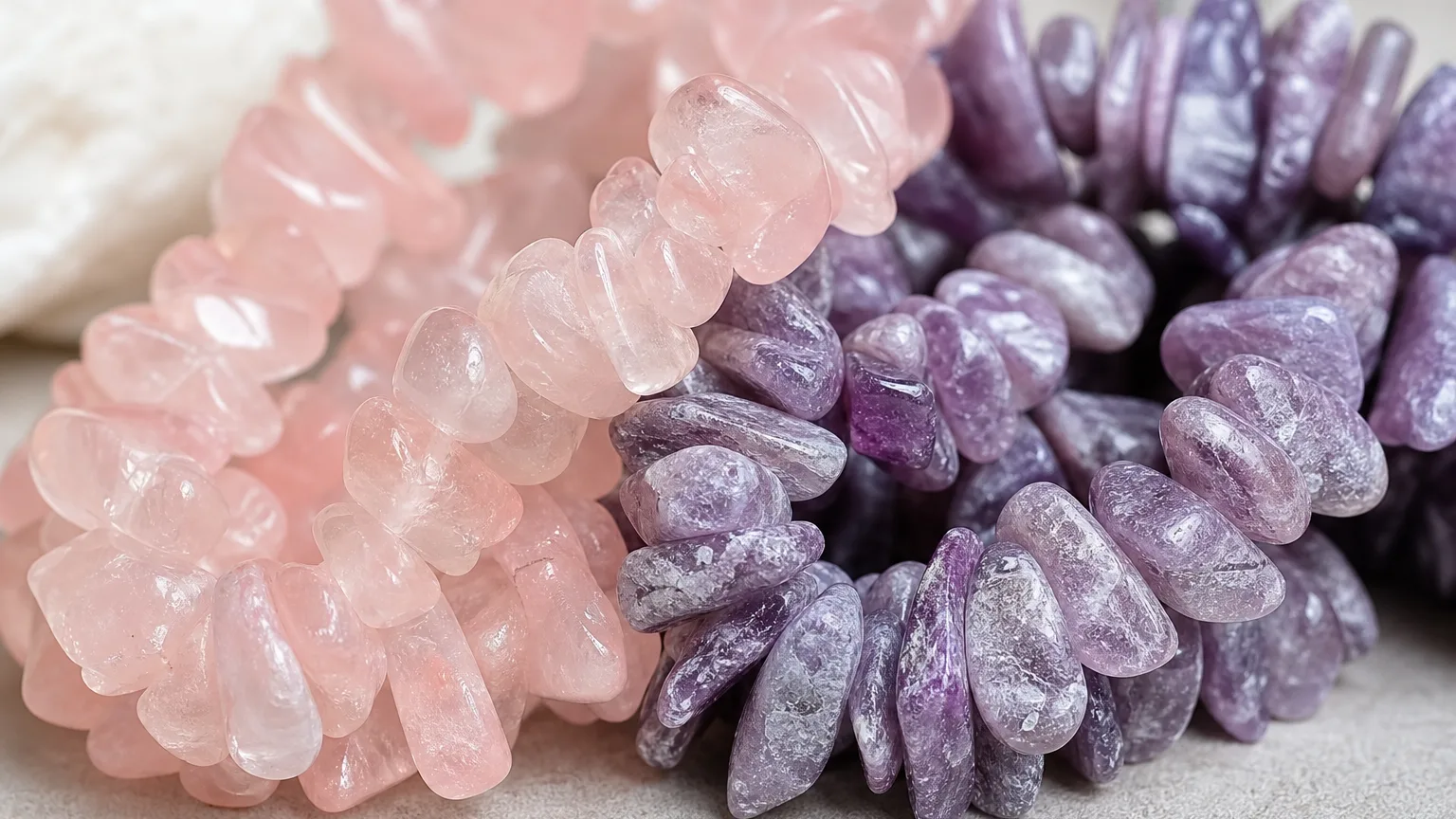
Benefits of Rose Quartz + Lepidolite
Together, Rose Quartz and Lepidolite cover six complementary strengths:
1. Heart-Centered Emotional Support
Both stones sit at the Heart chakra — the center most associated with love, compassion, and emotional balance in crystal tradition. As a layered pair, Rose Quartz is said to bring warmth and self-acceptance, while Lepidolite is chosen for the steadier, calmer feeling it carries. People tend to reach for this pairing when a hard day feels heavy and they want both comfort and something that helps it settle.
2. Calm Through Transition
Lepidolite is traditionally associated with calm and new beginnings; Rose Quartz is linked to self-care and recovery. That makes the pair a gentle companion for life transitions — the end of a relationship, a move, a new job, any stretch that asks you to be tender with yourself. The point isn’t one strong push forward. It’s feeling supported while you move through change at your own pace.
3. Self-Love With a Steadier Base
Rose Quartz is one of the most popular stones for self-love and self-worth work. Pair it with Lepidolite’s calming quality and the intention feels less like an item on a checklist and more like something you can settle into. Many people find self-compassion lands more gently this way. It’s a common morning-routine pairing for kindness toward yourself.
4. Earth-and-Air Balance
Rose Quartz carries an earth element — grounding, nurturing. Lepidolite carries air — light, clarifying. In crystal tradition this earth-and-air mix reads as balancing: earth gives stability and rootedness, air gives movement and a sense of space. Held together, the pairing is often described as helping you feel both held and unburdened, instead of either heavy or scattered.
5. A Gentler Evening Wind-Down
This is a pairing our site already recommends, and it shows up a lot around the evening routine. Rose Quartz is traditionally used for the tender thoughts that surface at the end of the day, and Lepidolite for the quieter, calmer feeling it brings. Kept close — Rose Quartz on the wrist, Lepidolite as a palm stone or on the nightstand — the two support a softer, lower-stimulation wind-down. You don’t have to lean on one strong stone to get there.
6. Support for Grief and Recovery
Rose Quartz is frequently chosen during grief and emotional recovery, and Lepidolite is often selected for the steadiness it’s said to bring through difficult stretches. Together they cover two sides of the same need — a heart that wants warmth and comfort, and a mind that wants something to settle onto. Many people keep this pairing close during periods of loss, when the support they want feels gentle, not intense.
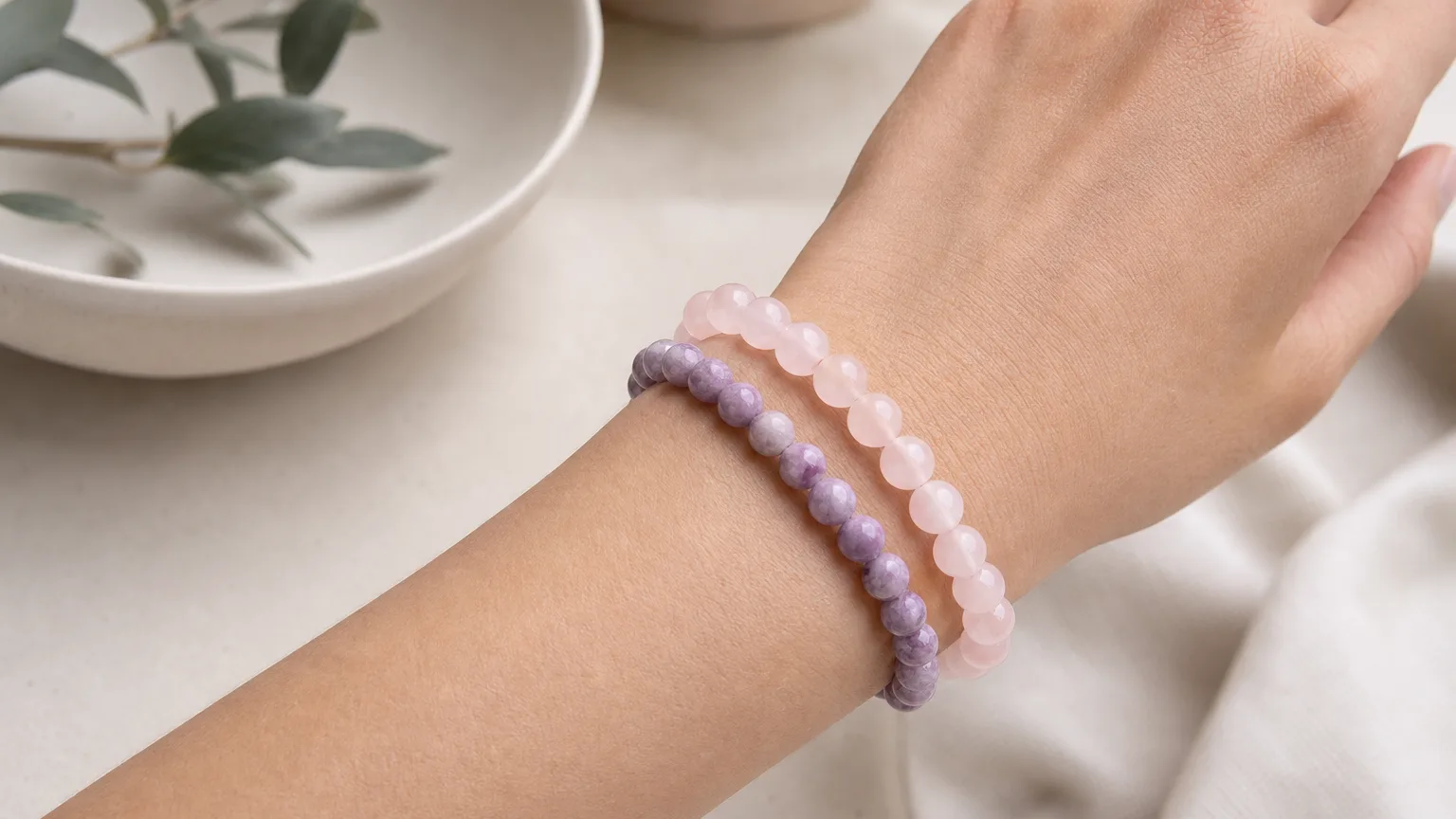
How to Use Rose Quartz and Lepidolite Together
Wear them
A common question is can I wear Rose Quartz and Lepidolite on the same hand? Yes — the two share the Heart chakra, so they’re traditionally considered comfortable together. A Rose Quartz bracelet is the better everyday wearable, since it’s a durable quartz. A Lepidolite chip-bead bracelet can join it on the same wrist; just keep it from being squeezed or stacked hard against heavier stones, because Lepidolite is soft (Mohs 2.5–4) and can scratch or flake. Many people prefer Rose Quartz on the wrist and Lepidolite kept as a palm stone for sleep and calm.
Meditate
Hold Rose Quartz in one hand and rest Lepidolite on or near the chest, over the Heart center. Five to ten minutes is enough for a simple ritual, especially if you’re new to working with these two stones. The aim is a softer, steadier feeling, not a particular physical sensation — and many people fold this short sit into an evening wind-down.
Crystal grid
Place Rose Quartz at the center as the heart of the grid, with Lepidolite stones forming a ring around it to bring a calming, settling quality. It’s a simple, classic grid for self-care, emotional recovery, or gentle transition work — easy to set up on a nightstand or small table.
Place in a room
A Rose Quartz sphere on the nightstand keeps the bedroom feeling warm and tender; a Lepidolite palm stone beside it brings a quieter, calmer mood. Together they turn a bedroom or self-care corner into a low-stimulation space. A good place to start if you want a softer evening routine before sleep.
Caring for Rose Quartz + Lepidolite
Each stone has its own care needs:
- Rose Quartz: Water: Brief rinse safe · Sun: Avoid prolonged sun (may fade) · Salt: Avoid salt water.
- Lepidolite: Water: Avoid water · Sun: Avoid prolonged sun · Salt: Avoid salt water.
When in doubt, cleanse both with sound or moonlight — methods that are gentle across all stone types.
How to cleanse your crystals →
Shop Rose Quartz + Lepidolite
Every stone below is genuine, ethically sourced, and real — not dyed, not glass.
Bundle any 3 and save 20%.
Shop Crystals for This Guide
Explore crystal jewelry and stones from our current collection.


Rose Quartz Anklet


Rose Quartz Mala

Rose Quartz Tower

Rose Quartz Cube
Frequently Asked Questions
Can I wear Rose Quartz and Lepidolite together every day?
Many people do. If you’re new to combining stones, start with a few hours and notice how the pairing feels before making it a daily habit.
Can I wear Rose Quartz and Lepidolite on the same hand?
You can. Some wearers follow the tradition of keeping calming stones on the receiving (left) hand and active ones on the giving (right) hand, but it comes down to personal preference.
Can I sleep with Rose Quartz and Lepidolite?
You can keep them nearby while you sleep. Rose Quartz is often placed on the wrist or nightstand, while Lepidolite is best kept on the nightstand, since it’s soft and can be damaged by pressure or moisture.
How do I cleanse Rose Quartz and Lepidolite?
Rose Quartz: Water: Brief rinse safe · Sun: Avoid prolonged sun (may fade) · Salt: Avoid salt water. Lepidolite: Water: Avoid water · Sun: Avoid prolonged sun · Salt: Avoid salt water. When in doubt, sound or moonlight cleansing is gentle across all stone types.
Can I add a third stone to Rose Quartz and Lepidolite?
Yes — Clear Quartz is a neutral amplifier that bridges most pairings without competing. Add one stone at a time so you can notice each shift.
Related
- Rose Quartz Meaning
- Lepidolite Meaning
- How to Cleanse Crystals
- Amethyst and Lepidolite
- Jade and Rose Quartz
- Rose Quartz and Black Tourmaline
- Rose Quartz and Amazonite
- Crystal Compatibility Checker
Crystal meanings are shared for entertainment and spiritual practice. They’re not a substitute for professional medical or mental-health care.