
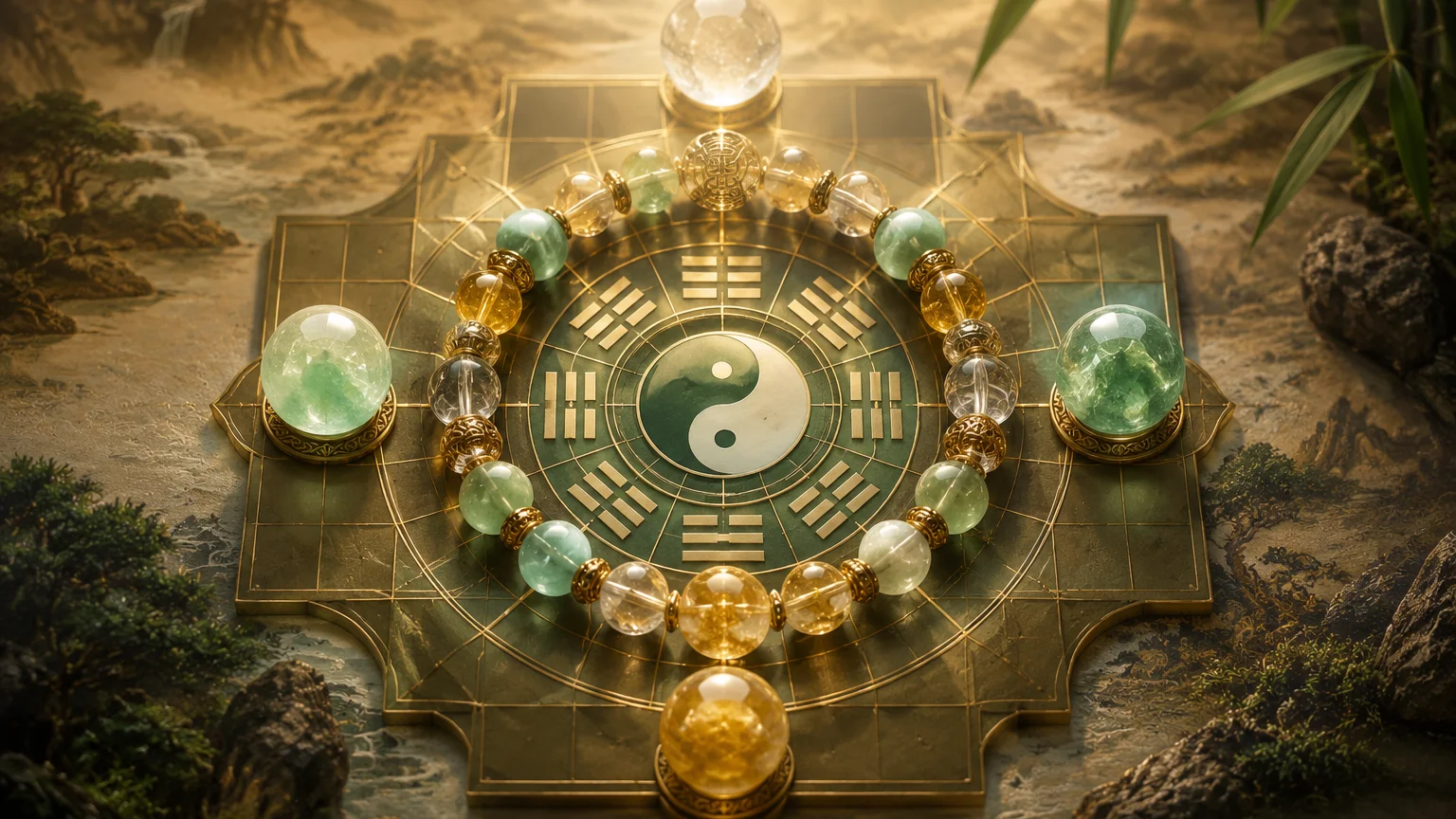
Feng Shui Bracelet: Meaning, Which Hand & Best Crystals
Feng Shui Bracelet: Meaning, Which Hand & Best Crystals
A feng shui bracelet is a strand of beads worn on the wrist as a personal, wearable form of placement. Based on traditional use, the receiving (non-dominant) hand is said to draw energy in, while the giving (dominant) hand projects it outward, so many practitioners wear abundance stones like Citrine on the left wrist and protective stones like Black Tourmaline on the right. The bracelet serves as a tactile reminder of an intention throughout the day, not a certain outcome.
- Placement: Wear receiving-energy stones (abundance, love) on the non-dominant hand and projecting or protective stones on the dominant hand.
- Crystals: Citrine, Black Tourmaline, Amethyst
What Is Feng Shui Bracelet?
A feng shui bracelet is a strand of beads worn on the wrist as a personal, wearable form of placement. Based on traditional use, the receiving (non-dominant) hand is said to draw energy in, while the giving (dominant) hand projects it outward, so many practitioners wear abundance stones like Citrine on the left wrist and protective stones like Black Tourmaline on the right.
Feng Shui Bracelet Explained
A feng shui bracelet functions as a strand of beads worn on the wrist as a personal, wearable form of spatial alignment. To apply this practice consistently, follow these steps: 1. Identify your dominant hand (most right-handed people use the right). 2. Choose an intention such as abundance, protection, or clarity. 3. For abundance, wear Citrine beads on the non-dominant (receiving) wrist. 4. For protection, wear Black Tourmaline on the dominant (giving) wrist to support a boundary. 5. Cleanse the bracelet monthly under moonlight or with sound. The core placement rule directs you to wear receiving-energy stones (abundance, love) on the non-dominant hand and projecting or protective stones on the dominant hand. For example, wear a Citrine beaded bracelet on the left wrist to invite abundance and a Black Tourmaline bracelet on the right to support a sense of protection. The bracelet serves as a tactile reminder of an intention throughout the day, not a certain outcome.
How to Place & Activate
- Step 1: Identify your dominant hand (most right-handed people use the right).
- Step 2: Choose an intention such as abundance, protection, or clarity.
- Step 3: For abundance, wear Citrine beads on the non-dominant (receiving) wrist.
- Step 4: For protection, wear Black Tourmaline on the dominant (giving) wrist to support a boundary.
- Step 5: Cleanse the bracelet monthly under moonlight or with sound.
Tip: Wear a Citrine beaded bracelet on the left wrist to invite abundance and a Black Tourmaline bracelet on the right to support a sense of protection.
Meaning & Application
Wrist-worn stones appear in several Asian traditions, including Tibetan Buddhist prayer bead (mala) practice, where 108 beads count repetitions. The hand-assignment principle (receiving on the non-dominant side, projecting on the dominant) comes from BTB teaching. In the BTB tradition, practitioners align bracelets with the front-door bagua area, placing the door at the bottom row to map Knowledge, Career, and Helpful People zones without a compass. In classical Eight Mansions feng shui, orientation relies on actual compass bearings, positioning Career toward North and Fame toward South, while the Ba Zhai system calculates four auspicious directions (Sheng Chi, Tien Yi, Nien Yen, Fu Wei) alongside four inauspicious ones, noting that the lunar year begins at Li Chun around February 4. The five elements describe how materials interact with space: Water aligns with black tones in the North sector for Career and Helpful People, Wood governs green hues in the Family zone, Fire corresponds to red in the Fame area, Earth anchors yellow in the Center, Knowledge, and Love sectors, and Metal relates to white in the Children and Helpful People regions. Based on tradition, wearing a stone this way is a mindfulness anchor, not a promise of prosperity, and the practice remains a traditional method for reflection rather than a guarantee.
Key Facts
| Aspect | Detail |
|---|---|
| Practice | placement |
| Principle | A feng shui bracelet is a strand of beads worn on the wrist as a personal, wearable form of placement. |
| Supporting Crystals | Citrine, Black Tourmaline, Amethyst |
Crystals to Enhance Your Space
Selecting a feng shui bracelet relies on matching mineral properties to your daily focus. The following stones combine geological characteristics with established placement guidelines to help you cultivate consistent awareness.
- Citrine —
Citrine forms as a silica mineral with hexagonal crystals that develop warm yellow tones from natural iron impurities. In traditional placement, many people wear these beads on the non-dominant wrist to invite abundance, aligning with the fire element’s upward-moving quality to support forward momentum. Keeping this bracelet visible during work hours provides a quiet anchor for tracking progress on growth-oriented goals.
- Black Tourmaline —
Black tourmaline crystallizes as a complex borosilicate mineral, typically forming elongated prismatic structures that carry a dense, grounding presence. Based on traditional placement, wearing these stones on the dominant wrist helps project outward energy, which many wearers use to support a sense of clear, settled boundaries. Placing this bracelet near your workstation or entryway offers a tactile reference point for maintaining personal space during demanding routines.
- Amethyst —
Amethyst is a violet variety of quartz whose coloring comes from trace iron and aluminum combined with natural irradiation over time. In the BTB tradition, the signature purple shade aligns with the wealth corner of the bagua, inviting abundance through its steady, reflective frequency rather than direct financial promises. Many wearers keep an amethyst bracelet on their non-dominant wrist as a mindful cue to pause and reassess priorities during busy periods.
Explore Crystals in Feng Shui, Bagua Map, Wealth Corner guides.
Eastern Traditions
Wrist-worn stones appear in several Asian traditions, including Tibetan Buddhist prayer bead (mala) practice, where 108 beads count repetitions. The hand-assignment principle (receiving on the non-dominant side, projecting on the dominant) comes from BTB teaching. Based on tradition, wearing a stone this way is a mindfulness anchor, not a promise of prosperity.
Frequently Asked Questions
Which hand should I wear a feng shui bracelet on?
The receiving (non-dominant) hand is traditionally used to draw energy inward, making it suitable for abundance and love stones, while the giving (dominant) hand projects energy outward, which is better suited for protective or boundary-supporting crystals. Identify your dominant hand first, then match the stone’s purpose to the appropriate wrist.
What is the best crystal for a feng shui bracelet?
There is no single best stone, as the right choice depends entirely on your current intention. Many people pair citrine for growth-focused days, black tourmaline when they need grounded boundaries, or amethyst to align with traditional bagua wealth corners and encourage mental clarity. Choose the crystal that resonates with the specific awareness you wish to cultivate.
How many beads should a feng shui bracelet have?
Traditional bead counts vary by purpose, with 108 beads originating from Tibetan Buddhist mala practice for counting repetitions, while 14 or 27 beads are also common for health and clarity intentions. Modern makers often adjust the number to fit wrist size, so the most practical approach is to choose a count that feels comfortable and aligns with your personal rhythm.
Can I wear multiple feng shui bracelets at once?
You can wear multiple bracelets, but keeping the combination to one or two pieces prevents conflicting intentions and maintains clear focus. If layering stones, pair complementary elements—such as a grounding black tourmaline with a clarifying amethyst—and ensure neither piece crowds your wrist or restricts movement.
Related Feng Shui Guides
- Feng Shui
- Feng Shui Bagua Map
- Feng Shui Wealth Corner
- Five Elements in Feng Shui
- Kua Number
- Feng Shui for Protection
- Crystals for Wealth
- Crystals for Love
- Crystals in Feng Shui
- Kua Number Calculator
- Bagua Map Tool
Feng Shui and crystal placement are traditional practices for creating supportive, intentional spaces — tools for reflection and wellbeing, not substitutes for professional advice or guarantees of specific outcomes.