
Amethyst Meaning: Healing Properties & Uses
Amethyst is the purple variety of quartz — a stone long tied to calm, clarity, and spiritual focus. If you’re drawn to it for meditation, sleep, or simply a quieter mind, this guide walks through what amethyst means, what it’s actually made of, and how people work with it day to day. Crystal meanings reflect tradition and personal practice, not medical advice.
What Is Amethyst Meaning?
At its simplest, amethyst means stillness and clear-headed awareness. Across cultures it’s been called a stone of sobriety, protection, and spiritual insight — a focus point for meditation, a bedside stone for winding down, or a quiet reminder to slow down.
For a lot of people, that’s the whole appeal: one stone, one intention, one small daily ritual. You don’t need to believe anything mystical to benefit — the value often comes from the act of choosing, carrying, or sitting with the stone and letting it gently nudge you back to a calmer baseline. In that sense amethyst is less a “magic rock” and more a physical cue you train yourself to respond to.
Amethyst Meaning and Symbolism
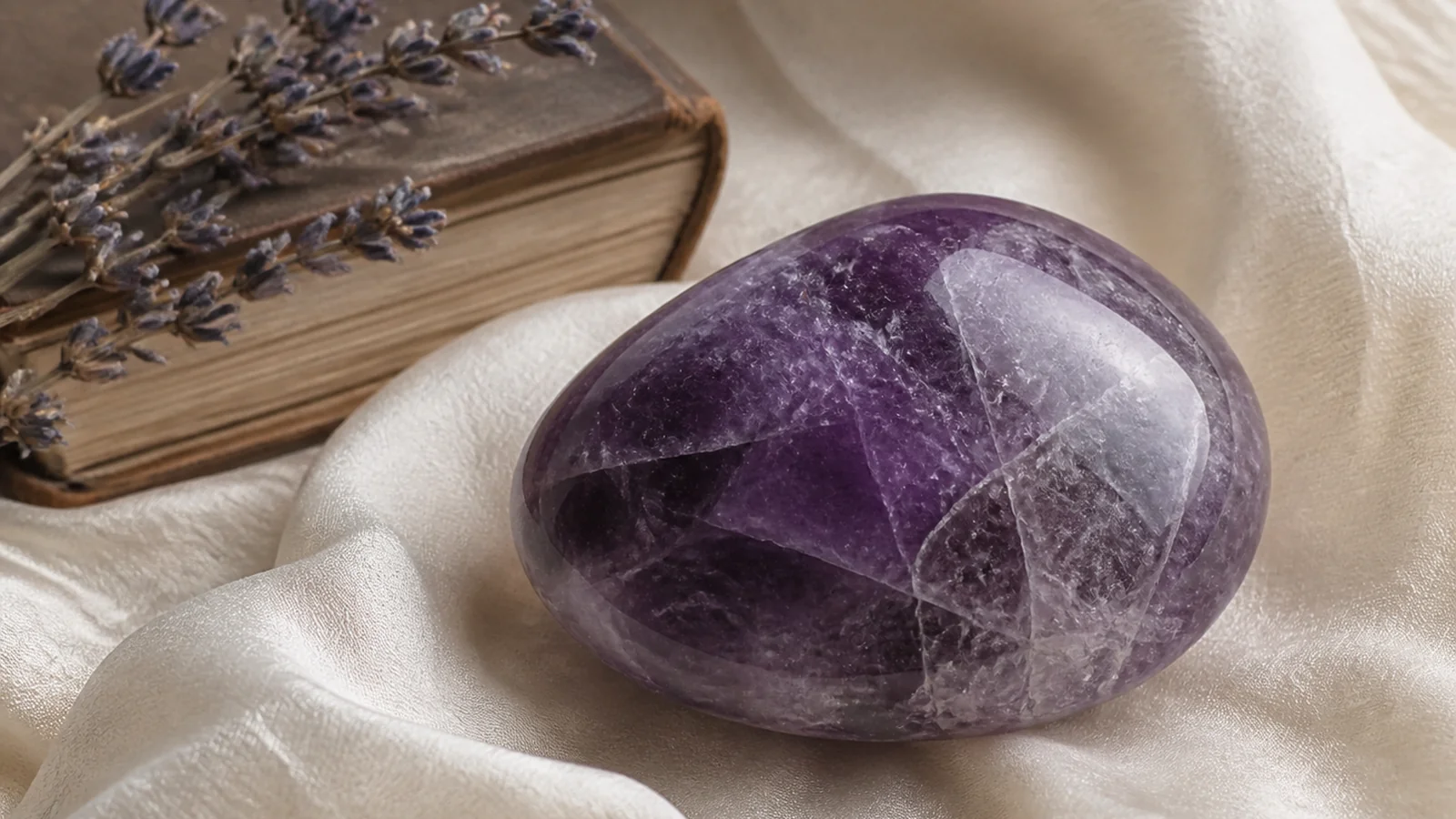
The name itself tells a story. Améthyste comes from the ancient Greek ametusthos, meaning “not intoxicated.” Greek myth describes a young woman, Amethyste, turned into a clear crystal to protect her from Dionysus, the god of wine — and the god, regretful, poured his wine over the stone, staining it purple. Whether or not you take the myth literally, it captures why the stone became a symbol of a clear head and steady nerves.
That symbolism stuck. Ancient Egyptians carved amethyst into amulets and intaglio seals. In medieval Europe, bishops wore amethyst rings — it’s still sometimes called the “bishop’s stone” — as a sign of clear judgment and devotion. It also appears repeatedly in British royal regalia, valued for its deep color and the association with dignity. Across very different eras, the common thread was the same: a stone that helped you keep your wits about you.
Today the common threads are consistent: calm, protection, and spiritual clarity. You’ll see amethyst described as a “stone of peace,” linked to quieting an overactive mind and supporting intentional focus. How much of that you experience personally is, honestly, up to you — but the symbolism has held for thousands of years across very different cultures, which says something on its own. To explore more stones, browse the full Crystal Guide.
Amethyst Properties
The Science
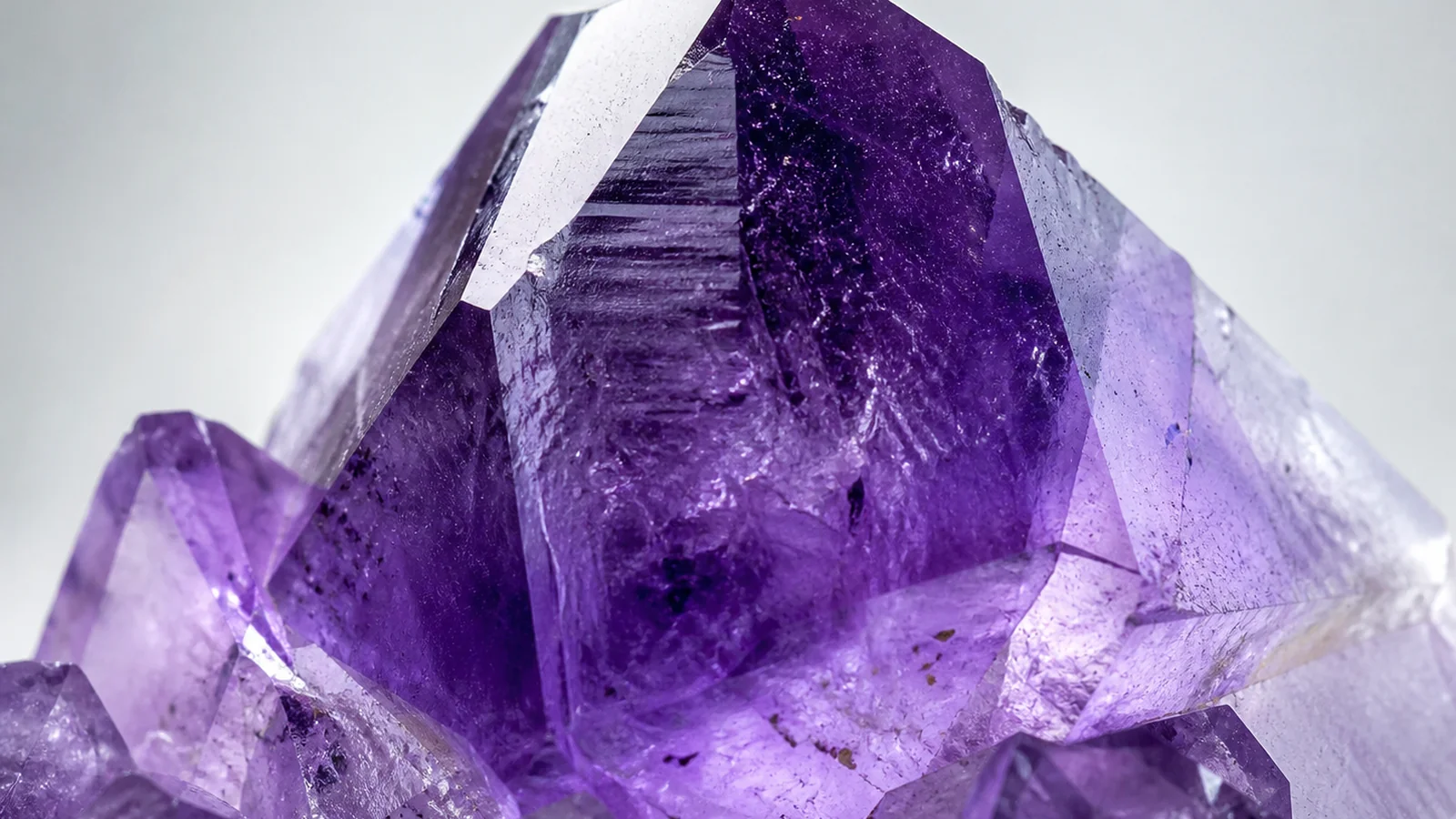
Amethyst is quartz (SiO₂) with a twist: trace iron, exposed to natural radiation underground over long periods, takes on that signature purple. It’s a hard stone — 7 on the Mohs scale — so it resists scratching in everyday wear, which is exactly why it holds up well in bracelets and rings that see daily use. One quirk worth knowing: heat changes the color. Warm amethyst and it fades to yellow, effectively becoming citrine. Heat-treat certain amethyst from specific sources under controlled conditions and it can turn green — that green material is prasiolite, the stone sold (a bit misleadingly) as “green amethyst.” The purple itself can also fade in strong, prolonged sunlight. None of this is mystical — it’s standard mineral behavior, and it’s the reason a few simple care rules matter more than you’d expect.
Traditional Meaning
Tradition ties amethyst to calm, protection, and spiritual awareness. It’s associated with the crown and third eye centers and is often described as a stone that “quiets the mind” — many believe it supports meditation, intuition, and a sense of inner stillness. Across history it’s been carried as a protective talisman and used in rituals meant to clear heavy or stuck energy. If you’ve ever walked into a crystal shop and felt drawn straight to the purple, you’re in good company — that pull is part of why amethyst has been a centerpiece of spiritual practice for so long. These associations come from spiritual tradition and personal practice rather than clinical study.
Mindfulness & Psychology
From a psychological angle, amethyst works as a tangible anchor — something to hold, notice, or place on a desk as a cue to pause. The color purple is linked in color psychology to calm and introspection, and the act of choosing, carrying, or sitting with a crystal can support intention-setting: you decide what the stone represents for you, and seeing it nudges you back to that intention. It’s a small ritual, and like many rituals, part of its value is simply creating a moment of attention in an otherwise noisy day. These effects come from tradition and personal practice, not clinical research. Crystals complement — but never replace — professional care.
Amethyst Benefits
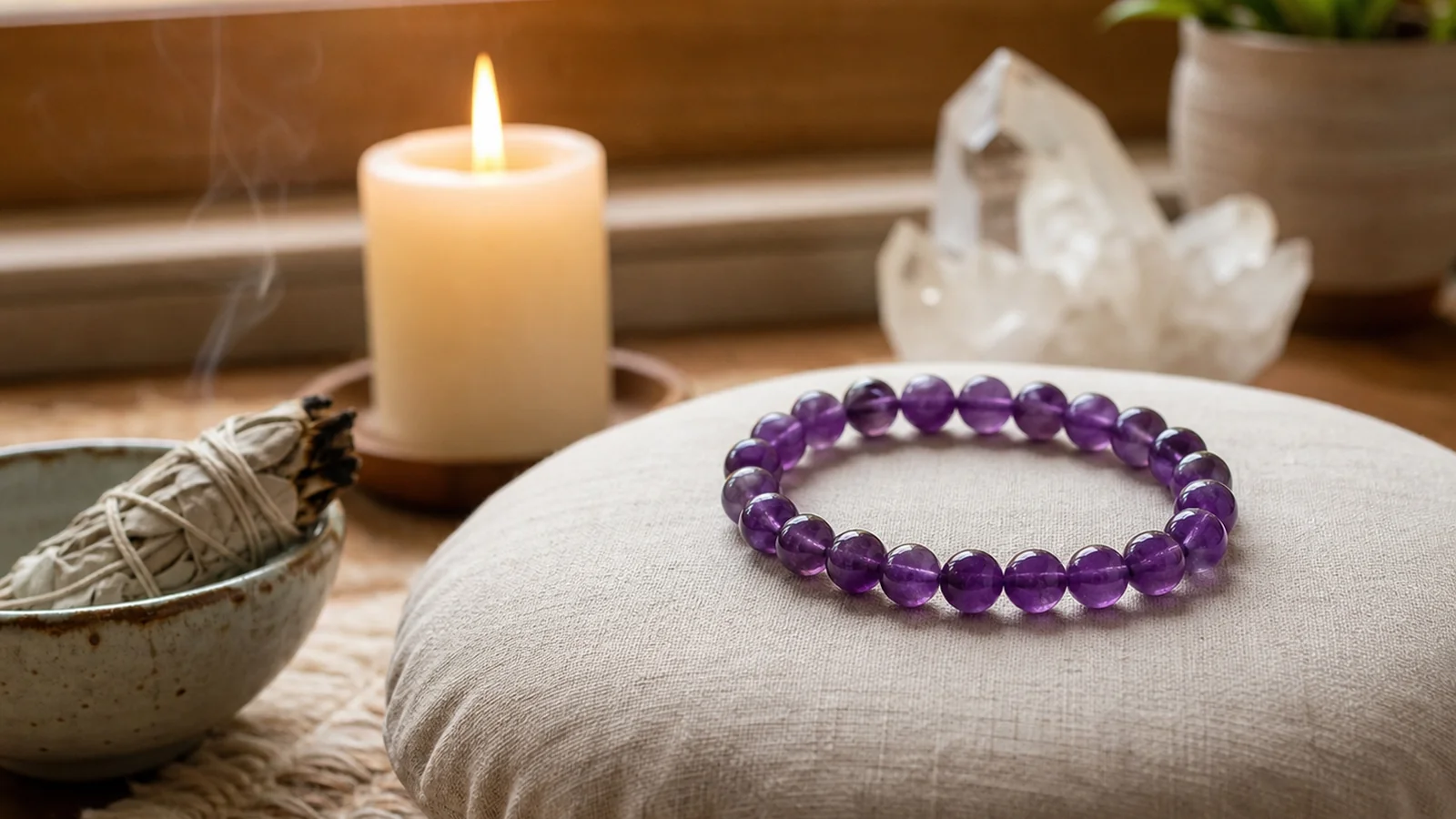
People who work with amethyst usually describe it in terms of everyday shifts, not dramatic cures. The stone tends to show up in the small, repeatable moments of a day — the five quiet minutes before work, the evening wind-down, the breath you take when you glance at your wrist. Here are a few of the benefits people mention most often:
A quieter mind for meditation
Holding or placing amethyst nearby gives your attention somewhere gentle to land, which makes settling into a sit feel easier — especially on days when your thoughts won’t slow down on their own.
A calmer desk
Many keep a piece at their workspace as a visual reminder to breathe and not spiral into the next task the moment stress builds. It’s a low-effort cue that resets your pace.
An easier wind-down
Placed on a nightstand, it becomes part of a small evening ritual — dim the lights, put the phone down, notice the stone. Over time that routine itself signals your body it’s time to rest.
A steadier mood
Carried through the day, amethyst can act as a gentle check — when stress builds, a glance or a touch brings you back to a calmer baseline instead of reacting on impulse.
The pattern underneath all of these is the same: the stone isn’t doing the work for you, but it gives your day a structure that makes calm more likely. If you’re exploring stones for specific needs, see our guides to crystals for anxiety et crystals for sleep.
Amethyst Chakra, Zodiac, and Element Associations
In traditional systems, amethyst is most often linked to the crown et third eye centers — the areas tied to insight, intuition, and a sense of connection beyond the everyday. It’s a traditional birthstone for February, and it’s commonly paired with Pisces et Aquarius. Its element is usually given as Air. For related stones, see crown chakra crystals.
These are correspondences built up through spiritual tradition, not rules carved in stone. If your own sense of amethyst points somewhere else — a different chakra, a different element — that’s completely fine. Many people work with stones intuitively, following what feels right rather than a textbook chart, and there’s a long history of practitioners doing exactly that.
How to Use Amethyst
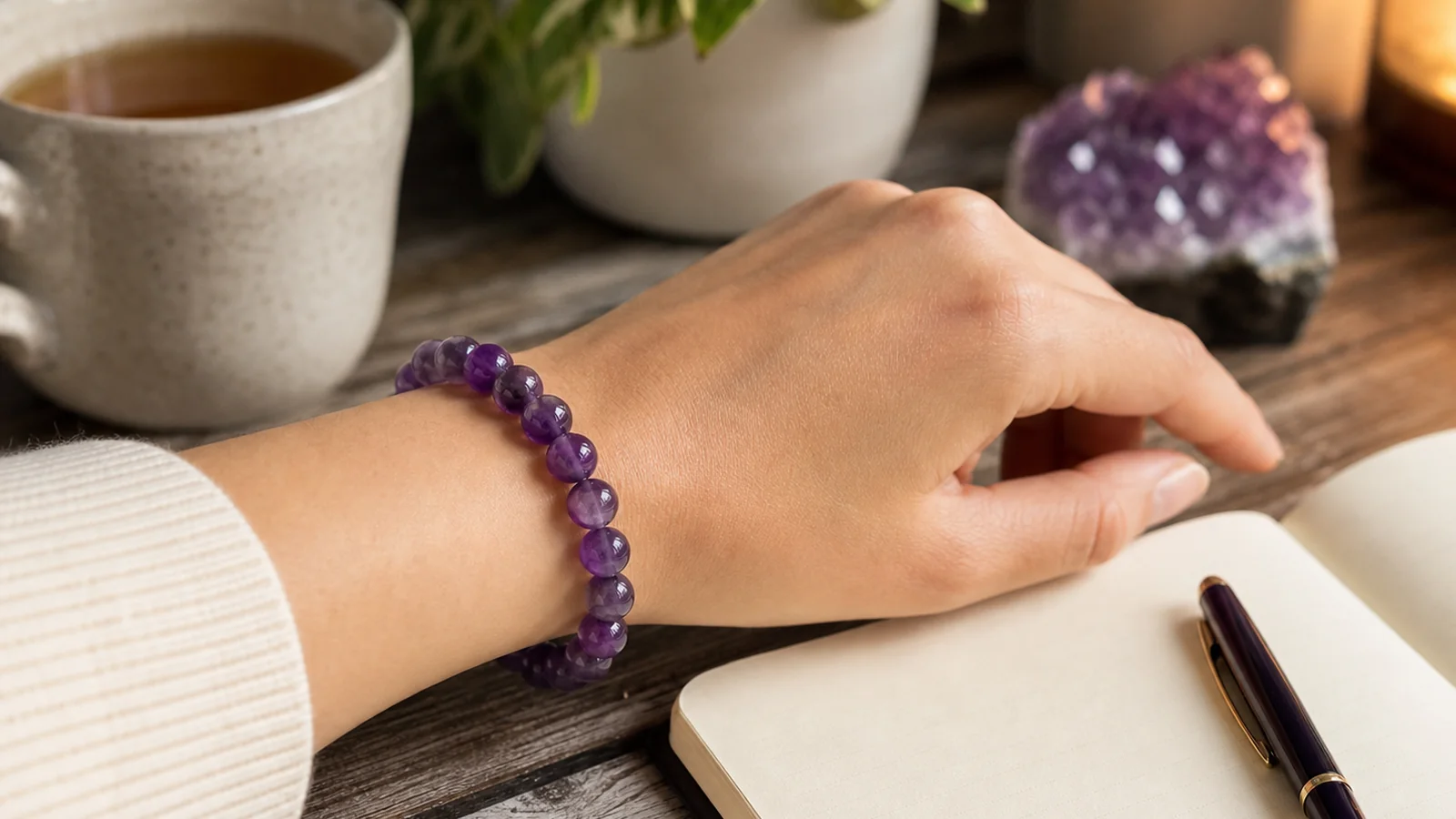
Amethyst is flexible — there’s no single “right” way, only what fits your routine. The key is consistency: a stone you actually see and touch every day does far more than one that sits in a drawer.
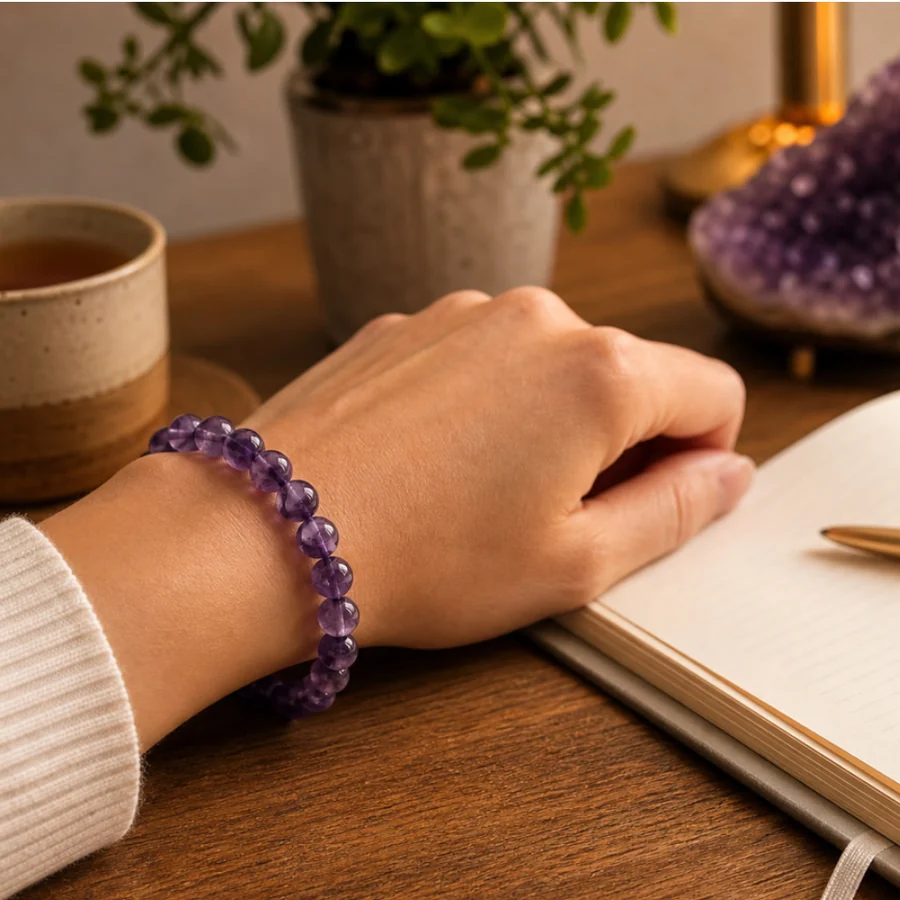
Wear it. A bracelet or pendant keeps the stone with you through the day. For a reminder-style practice, choose one piece and pair it with a specific intention each morning — “stay calm in the meeting,” “breathe before I react.”
Meditate with it. Hold a tumbled stone in your palm or rest it on your forehead (third eye area) while you sit. Even a few minutes of focused attention counts; the goal is presence, not duration.
Place it at home. A cluster on the nightstand or desk works as both décor and a visual cue. Larger geodes are popular for shared spaces, where they add presence to a room.
Build a small evening ritual. Set the stone down, lower the lights, and let it mark the shift from “doing” to “resting.” Repetition is what turns it from a gesture into a habit.
Which Amethyst Form Is Right for You?
| Form | Best for | Choose it if |
|---|---|---|
| Bracelet | Daily wearing | You want a visible reminder through the day |
| Tumbled stone | Pocket or meditation | You want something small, smooth, and easy to hold |
| Cluster / Geode | Desk, bedside, or room display | You want a visual anchor with natural points and depth of color |
| Pendant / Earrings | Personal meaning | You prefer a smaller stone worn near the face, neckline, or body |
| Anklet | Subtle everyday jewelry | You want a quieter wearable form that still feels personal |
| Raw point | Altar or intention work | You like natural texture and a more directional shape |
How to Tell Real Amethyst from Fakes
Because amethyst is popular, the market has fakes — usually glass or dyed quartz sold to look like the real thing. A few checks help you tell them apart before you buy:
- Color zoning. Real amethyst often has slight unevenness or lighter/darker patches. Perfectly uniform, neon-purple color is a red flag — nature rarely produces that.
- Bubbles. Tiny round bubbles inside suggest glass, not crystal. Tilt the stone in the light and look closely.
- Hardness. At Mohs 7, real amethyst scratches glass and resists a steel knife. Glass won’t scratch glass.
- Temperature. Crystal stays cool longer than glass when warmed in your hand. A stone that goes room-temperature fast may be glass.
- Price. Deep, clean, large pieces at suspiciously low prices are usually too good to be true. Know the going rate before you shop.
A note on “green amethyst.” What’s sold as green amethyst almost always isn’t amethyst at all — it’s prasiolite, a green quartz produced by heat-treating amethyst from specific sources. It’s a real stone in its own right (with its own meaning), but calling it “green amethyst” is a market name, not a mineral one. If you want purple amethyst, “green amethyst” is a different stone.
How to Cleanse and Charge Amethyst
In crystal practice, “cleansing” clears accumulated energy and “charging” refreshes the stone. Whether you read that literally or symbolically, the routine of caring for your stone keeps your relationship with it intentional. A few reliable methods:
- Moonlight. Leave it out overnight under a full moon — the gentlest option and the most-recommended. Many make it a monthly ritual.
- Smoke. Pass it through sage or palo santo smoke. Let the smoke drift over every side.
- Sound. A singing bowl or bell near the stone. Vibration is said to reset the field; at minimum, it’s a mindful pause.
- Other crystals. Resting it on a selenite plate or clear quartz cluster is popular for an overnight “reset.”
Two things to avoid: prolonged direct sunlight (the purple can fade over time) and salt water (salt can dull or pit the surface). A brief rinse under cool water is fine; long soaks aren’t. For the full routine, see our guide to cleansing crystals.
Best Crystals to Pair With Amethyst
Pairing is about layering intentions — picking stones whose qualities complement rather than compete. A few classic combinations that work well with amethyst’s calm, clarifying energy:
- Amethyst + Quartz rose — calm softened with warmth; a gentle, heart-centered pairing many reach for emotional balance.
- Amethyst + Quartz transparent — clear quartz is said to amplify; many use it to “boost” amethyst’s focus and clarity.
- Amethyst + Tourmaline noire — calm meets grounding; a popular combo for feeling both settled and protected through a demanding day.
The logic of pairing is about complementary intentions, not strict rules. Pick combinations that match what you’re actually working on, and trust your own sense of what feels balanced.
Who Should Use Amethyst?
Amethyst suits people who want a focus point for calm, meditation, or a clearer mind — meditators, anyone building a wind-down routine, or people who simply like having a physical reminder to slow down. It’s one of the most approachable stones precisely because it doesn’t ask much of you: pick it up, give it a job, and let it do its quiet work in the background of your day.
A few honest expectations: amethyst isn’t a treatment for anxiety, insomnia, or any condition — if you’re dealing with something persistent, a healthcare professional is the right call, and the stone can be a comfort alongside that. It also won’t “do” anything on its own; its value comes from the intention and routine you build around it. If you go in expecting a stone to fix things for you, you’ll be disappointed. If you go in expecting a supportive anchor for your own practice, it tends to fit well.
FAQ About Amethyst Meaning
Can amethyst go in water?
Brief contact is fine — it’s a hard stone (Mohs 7). Avoid long soaks, hot water, and salt water, which can dull or damage it over time.
What chakra is amethyst associated with?
Traditionally the crown and third eye centers, linked to insight, intuition, and spiritual focus.
How can I tell if my amethyst is real?
Look for slight color zoning (not perfectly uniform), check for bubbles (a sign of glass), and test hardness — real amethyst scratches glass.
Is “green amethyst” real amethyst?
No. “Green amethyst” is almost always prasiolite — green quartz made by heat-treating amethyst. It’s a different stone with its own meaning.
How do I cleanse amethyst?
Moonlight, smoke (sage/palo santo), or sound. Avoid prolonged sunlight (color fades) and salt water.
Where should I place amethyst in my home?
Common spots are the nightstand (for winding down) and the desk (as a calm cue). Clusters and geodes work well in shared spaces.
Does amethyst fade in sunlight?
Yes, with prolonged direct exposure. Display it in indirect light or rotate it out of bright sun, and the color stays rich.
Is amethyst good for beginners?
Very. It’s affordable, widely available, durable, and forgiving — an easy first stone for anyone starting a crystal practice.
Final Thoughts on Amethyst
Amethyst has earned its long reputation as a stone of calm and clarity — and it earns it again for each person who picks it up and gives it a job to do. If you’re curious, the simplest way to start is one piece, one intention, and a small daily moment to notice it. You don’t need the biggest cluster or the rarest geode; you need a stone you’ll actually see and use. Let the routine do the work, and let the stone be the quiet anchor that holds it in place.
From there, amethyst tends to open a door — to a calmer evening, a steadier morning, or simply a habit of pausing. If that’s what you’re after, you’re in the right place. For more, explore the Crystal Guide or browse amethyst jewelry and crystals.