
Citrine Meaning: Healing Properties & Uses
Citrine is the yellow to golden-brown variety of quartz, colored by trace iron and heat. For centuries it has been called the Merchant’s Stone and carried as a token of abundance and sunny confidence. If you’re drawn to citrine for motivation, wealth-building rituals, or a brighter outlook, this guide covers what citrine actually is, what it has meant across cultures, and how people work with it today. Crystal meanings reflect tradition and personal practice, not medical advice.
Crystal meanings reflect tradition and personal practice, not medical advice. One important fact up front: most citrine on the market is heat-treated amethyst or smoky quartz — see Quality Notes for how to tell.
What Is Citrine Meaning?
At its simplest, citrine means abundance, confidence, and warm, active energy. Where darker stones often read as grounding or protective, citrine sits on the brighter side — linked to optimism, initiative, and the willingness to begin. It’s one of the few stones traditionally tied as much to doing (starting projects, attracting opportunity) as to feeling.
For many people, that’s exactly the appeal: a piece you keep on a desk or in a wallet as a small, physical nudge toward forward motion. You don’t need to hold any belief about magic for it to work as a cue — the value often comes from choosing the stone, giving it a job (“remind me to follow up today”), and letting its warm color pull your attention back to what you meant to do. In that sense citrine is less a lucky charm and more a tactile anchor for intention.
Citrine Meaning and Symbolism
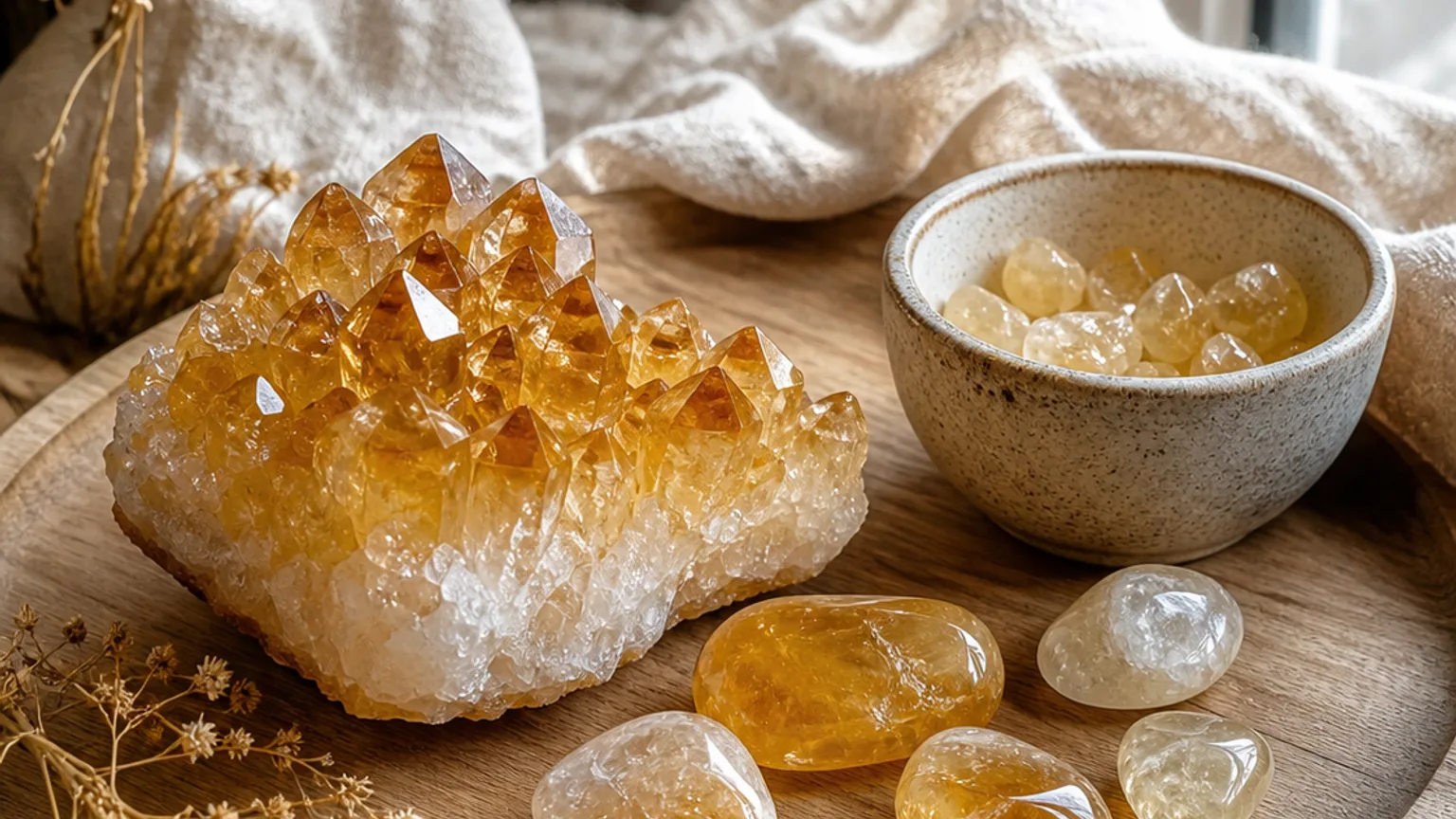
Citrine’s symbolism centers on abundance and the sun, and it’s one of the older prosperity stones in the record. The name comes from the Old French citre and Latin citrus, for the yellow-green citron fruit — a nod to its color more than any single myth. In ancient times it was sometimes confused with topaz (the word “topaz” itself may derive from a Sanskrit term for “fire”), which is why you still see “topaz” misused in old citrine names like “Madeira topaz” or “golden topaz.”
The prosperity thread is the one that stuck. From the Victorian era — when citrine became a favorite in Scottish pebble jewellery, cut into brooches and kilt-pin accents — to 20th-century crystal practice, citrine built a reputation as the Merchant’s Stone. Shopkeepers were said to keep a piece in the cash box to attract commerce, and the habit carried into modern crystal circles, where citrine is one of the first stones reached for in money or business rituals. The common thread across eras is warmth, sunlight, and the energy of increase — not passive luck, but the confidence to act on opportunity.
Today the threads hold together: abundance, confidence, and a bright, forward-leaning energy. How much of that lands for you personally is up to you — but the symbolism has been remarkably stable for a stone whose market identity has shifted a lot. To explore more stones, browse the full Crystal Guide.
Citrine Properties
The Science
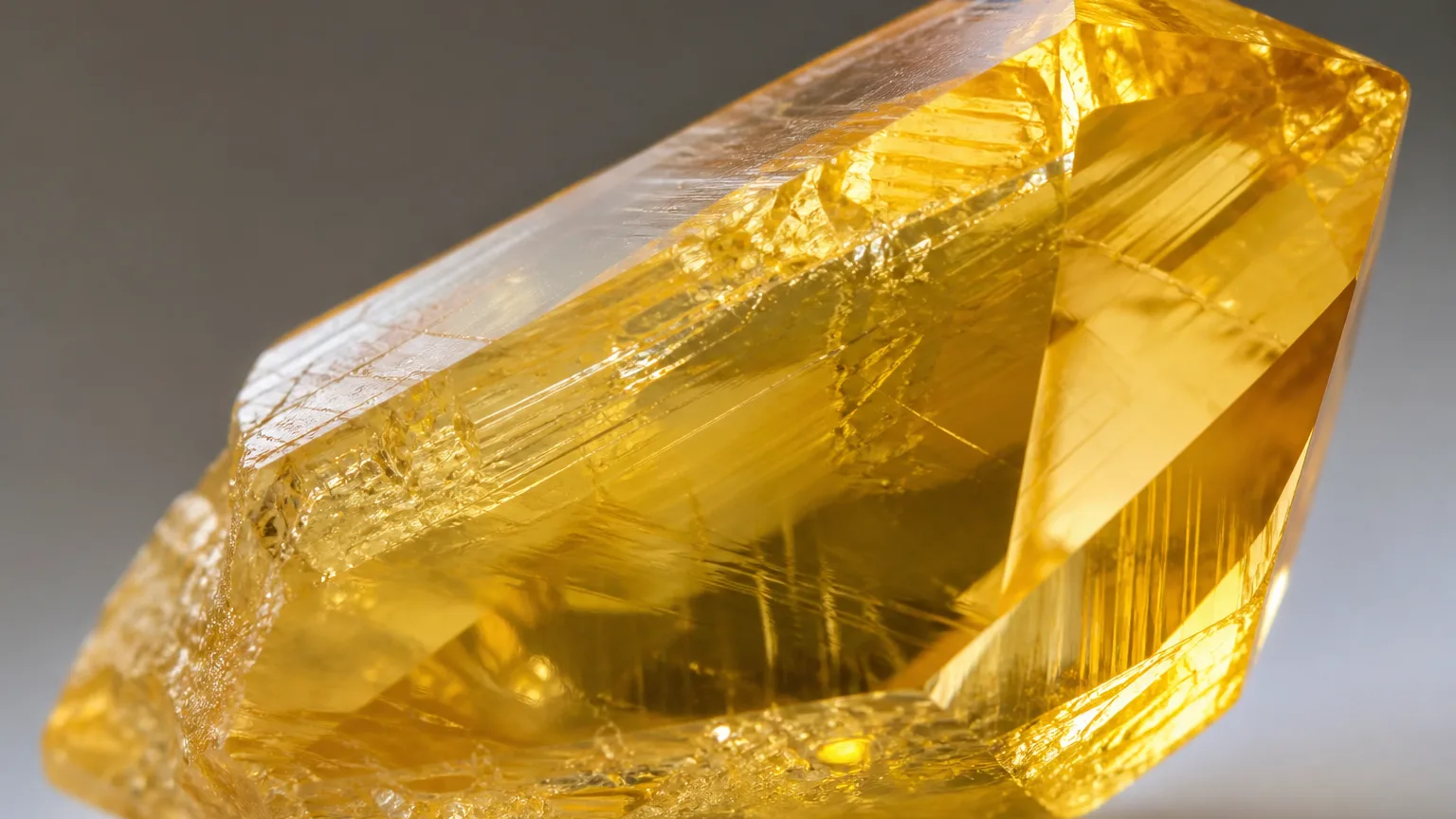
Citrine is quartz — silicon dioxide, SiO₂ — the same mineral family as amethyst, smoky quartz, and clear quartz. Its yellow to golden-brown color comes from trace iron (Fe³⁺) inside the crystal lattice, brought out by heat. The key fact to know: natural citrine is rare. Most of the bright orange to brown “citrine” sold today is actually amethyst or smoky quartz that has been heated in a lab or oven, which converts its color to the citrine range. This heat treatment is a permanent, industry-standard process (not a coating or dye), and the result is still real quartz — but it’s worth knowing the difference if color or origin matters to you. Citrine rates 7 on the Mohs scale, so it’s durable for everyday jewelry. It has a vitreous (glassy) luster, is transparent to translucent, and major sources include Brazil, Madagascar, Russia, and Spain. None of this is mystical — it’s standard mineralogy, and it explains why citrine is both affordable and widely available.
Traditional Meaning
Tradition ties citrine to abundance, confidence, and the energy of the sun. It’s linked to the solar plexus and sacral centers and is often described as a stone that “carries warmth” and supports motivation, self-worth, and the courage to act on ideas. Across crystal practice it’s the classic prosperity stone — many believe it attracts opportunity and is best placed in a workspace, wallet, or the “wealth corner” of a home. The framing is consistently active rather than passive: citrine is less about luck landing on you and more about the energy to go meet it. These associations come from spiritual tradition and personal practice rather than clinical study.
Mindfulness & Psychology
From a psychological angle, citrine works well as a warm, optimistic anchor — the kind of object you reach for when you want to shift into a more active, less hesitant headspace. Yellow and gold are linked in color psychology to energy, attention, and a sense of possibility, and the act of choosing a citrine piece and pairing it with an intention (“start before you feel ready”) turns it into a small, repeatable cue. Many people who keep a stone on their desk describe it as a visual reminder to pick momentum over perfection. Like any ritual object, part of its value is simply creating a moment of focus in a distracted day. These effects come from tradition and personal practice, not clinical research. Crystals complement — but never replace — professional care.
Citrine Benefits

People who work with citrine usually describe it in terms of warm, active momentum, not sudden windfalls. It tends to show up as a brighter, more willing headspace — useful when you’re starting something or trying to keep moving. Here are a few of the benefits people mention most:
A confidence nudge
Carrying or wearing citrine gives you a warm, physical cue to act instead of overthink — a small reminder that done is better than perfect.
A brighter desk
Many keep a piece where they work as a visual prompt to choose momentum and follow through, especially on slow or resistant mornings.
An abundance ritual
Placed in a wallet, cash box, or the wealth corner of a room, citrine anchors a regular practice of attention toward opportunity and giving.
A morning spark
Held during a short morning intention-setting, it acts as a focal point for what you want to move on today — presence with a forward lean.
The pattern underneath all of these is the same: citrine isn’t dropping opportunities in your lap, but it gives your day a warm, active reference point that makes initiative more likely. If you’re exploring stones for specific needs, see our guides to crystals for wealth et crystals for confidence.
Citrine Chakra, Zodiac, and Element Associations
In traditional systems, citrine is most often linked to the solar plexus center — the area tied to confidence, willpower, and self-worth — with a secondary tie to the sacral center for creativity and drive. Astrologically, it’s commonly paired with Aries et Leo (the fire signs that share its warm, active quality). Its element is Fire. It’s a traditional birthstone for November. For related stones, see amethyst meaning — the two are mineral siblings (amethyst turns into citrine when heated).
These are correspondences built up through tradition, not fixed rules. If your own sense of citrine points somewhere else, that’s completely fine. Many people work with stones intuitively, and there’s a long history of practitioners doing exactly that.
How to Use Citrine

Citrine is flexible and forgiving — there’s no single right way, only what fits your routine. The key is keeping it somewhere you’ll actually notice it.
Wear it. A citrine bracelet, ring, or pendant keeps the stone against your skin through the day. For an abundance practice, pair it with one intention each morning — “act on one opportunity today,” “follow up before noon.”
Meditate with it. Hold a tumbled piece in your palm or rest it on your upper belly (solar plexus area) while you sit. Even a few minutes of focused attention counts; the goal is presence, not duration.
Place it with intention. A cluster or raw point on a desk, near a wallet, or in the far-left “wealth corner” of a room (a feng shui convention) works as both décor and a visual cue.
Build a small morning ritual. Hold the stone, set one thing you want to move on, and let it mark the start of your day. Repetition is what turns a gesture into a habit.
Which Citrine Form Is Right for You?

| Form | Best for | Choose it if |
|---|---|---|
| Bracelet | Daily wearing | You want a warm, visible reminder of momentum through the day |
| Ring / Pendant | Close-to-body confidence | You prefer one piece near the hand or chest |
| Tumbled stone | Wallet, pocket, meditation | You want something smooth to carry and hold |
| Raw point / Cluster | Desk, wealth corner, display | You like natural texture and a sculptural shape on a shelf |
| Geode / Cut base | Shared spaces | You want a larger statement piece for a room |
How to Tell Real Citrine from Fakes & Heat-Treated
This is the part most citrine guides skip, and it matters: most citrine on the market is not natural. Knowing what you’re buying changes both the price you should pay and the story behind the stone.
- Natural citrine is rare and pale. True natural citrine tends to be a soft, pale yellow to smoky honey color, often with a cooler, slightly washed-out tone. It’s uncommon — most mines produce very little of it.
- Most “citrine” is heated amethyst or smoky quartz. When amethyst or smoky quartz is heated (in a lab or even by natural geothermal conditions), it turns a bright golden-orange to brownish-red. The deep, saturated orange you see in most shops and jewelry is almost always heat-treated material. This is a standard, accepted treatment — not a fake — but it’s often sold without explanation.
- Color is the tell. Bright, uniform orange-red with a brownish tint usually means heated amethyst. Pale, smoky, slightly greenish-yellow leans natural. If the color looks too perfect and saturated, assume treated.
- Clarity. Heated amethyst citrine is often very clear and bright (the heating clears inclusions). Natural citrine is more likely to have faint inclusions or a cloudy, smoky quality.
- Price & source. Natural citrine commands a higher price. If a piece is cheap, large, and deeply orange, it’s almost certainly heated amethyst. Ask the seller directly — reputable ones will say which it is.
Bottom line: heated citrine is still genuine quartz and carries the same mineral properties; it’s not a scam. But if you care about natural origin, or you’re paying a premium, you should know the difference. A seller who can’t answer “is this natural or heat-treated?” is a signal in itself.
How to Cleanse and Charge Citrine
Citrine is one of the easier stones to care for. At Mohs 7 it’s hard and durable, and — unlike amethyst — its color is stable and won’t fade in sunlight.
- Water. A brief rinse under cool water is fine; citrine isn’t water-soluble and won’t be damaged. Avoid long soaks in salt water if the piece has metal settings (the salt can dull the metal, not the stone).
- Sunlight. Unlike many colored stones, citrine is sun-safe — its color comes from heat-stable iron, so prolonged light won’t bleach it. A few hours in sunlight is a common “charging” method.
- Smoke or sound. Passing citrine through sage or palo santo smoke, or using a singing bowl nearby, is a gentle option many prefer.
- Other crystals. Resting it on a selenite plate or clear quartz cluster is a popular overnight “reset.”
Citrine is one of the few stones traditionally said to be self-cleansing — it doesn’t hold negative energy and doesn’t need frequent clearing. Whether you take that literally or as a useful bit of lore, the practical upshot is low maintenance. For a general cleansing routine, see our guide to cleansing crystals.
Best Crystals to Pair With Citrine
Pairing is about layering intentions — picking stones whose qualities complement rather than compete. A few classic combinations with citrine’s warm, active energy:
- Citrine + Améthyste — active meets calm; a balanced pairing many reach for when they want drive without burnout. (They’re also mineral siblings — amethyst becomes citrine when heated.)
- Citrine + Clear Quartz — clear quartz is said to amplify; many use it to “boost” citrine’s abundance intention without adding another strong color.
- Citrine + Green Aventurine — a classic “opportunity” pairing, often kept together in a wallet or cash box for combined abundance energy.
The logic of pairing is about complementary intentions, not strict rules. Pick combinations that match what you’re actually working on, and trust your own sense of balance.
Who Should Use Citrine?
Citrine suits people who want a warm, active anchor for confidence and momentum — anyone starting a project, building a business, or trying to break a cycle of overthinking. It’s one of the more approachable stones because its color and energy are bright rather than heavy, and it’s durable enough for daily wear.
A few honest expectations: citrine is not a money magnet that drops wealth into your life, and it’s not a treatment for low mood, anxiety, or any condition — if you’re dealing with something persistent, a healthcare professional is the right call, and the stone can be a comfort alongside that. Its value comes from the intention and routine you build around it. If you go in expecting it to do the work for you, you’ll be disappointed; if you go in expecting a warm cue to act, it tends to fit well.
FAQ About Citrine Meaning
Is most citrine real?
It’s real quartz, but most “citrine” on the market is heat-treated amethyst or smoky quartz — not natural citrine. The treatment is standard and accepted; natural citrine is rare, pale, and pricier. Ask the seller which it is.
Can citrine go in water?
Yes. At Mohs 7, citrine is hard and water-safe. A brief rinse is fine; avoid long salt-water soaks if the piece has metal settings.
Does citrine fade in sunlight?
No. Unlike amethyst, citrine’s color is heat-stable and sun-safe. It won’t bleach in prolonged light, which is why sunlight is a common charging method.
What chakra is citrine linked to?
Mostly the solar plexus (confidence, willpower), with a secondary tie to the sacral center.
Why is citrine called the Merchant’s Stone?
From a long tradition of shopkeepers keeping a piece in the cash box to attract commerce. The symbolism is about active abundance — the confidence to act on opportunity — not passive luck.
How do I tell natural citrine from heated?
Color is the tell: bright, saturated orange-red is usually heated amethyst; pale, smoky, slightly greenish-yellow leans natural. Price and a frank seller confirm it.
Is citrine good for beginners?
Very. It’s affordable, durable (Mohs 7), bright, and low-maintenance — an easy first stone for anyone drawn to its warm, forward energy.
Final Thoughts on Citrine
Citrine earns its long reputation as the stone of abundance and confidence — and it earns it again for each person who picks up a piece and gives it a job to do. If you’re curious, the simplest start is one piece, one intention, and a small daily moment to act on it. Whether your citrine is natural pale yellow or heat-treated golden-orange, it carries the same warm, durable quartz and the same invitation to move. Let the routine do the work, and let the stone be the bright anchor that holds it.
From there, citrine tends to open a door — to a steadier morning, a more willing start, or simply a habit of acting before you feel ready. If that’s what you’re after, you’re in the right place. For more, explore the Crystal Guide or browse citrine jewelry and pieces.