
Lapis Lazuli Meaning: Healing Properties & Uses
Lapis lazuli is a deep blue rock flecked with gold pyrite and streaked with white calcite — prized for thousands of years as a stone of wisdom, truth, and inner vision. It’s also a rock made of several minerals, not one. This guide covers what lapis is, what it means, its long history, and how people work with it. Crystal meanings reflect tradition and personal practice, not medical advice.
What Is Lapis Lazuli Meaning?
At its simplest, lapis lazuli means wisdom, truth, and inner vision. With its royal blue color and golden flecks, it’s been called a stone of kings, scholars, and seekers — a steady presence for people who want to think clearly, speak honestly, and trust what they see inwardly.
For many, that’s the whole draw: a stone that feels rich and grounding in the hand and nudges you toward clarity. You don’t need to hold any specific belief to get something from it — the value often comes from choosing, holding, or placing the stone as a cue to return to a more truthful, more considered baseline.
Lapis Lazuli Meaning and Symbolism

The name says what it is: lapis is Latin for “stone,” and lazuli comes from the Persian lazhward, meaning blue — so lapis lazuli is simply “blue stone.” But few stones carry as much history. Mines in the mountains of Afghanistan have produced lapis for over 6,000 years, and it traveled the ancient trade routes to Egypt, Mesopotamia, and beyond.
The ancient Egyptians carved it into scarabs, amulets, and inlay — most famously the stripes and eye details on King Tutankhamun’s gold death mask. Sumerians and Babylonians used it for cylinder seals and fine carvings. Centuries later, Renaissance painters ground lapis into ultramarine, the brilliant blue of the Virgin Mary’s robes — prized so highly it often cost more than gold. Across all of it, the shared theme was the same: a stone tied to royalty, the divine, wisdom, and truth.
Modern crystal guides carry those themes forward, linking lapis to clear thinking, honest communication, and inner vision. How much of that you feel is up to you, but the symbolism has held for thousands of years across very different cultures. To explore more stones, browse the full Crystal Guide.
Lapis Lazuli Properties

The Science
Unlike most “crystals,” lapis lazuli is a rock, not a single mineral. Its blue comes mainly from lazurite, a feldspathoid mineral in the sodalite group, mixed with white calcite (the pale veining) and brassy pyrite (the gold flecks), plus smaller amounts of other minerals. That deep blue is unusual in nature — it comes from sulfur trapped in the crystal lattice as S₃⁻ ions, which absorb light in just the right way to produce the color. It’s a fairly soft stone, about 5–5.5 on the Mohs scale, opaque, with a dull-to-glassy shine when polished. The finest material, with even color and just a sprinkle of pyrite, still comes from Afghanistan. None of this is mystical — it’s mineralogy, and the mix of minerals is exactly why care matters.
Traditional Meaning
Lapis carries one of the richer traditions of any stone. Across ancient Egypt, Mesopotamia, and later the classical and Islamic worlds, it was tied to royalty, the heavens, wisdom, and divine favor — often reserved for the highest ranks. In modern crystal practice it’s tied to the third eye and throat centers and described as a stone of inner vision, honest communication, and clear judgment — many believe it helps you see a situation clearly and speak your truth. The royal blue with gold flecks is part of why it’s long been tied to dignity and insight. These associations draw on both genuine ancient use and modern practice.
Mindfulness & Psychology
From a psychological angle, lapis works as a tactile anchor — a cool, weighty stone to hold when you want to think something through or steady yourself before a hard conversation. The act of choosing and carrying a stone can support intention-setting: you decide it stands for “see clearly” or “speak true,” and the feel of it draws you back. Deep blue reads as calm, focused, and serious in color psychology, and the simple ritual of noticing the stone creates a brief pause to gather your thoughts. These effects come from tradition and personal practice, not clinical research. Crystals complement — but never replace — professional care.
Lapis Lazuli Benefits

People who work with lapis usually describe it in terms of thinking more clearly and speaking more honestly, not dramatic changes. The stone tends to show up in moments that call for judgment or honesty — a pause before a big decision, the weight of it during a difficult talk, the glance at a wrist when tempted to deflect. A few benefits people mention most:
Clearer judgment
Holding lapis gives a busy mind a place to settle, which makes it easier to step back and see a situation clearly instead of reacting on impulse.
Honest communication
Carried as a reminder, it nudges you toward saying what’s true rather than what’s easy — useful before a conversation where the honest answer matters.
Steadier focus
Many keep a piece at their workspace as a cue to cut through noise and concentrate on one thing, especially when a task needs real thought.
A deeper meditation
Held during a sit, its weight gives your hand something to notice, which can quiet mental chatter and bring you into the present moment.
The pattern underneath is the same: the stone isn’t doing the work for you, but it gives your day a small structure that makes clarity and honesty more likely. If you’re exploring stones for specific needs, see our guides to crystals for anxiety et third eye crystals.
Lapis Lazuli Chakra, Zodiac, and Element Associations
In traditional systems, lapis is most often linked to the third eye et throat centers — the third eye for inner vision and insight, the throat for honest communication. It’s commonly paired with Sagittarius et Libra, and its element is usually given as Air. For related stones, see throat chakra crystals.
These are correspondences built up across both ancient and modern tradition, not fixed rules. If your own sense of a piece points somewhere else, that’s completely fine. Many people work with stones intuitively, following what feels right rather than a chart.
How to Use Lapis Lazuli

Lapis is flexible — there’s no single right way, only what fits your routine. The key is consistency: a stone you actually see and hold each day does far more than one that sits in a drawer.
Wear it. A beaded bracelet or cabochon pendant keeps the stone with you through the day. Pair one piece with a specific intention each morning — “see clearly,” “speak true.”
Meditate with it. Hold a tumbled stone in your palm or rest it on your forehead (third eye area) while you sit. Its cool weight gives your attention somewhere to rest; a few focused minutes count.
Place it at home. A sphere, free-form, or carved figure on a desk or shelf works as décor and a visual cue. The deep blue brings a rich, calm presence to a room.
Keep it on your desk. As a touchstone for clear thinking, a piece within view can prompt you to pause and think before reacting to the next thing.
Which Lapis Lazuli Form Is Right for You?
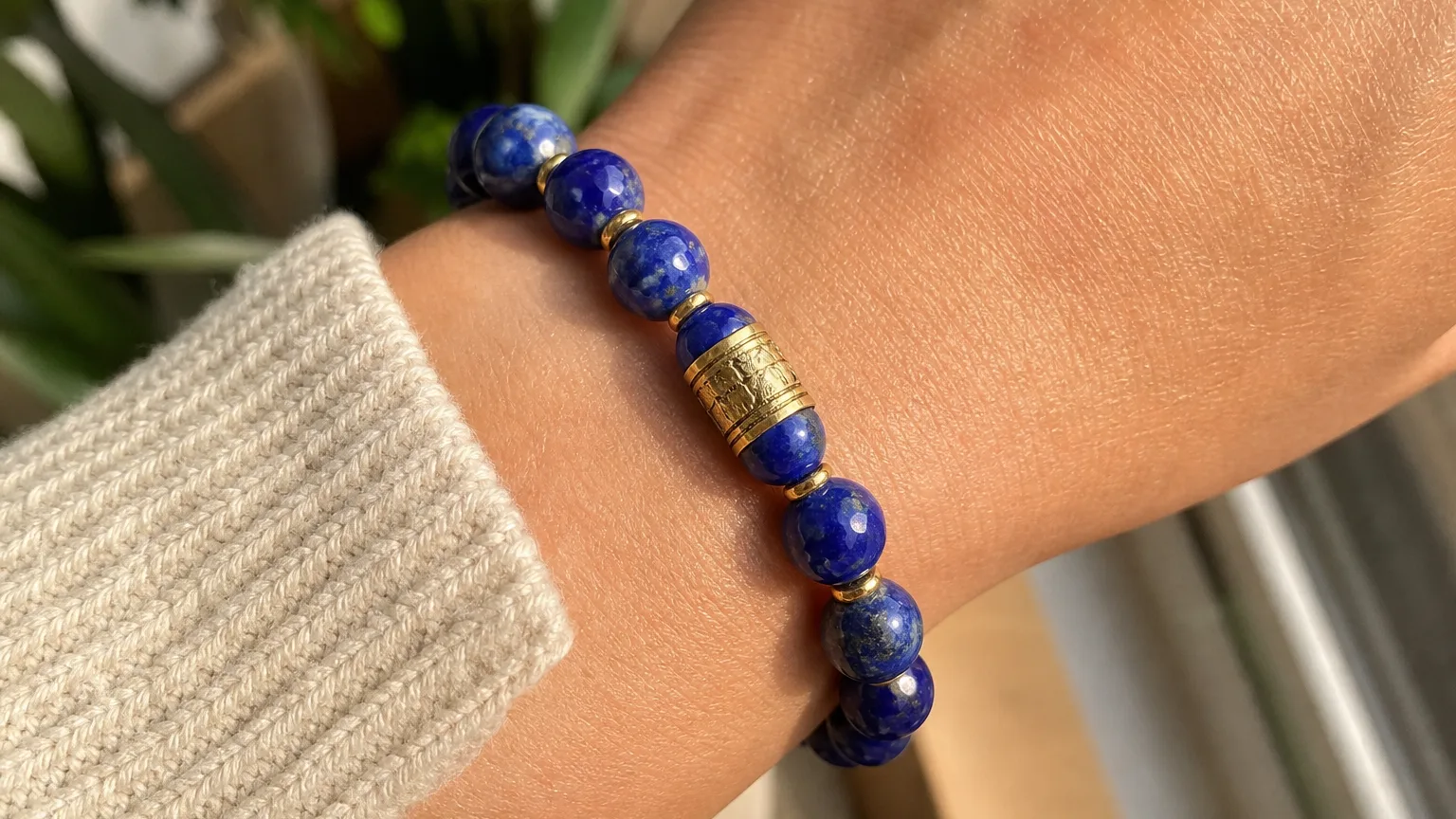
| Form | Best for | Choose it if |
|---|---|---|
| Bracelet | Daily wearing | You want a visible, wearable reminder through the day |
| Tumbled stone | Pocket or meditation | You want something small, smooth, and easy to hold |
| Cabochon pendant | Communication focus | You want a polished stone worn near the throat |
| Sphere | Desk or shelf display | You want a calm, balanced shape as a room anchor |
| Carved figure | Altar or intention space | You like a symbolic shape that adds meaning to a display |
| Inlay / bead jewelry | Statement pieces | You love the gold-flecked blue as a centerpiece look |
How to Tell Real Lapis Lazuli from Fakes
Because quality lapis is valuable, the market is full of imitations — dyed howlite, dyed jasper, glass, and reconstituted (crushed-and-glued) lapis. A few checks help before you buy:
- Pyrite and calcite. Real lapis usually shows some gold pyrite flecks and white calcite veining, unevenly spread. Stones that are perfectly uniform blue, or where the “gold” is too even and flat, may be dyed or glass.
- Color. Natural lapis ranges from denim to deep royal blue, often with slight unevenness. Perfectly vivid, uniform “neon” blue is usually dyed.
- The dye test. Rub a cotton swab dampened with acetone or nail polish remover on a hidden spot. Dyed stones often leave blue on the swab; genuine lapis won’t, since the color is structural, not a coating.
- Hardness. At about Mohs 5–5.5, real lapis is soft enough to be scratched by a steel knife but resists a fingernail. Glass and reconstituted lapis feel and behave differently.
- Price and seller. Large, flawless, deep-blue pieces at low prices are usually dyed or reconstituted. Buy from sellers who name the source (Afghanistan and Chile are the main ones).
A note on grades. “AAA” or “grade A” lapis usually means even, deep blue with attractive pyrite and little white calcite. Lower grades have more calcite (lighter, more veined). Neither is fake — they’re just different looks and price points.
How to Cleanse and Charge Lapis Lazuli
In crystal practice, “cleansing” clears accumulated energy and “charging” refreshes the stone. Lapis needs gentler care than harder stones, since water and harsh methods can damage it. A few safe methods:
- Smoke. Pass it through sage or palo santo smoke and let it drift over every side — the safest cleanse for lapis.
- Moonlight. Leave it out overnight under a full moon — gentle and effective.
- Sound. A singing bowl or bell near the stone. At minimum, it’s a mindful pause.
- Other crystals. Resting it on a selenite plate or clear quartz cluster is popular for an overnight reset.
Things to avoid: water and salt water — lapis contains calcite (sensitive to moisture and acid) and pyrite (which can oxidize when wet), so keep it dry and clean it with a soft, dry cloth. Avoid prolonged direct sunlight, which can fade the blue over time, and chemicals and ultrasonic cleaners. For the full routine, see our guide to cleansing crystals.
Best Crystals to Pair With Lapis Lazuli
Pairing is about layering intentions — picking stones whose qualities complement rather than compete. A few combinations that work well with lapis’s wise, truthful energy:
- Lapis + Sodalite — two blue stones tied to clear thinking and honest communication; a natural pair for mental focus and the throat center.
- Lapis + Améthyste — wisdom meets calm. A balanced pairing for meditation or reflective work where insight matters.
- Lapis + Pyrite — a natural combination, since lapis already contains pyrite; many layer the two for a confident, grounded feel.
The logic of pairing is about complementary intentions, not strict rules. Pick combinations that match what you’re actually working on, and trust your own sense of what feels balanced.
Who Should Use Lapis Lazuli?
Lapis suits people who want a clearer mind and steadier honesty — anyone who has a big decision to make, a hard truth to speak, or simply wants a reminder to think carefully and trust their own judgment. Its royal blue with gold flecks also makes it a favorite for people who love how it looks as jewelry or a desk piece.
A few honest expectations: lapis isn’t a treatment for anxiety, depression, or any condition — if you’re dealing with something persistent, a healthcare professional is the right call, and the stone can be a comfort alongside that. It won’t “do” anything on its own; its value comes from the intention and routine you build around it. If you go in expecting a stone to fix things for you, you’ll be let down. If you go in expecting a steady support for your own practice, it tends to fit well.
FAQ About Lapis Lazuli Meaning
Can lapis lazuli go in water?
No — keep it dry. Lapis contains calcite (sensitive to moisture and acid) and pyrite (which can oxidize when wet), so water and salt water can dull or damage it. Clean it with a soft, dry cloth.
Is lapis lazuli a mineral or a rock?
A rock. It’s made mostly of the mineral lazurite, plus calcite (white), pyrite (gold flecks), and smaller amounts of other minerals — not a single crystal.
What chakra is lapis linked to?
Mostly the third eye and throat centers — the third eye for inner vision and insight, the throat for honest communication.
How can I tell if my lapis is real?
Look for natural gold pyrite flecks and white calcite veining (uneven), and do the acetone swab test — dyed stones leave blue on a cotton swab, genuine lapis won’t.
Where does the best lapis come from?
Afghanistan, especially the ancient mines in the northeast, has produced the finest lapis for thousands of years. Chile is another well-known source.
Does lapis fade in sunlight?
It can, with prolonged direct exposure. The blue is structural, but strong, constant sun can still dull it over time, so keep it out of bright light.
Is lapis lazuli good for beginners?
Yes, with one caveat: it needs gentle, dry care. It’s beautiful, widely available, and meaningful — just avoid water and harsh cleaning.
Final Thoughts on Lapis Lazuli
Lapis lazuli has earned its place as a stone of wisdom and truth — and it earns it again for each person who picks up a piece and gives it a job to do. If you’re curious, the simplest start is one piece, one intention, and a small daily moment to notice it. You don’t need the deepest blue or the rarest grade; you need a stone you’ll actually see and hold. Let the routine do the work, and let the stone be the steady reminder that brings you back.
From there, lapis tends to open a door — to a clearer decision, a more honest conversation, or simply a habit of pausing to think. For more, explore the Crystal Guide or browse lapis lazuli jewelry and crystals.