Labradorite Meaning: Healing Properties & Uses
Labradorite is a feldspar famous for its flashes of blue, gold, and green — an optical effect called labradorescence, caused by light bending through the stone’s layered structure. Long tied to transformation, intuition, and protective energy, it’s a stone people reach for during change. This guide covers what labradorite is (and how that shimmer works), what it has meant, and how people work with it. Crystal meanings reflect tradition and personal practice, not medical advice.
What Is Labradorite Meaning?
At its simplest, labradorite means transformation and protective intuition — the feeling of moving through change with a steadier, more inward light. Where some stones read as purely calming or grounding, labradorite sits between: protective on the outside and intuitive on the inside, like a stone that holds light you only see at the right angle.
For many people that’s exactly the appeal — a dark piece that flashes color when it catches the light, kept on a desk or worn as a cue to stay steady through change. You don’t need to believe anything about energy to use it that way; the value often comes from choosing the piece, giving it a job (“steady me through this”), and letting its shifting shimmer pull you toward patience and intuition. In that sense labradorite is a cue to grounded transformation.
Labradorite Meaning and Symbolism
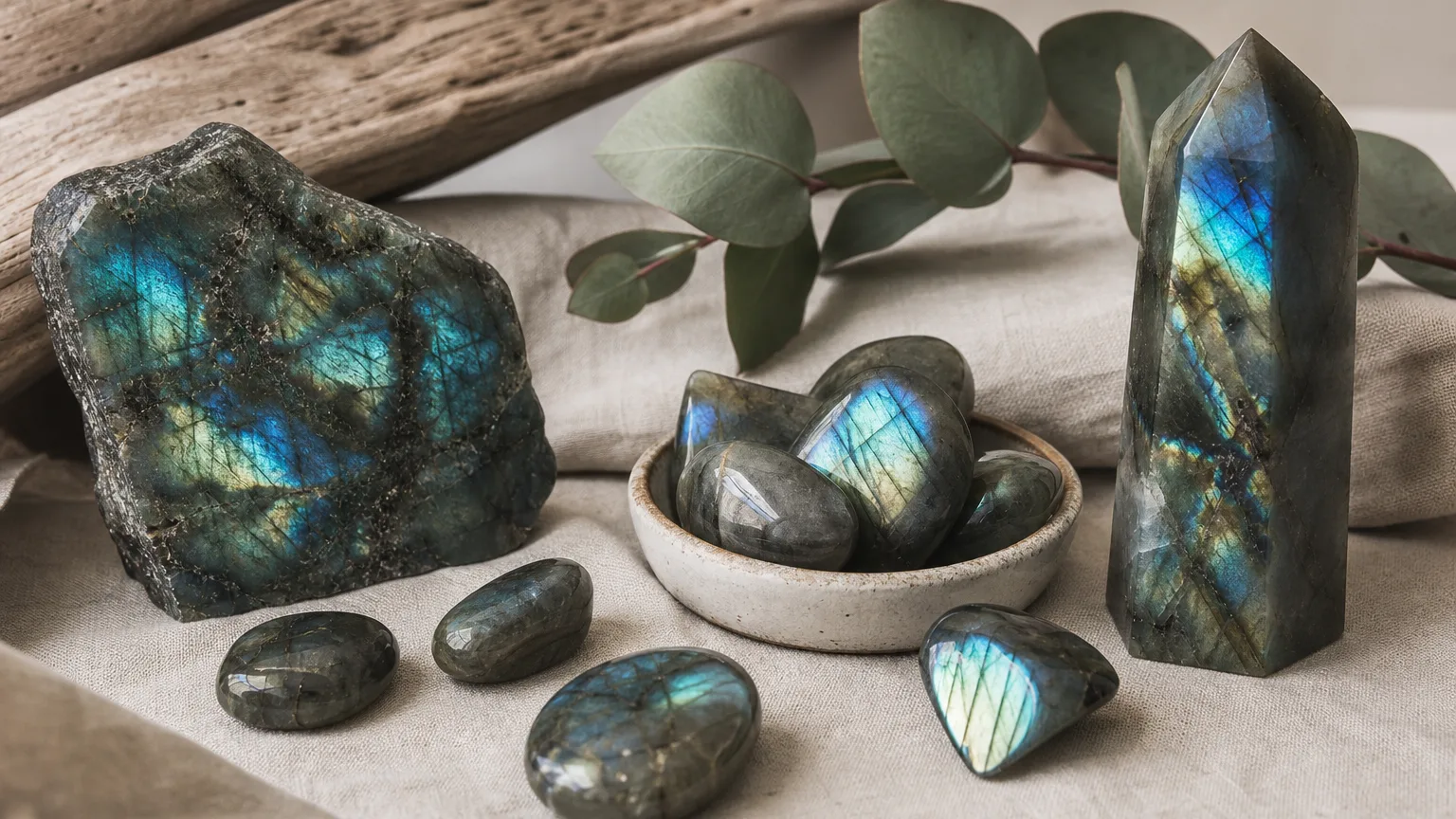
Labradorite is named after the Labrador Peninsula in Canada, where it was first identified — and its signature feature is labradorescence: bright flashes of blue, gold, green, or orange that appear and shift as you turn the stone. The effect is optical, not pigment — light bends and interferes through microscopic layered structures inside the feldspar, so the color only shows at certain angles. It’s a dark stone that hides light until you move it.
A well-known folk legend says the Northern Lights were once trapped inside labradorite along the coast of Labrador, and that a traveler set some of that light free to the sky — leaving the shimmer behind in the stone. Whether you read that as myth or metaphor, it captures the feeling people attach to labradorite: hidden light, transformation, and protection on a journey. In modern crystal practice it’s reached for during change, new beginnings, or any time someone wants a steadier sense of intuition and inner strength.
The thread through all of it is the same: transformation, intuition, and protective steadiness. Today labradorite is usually described as a stone of change — reached for during transitions, creative work, or to feel more inwardly guided and protected. How much of that lands for you personally is, honestly, up to you — but the stone has held that reputation across a lot of modern practice. To explore more stones, browse the full Crystal Guide.
Labradorite Properties
The Science
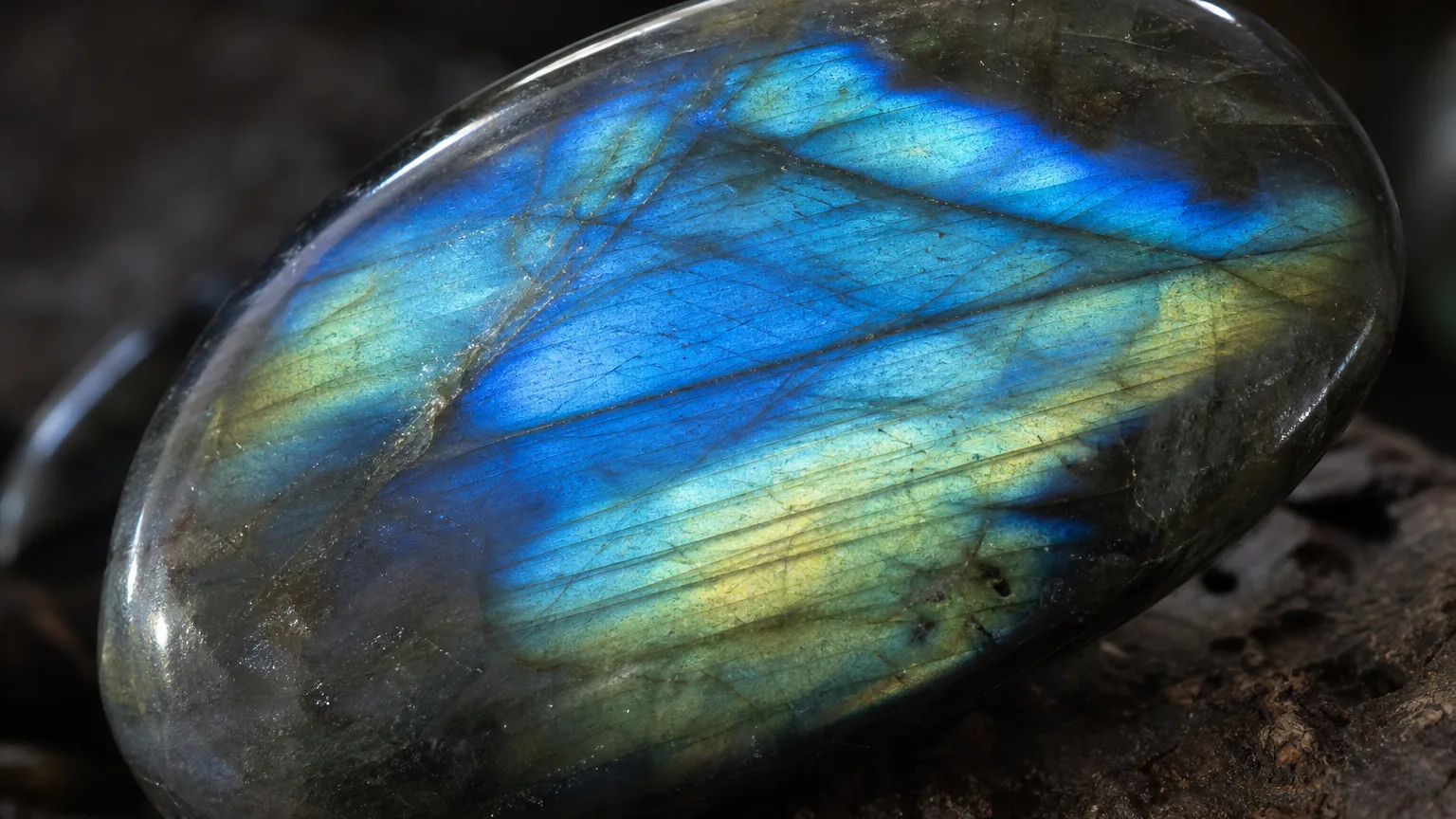
Labradorite is a plagioclase feldspar — a calcium-sodium aluminum silicate, (Ca,Na)(Si,Al)₄O₈ — with a Mohs hardness of about 6 to 6.5. Its famous shimmer, labradorescence, is an optical effect, not a pigment: light bends and interferes through microscopic exsolution layers (thin alternating plates of different feldspar composition) inside the stone, producing flashes of blue, gold, green, or orange that shift with the angle. The finest material, with the widest range of color, is sometimes called spectrolite (most famously from Finland). Major sources include Canada (Labrador), Madagascar, Finland, and Ukraine.
Traditional Meaning
Tradition ties labradorite to transformation, intuition, and protective steadiness. It’s linked to the throat and third eye centers and is often described as a stone that shields during change — supporting intuition, inner knowing, and the courage to move through something new. A folk legend connects it to the Northern Lights, reinforcing its tie to hidden light and transformation. Across modern crystal practice it’s reached for during transitions, new beginnings, or any time someone wants to feel more inwardly guided. These associations come from spiritual tradition and personal practice rather than clinical study.
Mindfulness & Psychology
From a psychological angle, labradorite works as a shifting, captivating visual cue — the kind of object you turn in the light when you want a moment of wonder and a pause. Its dark body with sudden flashes of color reads as hidden depth, and the act of keeping a piece nearby and pairing it with an intention (“trust the change”) turns it into a small cue to stay patient with a process. Part of its appeal is simply that it rewards attention — the shimmer only shows when you engage with it. These effects come from tradition and personal practice, not clinical research. Crystals complement — but never replace — professional care.
Labradorite Benefits
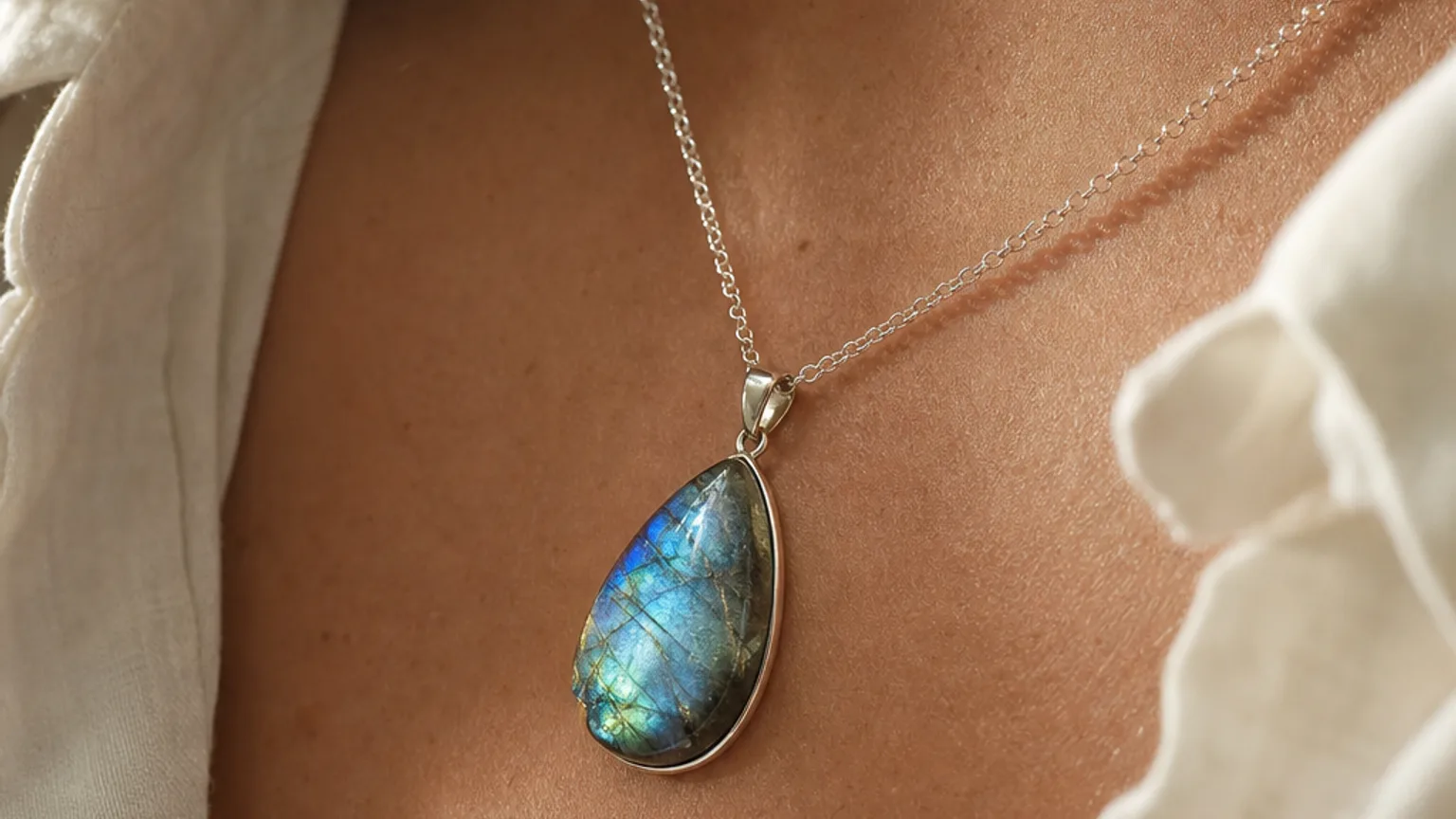
People who work with labradorite usually describe it in terms of steadiness through change and a nudge toward intuition, not dramatic shifts. It tends to show up as a calmer, more inward feeling — useful during transitions or when you’re second-guessing yourself. A few of the benefits people mention most:
Steadiness through change
Keeping labradorite nearby during a transition gives you a quiet, protective cue to move through it patiently rather than rush or resist.
A nudge toward intuition
Its hidden-flash quality is a reminder to look inward — a cue to trust your own sense of things when the path isn’t obvious.
A sense of protection
Many carry or wear it as a shield during demanding stretches — a steady, protective presence rather than a dramatic barrier.
A moment of wonder
Turning the stone to catch its flash is a small, deliberate pause — a brief hit of wonder that breaks a flat or stressed mood.
The pattern underneath all of these is the same: labradorite isn’t transforming anything for you by magic, but it gives your day a cue toward patience, intuition, and steady change. If you’re exploring stones for specific needs, see our guide to crystals for stress.
Labradorite Chakra, Zodiac, and Element Associations
In traditional systems, labradorite is most strongly linked to the throat et third eye centers — the areas tied to expression, intuition, and inner knowing. Astrologically, it’s often paired with Leo et Sagittarius. Its element is usually given as Water, sometimes Air. For related stones, see throat chakra crystals.
These are correspondences built up through tradition, not fixed rules. If your own sense of labradorite points somewhere else — a different chakra, a different element — that’s completely fine. Many people work with stones intuitively, following what feels right rather than a textbook chart, and there’s a long history of practitioners doing exactly that.
How to Use Labradorite
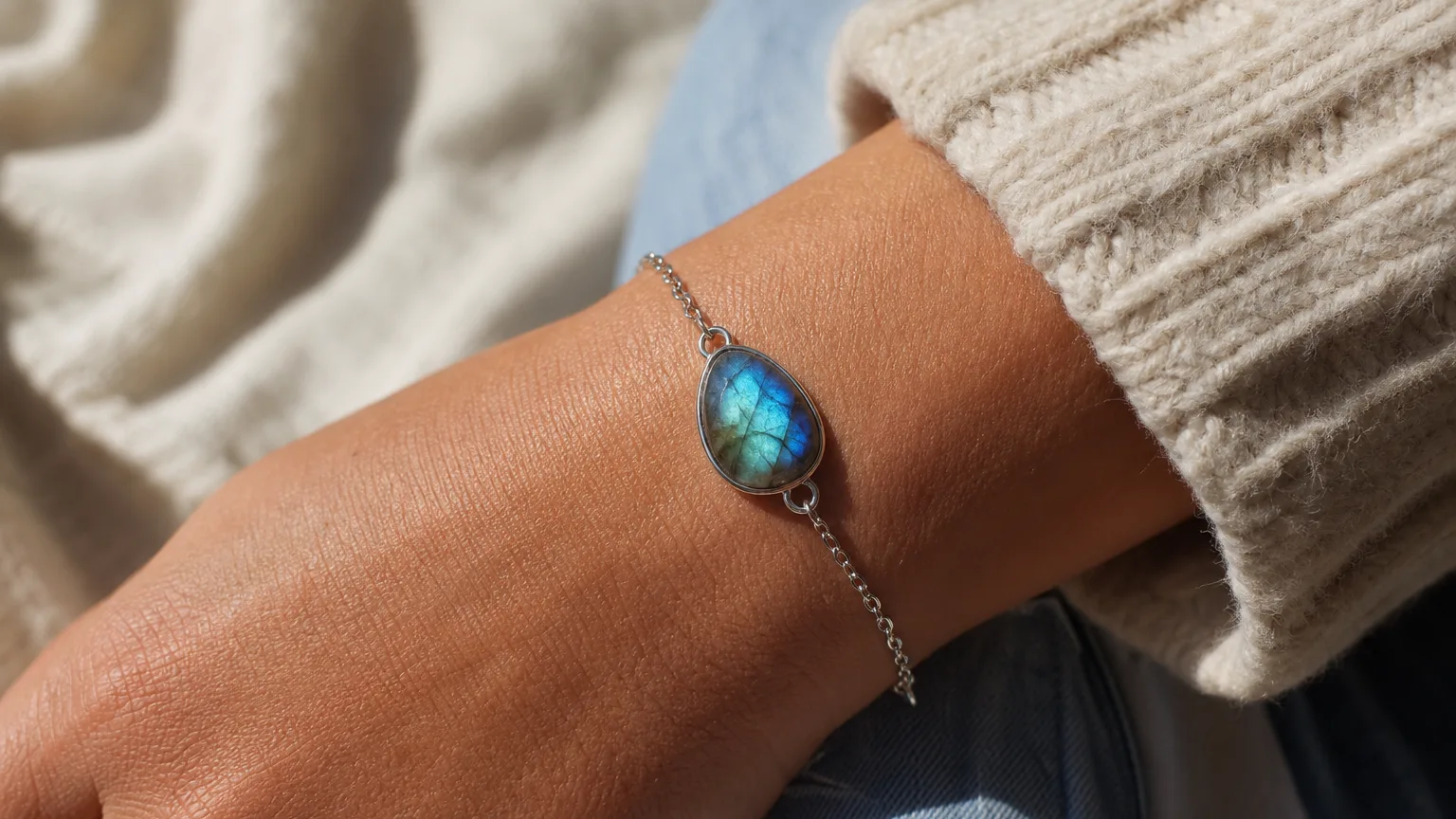
Labradorite is durable (Mohs 6–6.5) and easy to wear and live with — there’s no single right way, only what fits your routine. The key is consistency: a piece you actually see and turn in the light does far more than one stored away.
Wear it. A labradorite pendant, ring, or bracelet keeps the stone against your skin and in your sight — and gives you something to turn when you want its flash. Pair it with one intention each morning — “steady me through this change.”
Keep it on a desk. A polished piece where you work acts as both décor and a cue — turn it when you need a pause or a nudge toward intuition.
Meditate with it. Hold a tumbled piece in your palm or rest it between your brows (third eye area) while you sit. Even a few minutes of focused attention counts; the goal is presence, not duration.
Carry a tumbled piece. A smooth stone in a pocket is a discreet touchstone — something to turn and hold when you want steadiness on the move.
Which Labradorite Form Is Right for You?
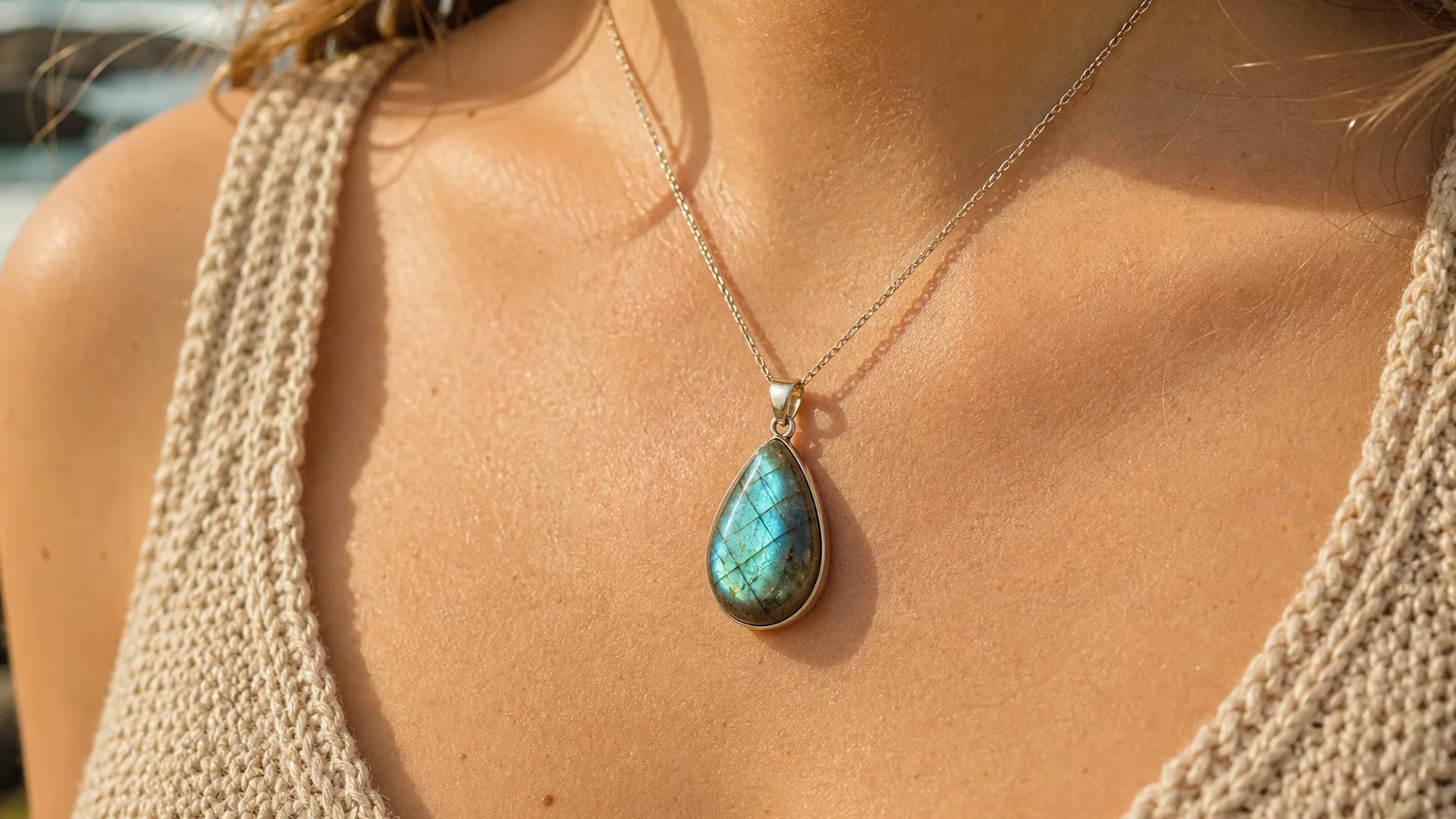
| Form | Best for | Choose it if |
|---|---|---|
| Cabochon pendant | Daily wearing | You want a flash-catching piece worn near the throat or chest |
| Tumbled stone | Pocket or meditation | You want something smooth to turn and hold |
| Polished slab / palm stone | Desk anchor, hand-holding | You want a larger piece to display and grip during change |
| Ring | Close-to-hand | You want a flash piece you can turn easily under the light |
| Sphere | Display only | You want a rounded, polished piece for a desk or altar |
| Raw piece | Display only | You like the natural, rough look and larger flashes on a flat face |
How to Tell Real Labradorite from Fakes
Labradorite is popular, so imitations show up — usually resin or glass with a metallic coating, or plain grey feldspar sold without the flash. A few checks help:
- The flash test. Genuine labradorescence moves and shifts as you turn the stone — it’s structural, sitting beneath the surface, not a painted-on coating. A flat, uniform metallic sheen that doesn’t move is likely a coating or resin.
- Angle and dark body. Real labradorite is dark (grey to near-black) at most angles, with the flash appearing only at certain tilts. If a stone is bright from every angle, it’s probably glass or a coated imitation.
- Hardness. At Mohs 6–6.5, real labradorite resists a fingernail and scratches glass. A soft or very light piece is likely resin or a different material.
- No flash at all. Some genuine labradorite has little or no labradorescence — it’s still real feldspar, just lower grade. But a seller should price it accordingly and not pass off plain grey stone as “high flash.”
- Spectrolite. Material with a very wide range of full-spectrum color (often from Finland) is sometimes sold as spectrolite, a premium variety of labradorite. Both are genuine; spectrolite is simply the top color grade.
How to Cleanse and Charge Labradorite
Labradorite is a hard feldspar (Mohs 6–6.5) and fairly easy to care for — its labradorescence is structural and stable.
- Water. A brief rinse under cool water is fine. Avoid long soaks in salt water if the piece has metal settings.
- Sunlight. Labradorite is sun-stable — its flash won’t fade in light. Brief sun cleansing is safe.
- Smoke or sound. Passing it through sage or palo santo smoke, or using a singing bowl nearby, is a no-contact option many prefer.
- Moonlight. A night under the moon — especially a full moon — is a popular gentle method that fits labradorite’s mystical, inward character.
Two things to keep in mind: store labradorite away from harder stones (like quartz or topaz) so it doesn’t pick up scratches, and avoid harsh chemical cleaners, which can dull the polish. For the full routine, see our guide to cleansing crystals.
Best Crystals to Pair With Labradorite
Pairing is about layering intentions — picking stones whose qualities complement rather than compete. A few combinations that work well with labradorite’s change-oriented, intuitive energy:
- Labradorite + Moonstone — two feldspars of intuition and change; a gentle pairing many reach for during transitions.
- Labradorite + Tourmaline noire — transformation meets grounding and protection; a steady combo for moving through change.
- Labradorite + Améthyste — intuition meets calm; a pairing for inward focus and a clearer head.
- Labradorite + Quartz transparent — clear quartz is said to amplify; many use it to lift labradorite’s intentions for change.
The logic of pairing is about complementary intentions, not strict rules. Pick combinations that match what you’re actually working on, and trust your own sense of what feels balanced.
Who Should Use Labradorite?
Labradorite suits people who want a protective, intuitive stone for transformation and change — anyone going through a transition, doing creative or intuitive work, or drawn to its hidden-flash beauty. It’s approachable because it’s durable, wearable, and asks little: keep it nearby, turn it in the light, and let it mark a steadier, more inward corner of your day.
A few honest expectations: labradorite isn’t a treatment for anxiety, depression, or any condition — if you’re dealing with something persistent, a healthcare professional is the right call, and the stone can be a comfort alongside that. Its value comes from the intention and routine you build around it. If you go in expecting a stone to transform your life for you, you’ll be disappointed; if you go in expecting a protective, intuitive cue you can return to, it tends to fit well.
FAQ About Labradorite Meaning
What is labradorite good for?
Traditionally, transformation, intuition, and protective steadiness. People reach for it during change, new beginnings, or any time they want a steadier sense of inner guidance.
What is labradorescence?
The shimmer that gives labradorite its fame — flashes of blue, gold, green, or orange that shift as you turn the stone. It’s an optical effect from light bending through microscopic layers inside the feldspar, not a pigment.
Why is labradorite linked to the Northern Lights?
A folk legend says the Northern Lights were once trapped inside the stone. It’s a story, not a fact — but it captures the feeling people attach to labradorite: hidden light, transformation, and protection.
What’s the difference between labradorite and spectrolite?
Spectrolite is a premium variety of labradorite — usually from Finland — with a wider, fuller range of color in its flash. Both are genuine labradorite; spectrolite is simply the top color grade.
What chakra is labradorite linked to?
Mostly the throat and third eye centers (expression, intuition, inner knowing).
Can labradorite go in water?
Yes. At Mohs 6–6.5 it’s a hard, water-safe stone. A brief rinse is fine; avoid long salt-water soaks with metal settings.
How can I tell real labradorite?
Turn the stone: real labradorescence moves and sits beneath the surface, on a dark body. A flat metallic sheen that doesn’t shift, or a stone that’s bright from every angle, suggests glass, resin, or a coating.
Final Thoughts on Labradorite
Labradorite earns its long reputation as a stone of transformation and intuition — the dark piece that hides light, then flashes it when you engage. If you’re curious, the simplest start is one piece you’ll actually wear or turn, paired with a small daily moment to notice it. Let the routine do the work, and let the stone be the steady, protective anchor that reminds you to trust the change you’re moving through.
From there, labradorite tends to open a steadier space — a calmer transition, a quieter intuition, or simply a habit of pausing to look inward. For more, explore the Crystal Guide or browse labradorite pieces.