
Best Yellow Crystals: Names, Meanings, Properties & Uses
Quick Answer: Best Crystals for Yellow
The best crystals for Yellow include Citrine, Pyrite, amber, traditionally used in mindfulness and spiritual practices. Crystal properties are complementary wellness tools, not medical treatments.
Understanding Yellow Crystals
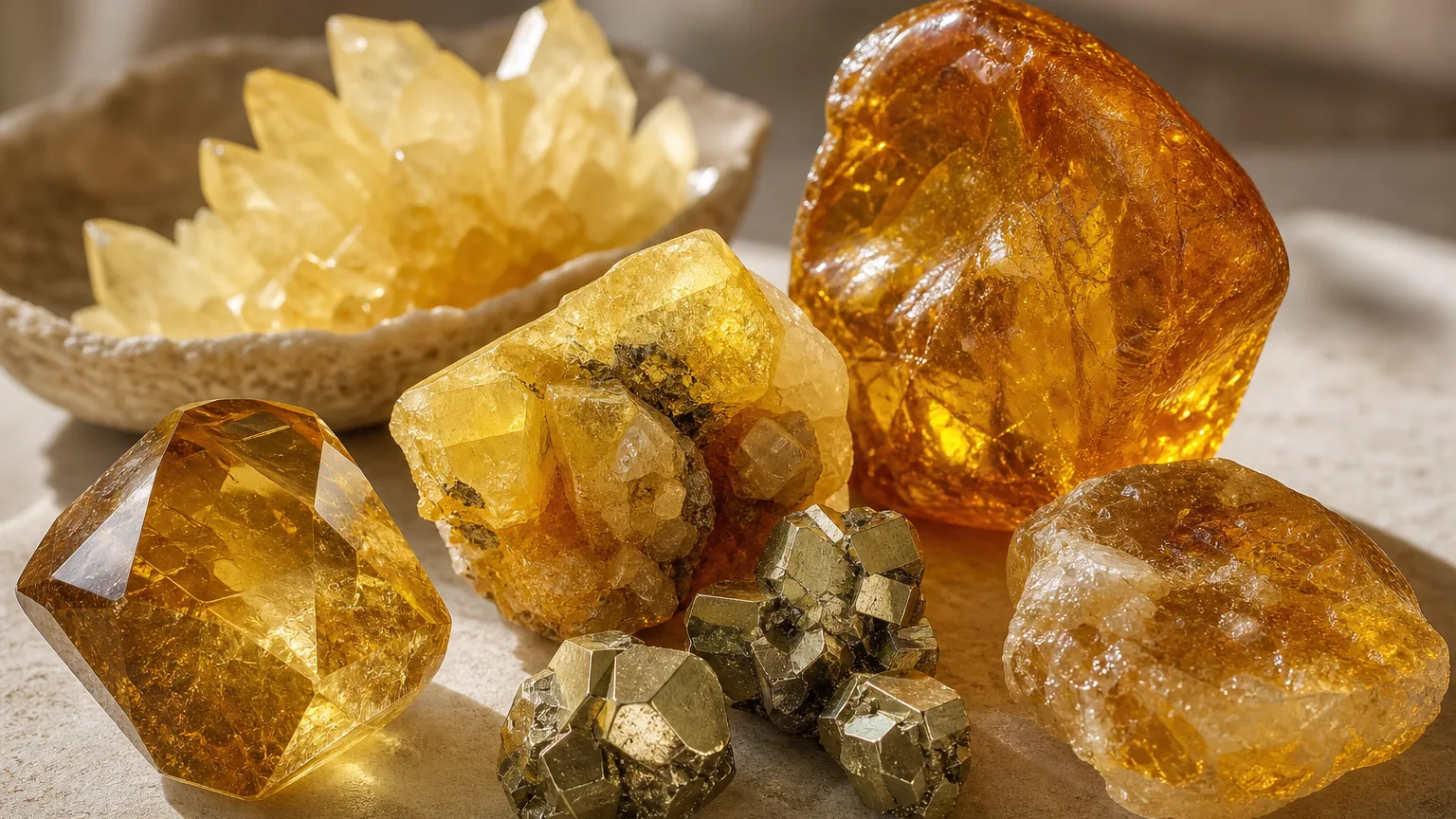
Yellow is the color we instinctively read as sunlight, warmth, and ripeness, so it carries a charge that feels immediate and life-giving. Mineralogically, the hue comes from a surprisingly small set of causes: iron in its ferric (Fe³⁺) state, trapped natural radiation, fossilized tree resin, or inclusions of sulfur and iron oxide. Each route produces a slightly different yellow, from the clear gold of citrine to the resinous honey of amber and the brassy gleam of pyrite.
Culturally, yellow has been tied to gold, grain, and the sun across nearly every tradition that left records. Ancient Egyptians linked it to Ra and the sun disc; Chinese imperial architecture reserved yellow roof tiles for the emperor; medieval alchemists worked with yellow sulfur as one of the three primes. In crystal practice, that lineage shows up as a steady association with the Solar Plexus chakra, the seat of personal will and self-trust.
Modern color psychology reads yellow similarly. It is the most visible wavelength in daylight, which is why it signals caution and attention on signs, and why a soft yellow room tends to feel cheerful and mentally alert. Working with yellow crystals draws on that same signal: a gentle wake-up for attention, motivation, and the feeling that effort is worthwhile.
Quick facts: Symbolism: Joy, optimism, confidence. Psychology: Mental stimulation, energy, cheer. Associated chakra: Solar Plexus, element: Air/Fire.
Not sure which color is right for you? Try the Crystal Quiz ↗
How to Identify Yellow Crystals
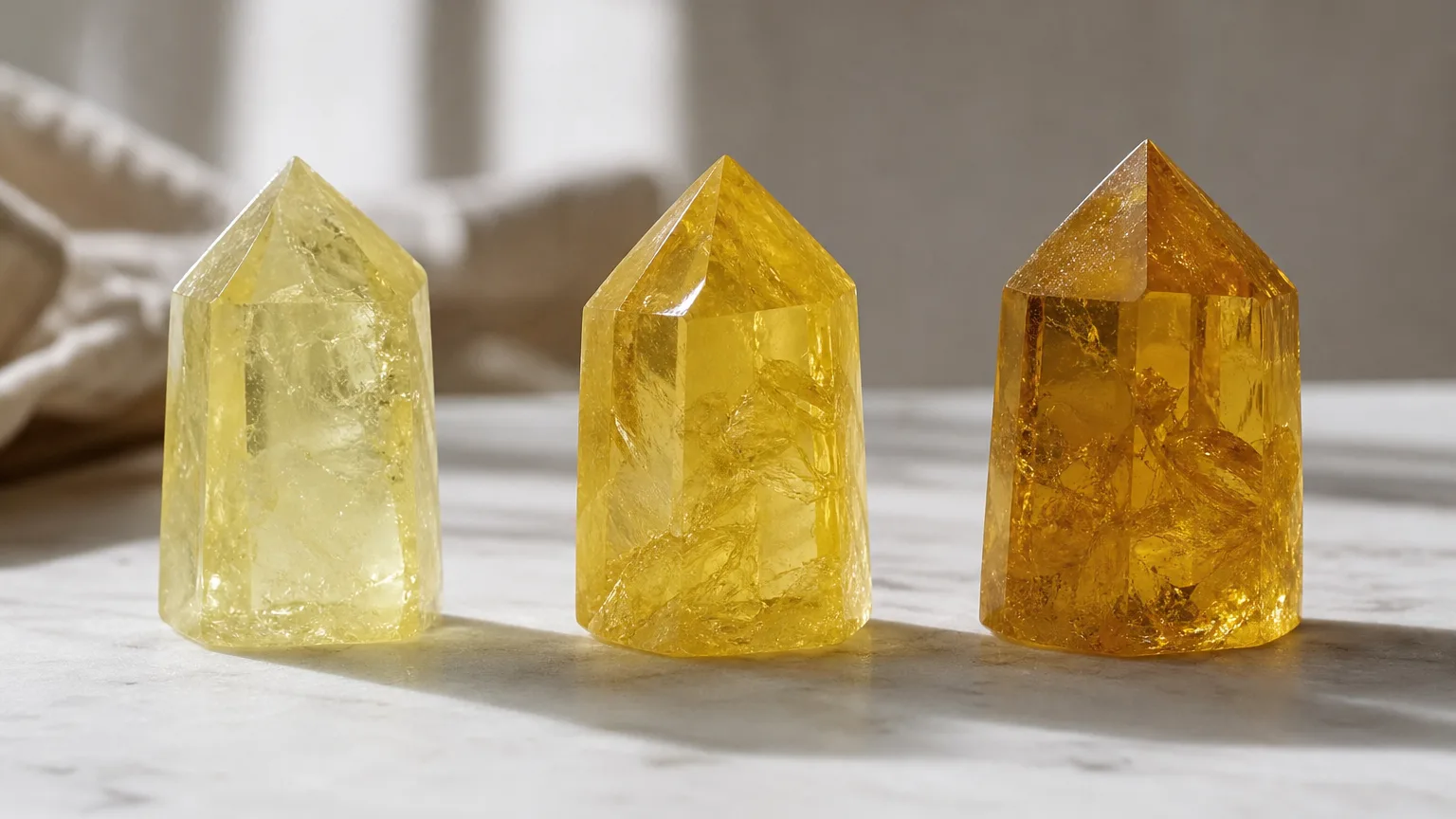
Yellow crystals span a wide tonal range, so identification starts with hue and texture rather than color alone. Light, translucent yellows (pale citrine, honey copal) read as watery and bright, while deep golden to brownish-yellows (heated citrine, dark amber) look warmer and more opaque. Metallic yellows belong almost entirely to pyrite and marcasite, with a mirror-like brass gleam no other stone on this list shares.
Surface texture is the next clue. Yellow quartz has a glassy luster; amber and copal are resinous, warm to the touch, and may soften under heat; bumblebee jasper shows matte, banded layers of yellow, orange, and black that no transparent stone reproduces; chondrodite and chrysoberyl are hard, bright, and slightly greasy to vitreous. Specimens that look layered or striped are almost never single-mineral yellow quartz.
Two stones are routinely confused. Citrine vs. heat-treated amethyst (smoky or “baked” citrine): natural citrine is a pale to smoky yellow with subtle smoky zoning, while most commercial “citrine” is amethyst baked to a deep, even orange-brown with a reddish tint. Amber vs. copal: true amber is millions of years old and harder, while copal is younger, stickier, and can develop a crackle surface over time. A drop of alcohol (test on a hidden spot) softens copal but not mature amber.
Light also shifts these stones. Amber, copal, and fire opal can look deeper indoors and brighter in sunlight; pyrite stays constant and reflective; bumblebee jasper changes little with lighting. If a “yellow” stone shifts dramatically green or blue under different bulbs, it is more likely a colored opal or treated material than a straightforward yellow crystal.
9 Best Crystals for Yellow
Citrine
Color: Yellow, golden-orange, brownish-yellow
Meaning: Joy, optimism, confidence
Idéal pour : Wealth, Confidence, Morning energy
Chakra: Solar Plexus, Sacral
Element: Fire
Best way to use: Wear as jewelry
Affirmation: I trust my own drive and act on it.
Citrine is the yellow variety of quartz (SiO₂), and its color is the result of trace iron interacting with natural radiation in the earth, not the deep, even orange of the more common heat-treated amethyst sold under the same name. True natural citrine reads as a pale, smoky gold, like weak morning sunlight held in glass, which is exactly why it has long been tied to the Solar Plexus and to a steady, self-directed kind of confidence. In practice it is used as a focal stone for will and follow-through, often kept on a desk or worn when a decision needs to be carried through. On the level of mood, its warm hue acts as a gentle visual prompt toward optimism and effort, a small daily cue that doing the next thing is worthwhile.
Pyrite
Color: Brass-yellow, metallic
Meaning: Joy, optimism, confidence
Idéal pour : Motivation, Wealth mindset, Focus
Chakra: Solar Plexus
Element: Fire
Best way to use: Carry or hold in meditation
Affirmation: I move forward with steady, focused will.
Pyrite is iron disulfide (FeS₂), and its yellow is unlike any other on this list: a hard, metallic brass that catches light like a coin. That bright, reflective surface is the source of its “fool’s gold” nickname, and it is also why the stone reads as alert and assertive rather than soft and warm. Mineralogically it forms in sharp cubes and nodules, and in crystal practice it sits at the Solar Plexus as a stone of focus, motivation, and a grounded wealth mindset, less about wishing and more about doing the work. Many people place a piece where they can see it while they work, touching it during a thinking pause the way you might turn a pen. As a mood cue, the brassy gleam works like a small shot of daylight on the desk, useful when attention is flagging.
amber
Color: Yellow, Orange, Brown, Honey
Meaning: Joy, optimism, confidence
Idéal pour : Warmth, Protection, Comfort
Chakra: Sacral, Solar Plexus
Element: Fire
Best way to use: Wear as jewelry
Affirmation: I carry warmth and steadiness through my day.
Amber is not a mineral at all but fossilized tree resin, often tens of millions of years old, and its yellow comes from the way trapped air and organic compounds scatter light inside it. That gives amber a resinous, honey-gold glow that feels warm to the skin and looks deeper in low light, brighter in sunlight, a quality no true stone reproduces. It is light enough to float in salt water and soft enough to be marked by heat, which is why it has been worn close to the body for warmth and comfort across centuries. In practice it is used as a gentle, protective companion for the Sacral and Solar Plexus centers, often chosen when someone wants a softer yellow than quartz or pyrite. Psychologically its warmth reads as reassurance, a tactile, sun-colored object to hold during stress or worry.
bumblebee-jasper
Color: Yellow, orange, black banded
Meaning: Joy, optimism, confidence
Idéal pour : Display, Energy, Creative drive
Chakra: Sacral, Solar Plexus
Element: Fire
Best way to use: Wear, carry, or place in your space
Affirmation: I bring bold, bright energy to what I make.
Bumblebee jasper is technically not a true jasper but a banded volcanic rock from Indonesia, and its vivid yellow comes from real sulfur deposited alongside orange realgar and black manganese oxides. That makes it one of the most striking yellows on this list, a matte, striped surface of yellow, orange, and black that looks almost painted on. Because it can contain sulfur and arsenic-bearing minerals, it should be handled with simple care: wash your hands after touching rough pieces, keep dust out of your lungs, and display polished specimens rather than grinding them. In practice it is used as a Sacral and Solar Plexus stone for creative drive and outward energy, the kind of bold push that gets a stalled project moving again. Visually it works as a cheerful focal object in a studio or workspace.
Read full bumblebee-jasper meaning →
chondrodite
Color: Yellow, orange, reddish-brown
Meaning: Joy, optimism, confidence
Idéal pour : Mineral collections, Teaching, Study
Chakra: — (no established tradition)
Element: Fire
Best way to use: Wear, carry, or place in your space
Affirmation: I stay attentive and finish what I start.
Chondrodite is a less common nesosilicate mineral, part of the humite group, and its yellow to orange-brown color comes from iron and titanium in its crystal structure. It is harder and brighter than it looks, with a slightly greasy to vitreous luster, and good crystals are prized by collectors more than by mainstream crystal buyers, which is exactly its appeal here. It has no established chakra tradition, so it is best understood as a quiet, focused yellow stone rather than a symbolic one, well suited to a study desk, a teaching collection, or anywhere you want a low-distraction object that rewards close looking. As a mood cue its warm, mineral yellow reads as steady attention, the kind of calm focus that long tasks ask for, without the high shine of pyrite or the softness of amber.
Read full chondrodite meaning →
chrysoberyl
Color: Yellow, green, yellow-green
Meaning: Joy, optimism, confidence
Idéal pour : Focus, Discipline, Willpower
Chakra: Solar Plexus, Crown
Element: Fire, Air
Best way to use: Wear as jewelry
Affirmation: I choose clearly and stand by my choice.
Chrysoberyl is one of the hardest natural gemstones, an aluminate of beryllium, and its clean yellow to yellow-green color comes from iron replacing some of the aluminum in the lattice. Unlike softer yellow stones, it takes a bright, glassy polish and holds up to daily wear, which is why it has long been cut for fine jewelry. Some chrysoberyl forms the cat’s-eye effect, and a rare variety (alexandrite) even shifts color between daylight and lamplight. In crystal practice it is associated with the Solar Plexus and Crown as a stone of discipline and clear willpower, a yellow that reads as decision rather than cheer. Many people wear it on days that ask for firm choices, hard conversations, or sustained focus. Its bright, slightly cool yellow acts as a steady visual anchor for staying on track.
Read full chrysoberyl meaning →
copal
Color: Yellow, gold, orange, brown, white
Meaning: Joy, optimism, confidence
Idéal pour : Fresh starts, Brighter mood, Sacred space
Chakra: Solar Plexus, Crown
Element: Fire
Best way to use: Wear as jewelry
Affirmation: I clear the air and begin again.
Copal is young, semi-fossilized tree resin, the same material amber becomes over millions more years, so it shares the same resinous golden glow but is softer, lighter, and easier to mark. Its yellow ranges from pale cream to a rich gold, and unlike mature amber it can soften and release scent when warmed, which is why it has been burned as incense in ceremonies from the Americas to East Africa for fresh starts and sacred space. In crystal practice it is linked to the Solar Plexus and Crown as a stone of clearing and brighter mood, used when a space or a frame of mind feels stale. The scent is the real distinguisher: a piece of copal warmed in the hand carries a faint, piney sweetness that no mineral yellow stone has, which makes it a sensory tool as much as a visual one.
fire-opal
Color: Yellow, orange, cherry-red
Meaning: Joy, optimism, confidence
Idéal pour : Creative drive, Expression, Energy
Chakra: Sacral, Solar Plexus
Element: Fire
Best way to use: Wear as jewelry
Affirmation: I let my warmth and ideas show.
Fire opal is a hydrated silica (SiO₂·nH₂O) with a high water content, and its base color is a translucent yellow to cherry-red that comes from microscopic silica spheres and trace iron, quite different from the play-of-color seen in precious opal. Mexican fire opal is the best-known source, and its warm, glowing yellow looks almost lit from within, brighter and more juicy than the dry gold of citrine. Because of its water content, it can crack if it dries out, so it is best kept away from strong heat and long sun exposure. In crystal practice it sits at the Sacral and Solar Plexus centers as a stone of expression, creative energy, and a willingness to be seen. Psychologically its vivid, almost edible yellow reads as play and outward warmth, a good companion for social or creative days.
mimetite
Color: Yellow, orange, red-brown
Meaning: Joy, optimism, confidence
Idéal pour : Vitality, Will, Focus
Chakra: Solar Plexus
Element: Fire
Best way to use: Place in your space
Affirmation: I hold my direction with steady vitality.
Mimetite is a lead chloro-arsenate mineral that forms in bright yellow to orange and red-brown crystals, often as thin needles or botryoidal coatings on other minerals. Its color is strong and warm, closer to a clear gold than the muted tones of many lead minerals, and it frequently appears alongside pyromorphite and vanadinite, which it closely resembles, so identification often needs a closer look. Because it contains lead, it should be displayed rather than handled constantly, and rough pieces are best kept out of reach of children and pets. In crystal practice it is associated with the Solar Plexus as a stone of vitality, will, and focused effort, a yellow that reads as steady drive rather than sudden spark. Visually it works as a single bright specimen in a space where you want a reminder to keep moving on what matters.
How to Choose Yellow Crystals by Intention
| Intention | Best Crystals | Why |
|---|---|---|
| Confidence & personal power | Citrine, Pyrite, Chrysoberyl | Solar Plexus stones traditionally tied to will, self-trust, and follow-through. |
| Wealth & motivation mindset | Citrine, Pyrite, Mimetite | The gold-yellow tones and “merchant’s stone” reputation many people link to abundance. |
| Warmth, comfort & protection | Amber, Copal | Resinous, sun-warm stones often used as gentle, comforting companions. |
| Creative drive & expression | Bumblebee Jasper, Fire Opal | Orange-yellow stones linked to the Sacral center and outward creative energy. |
| Focus, discipline & study | Chrysoberyl, Chondrodite | Hard, bright, low-distraction stones that suit a desk or study space. |
| Fresh starts & sacred space | Copal, Fire Opal | Stones often cleared by scent, smoke, or fresh intention for a new phase. |
How to Use Yellow Crystals
Yellow stones work best when you give them a clear job and a place in your day. Four uses fit the sunny, forward-moving quality of yellow especially well.
Morning routine. Yellow is a wake-up color, so it pairs naturally with the first hour. Set citrine or amber on a windowsill overnight so early light reaches it, then hold it for a minute while you set one clear intention for the day. A short ritual at sunrise helps the brain shift from rest into action more cleanly than reaching for your phone.
Desk and workspace. Pyrite, chrysoberyl, and chondrodite are dense, focused stones that suit a work surface. Place one within your sight line, not just your drawer. The visible yellow acts as a small visual cue for attention and follow-through, and many people use it as a tactile object to touch during a thinking pause instead of opening another tab.
Confidence ritual. Before something that asks for nerve, a meeting, a hard conversation, a presentation, hold a solar plexus stone (citrine, pyrite, or amber) and speak one short line aloud: what you want to do and why it matters. Pairing a physical object with a spoken intent turns a vague wish into a concrete commitment and lowers the mental load of overthinking.
Solar plexus meditation. In a short seated practice, lie or sit back and place a yellow stone flat on the upper abdomen, just below the sternum, the body area traditionally mapped to the Solar Plexus. Breathe slowly for three to five minutes and let your attention rest there. If the stone feels too cool, warm it in your hands first; amber and copal hold warmth well.
For other uses, keep it simple: carry a small piece in a pocket, place a cluster where natural light reaches it, or set a stone beside a journal. Cleanse yellow stones gently, especially amber and copal, which can be damaged by heat or strong chemicals. A few minutes of soft morning sunlight or a wipe with a damp cloth is enough for most.
Yellow Crystals for Confidence and Personal Power
Confidence, in practical terms, is the feeling that you can act before you feel ready. Yellow crystals lean into that gap because they sit at the Solar Plexus, the body region long associated with will, self-trust, and the willingness to be seen. The color itself carries the same signal, alert, warm, outward, which is why it is used to mark attention and action in everything from traffic signs to sports uniforms.
Two rituals make this practical. Morning desk ritual: place citrine or pyrite on your workspace before you start, name one task you have been avoiding, and commit to a ten-minute start on it while the stone is in view. The object becomes a small anchor that pulls attention back when it drifts. Bedside reflection: at the end of the day, hold amber or chrysoberyl for two minutes and name one thing you did that took courage, however small. Pairing the warm yellow tone with a concrete recall of your own follow-through slowly rebuilds the inner evidence that you act when it matters.
None of this is magic. It is a visible cue plus a repeated act, and the yellow stone is simply a tactile, encouraging object that keeps the cue in front of you. Over time, the habit of naming a brave action and then doing the next one is what builds a steadier sense of personal power.
Yellow Crystals at a Glance
| Crystal | Best for | Chakra | Best way to use |
|---|---|---|---|
| Citrine | Morning energy, wealth mindset, optimism | Solar Plexus, Sacral | Wear as jewelry; set on a sunlit windowsill |
| Pyrite | Focus, motivation, confidence at work | Solar Plexus | Place on the desk; hold during a thinking pause |
| Amber | Warmth, comfort, gentle protection | Sacral, Solar Plexus | Wear against the skin; warm before meditation |
| Bumblebee Jasper | Creative drive, bold energy | Sacral, Solar Plexus | Display in the studio; carry for a push |
| Chondrodite | Study, teaching, mineral interest | — (no established tradition) | Keep on a study desk; handle for focus |
| Chrysoberyl | Discipline, willpower, clear decisions | Solar Plexus, Crown | Wear as jewelry for hard-conversation days |
| Copal | Fresh starts, brighter mood, sacred space | Solar Plexus, Crown | Burn or warm as resin; set on an altar |
| Fire Opal | Expression, creative energy, play | Sacral, Solar Plexus | Wear as jewelry for social or creative days |
| Mimetite | Vitality, focused will | Solar Plexus | Place in your space; hold during a short sit |
Shop Crystals for This Guide
Explore crystal jewelry and stones from our current collection.


Citrine Anklet


Bracelet en or citrine


Citrine Stud Earrings


Citrine Druzy Pendant Necklace
FAQ
What are yellow crystals good for?
Yellow crystals are most often used for confidence, motivation, and a brighter mood. In tradition they map to the Solar Plexus chakra, the area tied to will and self-trust, and to the sun and warmth. Many people keep them on a desk or wear them when they want to feel more alert and forward-moving.
What do yellow crystals mean?
Across cultures, yellow has symbolized sunlight, gold, grain, and ripeness. In crystal practice that reads as joy, optimism, confidence, and personal power, the feeling that effort is worthwhile and that you can act on your own behalf.
What is the most powerful yellow crystal?
There is no single “most powerful” stone; citrine and pyrite are the most commonly recommended for confidence and motivation because of their strong Solar Plexus association and long history of use. The best choice is the one whose feel and look fit your intention.
What is the rarest yellow crystal?
Among the stones on this list, chrysoberyl, especially its cat’s-eye and alexandrite-bearing forms, is one of the harder and rarer yellow minerals. High-grade fire opal with strong play-of-color is also uncommon. Common “yellow” stones on the market are often citrine, much of it heat-treated amethyst.
What crystal is light yellow / pale gold?
Pale yellow usually points to natural citrine, light honey amber, or yellow calcite. Soft, cloudy pale-yellow stones are often citrine that has not been heat-treated, while clear pale-gold stones are more likely citrine quartz or pale chrysoberyl.
What crystal is dark yellow / golden-brown?
Deeper golden to brownish-yellow tones usually belong to heat-treated citrine, dark amber, or bumblebee jasper’s yellow bands. If the stone is metallic and brassy, it is pyrite rather than a transparent yellow crystal.
What crystal is shiny yellow and metallic?
A bright, mirror-like metallic yellow is almost always pyrite (iron disulfide, FeS₂), sometimes called “fool’s gold.” No transparent yellow crystal has that brassy reflective surface.
Are yellow crystals scientifically proven to heal?
No. Crystal benefits are not proven by science as medical treatments for any condition. What is well documented is the psychological effect of color: yellow is the most visible wavelength in daylight and tends to support alertness, attention, and a lifted mood. Think of yellow crystals as a meaningful cue and a mindfulness aid, not a cure.