
Albite Meaning: Healing Properties & Uses
Albite is a common white feldspar mineral — part of the same family as moonstone and labradorite — tied in modern practice to clarity, gentle flow, and patient communication. Hold it, set it where you think; the pages ahead cover what albite means, what it’s made of, and how people work with it. Crystal meanings reflect tradition and personal practice, not medical advice.
What Is Albite Meaning?
At its simplest, albite means clarity and gentle flow. It’s a white-to-colorless feldspar — part of the large plagioclase family that also includes labradorite and the material behind moonstone — whose clean, pale look reads as clear and calm, and which a small modern tradition ties to clear thinking and patient communication.
For many people that’s the appeal: a pale, clean stone that feels clarifying to hold. You don’t need any belief about energy to use it — the value often comes from choosing the piece, giving it a job (“help me think clearly and gently”), and letting its clean color pull you toward a clearer footing. In that sense albite is a cue for clarity more than anything else.
Albite Meaning and Symbolism

The name albite comes from the Latin albus, meaning “white” — a plain nod to its usual color. As a mineral it’s been known to science for centuries, and it’s one of the most abundant minerals in the Earth’s crust, turning up in granite, pegmatite, and many rocks.
What’s honest to say is that albite has a much thinner spiritual tradition than better-known stones. It carries a small, modern reputation as a stone of clarity, gentle flow, and patient communication, but you won’t find centuries of lore behind it the way you will for quartz or jade. Its interest is mostly mineralogical: it’s the quiet, pale foundation of a family that gives us the glow of moonstone and the flash of labradorite. How much meaning it holds for you is honestly up to you. To explore more stones, browse the full Crystal Guide.
Albite Properties
The Science
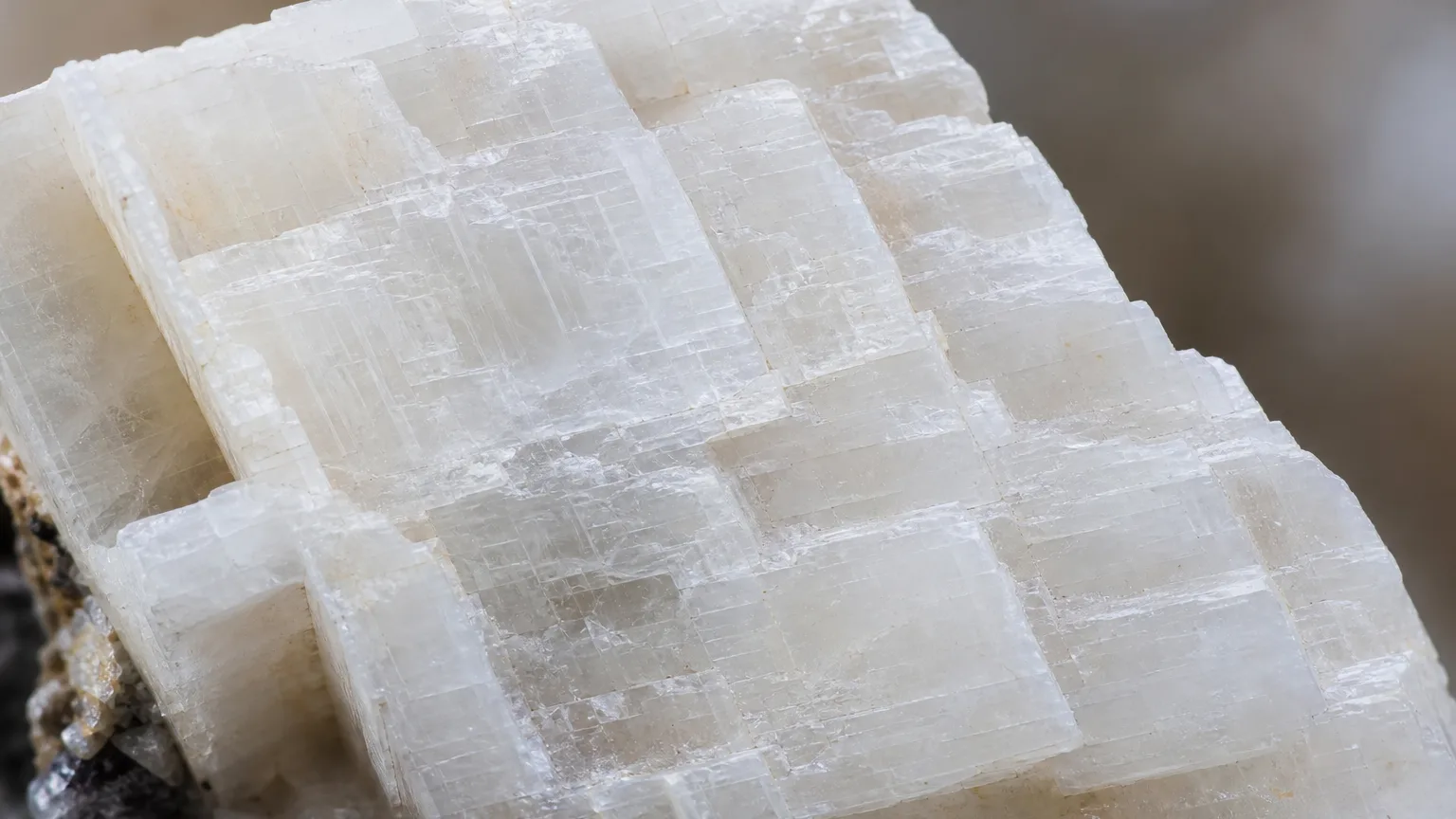
Albite is sodium aluminum silicate, NaAlSi₃O₈ — the sodium-rich end of the plagioclase feldspar series. It forms in the triclinic crystal system, often as flat, tablet-shaped crystals, and it’s moderately hard at Mohs 6–6.5. Its most useful identifying trait is cleavage: albite splits cleanly in two directions at nearly right angles, so it can fracture under a sharp knock even though it resists scratching. It’s usually colorless, white, or pale, with a vitreous to pearly luster, transparent to opaque, and a specific gravity near 2.6. A special form called peristerite shows a soft blue-white iridescence from microscopic layering — the same kind of effect, at a smaller scale, that gives moonstone its glow. Albite is extremely common worldwide, found in granitic and pegmatite rocks; fine crystals come from Brazil, Canada, the United States, and Madagascar.
Traditional Meaning
The spiritual tradition around albite is small and mostly modern. It’s linked to the throat and third eye centers, and the little lore that exists ties it to clear thinking, gentle flow, and patient, honest communication. Because there’s so little tradition behind it, this is best read as a quiet, modern set of associations rather than ancient practice. These associations come from spiritual tradition and personal practice rather than clinical study.
Mindfulness & Psychology
From a psychological angle, albite’s gift is its pale, clean look as a clarity cue. White and pale tones read in color psychology as clear, open, and calm, and choosing the stone for a clarity intention (“help me think clearly”) turns it into a quiet reminder to settle into clear, patient thinking. These effects come from tradition and personal practice, not clinical research. Crystals complement — but never replace — professional care.
Albite Benefits

People who work with albite usually describe it in terms of clearer thinking and a gentler, more patient frame of mind, not dramatic shifts. It shows up as a quieter mind and a calmer way of speaking. A few of the benefits people mention most:
Clearer thinking
Holding albite when thoughts are scattered is a cue toward clarity — its clean, pale look is a reminder to settle on one thing.
Gentler, patient speech
Chosen before a hard conversation, its calm, clear look becomes a reminder to speak slowly and gently.
A sense of flow
Kept on a desk, its clean energy is read as a quiet cue for steady, easy flow through the day’s tasks.
A calm, clarifying anchor
Carried or worn, its pale, even tone is a low-key cue to stay clear-headed through busy stretches.
The pattern underneath all of it is the same: albite isn’t sharpening your mind by magic — it gives your day a cue toward clarity and gentle flow. If you’re exploring stones for specific needs, see our guide to crystals for anxiety.
Albite Chakra, Zodiac, and Element Associations
In traditional systems, albite is most often linked to the throat and third eye centers — clear, honest expression and clear perception. Astrologers sometimes pair it with Libra and Aquarius. Its element is usually given as Air, which fits a clear, light stone. For related stones, see more crystals in the guide.
These are correspondences built up through spiritual tradition, not rules carved in stone. If your own sense of albite points to a different center or element, that’s completely fine — many people work with stones by feel rather than by a textbook chart, and there’s a long history of practitioners doing exactly that.
How to Use Albite

Albite is moderately hard (Mohs 6–6.5) but has strong cleavage, so it resists scratching yet can split under a sharp knock — handle it with care against impacts. As always, the key is consistency.
Hold it. A tumbled or flat crystal in the hand is a clean, calming cue for a quiet pause or a clear moment.
Place it where you think. On a desk or bedside table, its pale, clean look is both décor and a cue to settle into clear thinking.
Meditate with it. Rest a piece in your palm while you sit, and let its clean color give your attention one calm thing to rest on.
Carry a small piece. A tumbled stone in a soft pouch is a discreet clarity cue — keep it away from anything that could knock it along its cleavage.
Which Albite Form Is Right for You?

| Form | Best for | Choose it if |
|---|---|---|
| Tumbled stone | Pocket, meditation | You want a smooth, clean piece to hold or carry |
| Flat crystal (on matrix) | Display, intention work | You like the classic tablet-shaped crystals on host rock |
| Bead bracelet | Gentle daily wear | You want a wearable piece (handle carefully — cleavage) |
| Cabochon pendant | Personal jewelry | You prefer a single pale stone worn near the body |
| Peristerite cabochon | Statement piece | You like the soft blue-white iridescence of peristerite albite |
| Sphere | Desk, room display | You want a clean, calming centerpiece for a space |
How to Tell Real Albite from Look-alikes
Albite is common, and a few checks help you know what you have:
- Cleavage. Albite splits cleanly in two directions at near-right angles, leaving flat, shiny cleavage faces. That cleavage pattern is one of its clearest signs.
- Hardness. At Mohs 6–6.5, it scratches glass and resists a fingernail but is marked by harder stones. Glass and plastic imitations differ in feel and hardness.
- The feldspar family. Albite is the pale sodium end of the plagioclase series; labradorite is a more calcium-rich relative, and moonstone’s glow comes from fine albite layering. They’re related but distinct.
- Color and look. Natural albite is colorless, white, or pale, often with a glassy-to-pearly sheen. Vivid, uniform colors can be dyed or a different mineral.
- Price. As a very common mineral, albite is inexpensive. High prices for plain pieces are a sign it’s sold under a fancier name.
How to Cleanse and Charge Albite
In crystal practice, “cleansing” clears accumulated energy and “charging” refreshes the stone. Albite is moderately hard, but its cleavage means you should avoid sharp knocks and ultrasonic cleaners.
- Water. A brief rinse under cool water is fine. Avoid long soaks in salt water if the piece has metal settings.
- Sunlight. Albite is sun-stable, so sunlight is a safe cleansing method.
- Smoke or sound. Passing it through sage or palo santo smoke, or using a singing bowl nearby, is a no-contact option many prefer.
- Moonlight. A night under the moon is a popular gentle method, often paired with setting a clear intention.
Two practical notes: protect albite from sharp impacts (cleavage), and store it away from harder stones that could scratch it. Wipe it with a soft damp cloth rather than harsh chemicals. For the full routine, see our guide to cleansing crystals.
Best Crystals to Pair With Albite
Pairing is about layering intentions — stones whose qualities complement rather than compete. A few combinations that work well with albite’s clear, gentle energy:
- Albite + Labradorite — two feldspar family members; a pairing that pairs clarity with intuition.
- Albite + Clear Quartz — two clear stones; a bright pairing for sharp, one-pointed focus.
- Albite + Amethyst — clarity meets calm; a gentle pairing for clear, quiet meditation.
- Albite + Selenite — two light, clean stones; a clarifying pairing for a calm space.
The logic here is about complementary intentions, not strict rules. Pick what matches what you’re working on, and trust your own sense of balance.
Who Should Use Albite?
Albite suits people who want a quiet, clarifying stone for clear thinking and gentle communication — anyone who likes pale, clean stones, people who want a low-key clarity cue, or those interested in the feldspar family. It’s a modest, approachable stone without grand claims behind it.
A few honest expectations. Albite isn’t a treatment for anxiety, brain fog, or any condition — for anything persistent, a healthcare professional is the right call, and the stone can be a small comfort alongside that. Its spiritual tradition is thin, so read its “meaning” as a quiet, modern cue rather than ancient lore. And its cleavage means it asks for care against sharp impacts; handle it with a little attention. Its value comes from the intention and routine you build around it.
FAQ About Albite Meaning
What is albite?
A common white feldspar — sodium aluminum silicate, NaAlSi₃O₈ — and the sodium-rich end of the plagioclase feldspar series. It’s about Mohs 6–6.5 and is one of the most abundant minerals in Earth’s crust.
How is albite related to moonstone or labradorite?
They’re all feldspars. Moonstone’s glow comes from fine albite-rich layering; labradorite is a more calcium-rich plagioclase relative. Albite is the pale foundation of the family.
What is albite cleavage?
Albite splits cleanly in two directions at nearly right angles. So while it resists scratching, a sharp knock can split it along those planes — it asks for care against impacts.
Can albite go in water?
Yes — a brief rinse is fine. It’s a stable silicate; just avoid long salt-water soaks and skip ultrasonic cleaners because of the cleavage.
What chakra is albite?
Traditionally the throat and third eye centers — clear, honest expression and clear perception (though its tradition is small and mostly modern).
Does albite have much spiritual tradition?
Honestly, not much. It has a small modern reputation for clarity and gentle communication, but it doesn’t have centuries of lore like quartz or jade. Read its meaning as a quiet, modern cue.
What is peristerite?
A form of albite that shows a soft blue-white iridescence from microscopic layering — a smaller-scale version of the effect that gives moonstone its glow.
Final Thoughts on Albite
Albite earns its quiet place as a stone of clarity and gentle flow — and it earns it again each time its clean, pale look steadies a scattered moment. The simplest start is one piece you’ll actually hold, paired with a small daily moment to notice it. You don’t need the largest crystal or the rarest form; you need a clean stone you’ll actually see and use.
From there, albite tends to offer a clearer, gentler day — quieter thinking, calmer speech, a habit of easy flow. For more, explore the Crystal Guide or browse albite pieces.