
Fluorite Meaning: Healing Properties & Uses
Fluorite is one of the most colorful minerals in the crystal world — a calcium fluoride crystal that forms in striking bands of purple, green, blue, and yellow. Long tied to focus, clear thinking, and orderly decisions, it’s a stone people reach for when they want to concentrate or cut through mental clutter. This guide covers what fluorite is (and why it’s softer than it looks), what it has meant, and how people work with it. Crystal meanings reflect tradition and personal practice, not medical advice.
What Is Fluorite Meaning?
At its simplest, fluorite means focus and clarity — the feeling of a busy mind settling into order. Where some stones lean calming or grounding, fluorite reads as clarifying: linked to concentration, decision-making, and the ability to hold a long, complex thought without scattering.
For many people that’s exactly the appeal — a colorful, geometric piece you keep on a desk or hold while studying as a cue to stay on task. You don’t need to believe anything about energy to use it that way; the value often comes from choosing the piece, giving it a job (“help me focus”), and letting its clean structure pull your attention toward one thing at a time. In that sense fluorite is a clarifying cue to single-task.
Fluorite Meaning and Symbolism
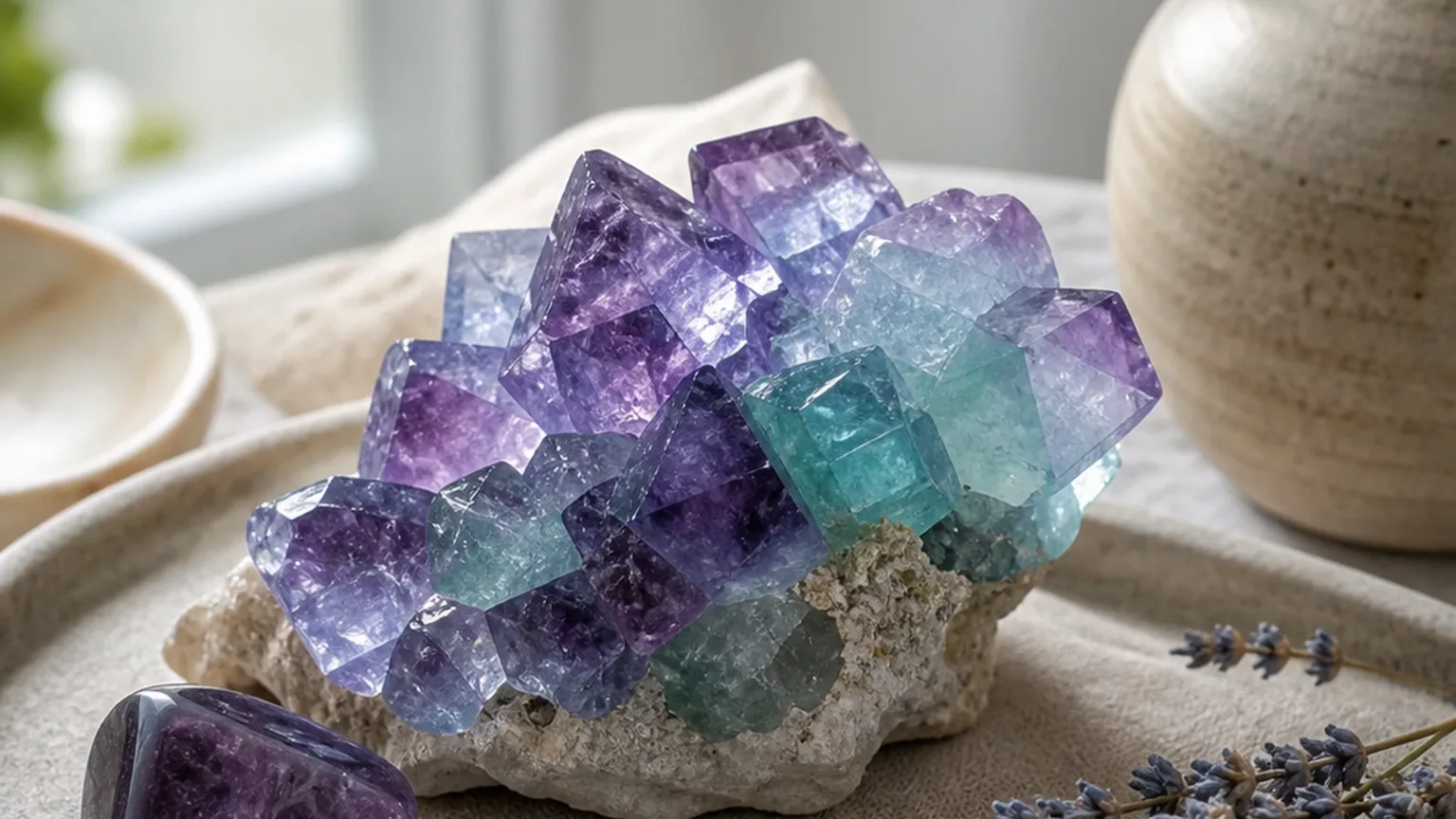
The name is a giveaway. Fluorite gave us the word fluorescence — many specimens glow under ultraviolet light, and the phenomenon was first studied in this very mineral. Its name traces back to the Latin fluere, “to flow,” because fluorite melts easily and was historically used as a flux in metalworking to help ores flow.
Fluorite has been carved and used for centuries — from Roman mosaic work to the famous Blue John of Derbyshire in England, a banded purple-and-yellow fluorite mined since the 1700s for ornamental vases and inlay. In modern crystal practice, fluorite built a reputation as a “study stone” or “genius stone” — the piece people reach for during learning, complex work, or any time a scattered mind needs to gather itself. That focus-and-clarity reputation is largely modern, but it’s been one of the most consistent associations across current practice.
The thread through all of it is the same: focus, clarity, and orderly thinking. Today fluorite is usually described as a clarifying stone — reached for to concentrate, to support clear decisions, or to tidy a cluttered mind. How much of that lands for you personally is, honestly, up to you — but the stone has held that reputation across a lot of modern practice. To explore more stones, browse the full Crystal Guide.
Fluorite Properties
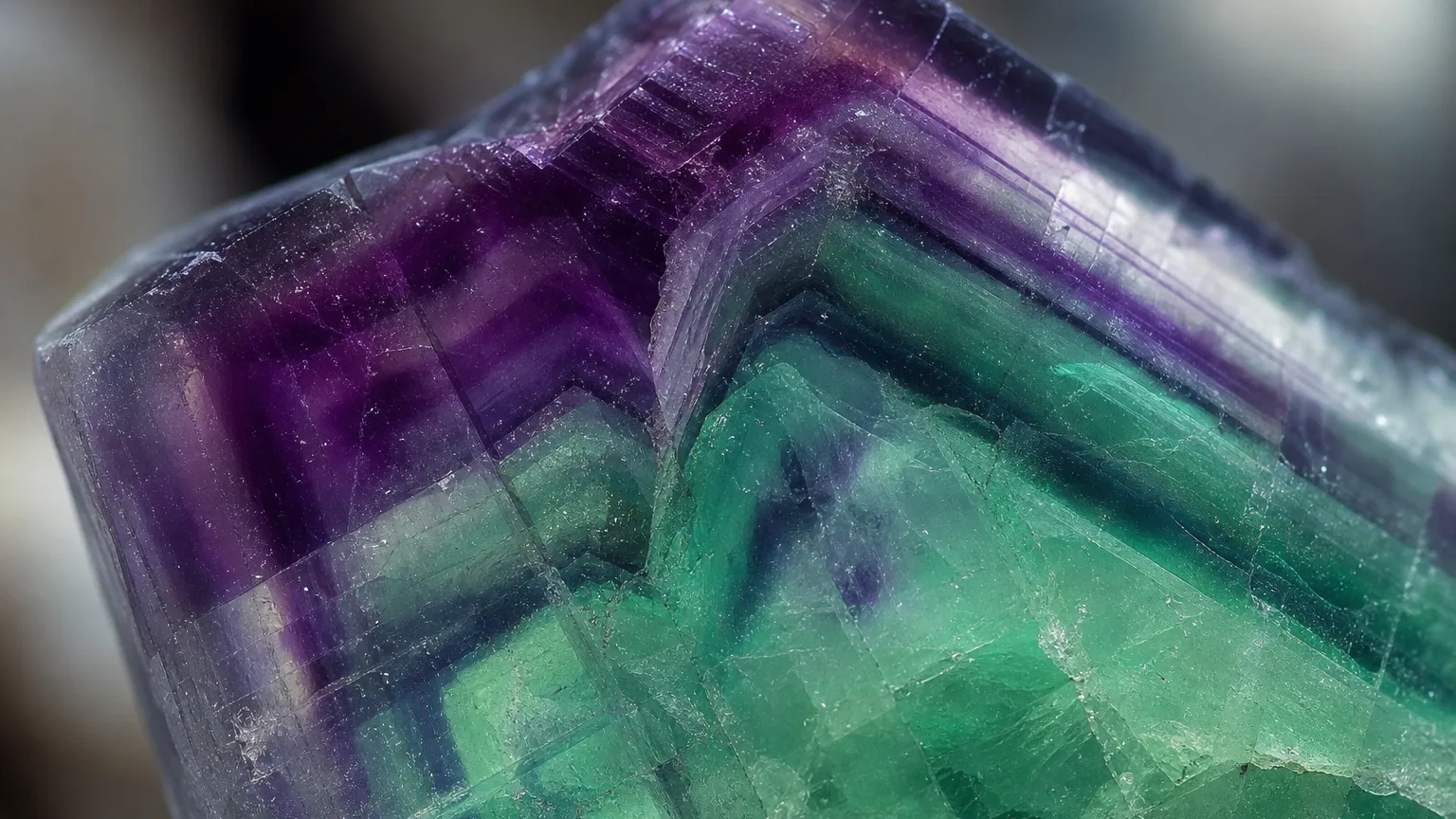
The Science
Fluorite is calcium fluoride, CaF₂, and at Mohs 4 it’s the reference mineral for that hardness — meaning it’s softer than most gemstones and needs care against scratching. It forms in beautiful cubic and octahedral crystals and is famous for its color zoning, with single specimens showing bands of purple, green, blue, yellow, and clear in sharp layers. Many fluorite specimens fluoresce under UV light (the source of the word “fluorescence”), and some fade in strong sunlight. It has perfect cleavage in four directions, so it can split along flat planes if knocked. Major sources include China, Mexico, England (the Blue John variety), and the United States.
Traditional Meaning
Tradition ties fluorite to focus, clarity, and orderly thinking. It’s often called a “study” or “genius” stone, linked to concentration, learning, and the ability to make clear decisions amid complexity. Across modern crystal practice it’s reached for during study, demanding work, or any time a scattered mind needs to gather itself, and many also use it for a sense of structure and protection against mental overload. Different colors are tied to different centers — purple to the third eye, blue to the throat, green to the heart. These associations come from spiritual tradition and personal practice rather than clinical study.
Mindfulness & Psychology
From a psychological angle, fluorite works as a visual and tactile cue to narrow attention — the kind of object you place where you work when you want to do one thing at a time. Its clean, geometric structure reads as orderly, and the act of placing a fluorite piece on your desk and pairing it with an intention (“one task at a time”) turns it into a small environmental cue. Like any ritual object, part of its value is simply marking a workspace as a place to focus. These effects come from tradition and personal practice, not clinical research. Crystals complement — but never replace — professional care.
Fluorite Benefits

People who work with fluorite usually describe it in terms of focus and clarity, not dramatic shifts. It tends to show up as a sharper, more orderly mind — useful when you’re studying, deciding, or just trying to stay on one task. A few of the benefits people mention most:
A sharper focus for study or work
A fluorite piece on your desk gives you a visual cue to stay on one thing — a small anchor when attention keeps drifting to the next tab or task.
Clearer decisions
Many hold a piece when weighing a complex choice, as a cue to slow down and think it through one factor at a time instead of reacting.
A tidier mind
Kept nearby during demanding work, its orderly, structured look is a gentle reminder to organize scattered thoughts before they pile up.
A calmer desk corner
As a geometric, colorful specimen, it doubles as décor and a focus cue — somewhere you tend to get pulled in too many directions.
The pattern underneath all of these is the same: fluorite isn’t sharpening your focus by magic, but it gives your day a cue toward one-task-at-a-time thinking. If you’re exploring stones for specific needs, see our guide to crystals for stress.
Fluorite Chakra, Zodiac, and Element Associations
In traditional systems, fluorite is color-linked — purple fluorite to the third eye, blue to the throat, green to the heart, and rainbow (multi-color) stones to several at once. Astrologically, it’s often paired with Pisces and Capricorn. Its element is usually given as Air, fitting for a stone tied to the mind. For related stones, see third eye chakra crystals.
These are correspondences built up through tradition, not fixed rules. If your own sense of fluorite points somewhere else — a different chakra, a different element — that’s completely fine. Many people work with stones intuitively, following what feels right rather than a textbook chart, and there’s a long history of practitioners doing exactly that.
How to Use Fluorite
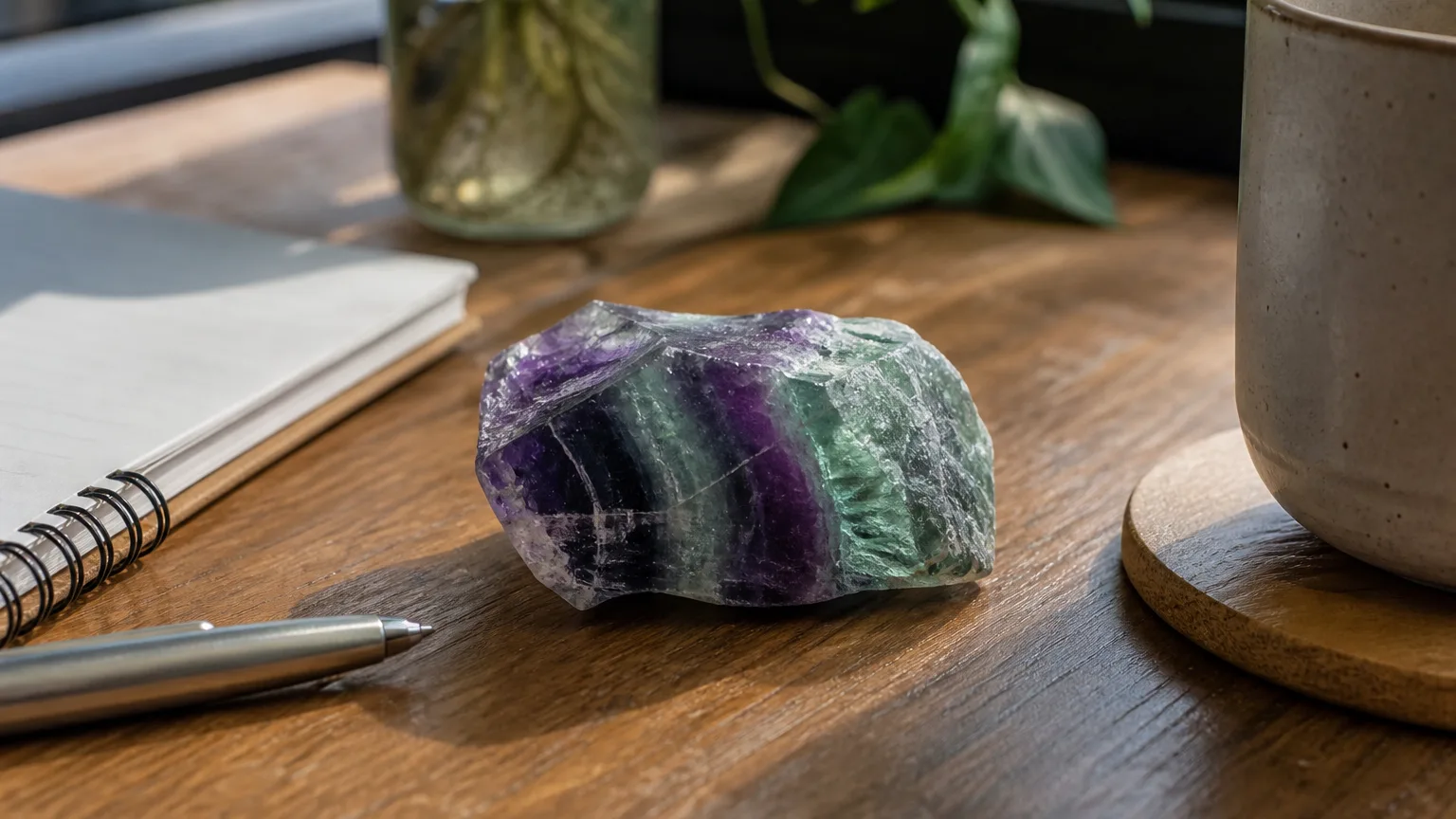
Fluorite is soft (Mohs 4) and cleaves easily, so it’s better suited to desk display and hand-holding than to everyday jewelry that takes knocks. The key is consistency: a piece you actually see and use does far more than one stored away.
Place it on your desk. A fluorite specimen or octahedron where you work acts as both décor and a focus cue — a visual reminder to stay on one task.
Hold it while studying or deciding. A tumbled piece in your palm gives your hand something to do and your mind a single point to return to when it wanders.
Meditate with it. Hold a piece or rest it on your forehead (third eye area) while you sit. Even a few minutes of focused attention counts; the goal is presence, not duration.
Carry a tumbled piece. A small stone in a pocket works as a discreet cue — something to touch when you want to gather a scattered mind.
Which Fluorite Form Is Right for You?
| Form | Best for | Choose it if |
|---|---|---|
| Tumbled stone | Pocket or meditation | You want something smooth and easy to hold or carry |
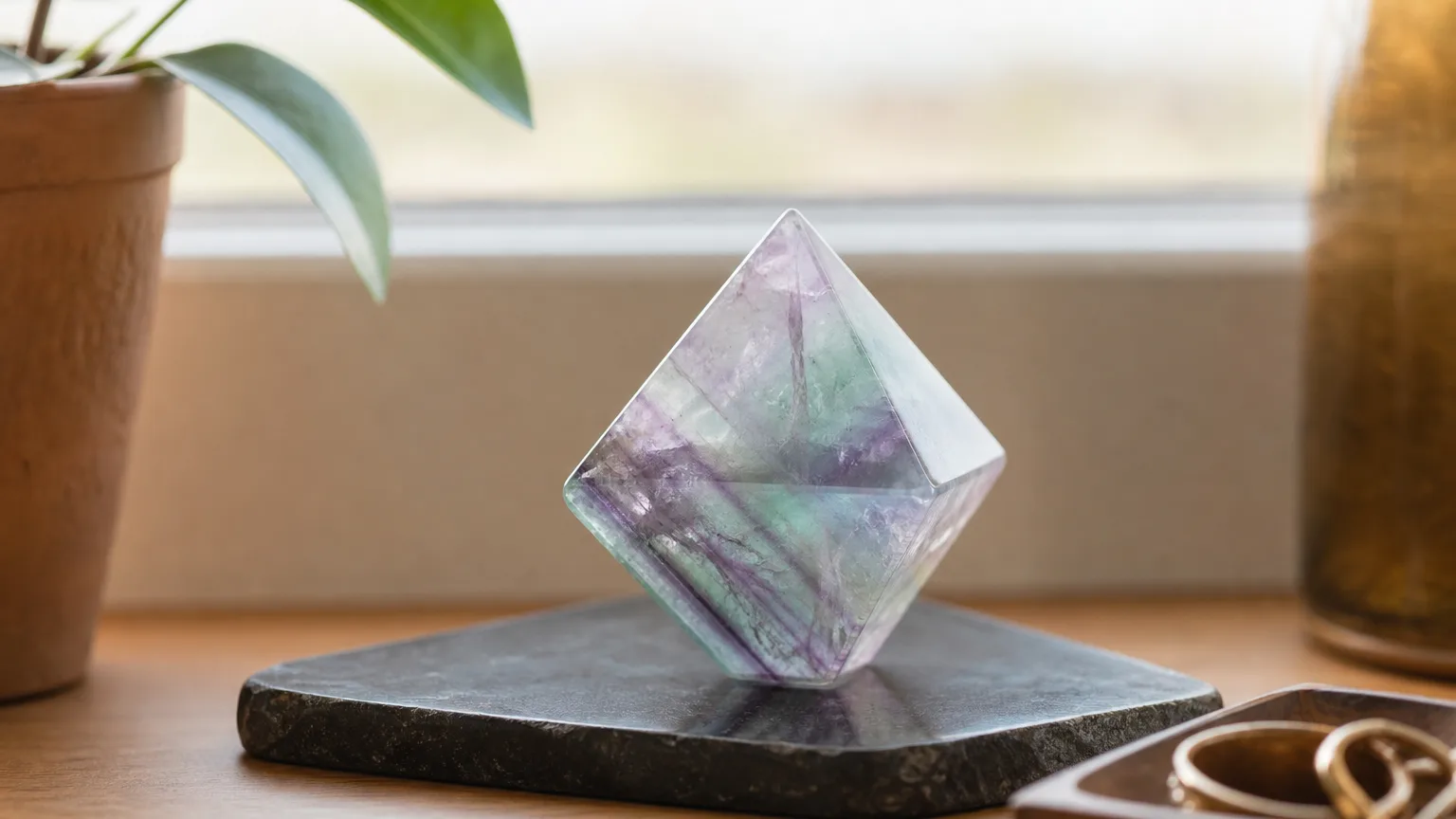
| Octahedron (carved) | Desk display, focus | You want a geometric specimen that doubles as a focus cue |
| Palm stone | Hand-holding while working | You want a larger, smooth piece to grip during study or decisions |
| Sphere | Desk or altar display | You like the color zoning visible from every angle |
| Raw cluster | Display only | You prefer natural cubic or octahedral crystal shapes |
| Pendant | Occasional wear | You want it near the body sometimes (it’s soft, so take care) |
How to Tell Real Fluorite from Fakes
Fluorite is colorful and popular, so glass and resin imitations show up — and some sellers pass off dyed or softer stones as fluorite. A few checks help:
- Color zoning. Real fluorite is famous for sharp color layers — bands of purple, green, blue, or yellow within a single piece, often following the crystal’s growth zones. Glass or resin fakes usually have a flat, swirled, or too-uniform color with no genuine banding.
- Hardness. At Mohs 4, real fluorite is scratched by a steel knife but not by a fingernail. If a “fluorite” resists a knife, it’s likely glass or quartz.
- Cleavage. Genuine fluorite has perfect cleavage in four directions and may show flat, step-like surfaces where it has split. Glass breaks with conchoidal (curved) fractures, not flat planes.
- Fluorescence. Many fluorite specimens glow under a UV light. Glass and resin won’t. (Not all fluorite fluoresces, but a glow is a strong sign it’s genuine.)
- Price. Large, flawless, vividly banded pieces at very low prices are usually too good to be true — expect glass or resin.
How to Cleanse and Charge Fluorite
Fluorite is soft (Mohs 4) and some specimens fade in light, so the care rules lean gentle. The main things to avoid are hard knocks (cleavage) and prolonged bright sun.
- Water. A brief wipe with a damp soft cloth is fine. Avoid long soaks, hot water, and salt water, which can dull the surface over time.
- Sunlight — avoid prolonged. Some fluorite fades in strong or prolonged light. Keep it out of direct sun for long periods; indirect light is the safer choice.
- Smoke or sound. Passing it through sage or palo santo smoke, or using a singing bowl nearby, is a no-contact option many prefer.
- Other crystals. Resting it on a selenite plate or clear quartz cluster is popular for a gentle overnight reset.
Two things to keep in mind: store fluorite away from harder stones (quartz, topaz) so its soft surface doesn’t get scratched, and handle raw or thin pieces gently — the cleavage means a hard knock can split it. For the full routine, see our guide to cleansing crystals — and treat fluorite as the soft, sun-shy one in that guide.
Best Crystals to Pair With Fluorite
Pairing is about layering intentions — picking stones whose qualities complement rather than compete. A few classic combinations that work well with fluorite’s clarifying energy:
- Fluorite + Clear Quartz — focus with a lift; many use clear quartz to amplify fluorite’s concentration intention.
- Fluorite + Amethyst — focus meets calm; a popular study pairing for staying on task without getting wired.
- Fluorite + Selenite — clarity paired with clearing; many use it to keep both mind and space feeling fresh.
- Fluorite + Black Tourmaline — focus meets grounding; a combo for staying clear-headed and rooted during demanding work.
The logic of pairing is about complementary intentions, not strict rules. Pick combinations that match what you’re actually working on, and trust your own sense of what feels balanced.
Who Should Use Fluorite?
Fluorite suits people who want a clarifying stone for focus and orderly thinking — students, anyone doing complex or demanding work, or people who feel mentally scattered and want to gather their attention. It’s approachable because it asks little: place it, hold it, and let it mark a workspace as a place to do one thing at a time.
A few honest expectations: fluorite isn’t a treatment for ADHD, anxiety, or any condition — if you’re dealing with something persistent, a healthcare professional is the right call, and the stone can be a comfort alongside that. Its value comes from the intention and routine you build around it. If you go in expecting a stone to sharpen your mind for you, you’ll be disappointed; if you go in expecting a clarifying cue you can return to, it tends to fit well.
FAQ About Fluorite Meaning
What is fluorite good for?
Traditionally, focus, clarity, and orderly thinking. People reach for it during study, complex work, or any time a scattered mind needs to gather itself.
Is fluorite soft?
Yes — at Mohs 4, fluorite is the reference mineral for that hardness, softer than most gemstones. That’s why it scratches easily and needs gentle care.
Why does fluorite glow?
Many fluorite specimens fluoresce — they glow under ultraviolet light. The word “fluorescence” actually comes from fluorite, where the effect was first studied.
What chakra is fluorite linked to?
It’s color-linked: purple to the third eye, blue to the throat, green to the heart. Rainbow (multi-color) stones are associated with several at once.
Can fluorite go in water?
A brief wipe with a damp cloth is fine. Avoid long soaks, hot water, and salt water, which can dull the soft surface over time.
Does fluorite fade in sunlight?
Some specimens do fade in strong or prolonged light. Keep fluorite out of direct sun for long periods and prefer indirect light.
How can I tell real fluorite?
Look for sharp color zoning (banded layers), test hardness (Mohs 4 — scratched by a knife, not a fingernail), and check for flat cleavage surfaces. A UV glow is a strong sign it’s genuine.
Final Thoughts on Fluorite
Fluorite earns its long reputation as a stone of focus and clarity — the colorful, geometric piece people reach for when a scattered mind needs to gather itself. If you’re curious, the simplest start is one specimen on your desk, paired with a small daily moment to notice it. Let the routine do the work, and let the stone be the orderly anchor that reminds you to do one thing at a time.
From there, fluorite tends to open a clearer space — a sharper study session, a tidier train of thought, or simply a habit of narrowing your focus before you scatter. For more, explore the Crystal Guide or browse fluorite pieces.