Snowflake Obsidian Meaning: Healing Properties & Uses
Snowflake Obsidian is black volcanic glass patterned with white cristobalite spots — the same volcanic glass as obsidian, with a softer, two-toned look. Long tied to balance, gentle grounding, and steady change, it’s often reached for as a calmer, more even-tempered cousin of black obsidian. This guide covers what snowflake obsidian is (and how it differs from plain black), what it has meant, and how people work with it. Crystal meanings reflect tradition and personal practice, not medical advice.
What Is Snowflake Obsidian Meaning?
At its simplest, snowflake obsidian means balance and gentle grounding — the feeling of two opposites (dark and light) held together in one stone. Where plain black obsidian reads as intense and protective, snowflake obsidian sits on the gentler side: still grounding, but softer, more even, and easier to live with day to day.
For many people that’s exactly the appeal — a black-and-white piece you keep nearby as a cue to stay balanced and grounded without intensity. You don’t need to believe anything about energy to use it that way; the value often comes from choosing the piece, giving it a job (“keep me balanced”), and letting its two-toned pattern pull you toward steadiness. In that sense snowflake obsidian is a cue to grounded balance.
Snowflake Obsidian Meaning and Symbolism
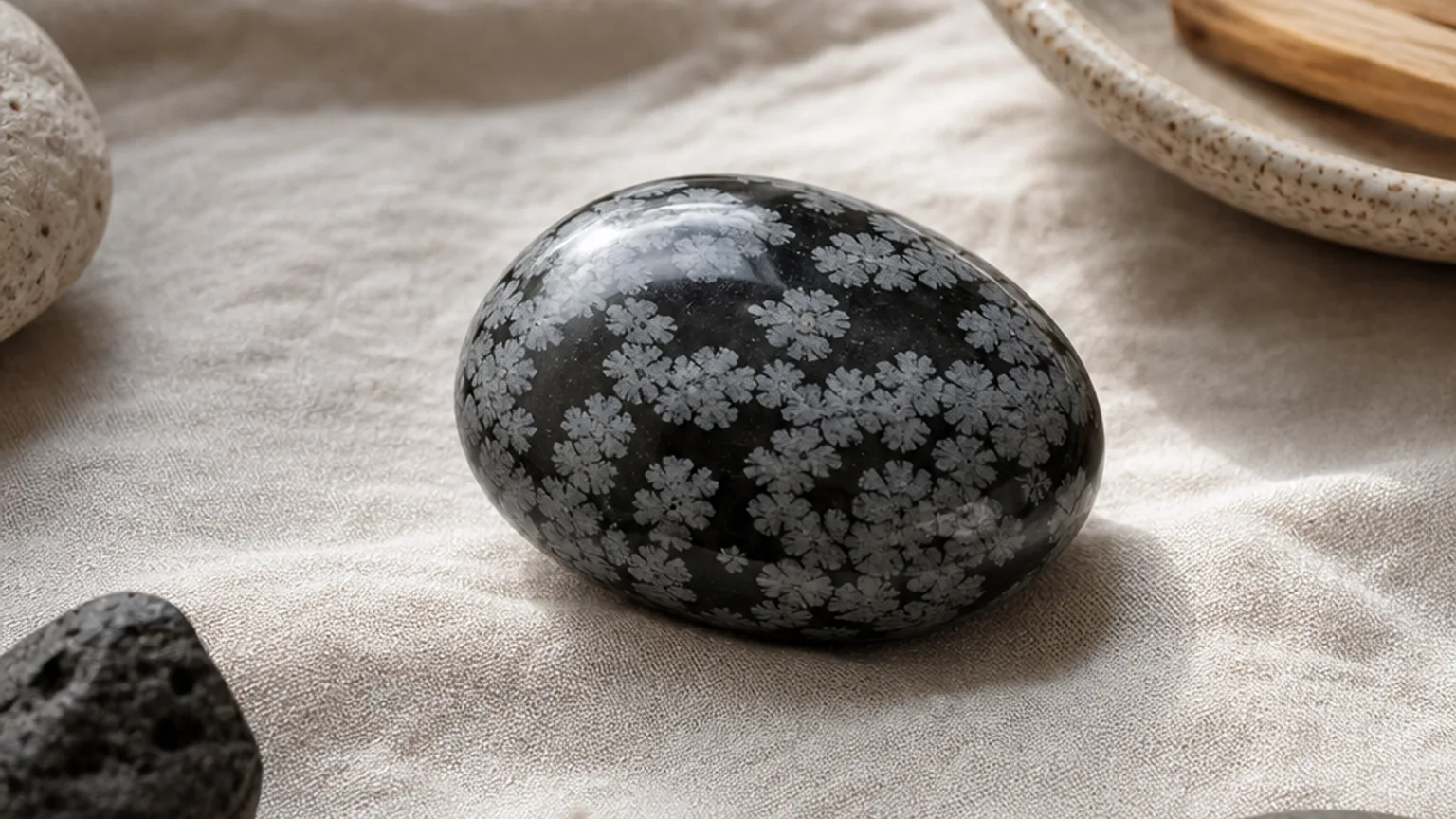
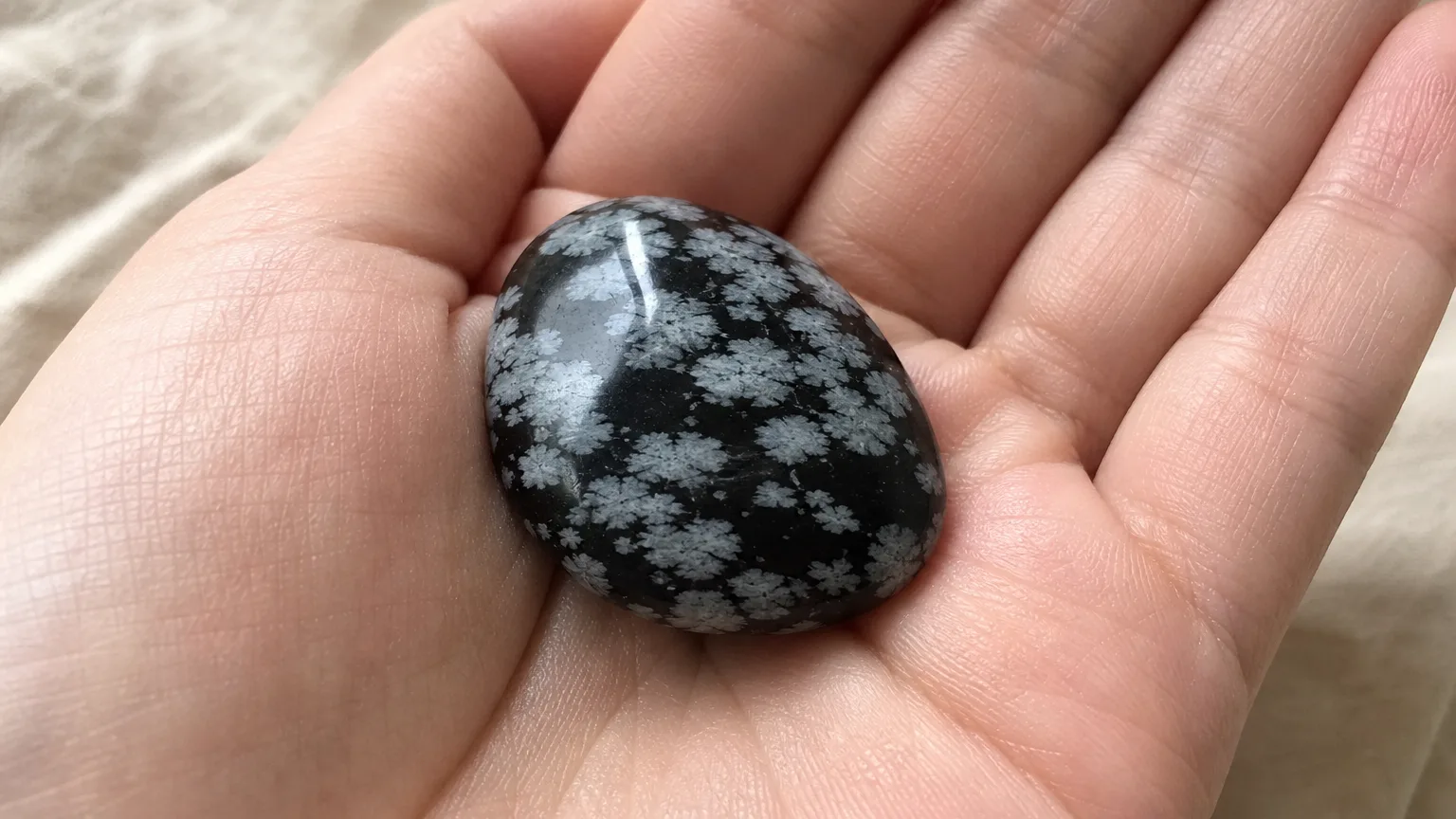
The name is descriptive: snowflake obsidian is obsidian — volcanic glass — patterned with white spots that look like snowflakes. Those spots aren’t a different pigment; they’re cristobalite, a white mineral that crystallized inside the glass as it slowly cooled, forming branching, radiating patterns. So the stone is literally black and white held in one piece.
That two-toned character is the heart of its symbolism. Snowflake obsidian has no single ancient myth of its own — it’s a variety of obsidian, with the same tool-and-mirror history. But in modern crystal practice, the black-and-white pattern became its meaning: balance, integration, and the pairing of opposites — grounding and light, shadow and clarity, the parts of yourself that seem to conflict. It’s often reached for as a calmer alternative to plain black obsidian, especially by people who find black obsidian too intense.
The thread through all of it is the same: balance, gentle grounding, and steady change. Today snowflake obsidian is usually described as a grounding-but-gentle stone — reached for to feel steady, to work with change at a manageable pace, or to bring opposites into balance. How much of that lands for you personally is, honestly, up to you — but the stone has held that balanced reputation across modern practice. To explore more stones, browse the full Crystal Guide.
Snowflake Obsidian Properties
The Science
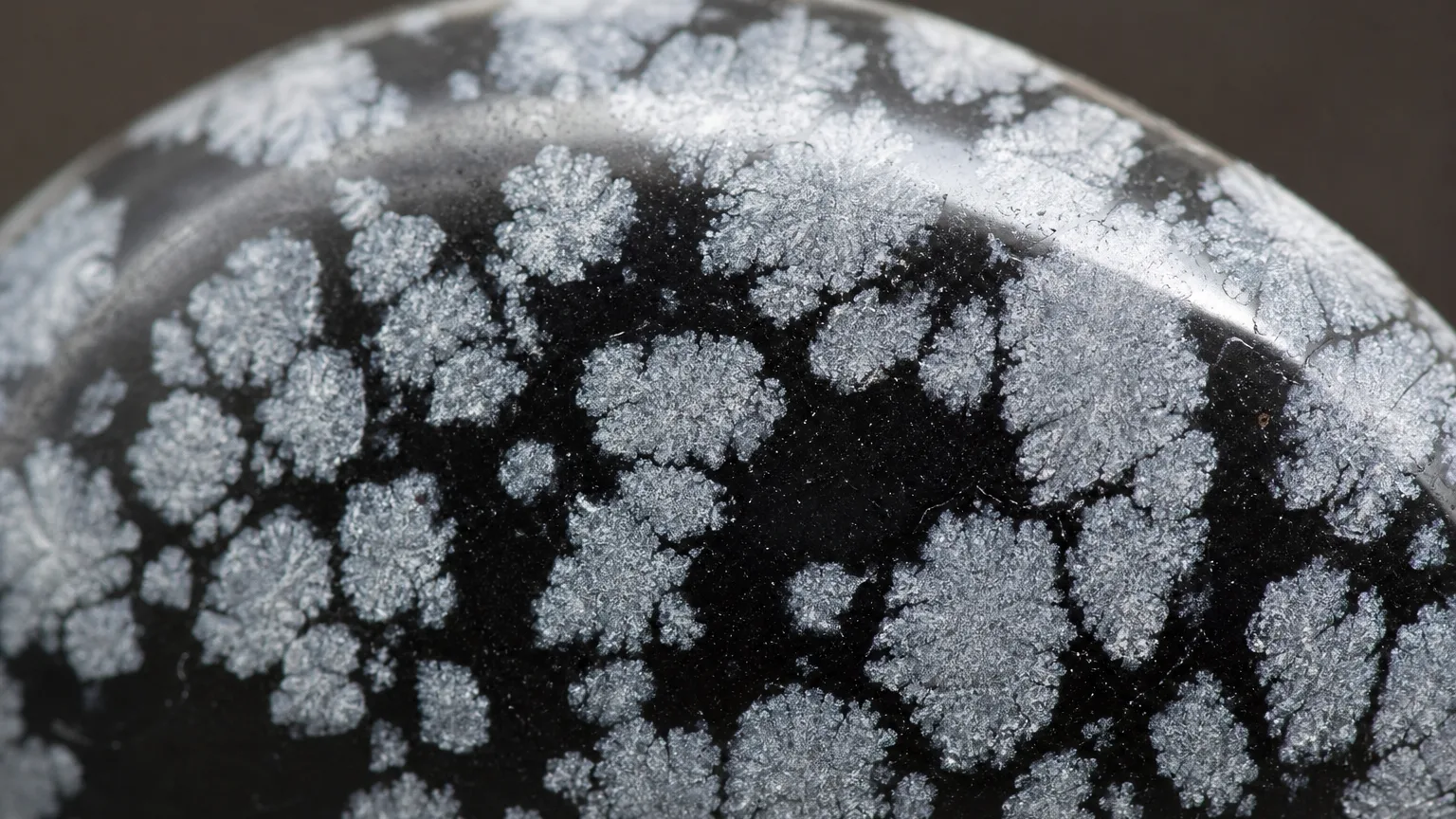
Snowflake obsidian is volcanic glass, not a mineral — it has no crystal structure because silica-rich lava cooled too fast for crystals to grow (other than the white spots). Those white “snowflakes” are cristobalite, a silica mineral that crystallized within the glass as it cooled, forming the branching, radiating patterns. The hardness is about 5 to 5.5 on the Mohs scale, and like all obsidian it breaks with a conchoidal fracture — smooth, curved, and famously sharp on raw edges. It forms at volcanoes worldwide alongside black obsidian, with sources in Mexico, the United States, Iceland, and elsewhere. None of this is mystical — it’s volcanology.
Traditional Meaning
Tradition ties snowflake obsidian to balance, gentle grounding, and steady change. It’s linked to both the root center (grounding) and the crown (clarity), reflecting its two-toned black-and-white nature. Across modern crystal practice it’s reached for to feel steady and balanced, to integrate opposing feelings, or to move through change at a calmer, more sustainable pace than plain black obsidian allows. These associations come from spiritual tradition and personal practice rather than clinical study.
Mindfulness & Psychology
From a psychological angle, snowflake obsidian works as a grounding-but-soft visual cue — the kind of object you hold when you want steadiness without intensity. Its two-toned pattern reads as balanced and integrated, and the act of keeping a piece nearby and pairing it with an intention (“hold both sides”) turns it into a small cue to stay even. Part of its appeal is simply that it feels gentler than plain black obsidian — a steadier anchor for daily use. These effects come from tradition and personal practice, not clinical research. Crystals complement — but never replace — professional care.
Snowflake Obsidian Benefits
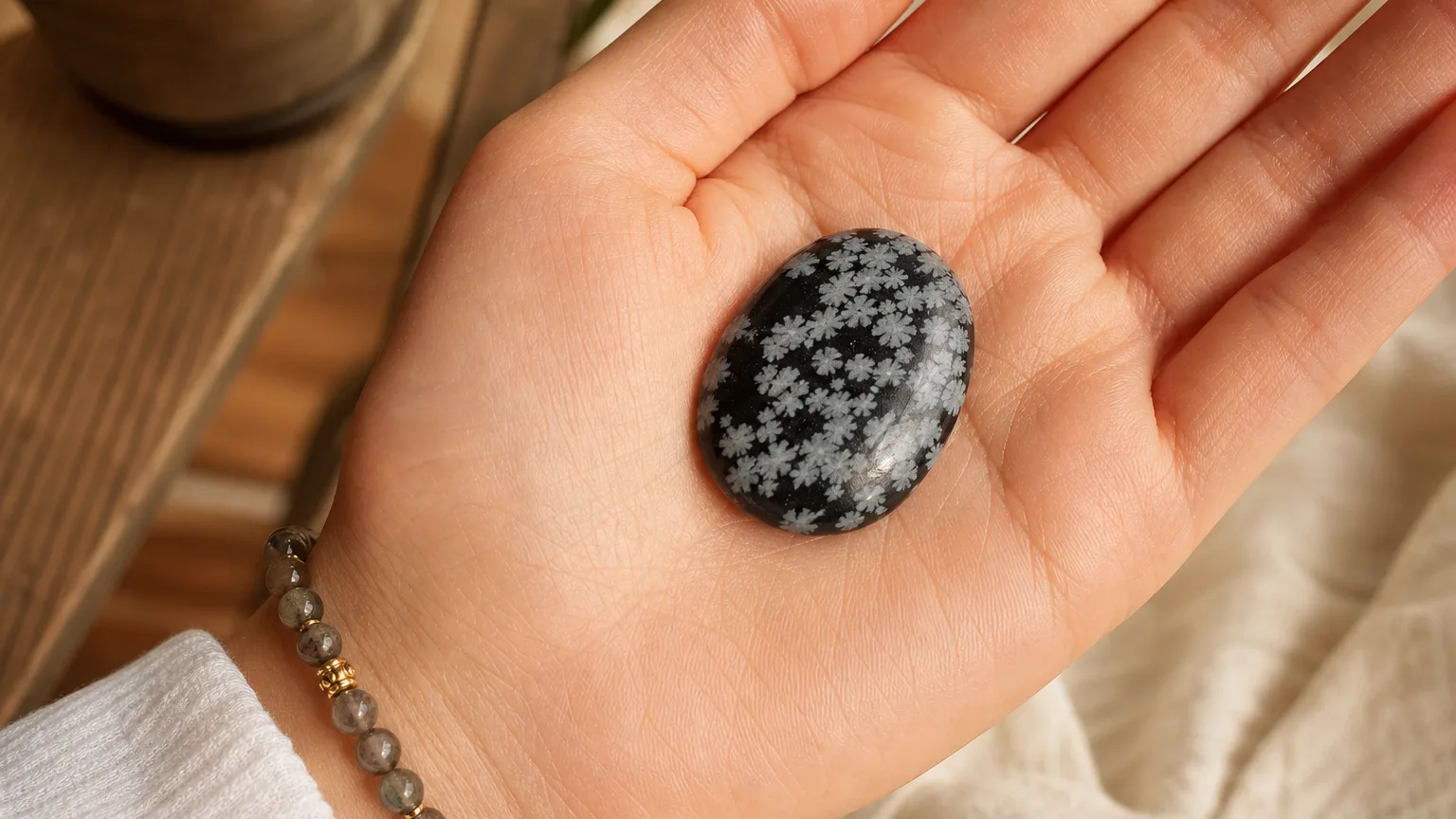
People who work with snowflake obsidian usually describe it in terms of balance and gentle grounding, not intensity. It tends to show up as a calmer, more even feeling — useful when you feel scattered, pulled between opposites, or want a steadier daily anchor. A few of the benefits people mention most:
A steadier daily anchor
Carried or kept nearby, snowflake obsidian is a gentle grounding cue — a softer presence than black obsidian for everyday steadiness.
Balance between opposites
Its two-toned pattern is a reminder that two sides can coexist — useful when you feel torn between competing feelings or demands.
Steady change
Many reach for it during change, as a cue to move at a calm, sustainable pace rather than get swept up or shut down.
A gentler alternative to black obsidian
If black obsidian feels too strong, snowflake obsidian is often chosen as the calmer cousin — grounding with less intensity.
The pattern underneath all of these is the same: snowflake obsidian isn’t balancing you by magic, but it gives your day a cue toward steadiness and integration. If you’re exploring stones for specific needs, see our guide to crystals for stress.
Snowflake Obsidian Chakra, Zodiac, and Element Associations
In traditional systems, snowflake obsidian is linked to two centers — the root (grounding, stability) and the crown (clarity, perspective) — reflecting its black-and-white, grounding-and-light character. Astrologically, it’s often paired with Scorpio and Virgo. Its elements are usually given as Earth and Fire — volcanic fire and grounding earth in one stone. For related stones, see root chakra crystals.
These are correspondences built up through tradition, not fixed rules. If your own sense of snowflake obsidian points somewhere else — a different chakra, a different element — that’s completely fine. Many people work with stones intuitively, following what feels right rather than a textbook chart, and there’s a long history of practitioners doing exactly that.
How to Use Snowflake Obsidian
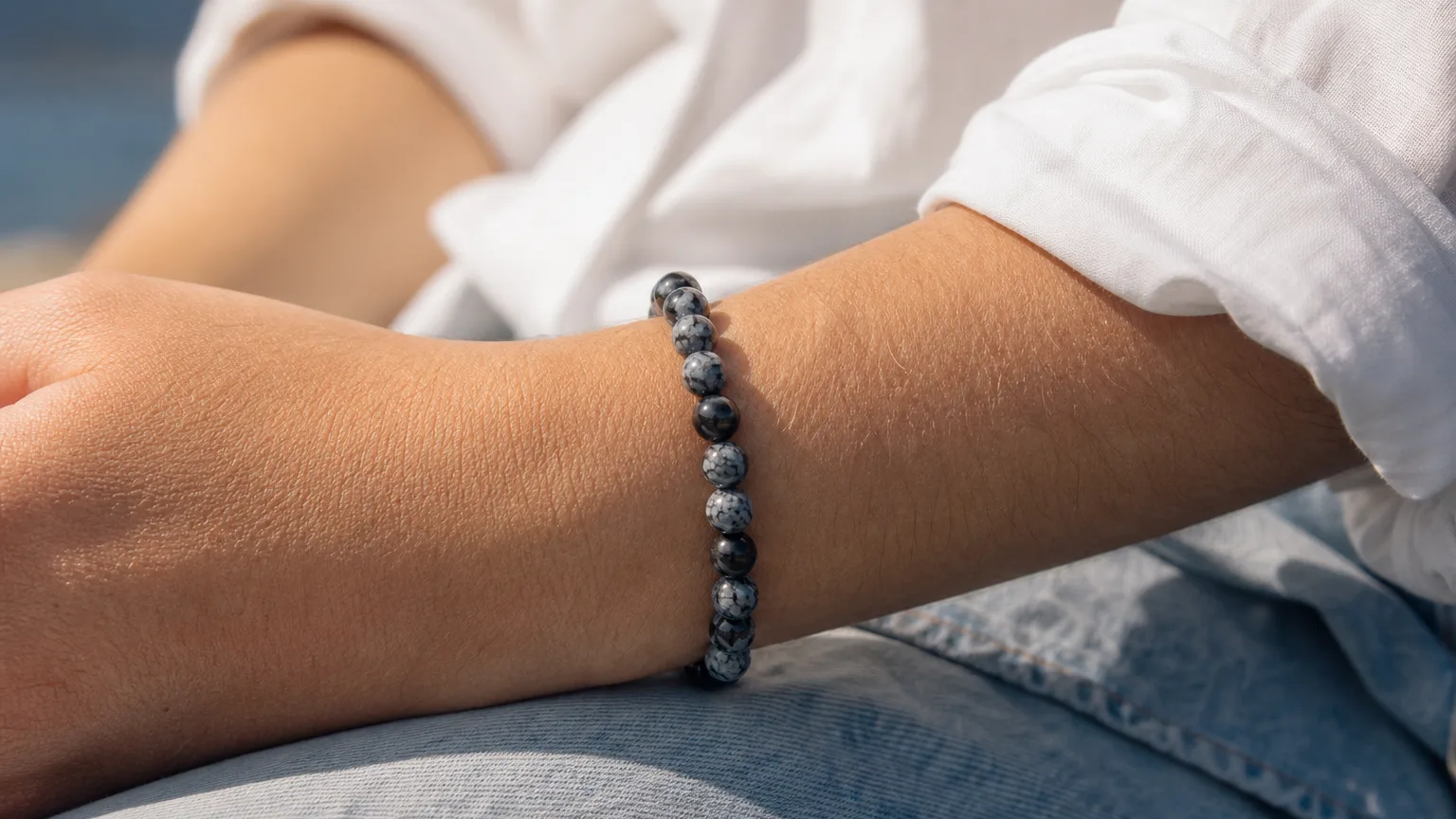
Snowflake obsidian is glass (Mohs 5–5.5) and breaks with sharp edges, so handle raw pieces with care and choose tumbled or polished forms for everyday use. The key is consistency: a piece you actually see and hold does far more than one stored away.
Carry a tumbled piece. A smooth stone in a pocket is a discreet touchstone — something to hold when you want steadiness on the move.
Keep it on a desk or nightstand. A piece where you spend time acts as both décor and a grounding cue — somewhere you tend to feel scattered.
Meditate with it. Hold a piece in your palm or rest it at the base of your spine (root area) while you sit. Even a few minutes of focused attention counts; the goal is presence, not duration.
Use it for balance. Hold the stone when you feel torn between two things — its two-toned pattern is a cue to hold both sides rather than pick one and suppress the other.
Which Snowflake Obsidian Form Is Right for You?
| Form | Best for | Choose it if |
|---|---|---|
| Tumbled / palm stone | Pocket, meditation, hand-holding | You want something smooth and safe to hold or carry |
| Polished slab | Desk anchor, display | You want a heavier piece to display and grip during stress |
| Sphere | Display, hand-holding | You want a rounded, polished piece for a desk or altar |
| Pendant / bracelet | Daily wearing | You want a grounding piece worn close to the body |
| Carved charm | Personal meaning | You prefer a small carved shape you connect with |
| Raw piece (with care) | Display only | You like the natural volcanic look — handle edges with care |
How to Tell Real Snowflake Obsidian from Fakes
Snowflake obsidian is natural glass, so the main fakes are ordinary glass with painted or printed spots, or dyed stone. A few checks help:
- The snowflake pattern. Real cristobalite spots are three-dimensional, branching, and slightly different in every piece — they sit inside the glass, not on top. Flat, uniform, printed-looking dots suggest glass or a coating.
- Pattern variety. No two genuine snowflake obsidian pieces are patterned the same. A repeated, identical “snowflake” across many pieces points to a manufactured material.
- Hardness and fracture. Like all obsidian, it’s glass (Mohs 5–5.5) and breaks with a conchoidal fracture. A soft or non-glassy stone isn’t obsidian.
- Body color. Genuine snowflake obsidian is black volcanic glass — not brown, grey, or dyed. The contrast with white cristobalite should be sharp.
- Seller honesty. Dyed howlite or marble is sometimes sold as “snowflake obsidian.” A reputable seller will identify it correctly.
How to Cleanse and Charge Snowflake Obsidian
Snowflake obsidian is glass (Mohs 5–5.5) and easy to care for, with one main rule: handle raw or broken edges carefully, since they’re razor-sharp.
- Water. A brief wipe or rinse with cool water is fine. Avoid long soaks in salt water if the piece has metal settings.
- Sunlight. Snowflake obsidian is sun-stable — its black-and-white pattern won’t fade. Brief sun cleansing is safe.
- Smoke or sound. Passing it through sage or palo santo smoke, or using a singing bowl nearby, is a no-contact option many prefer.
- Earth. Because it’s a grounding stone born of the earth, some rest it in soil for a few hours as a symbolic reset, then brush it off.
Two things to keep in mind: handle broken or raw edges with care (they’re sharp enough to cut), and store snowflake obsidian away from harder stones so its glass surface doesn’t get scratched. For the full routine, see our guide to cleansing crystals.
Best Crystals to Pair With Snowflake Obsidian
Pairing is about layering intentions — and snowflake obsidian’s gentle energy pairs well with both grounding and softening stones. A few combinations that work well:
- Snowflake Obsidian + Rose Quartz — balance softened with warmth; a gentle pairing for emotional self-care.
- Snowflake Obsidian + Amethyst — grounding meets calm; a balanced pairing for a clearer, steadier mind.
- Snowflake Obsidian + Clear Quartz — clear quartz is said to amplify; many use it to lift snowflake obsidian’s balancing intentions.
- Snowflake Obsidian + Smoky Quartz — two gentle grounding stones; a steady, low-intensity combo for daily use.
The logic of pairing is about complementary intentions, not strict rules. Pick combinations that match what you’re actually working on, and trust your own sense of what feels balanced.
Who Should Use Snowflake Obsidian?
Snowflake obsidian suits people who want a gentle, balancing grounding stone — anyone who finds plain black obsidian too intense, who feels scattered or pulled between opposites, or who wants a steady daily anchor. It’s approachable because it’s affordable, durable, and gentler than it looks: place it, hold it, and let it mark a steadier, more balanced corner of your day.
A few honest expectations: snowflake obsidian isn’t a treatment for anxiety, depression, or any condition — if you’re dealing with something persistent, a healthcare professional is the right call, and the stone can be a comfort alongside that. Its value comes from the intention and routine you build around it. If you go in expecting a stone to fix things for you, you’ll be disappointed; if you go in expecting a gentle, balancing cue you can return to, it tends to fit well.
FAQ About Snowflake Obsidian Meaning
What is snowflake obsidian good for?
Traditionally, balance, gentle grounding, and steady change. People reach for it to feel steady, to integrate opposing feelings, or to move through change at a calmer pace.
Is snowflake obsidian the same as obsidian?
It’s a variety of obsidian — the same black volcanic glass, patterned with white cristobalite spots. The base material is identical; the white “snowflakes” are a mineral that crystallized inside the glass.
What are the white spots in snowflake obsidian?
Cristobalite — a white silica mineral that crystallized within the volcanic glass as it cooled, forming the branching, snowflake-like patterns.
How is snowflake obsidian different from black obsidian?
Same base stone. Black obsidian is plain volcanic glass; snowflake obsidian has the added white cristobalite pattern. In crystal practice, snowflake is often seen as the gentler, more balancing cousin.
What chakra is snowflake obsidian linked to?
Both the root (grounding) and the crown (clarity) — reflecting its black-and-white, grounding-and-light character.
Can snowflake obsidian go in water?
Yes. It’s a hard glass (Mohs 5–5.5), water-safe. A brief wipe or rinse is fine; avoid long salt-water soaks with metal settings.
How can I tell real snowflake obsidian?
Look for three-dimensional, branching white cristobalite inside black glass (not flat printed dots), and check that no two pieces share the same pattern — a sign of natural, not manufactured, material.
Final Thoughts on Snowflake Obsidian
Snowflake obsidian earns its place as a stone of balance and gentle grounding — the two-toned volcanic glass people reach for when they want steadiness without intensity. If you’re curious, the simplest start is one smooth piece you’ll actually hold, paired with a small daily moment to notice it. Let the routine do the work, and let the stone be the gentle anchor that reminds you to hold both sides and stay steady.
From there, snowflake obsidian tends to open a calmer space — a more even mood, a steadier pace through change, or simply a habit of staying grounded without going hard. For more, explore the Crystal Guide or browse snowflake obsidian pieces.