
Tourmaline Meaning: Healing Properties & Uses
Tourmaline is a large family of hard, brilliantly colored borosilicate minerals — one of the most colorful gems on earth, found in red, green, blue, pink, black, and even “watermelon” (red and green in one stone). Each color carries its own feel, but the family overall is tied to balance, protection, and energy. This guide covers what tourmaline is, what it means, and how people work with it. Crystal meanings reflect tradition and personal practice, not medical advice.
What Is Tourmaline Meaning?
At its simplest, tourmaline as a family means balance, protection, and energy. Because it spans so many colors, it’s read as a stone that covers a wide range — from the grounding of black tourmaline to the heart-warming of pink and the clarity of blue — and the shared theme is versatility, balance, and protection.
For many, that’s the appeal: whatever the need, there’s a tourmaline that fits, and the family as a whole feels both colorful and protective. You don’t need to hold any specific belief to get something from these stones — the value often comes from choosing one that matches what you’re working on.
Tourmaline Meaning and Symbolism
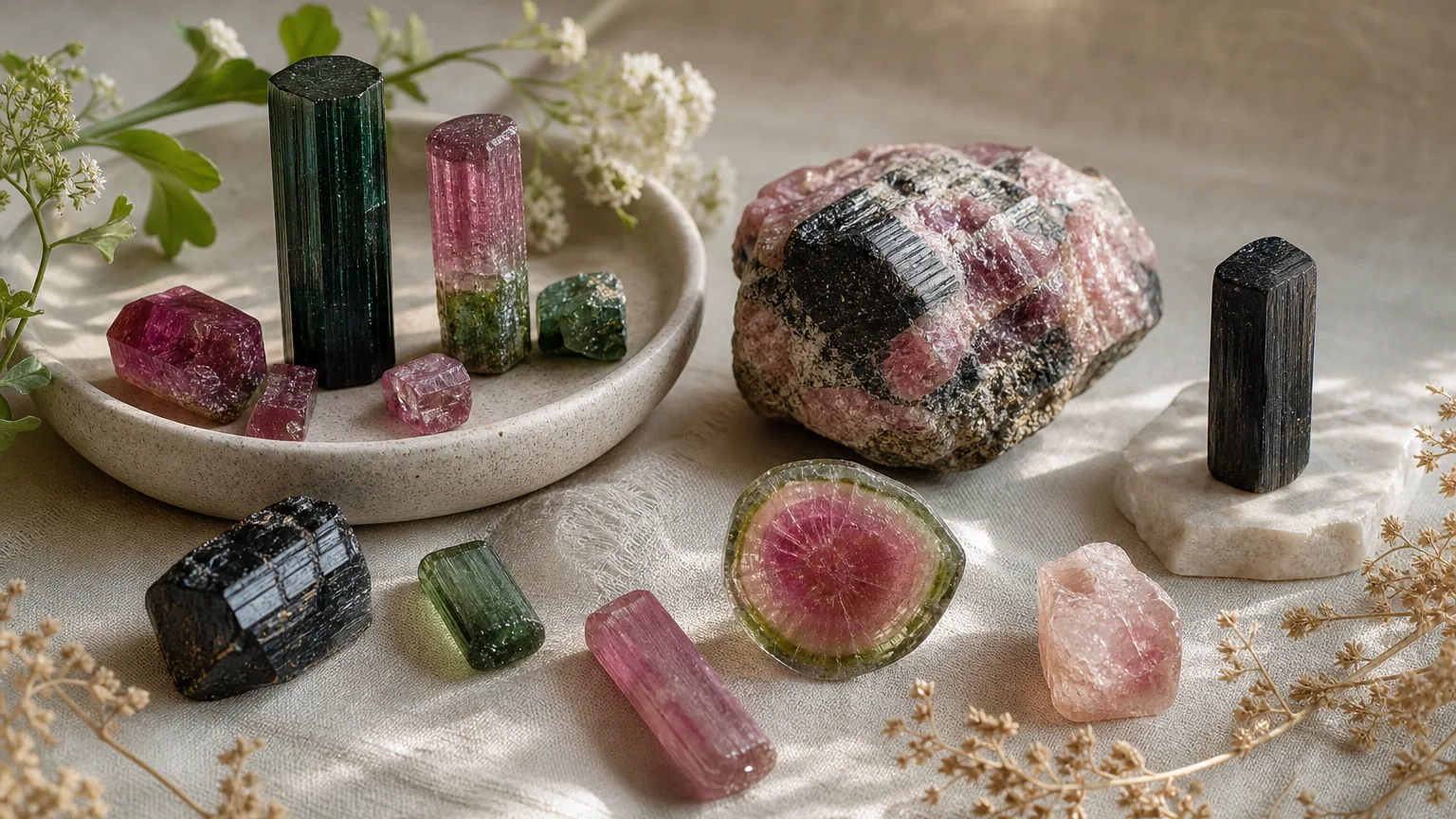
The name tourmaline comes from the Sinhalese word toramalli, meaning “mixed gems” — a nod to how colorful it is and how easily it was confused with other stones. For centuries, red and green tourmalines were mistaken for ruby and emerald; in the 1500s, a Portuguese explorer in Brazil found green tourmalines he thought were emeralds, and they weren’t recognized as a distinct gem until much later.
In modern practice, tourmaline as a family is tied to balance, protection, and energy. Black tourmaline (schorl) is the protection member; pink and red (rubellite) the heart and love stones; green (verdelite) the growth and healing; blue (indicolite) the calm and communication; and “watermelon” tourmaline (pink core, green rim) a heart-and-growth symbol. How much of that you feel personally is up to you. To explore more stones, browse the full Crystal Guide.
Tourmaline Properties
The Science
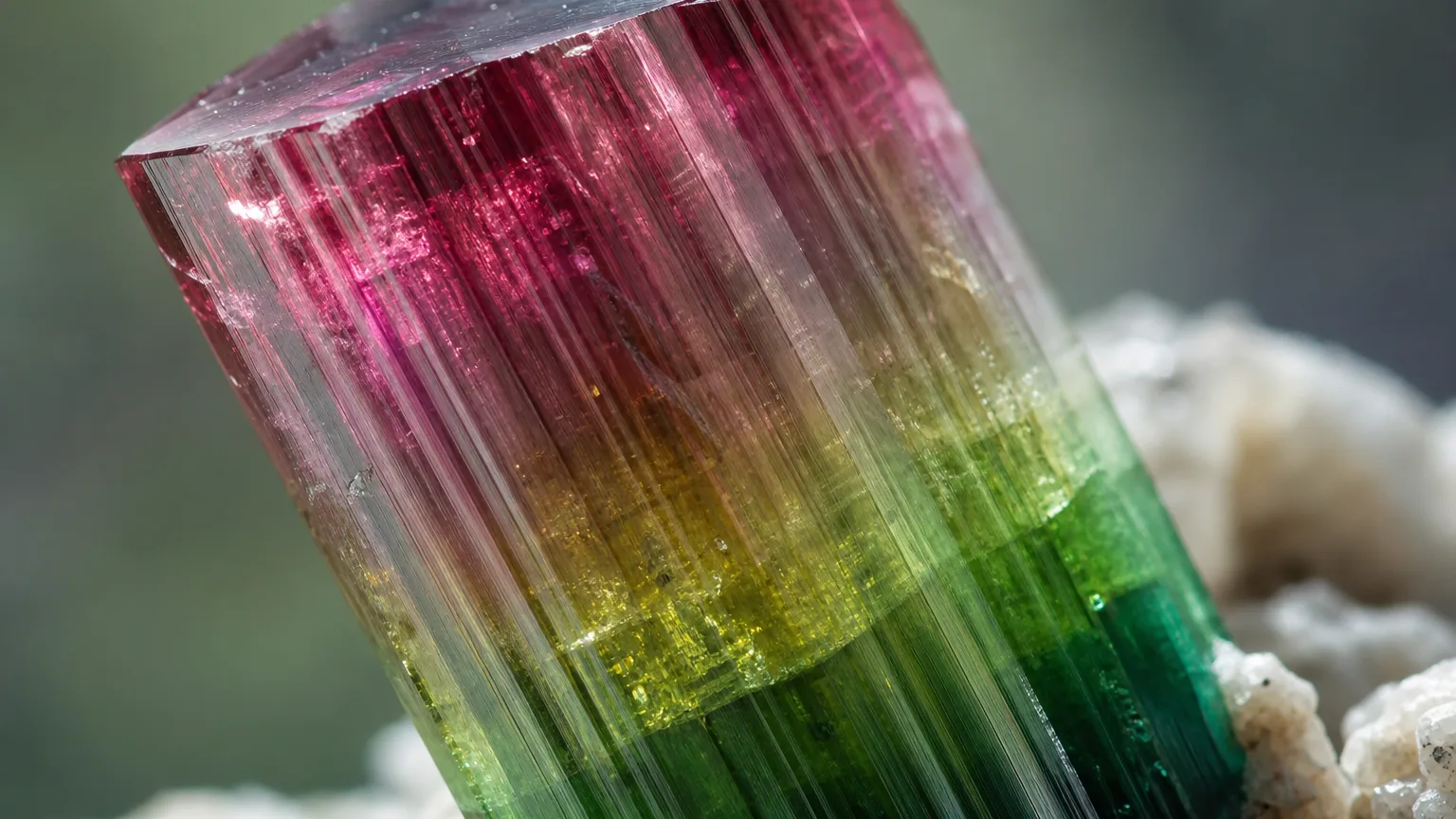
Tourmaline is a complex borosilicate mineral family with a formula that varies widely (roughly involving sodium, calcium, magnesium, iron, aluminium, lithium, and boron). It’s trigonal, hard at 7–7.5 on the Mohs scale, and famously comes in more colors than almost any other gem — red, green, blue, pink, yellow, black, and bi-color — driven by different trace elements (iron, manganese, chromium, copper, and others). It grows in distinctive three-sided columns with vertical striations and a triangular cross-section. One real and unusual property: tourmaline is pyroelectric and piezoelectric, building a small electrical charge when heated or pressed — a measurable mineral behavior, not a healing effect. Major sources include Brazil, Mozambique, Nigeria, Madagascar, Afghanistan, and the USA. None of this is mystical — it’s mineralogy.
Traditional Meaning
Tourmaline’s tradition is mostly modern, built up as gemologists finally distinguished it from ruby and emerald in the 18th–19th centuries. The family is tied to balance, protection, and energy, with each color carrying its own finer meaning — black for protection and grounding, pink for love and the heart, green for growth and healing, blue for calm and communication. Across the crystal community, tourmaline is carried for protection, balance, and color-specific support. These associations come from modern practice and personal experience.
Mindfulness & Psychology
From a psychological angle, the tourmaline family works through variety and fit — choosing the color that matches the moment, whether that’s black for protection, pink for warmth, or green for calm. The act of choosing and carrying a stone can support intention-setting: you pick one that stands for what you need, and the feel of it draws you back. Across the family, the shared effect is a cue to balance and protection. These effects come from tradition and personal practice, not clinical research. Crystals complement — but never replace — professional care.
Tourmaline Benefits
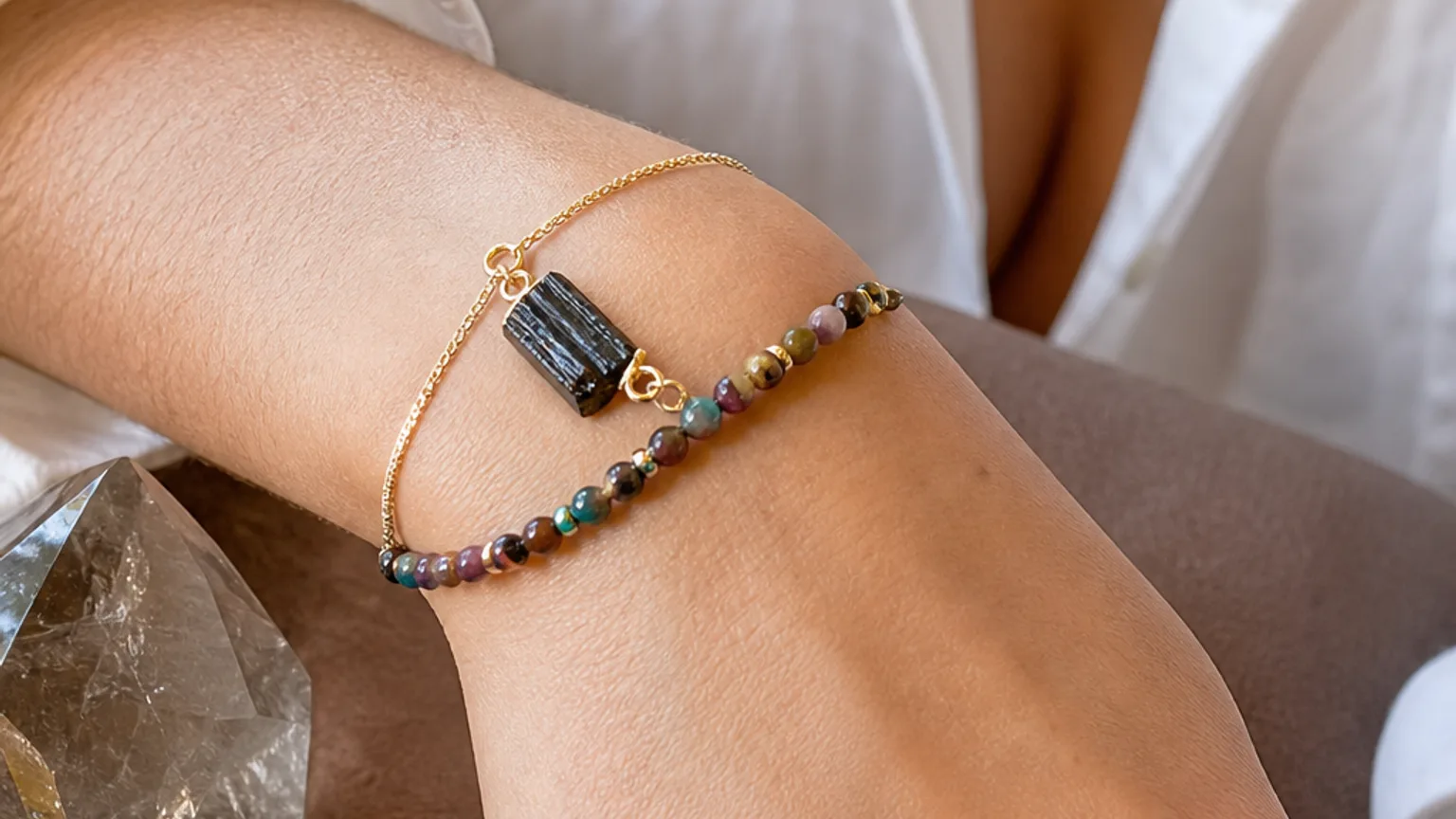
Because tourmaline is a family, its benefits are best read through the individual colors — but the shared theme is balance, protection, and energy. A few ways people work with the family:
Protection (black)
Black tourmaline (schorl) is the family’s protective member — carried for grounding, shielding, and feeling safe around heavy situations.
Love and heart (pink/red)
Pink and red tourmaline (rubellite) lean toward the heart — warmth, compassion, and emotional openness.
Growth and calm (green/blue)
Green (verdelite) and blue (indicolite) tourmaline lean toward growth, healing, calm, and clear communication.
Balance and versatility
With a color for nearly every need, the family lets you match the stone to the moment and balance opposites.
The pattern underneath: the stones aren’t doing the work for you, but they give your day a small structure that makes balance and protection more likely. To go deeper, see our guides to crystals for protection and heart chakra crystals.
Tourmaline Chakra, Zodiac, and Element Associations
Because tourmaline is a family, its associations span the centers by color. Black leans to the root, pink and green to the heart, blue to the throat and third eye. As a family, tourmaline is commonly tied to the heart and root, to Libra and Sagittarius, and to the element of Earth (with Fire for the warmer colors). For related stones, see root chakra crystals.
These are broad correspondences, not fixed rules — each color has its own finer map. If your own sense of a piece points somewhere else, that’s completely fine.
How to Use Tourmaline
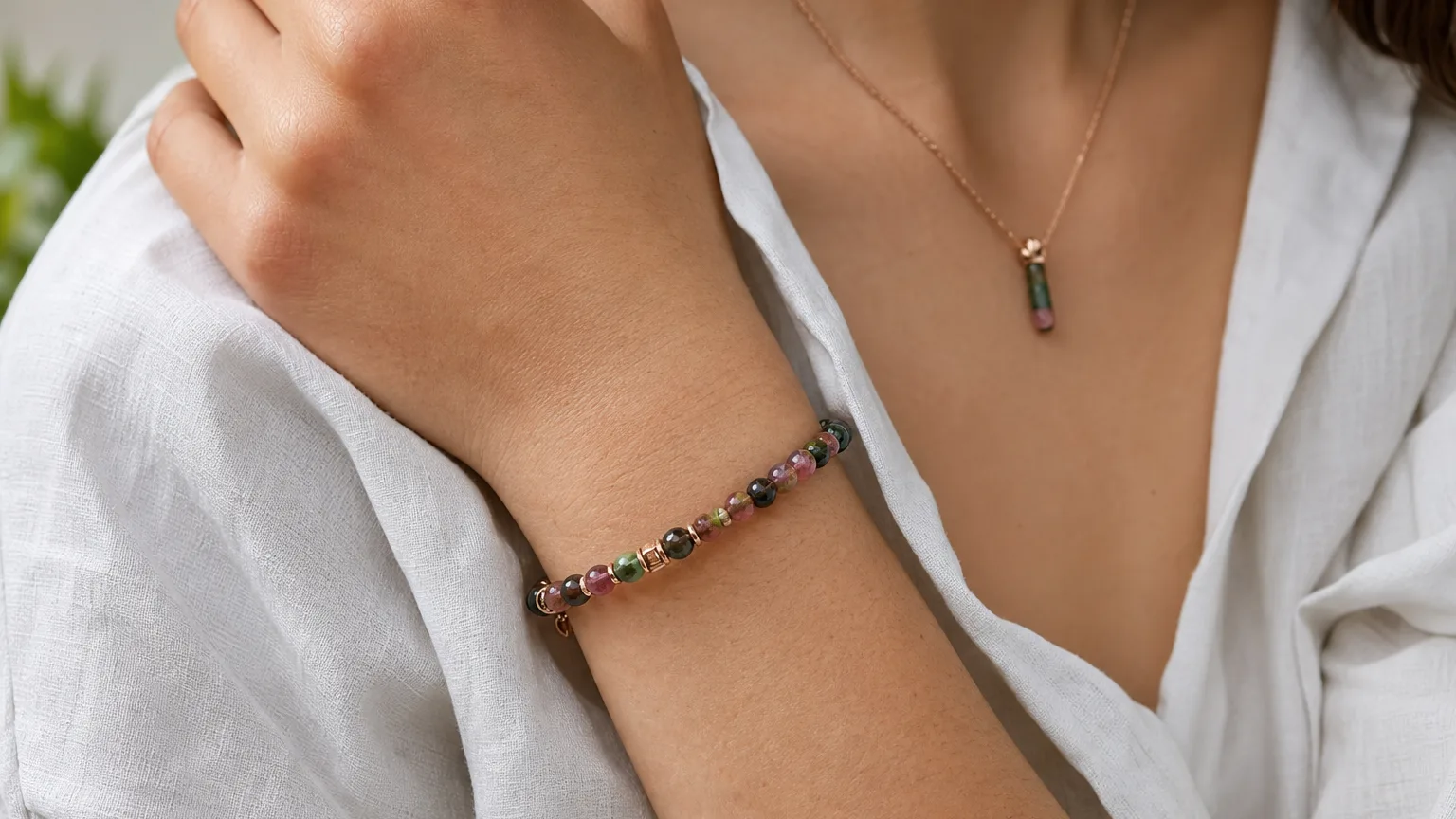
The tourmaline family is flexible — the main practice is choosing the right color for the moment and being consistent.
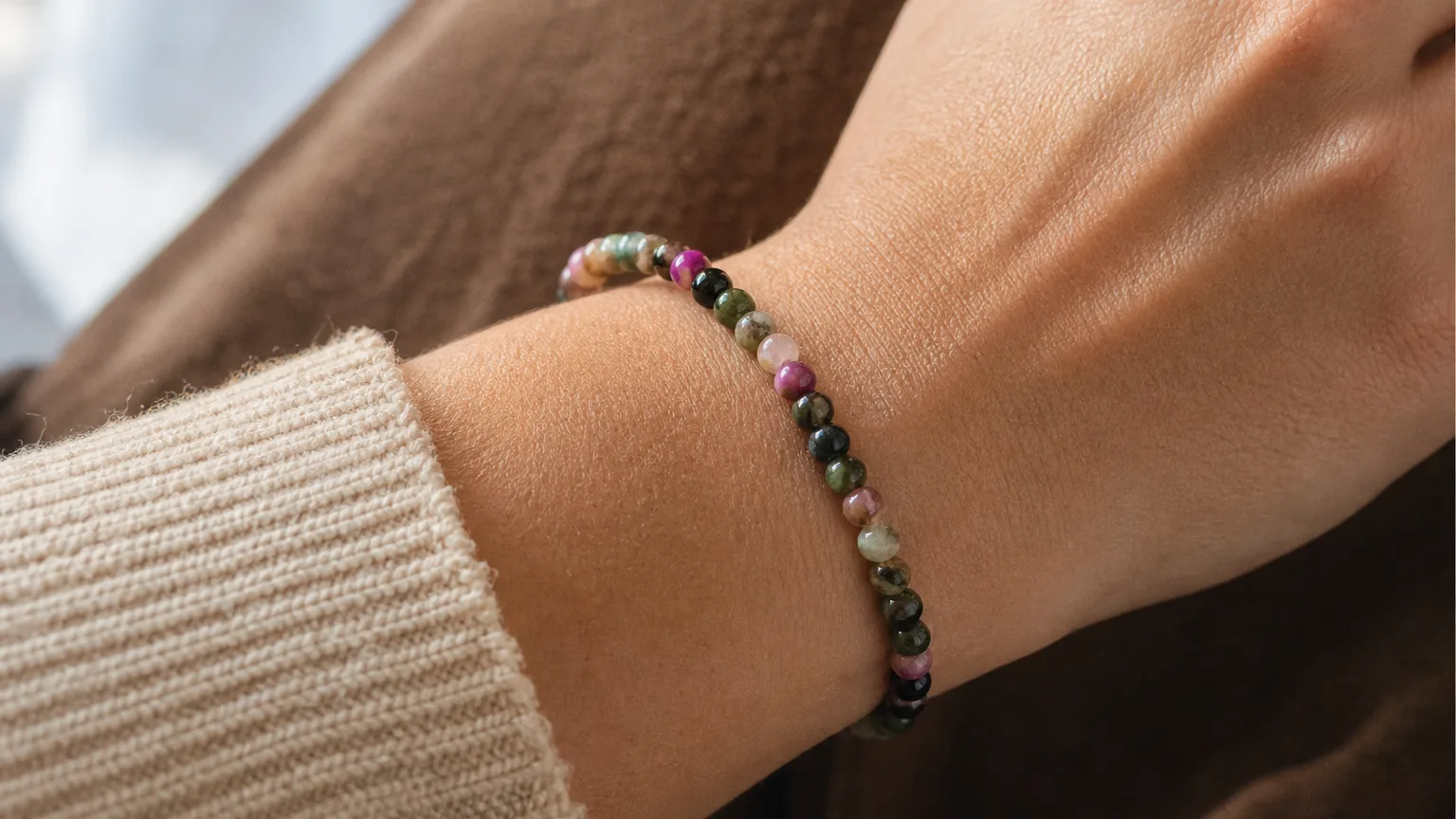
Wear it. A multi-color bead bracelet is the classic way to wear tourmaline (it shows off the range), or a single-color pendant or ring for a focused intention.
Meditate with it. Hold a tumbled stone in your palm while you sit. Black for grounding, pink for the heart, green for calm.
Pair colors. A popular practice is to keep both black and pink tourmaline — protection and warmth — to balance shielding with openness.
Place it at home. Different colors suit different rooms: black at the door for protection, pink in the bedroom for warmth, green where you want calm.
Which Tourmaline Form Is Right for You?
| Form | Best for | Choose it if |
|---|---|---|
| Bead bracelet (multi-color) | Daily wearing, showing range | You want the full color range on the wrist |
| Faceted ring / pendant | Single-color focus | You want one color (pink, green, blue) for a specific intention |
| Tumbled stone | Pocket or meditation | You want something small, smooth, and easy to hold |
| Cabochon | Showing color | You want a smooth polished stone (great for watermelon) |
| Earrings | Everyday jewelry | You want tourmaline color worn near the face |
| Raw crystal / cluster | Altar or display | You like the natural columnar shape and striations |
How to Tell Real Tourmaline from Fakes
Because tourmaline is colorful and popular, the market has imitations — glass, resin, and dyed stones. A few checks help before you buy:
- The crystal shape. Real tourmaline forms three-sided columns with vertical striations and a triangular cross-section. Perfectly smooth, rounded “tourmaline” beads with no columnar structure may be glass.
- Color and pleochroism. Tourmaline often shows slightly different colors from different angles (pleochroism) and tends to have some natural variation. Flat, too-vivid, single colors can be dyed or glass.
- Hardness. At Mohs 7–7.5, real tourmaline scratches glass. Glass and resin won’t.
- Watermelon check. Genuine watermelon tourmaline has a pink core and green rim in the same stone (not glued layers). Check the cross-section.
- Price and seller. Buy from sellers who name the variety and color. Vivid, flawless “tourmaline” at low prices is usually glass or dyed.
A note on dye. Some pale or cracked tourmaline is dyed to brighter colors. Dye isn’t dangerous but it isn’t the natural color and can fade, so for genuine tourmaline look for natural color variation and a reputable seller.
How to Cleanse and Charge Tourmaline
Tourmaline is hard and stable, so most of it is low-maintenance — with a color caveat. A few reliable methods:
- Water. A brief rinse under cool running water is fine for most tourmaline (Mohs 7–7.5). Avoid long soaks.
- Moonlight. Leave it out overnight under a full moon — gentle and effective.
- Smoke. Pass it through sage or palo santo smoke and let it drift over every side.
- Sound. A singing bowl or bell near the stone. At minimum, it’s a mindful pause.
Things to ease up on: prolonged direct sunlight (some pink, red, and rubellite tourmaline can fade in strong constant sun) and salt water (dulls the polish, corrodes metal findings). Ultrasonic cleaning is generally OK for clean stones but risky for included or treated ones. For the full routine, see our guide to cleansing crystals.
Best Crystals to Pair With Tourmaline
Because tourmaline is a family, “pairing” often means another color or a complementary stone. A few classic combinations:
- Black + Pink Tourmaline — protection meets warmth; the family’s signature pairing for balance between feeling shielded and staying open-hearted.
- Tourmaline + Clear Quartz — many use clear quartz to hold and amplify tourmaline’s color-specific intention.
- Tourmaline + Lepidolite — a natural pairing, since tourmaline and lepidolite often grow together; layered for calm and balance.
The logic of pairing is about complementary intentions, not strict rules. Pick combinations that match what you’re actually working on, and trust your own sense of what feels balanced.
Who Should Use Tourmaline?
The tourmaline family suits people who want flexibility and a stone for the moment — anyone drawn to its color range, who likes having a stone for protection (black), love (pink), growth (green), or calm (blue), or who simply wants a colorful, protective family to build a collection around.
A few honest expectations: tourmaline stones aren’t treatments for any condition — if you’re dealing with something persistent, a healthcare professional is the right call, and a stone can be a comfort alongside that. They won’t “do” anything on their own; their value comes from the intention and routine you build around them. If you go in expecting a stone to fix things for you, you’ll be let down. If you go in expecting a steady support for your own practice, the family tends to fit well.
FAQ About Tourmaline Meaning
Why is tourmaline so many colors?
Different trace elements (iron, manganese, chromium, copper, and others) produce its range — red, green, blue, pink, yellow, black, and bi-color. It’s one of the most colorful gem families on earth.
What is watermelon tourmaline?
A single tourmaline crystal with a pink core and green rim — naturally, not glued. It’s a popular heart-and-growth symbol, usually cut as a slice or cabochon to show both colors.
Is tourmaline really pyroelectric?
Yes — tourmaline genuinely builds a small electrical charge when heated or pressed (pyroelectric and piezoelectric). It’s a real, measurable mineral property, not a healing effect.
Can tourmaline go in water?
Yes, mostly — at Mohs 7–7.5, a brief rinse under cool water is fine. Avoid long soaks and salt water.
Does tourmaline fade in sunlight?
Some colors can — pink, red, and rubellite tourmaline may fade in prolonged strong sun. Keep colored tourmaline out of bright, constant light.
How can I tell if my tourmaline is real?
Look for the three-sided columnar shape with vertical striations, possible pleochroism (color shifts by angle), Mohs 7–7.5 hardness, and natural color variation. Too-vivid or perfectly smooth pieces may be glass or dyed.
Is tourmaline good for beginners?
Very — its members are affordable, durable, widely available, and the color range means there’s a tourmaline for almost anyone.
What is canary tourmaline?
Canary tourmaline is a bright yellow variety of tourmaline, often from Zambia or Mozambique. It is tourmaline colored by trace elements to a vivid yellow. Blue tourmaline (indicolite) is a blue-colored variety of tourmaline. It is the same tourmaline mineral, colored by iron to shades of blue.
Final Thoughts on Tourmaline
The tourmaline family has earned its place through sheer range — a color for nearly every mood and need, all from one brilliant mineral family. If you’re curious, pick the color that fits what you’re working on — black for protection, pink for love, green for growth, blue for calm — and give it a job to do. You don’t need the whole family at once; you need one stone you’ll actually see and hold. Let the routine do the work, and let the tourmaline be the colorful reminder that brings you back to balance.
For more, explore the Crystal Guide or browse tourmaline jewelry and crystals.