Garnet Meaning: Healing Properties & Uses
Garnet is the name for a whole family of silicate minerals that come in nearly every color — though deep red is the one most people know. Long tied to protection, passion, and energy, it’s also the modern January birthstone. If you’re drawn to its rich red for grounding or motivation, this guide covers what garnet actually is, why one “garnet” can look so different from another, and how to tell the real stone from look-alikes. Crystal meanings reflect tradition and personal practice, not medical advice.
What Is Garnet Meaning?
At its simplest, garnet means protection and steady energy. With its deep, wine-red tones (in the common varieties), it reads as warm and grounding — a stone people reach for motivation, courage, or a sense of being rooted and protected. It’s often carried as a reminder of commitment and loyalty.
For a lot of people that’s the whole appeal: one rich piece, one intention, one small daily ritual. You don’t need to believe anything mystical to benefit — the value often comes from the act of choosing the stone and letting its warm color pull your attention back to a steady, energized baseline. In that sense garnet is a visual cue you train yourself to return to.
Garnet Meaning and Symbolism
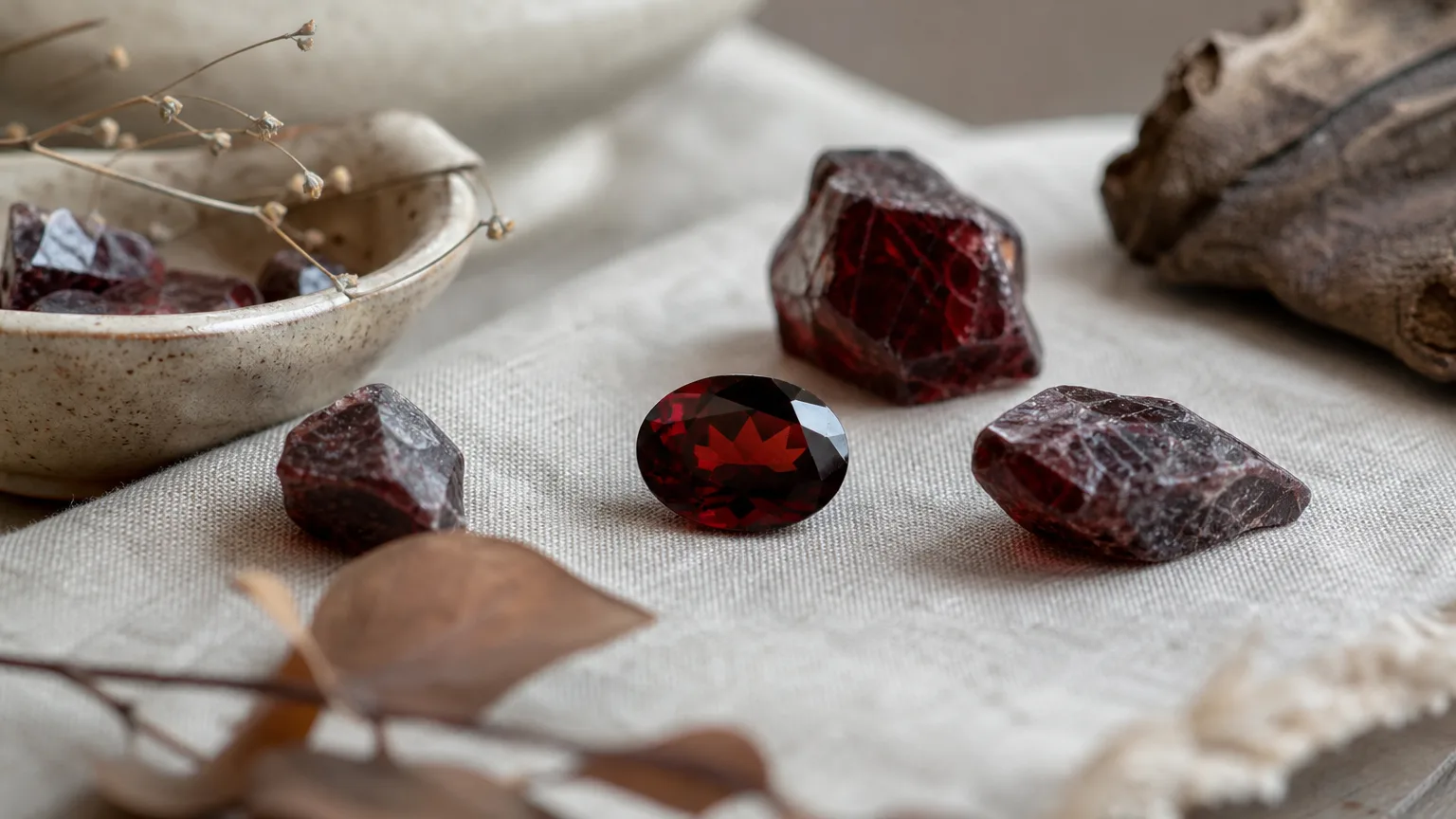
The first thing to know about garnet is that it isn’t a single mineral — it’s a family. Garnet is a group of closely related silicate minerals that share the same crystal structure but differ in their chemistry, which is why one garnet can be deep red, another orange, another vivid green, and another honey-brown. The name comes from the Latin granatus, meaning “seed” or “grain,” because the small red crystals looked like pomegranate seeds.
Garnet has a long history of use. Ancient Egyptians set it into jewelry, and Roman signet rings were carved from it. In medieval Europe it was carried as a protective stone, and the rich red varieties became strongly tied to ideas of life, courage, and loyalty — fitting for a stone the color of blood. In the 1800s, the famous Bohemian garnets (a bright red pyrope variety from Central Europe) fueled a whole jewelry boom, set in dense clusters across brooches and rings.
Today the common threads are consistent: protection, passion, energy, and commitment. You’ll see garnet described as a stone for motivation, grounding, and loyalty — and as the January birthstone, a meaningful gift to mark a birthday. How much of that you experience personally is up to you, but the symbolism has traveled across thousands of years. To explore more stones, browse the full Crystal Guide.
Garnet Properties
The Science
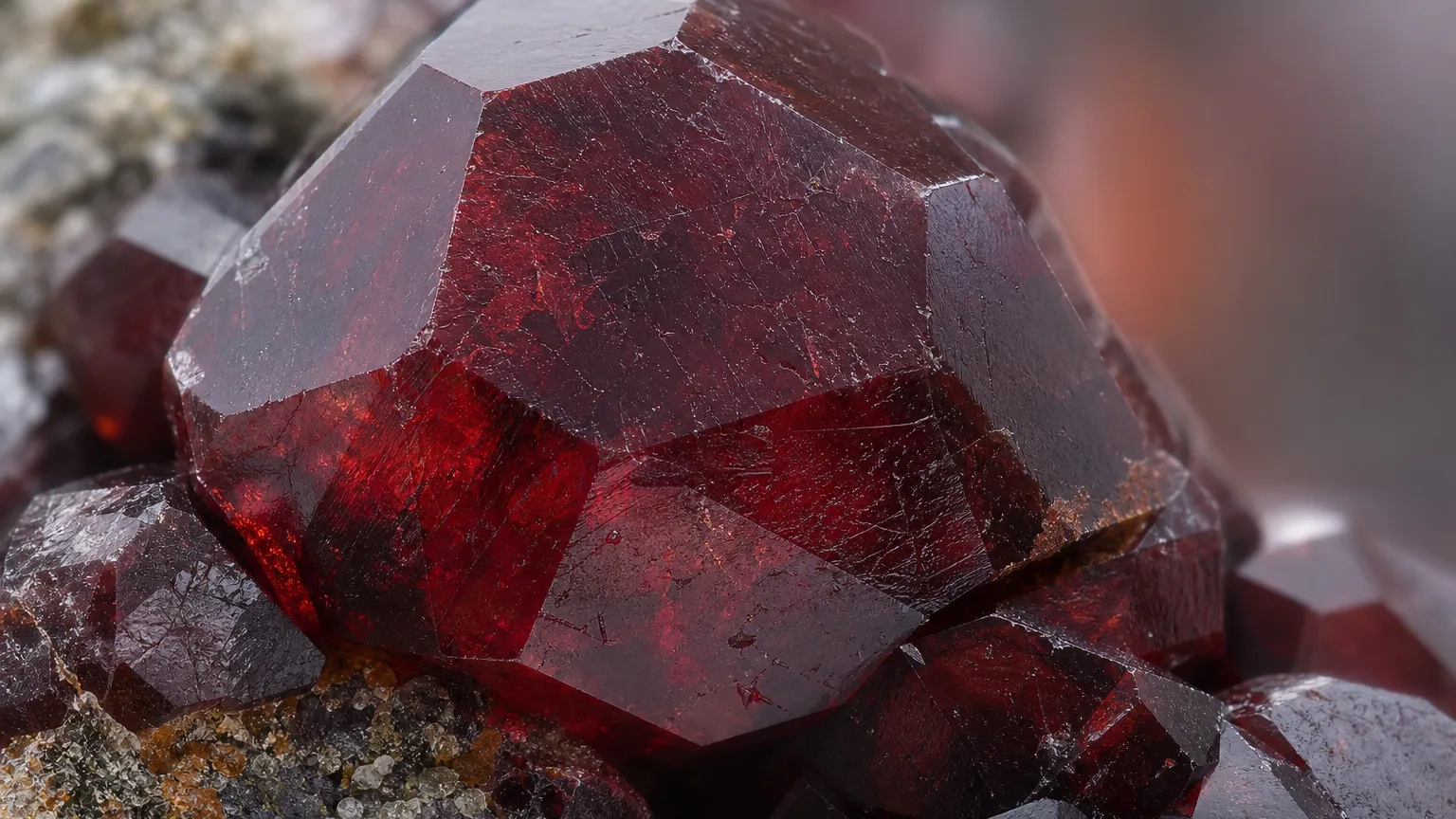
Garnet is a group of nesosilicate minerals with the general formula X₃Y₂(SiO₄)₃, where X and Y are different metals (things like iron, magnesium, calcium, aluminum, or chromium). Swap those metals and you get different species — almandine and pyrope for the common reds, spessartine for orange, grossular for green and honey (including the vivid green tsavorite), and andradite for the rare green demantoid. They all crystallize in the cubic system, often forming the rounded, twelve-faced shapes (rhombic dodecahedrons) garnet is famous for. Hardness ranges from about 6.5 to 7.5 on the Mohs scale, so most garnets are tough enough for everyday wear. Sources span the globe, with notable material from India, Sri Lanka, Madagascar, Brazil, Tanzania, and Russia. None of this is mystical — it’s mineralogy, and the variety is a direct result of the chemistry.
Traditional Meaning
Tradition ties garnet to protection, passion, and steady energy. It’s linked to the root and sacral centers and is often described as a stone of courage and commitment — many believe it grounds scattered energy, supports motivation, and strengthens loyalty and friendship. Across thousands of years it was carried as a protective talisman, especially by travelers, and the deep red varieties carried a strong link to vitality and the life force. These associations come from spiritual tradition and personal practice rather than clinical study.
Mindfulness & Psychology
From a psychological angle, garnet works as a warm, grounding focal cue — something rich and red to hold when you want to feel rooted and energized. In color psychology, deep red is linked to drive, warmth, and presence, and the act of carrying a piece and pairing it with an intention (stay grounded and motivated today) turns it into a small cue you keep returning to. For anyone who feels scattered or low on drive, a glance at that warm tone can be a steadying nudge. These effects come from tradition and personal practice, not clinical research. Crystals complement — but never replace — professional care.
Garnet Benefits

People who work with garnet usually describe it in terms of energy, grounding, and protection, not dramatic effects. It tends to show up as a steadier, more motivated mood. Here are a few of the benefits people mention most often:
A lift in drive and energy
Its warm red tone reads as energizing; many keep it nearby when they need motivation and forward motion rather than rest.
A grounding anchor
Carried through demanding days, garnet is a cue to feel rooted and steady — a reminder to stay present when things speed up.
A sense of protection
Long carried as a protective charm, many wear it through travel or hard stretches as a reassuring, steady presence.
A symbol of loyalty
Tied to commitment and friendship, garnet makes a meaningful gift — and it’s the traditional second-anniversary stone.
The pattern underneath all of these is the same: the stone isn’t doing the work for you, but it gives your day a cue toward grounded energy. If you’re exploring stones for specific needs, see our guide to 不安に効くクリスタル.
Garnet Chakra, Zodiac, and Element Associations
In traditional systems, garnet is most often linked to the root and sacral centers (and the heart for green varieties) — the areas tied to grounding, drive, and warmth. It’s a modern birthstone for January, and it’s commonly paired with Capricorn, Aquarius, and Aries. Its element is usually given as Fire. For related stones, see root chakra crystals.
These are correspondences built up through tradition, not rules carved in stone. If your own sense of garnet points somewhere else — a different chakra, a different element — that’s completely fine. Many people work with stones intuitively, following what feels right rather than a textbook chart, and there’s a long history of practitioners doing exactly that.
How to Use Garnet
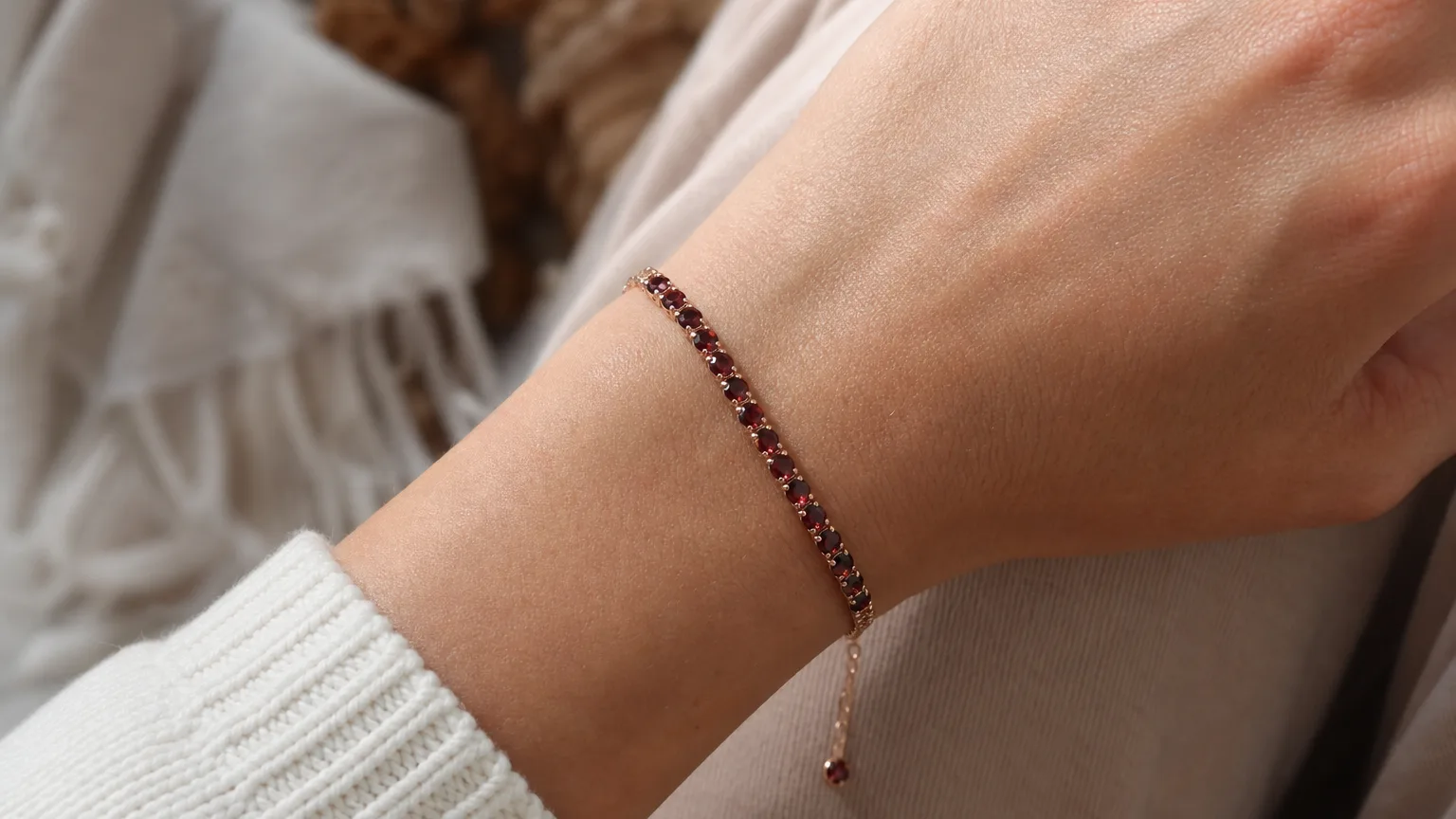
Garnet is a hard stone (Mohs 6.5–7.5), so it takes daily wear well — a real advantage for a piece you’ll live in. The key is consistency: a stone you actually see and touch every day does far more than one stored away.
Wear it. A ring or beaded bracelet keeps the warm color with you through the day. Pair one piece with a specific intention — “stay grounded,” “keep moving forward.”
Meditate with it. Hold a tumbled piece in your palm or rest it at your root while you sit. Even a few minutes of calm focus counts; the goal is presence, not duration.
Carry a tumbled stone. A smooth piece in a pocket is a discreet touchstone — something to hold when you want a grounding nudge.
Keep it as a birthstone or anniversary piece. For a January birthday or a second anniversary, a single garnet is a meaningful, durable piece meant to be worn for years.
Which Garnet Form Is Right for You?

| Form | Best for | Choose it if |
|---|---|---|
| Faceted stone | Rings, pendants | You want a classic cut that shows the deep red brilliance |
| Beaded bracelet | Daily wearing | You want an affordable, wearable row of garnet through the day |
| Pendant | Daily wearing | You want the warm color worn near the heart or chest |
| Raw dodecahedron | Collection, display | You like the natural twelve-sided crystal shape on a shelf |
| Cabochon | Rings, casual jewelry | You prefer a smooth domed cut in a chosen color |
| Tumbled stone | Pocket or meditation | You want a smooth, affordable piece to hold or carry |
How to Tell Real Garnet from Look-Alikes
Garnet is common and usually sold as natural stone, so outright fakes are less of an issue than with rarer gems — but it’s still worth knowing what you’re holding. A few checks help:
- Hardness. At Mohs 6.5–7.5, real garnet scratches glass and resists a steel knife. Glass imitations are softer and won’t scratch glass.
- Weight. Garnet is dense (specific gravity 3.5–4.3), so a genuine piece feels heavier than a same-sized piece of glass or plastic.
- Color. Natural red garnet usually has subtle brown or orange undertones and some variation. Perfectly uniform, neon-bright red can point to glass or another stone.
- Garnet vs ruby. Ruby is harder (Mohs 9) and far more expensive, and the two are sometimes confused. A gemological check settles it — if a “ruby” price seems too good, it may be garnet.
- Rare green varieties. Tsavorite and demantoid are valuable green garnets, and they’re sometimes imitated by glass or green glass composites. Buy these from a reputable dealer.
For most everyday red garnet, a reputable seller and a sensible price are enough — it’s an honest, affordable stone. Save the gem-lab certificate question for the rarer, pricier varieties.
How to Cleanse and Care for Garnet
Garnet is a hard, stable stone, so it’s easy to care for — one of the more forgiving colored stones for daily wear. A few reliable practices:
- Water. A brief rinse under cool water is fine, and a little mild soap works for routine cleaning.
- Sunlight. Garnet color is stable, so sun cleansing is safe and won’t fade the stone.
- Moonlight. A night under the moon is a popular gentle method, often paired with setting an intention.
- Smoke or sound. Passing it through sage or palo santo smoke, or using a singing bowl nearby, is a no-contact option many prefer.
One practical note: avoid sudden temperature swings and harsh chemical cleaners, which can stress or dull the stone. Ultrasonic cleaning is generally fine for most garnets but best avoided for heavily included stones. For the full routine, see our guide to cleansing crystals.
Best Crystals to Pair With Garnet
Pairing is about layering intentions — picking stones whose qualities complement rather than compete. A few combinations that work well with garnet’s grounding, energetic presence:
- Garnet + ローズクォーツ — warm passion softened with tenderness; a balanced pairing for the heart.
- Garnet + Smoky Quartz — energy meets grounding; a popular combo for staying motivated and rooted.
- Garnet + シトリン — two warm, energetic stones; a bright pairing for drive and an upbeat mood.
The logic of pairing is about complementary intentions, not strict rules. Pick combinations that match what you’re actually working on, and trust your own sense of what feels balanced.
Who Should Use Garnet?
Garnet suits people who want a warm, grounding stone for energy, courage, and commitment — anyone wanting motivation, a steadier root, or a meaningful January birthstone that can be worn daily. It’s an approachable stone because it’s affordable, widely available, and tough enough to live in.
A few honest expectations: garnet isn’t a treatment for fatigue, low mood, or any condition — if you’re dealing with something persistent, a healthcare professional is the right call, and the stone can be a comfort alongside that. It’s a mineral family rather than a single stone, so colors and species vary widely, which is part of its appeal. Its value comes from the intention and routine you build around it. Go in expecting a warm, durable, symbolic stone you can wear for years, and it tends to fit well.
FAQ About Garnet Meaning
What is garnet made of?
Garnet is a group of silicate minerals with the formula X₃Y₂(SiO₄)₃. Different metals in that formula create different species and colors — red almandine, orange spessartine, green tsavorite, and so on.
What colors does garnet come in?
Nearly every color. Deep red is most common, but garnet also comes in orange, green, yellow, honey-brown, purple-red, and (rarely) blue. Green tsavorite and demantoid are especially prized.
Is garnet a January birthstone?
Yes. Garnet is the modern birthstone for January, and it’s also the traditional second-anniversary stone.
What chakra is garnet associated with?
Traditionally the root and sacral centers (and the heart for green varieties), linked to grounding, drive, and warmth.
How hard is garnet?
About 6.5–7.5 on the Mohs scale, depending on the species. Most garnets are tough enough for everyday rings and daily wear.
How can I tell real garnet from glass or ruby?
Test hardness (real garnet scratches glass), check the weight (garnet is dense), and look for natural color variation. Ruby is harder and far pricier — a gem lab settles any doubt.
What does garnet symbolize?
Most often protection, passion, energy, and commitment — a warm, grounding stone with a long history as a protective and loyal token.
What is Mozambique garnet?
Mozambique garnet is a red-to-purplish garnet (mostly almandine-pyrope blend) from Mozambique. It is the same garnet mineral, named for its African source.
Final Thoughts on Garnet
Garnet earns its place as a stone of protection and steady energy — and it earns it again for each person who wears it and gives it meaning. If you’re curious, the simplest start is one warm piece, one intention, and a small daily moment to notice it. You don’t need the rarest green species or the largest faceted stone; you need a piece you’ll wear and use. Let the routine do the work, and let that deep, steady red be the cue that grounds and motivates you.
From there, garnet tends to open a steadier, warmer space — a grounded mood, a lift of drive, or simply a durable stone you’re glad to wear. If that’s what you’re after, you’re in the right place. For more, explore the Crystal Guide or browse garnet pieces.