Best Blue Crystals: Names, Meanings, Properties & Uses
Quick Answer: Best Crystals for Blue
The best crystals for Blue include Kyanite, Larimar, Amazonite, traditionally used in mindfulness and spiritual practices. Crystal properties are complementary wellness tools, not medical treatments.
Understanding Blue Crystals
Blue is the colour most people reach for when they want to slow down. Across cultures it has been tied to the sky, the sea, and the open spaces that ask nothing of you. Ancient Egyptians ground lapis lazuli into pigment for the eyes of royal portraits; Tibetan and Native American traditions set turquoise into amulets for safe passage; medieval Europeans linked sapphire blue with clarity and the heavens. The thread is consistent: blue was the colour of distance, of breath, of a calmer mind.
Modern colour psychology echoes much of this. Exposure to blue tones tends to lower perceived stress and is widely used in spaces meant to feel quiet and trustworthy — therapy rooms, reading corners, the apps you open at midnight. In crystal practice, blue stones are most often paired with the throat and third eye centres, the areas linked to speaking honestly and listening inward. None of this is a cure. It is a sensory cue — a colour, a cool weight in the hand, a small ritual — that helps many people settle enough to think clearly and say what they mean.
Quick facts: Symbolism: Calm, truth, communication. Psychology: Soothing, focus, honest expression. Associated chakra: Throat/Third Eye, element: Water/Air.
Not sure which color is right for you? Try the Crystal Quiz ↗
How to Identify Blue Crystals
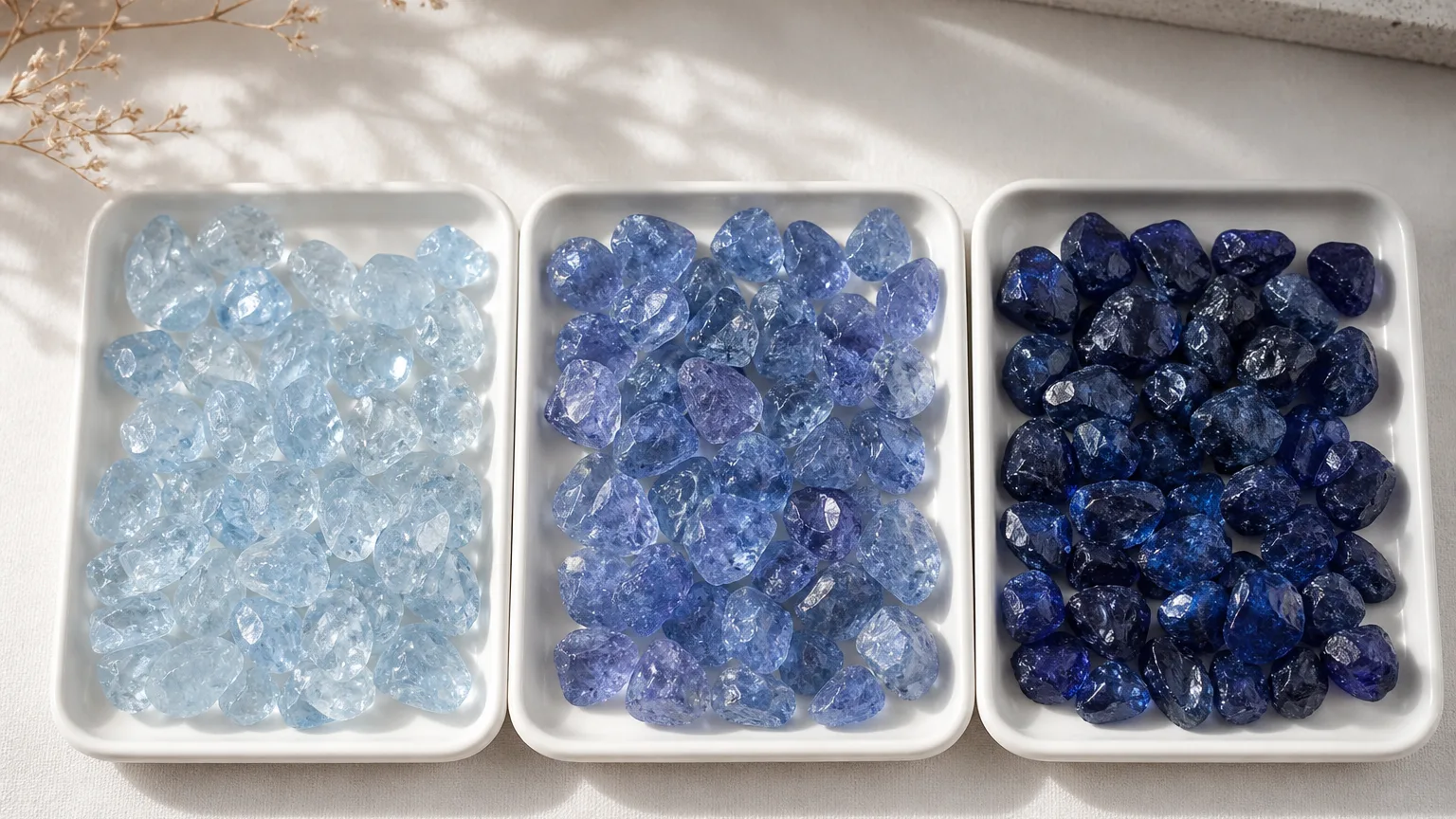
Blue covers a wide band, from the pale ice of angelite to the midnight of lapis, and learning to read the shade tells you a lot about a stone. Light to mid blues (angelite, aquamarine, pale apatite) usually look soft and slightly milky. Deep, saturated blues (lapis lazuli, sodalite, kyanite) tend toward indigo and often hold their colour only under bright light. Translucent blues let light pass through the edges; opaque blues reflect it off the surface.
Texture matters too. Kyanite has a glassy, fibrous look with parallel streaks. Turquoise and amazonite are waxy to earthy and rarely fully clear. Labradorite and moonstone are famous for schiller — a blue flash that moves as you tilt the stone, caused by light scattering through thin internal layers. If the “blue” only appears at certain angles and the body is grey or white, you are looking at a sheen stone, not a body-colour stone.
The common mix-ups: Amazonite vs Turquoise — amazonite is usually a brighter blue-green with white banding and a harder, glassier surface; turquoise runs more uniformly green-blue with a waxy, sometimes chalky feel. Lapis vs Sodalite — true lapis lazuli shows real gold pyrite flecks and white calcite veins; sodalite is a more even royal blue with few or no gold specks. Angelite vs howlite dyed blue — natural angelite is a soft, powdery blue with a slightly grainy texture; dyed howlite looks overly saturated and the colour sits in surface cracks. Light shifts the look of all of them: warm indoor bulbs push blue stones toward grey, while daylight shows their truest hue.
9 Best Crystals for Blue
Kyanite
색상: Blue (also black, green, orange)
Meaning: Calm, truth, communication
Best for: Communication, Meditation, Focus
차크라: Throat, Third Eye
요소: Air
Best way to use: Wear as jewelry
Affirmation: I speak my truth clearly and calmly.
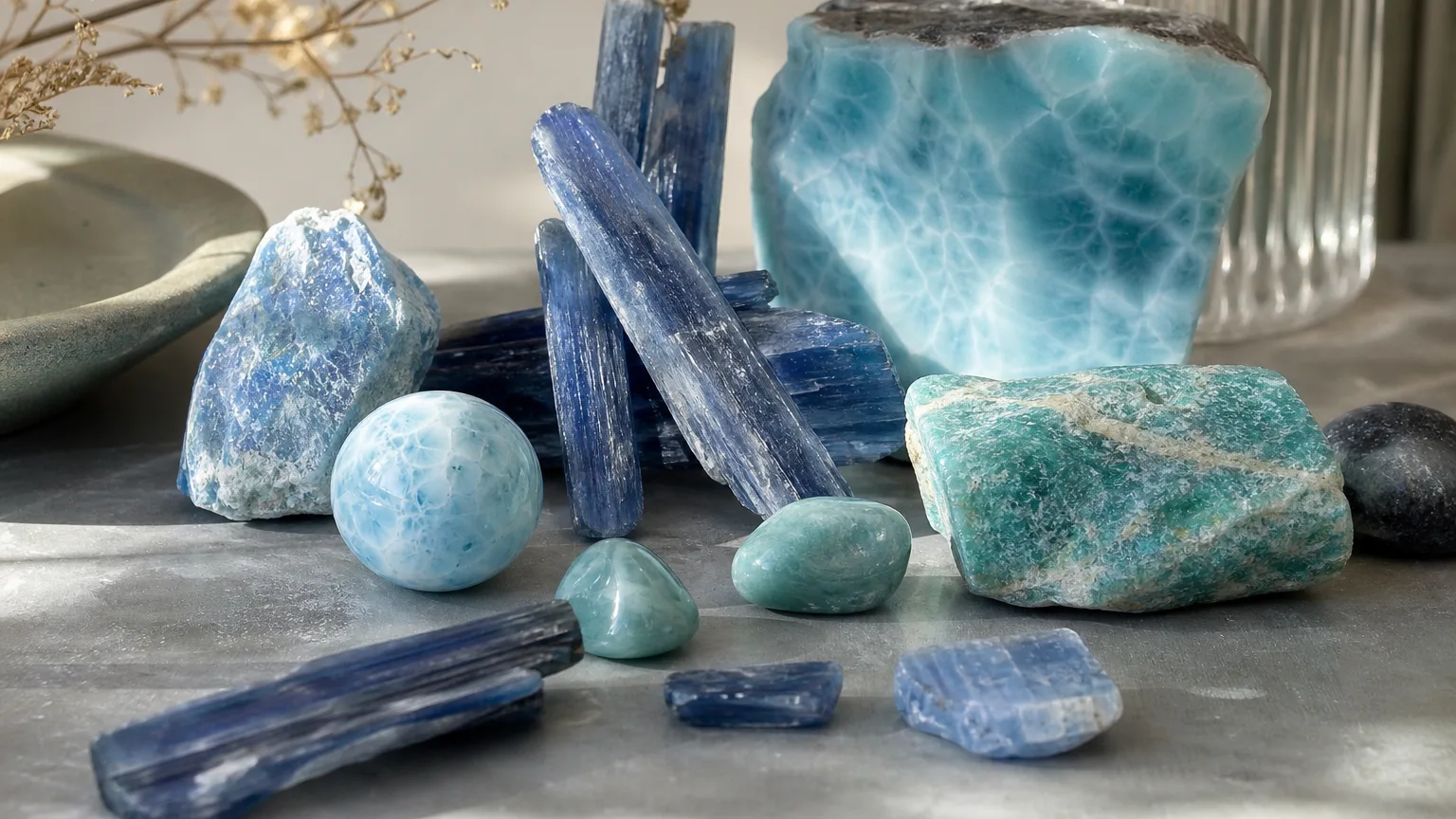
Kyanite is a blue silicate (Al₂SiO₅) that forms in long, blade-like crystals with a glassy, fibrous sheen — its streaky blue comes from trace iron and titanium. It is unusual among minerals: it rarely needs cleansing in tradition, and its colour reads cool and clean, the kind of blue that quiets the eye on contact. In practice it is tied to the throat and third eye centres and is the stone many people reach for before speaking, studying, or settling a racing mind. Hold a blade flat against the base of your throat and breathe slowly for a few minutes; let it be a cue to say what is true without rehearsing it first.
Larimar
색상: Blue, White
Meaning: Calm, truth, communication
Best for: Calm, Emotional balance, Communication
차크라: Throat, Heart
요소: Water
Best way to use: Wear as jewelry
Affirmation: I release tension and let calm flow through me.
Larimar is a rare blue variety of pectolite found only in the Dominican Republic. Its colour ranges from pale sky to deep ocean blue, often patterned with white waves that look like sunlight on water — the result of copper and manganese within a calcium-sodium silicate. The stone feels cool and smooth, and that watery look is exactly why it is used for calm and emotional balance, especially at the throat and heart. Many people keep a piece on the bedside table as a quiet visual cue to soften the breath before sleep. It is one of the gentlest blue stones for winding down an overbusy day.
Amazonite
색상: Blue-green, turquoise-green
Meaning: Calm, truth, communication
Best for: Communication, Calm, Honesty
차크라: Heart, Throat
요소: Water
Best way to use: Wear as jewelry
Affirmation: I express myself honestly and without fear.
Amazonite is a green-blue variety of microcline feldspar (KAlSi₃O₈), coloured by lead and water traces in its crystal structure. It usually shows a bright turquoise-to-blue-green body with clean white banding, and it takes a smooth, glassy polish that feels cool and steady in the hand. In tradition it sits between the heart and throat centres and is often used as a stone of honest expression — the kind you reach for when you have been holding something back. Place it on your desk while you write or email, and let it be a small cue to say the real thing instead of the safe one.
Turquoise
색상: Blue to green
Meaning: Calm, truth, communication
Best for: Communication, Protection, December birthstone
차크라: Throat, Third Eye
요소: Earth
Best way to use: Wear as jewelry
Affirmation: I am steady, protected, and true to my word.
Turquoise is a hydrous copper-aluminium phosphate (CuAl₆(PO₄)₄(OH)₈·4H₂O), and the copper is what gives it that signature sky-to-green blue, often threaded with dark matrix veins. It is one of the oldest stones used by humans — set into amulets across Tibet, the American Southwest, and ancient Egypt for protection on the road. To the touch it is waxy and slightly warm, and that long travel history is why it is still carried as a steady companion for difficult conversations and new situations. As December’s birthstone it makes a meaningful gift; worn at the throat, it serves as a quiet reminder to speak from a calm, grounded place.
Apatite
색상: Blue-green, blue, green, yellow, violet
Meaning: Calm, truth, communication
Best for: Motivation, Creative work, Expression
차크라: Throat, Third Eye
요소: Fire
Best way to use: Wear as jewelry
Affirmation: I act on my ideas with clarity and courage.
Blue apatite is a calcium phosphate (Ca₅(PO₄)₃(F,Cl,OH)) that ranges from a bright sea blue to blue-green, often translucent with a glassy brightness that catches the light. Unlike the softer blue stones, apatite has a sharper, more electric tone, which is part of why it is paired with motivation and creative follow-through rather than pure rest. It sits at the throat and third eye centres and is used by people who have plenty of ideas but struggle to act on them. Hold a piece during a planning session, or keep it where you can see it when you sit down to begin — a small visual nudge to start before you feel ready.
Angelite
색상: Soft blue
Meaning: Calm, truth, communication
Best for: Gentle expression, Meditation, Calm
차크라: Throat, Third Eye
요소: Air
Best way to use: Wear as jewelry
Affirmation: I speak gently, and I am heard.
Angelite is a soft, powdery blue form of anhydrite (CaSO₄) — a calcium sulphate that formed when the water evaporated from ancient seas. Its colour is pale and even, with a slightly grainy, matte surface that feels lighter than most blue stones. That gentle quality is exactly why it is used for soft, steady expression rather than forceful speech. Placed at the throat or third eye during a quiet evening sit, it serves as a cue to lower the volume — to speak honestly without bracing or pushing. Many people keep it beside the bed as part of a calming wind-down, alongside slow breathing and a few minutes of stillness.
Labradorite
색상: Grey-black body with blue/gold/green flash
Meaning: Calm, truth, communication
Best for: Change, Intuition, Creativity
차크라: Throat, Third Eye
요소: Water
Best way to use: Wear as jewelry
Affirmation: I trust myself through change and new beginnings.
Labradorite is a feldspar (Na,Ca)(Al,Si)₄O₈ whose grey-black body holds a flash of blue, gold, or green that moves as you tilt the stone — an effect called labradorescence, caused by light scattering through thin internal layers. So while it carries blue, it reads dark and shifting rather than openly blue, which fits its traditional link to change, intuition, and the in-between moments. Many people carry it during transitions — a new job, a move, a hard conversation — as a steadying object to hold in the hand. The flash is a small reward for paying attention, a reminder that useful things often appear only at the right angle.
Read full Labradorite meaning →
Moonstone
색상: White/cream with blue-white sheen
Meaning: Calm, truth, communication
Best for: Intuition, Emotional balance, June birthstone
차크라: Third Eye, Crown, Sacral
요소: Water
Best way to use: Wear as jewelry
Affirmation: I move with the natural rhythm of my own life.
Moonstone is a feldspar of orthoclase and albite whose body is white or cream, but a blue-white glow called adularescence drifts across its surface as you turn it — light scattering through the stone’s layered structure. So the “blue” here is a sheen, not a body colour, and that soft moving glow is why it has long been tied to the moon, intuition, and emotional tides. June’s birthstone is often used to steady mood swings and support inner listening. Kept on the bedside table (not inside the pillow), it gives the eyes a gentle, dim colour to rest on at night, a small cue to soften and let the day go.
라피스 라줄리
색상: Deep blue with gold and white
Meaning: Calm, truth, communication
Best for: Meditation, Communication, Focus
차크라: Third Eye, Throat
요소: Air
Best way to use: Wear as jewelry
Affirmation: I see clearly and speak with steady confidence.
Lapis lazuli is a rock rather than a single mineral — mainly lazurite (a sodium-calcium-aluminium silicate sulphate) mixed with white calcite veins and gold pyrite flecks that look like stars in a deep-blue sky. That combination of midnight blue, gold, and white is what made it the stone of scribes, priests, and royalty from ancient Egypt to the Renaissance, when it was ground into the pigment ultramarine. The deep blue reads heavy and serious, which suits its traditional tie to the third eye and throat — focus, honest speech, and clear judgement. Kept on a desk or held before a difficult conversation, it serves as a weighty cue to think first and then say what is true.
Read full Lapis Lazuli meaning →
How to Choose Blue Crystals by Intention
Blue stones overlap a lot, so the quickest way to choose is to match the stone to what you are actually trying to do. Use this matrix as a starting point.
| Intention | Best Blue Crystals | Why this stone |
|---|---|---|
| Honest, clear communication | Kyanite, Lapis Lazuli, Amazonite | Traditionally tied to the throat centre and to speaking without second-guessing |
| Calm and emotional balance | Larimar, Angelite, Moonstone | Soft, watery blues often used to settle overthinking and steady the mood |
| Focus and study | Lapis Lazuli, Kyanite, Sodalite | Deeper blues associated with the third eye and concentrated attention |
| Creative motivation | Apatite, Labradorite | Brighter, energetic blues linked to fresh ideas and follow-through |
| Protection during change | Turquoise, Labradorite | Stones long carried as travel and transition amulets |
| Intuition and reflection | Moonstone, Labradorite, Lapis Lazuli | Stones with sheen or depth, used for inner listening |
How to Use Blue Crystals
Blue stones are most often turned to for the throat and for winding down, so the rituals below focus on those two needs. Pick one or two rather than all of them.
1. Throat-centred meditation. Sit comfortably and hold a blue stone such as kyanite, larimar, or angelite against the base of your throat. Close your eyes and breathe slowly for three to five minutes. Before you finish, say one true sentence out loud — even something small. The point is to let your voice out before the day asks anything of it. This is the practice blue crystals are best known for.
2. Jewelry worn near the throat. A pendant or short necklace keeps the stone close to the throat centre through the day, where it acts as a quiet reminder to speak honestly and breathe before answering. Lapis, turquoise, and larimar all suit this. A ring or bracelet works too if you glance at it often.
3. Journaling on the desk. Place a piece of lapis lazuli, sodalite, or apatite next to your notebook when you write. The cool blue tone helps many people settle into honest self-expression. Use it as a visual anchor — when your eyes drift to the stone, write one line that is truer than the last.
4. Calming sleep routine. A small moonstone, angelite, or larimar placed on the bedside table (not inside the pillow) gives the eyes a soft, dim colour to land on as you wind down. Pair it with slow breathing or a few lines of journaling. This is especially useful for people whose minds race at night.
Other methods — carrying a stone in a pocket, placing one in a workspace, or holding it during a short breathing break — work well as supporting habits.
Blue Crystals for Communication and Calm Expression
Of all the things blue stones are used for, helping you say what you mean — calmly — is the one people return to most. The throat centre is associated with honest self-expression, and blue is the colour most often paired with it. This matters in the small moments: the difficult email, the conversation you have been avoiding, the meeting where you would rather stay quiet.
A simple ritual: keep one blue stone on your desk through the day and hold it for a few breaths before a conversation that feels charged. Lapis lazuli is a traditional choice for this — it was the stone of scribes and speakers in ancient Egypt. Amazonite is used for honesty and is a softer, gentler option if lapis feels too heavy. Kyanite is the stone many reach for before public speaking, exams, or interviews.
For calm expression at home, try a short evening reflection. Set larimar or angelite beside your journal and write three lines: one thing you held back today, one thing you said well, one thing you want to say tomorrow. The stone is a cue to be honest with yourself first. Over time, the practice is less about the crystal and more about building a habit of speaking clearly without bracing for conflict.
Blue Crystals at a Glance
| Crystal | Best for | 차크라 | Best way to use |
|---|---|---|---|
| Kyanite | Clear communication, focus | Throat, Third Eye | Hold at the throat before speaking or meditating |
| Larimar | Calm, emotional balance | Throat, Heart | Wear as a pendant; place on the bedside table |
| Amazonite | Honest expression, calm | Heart, Throat | Keep on the journaling desk; wear daily |
| Turquoise | Protection, steady speech | Throat, Third Eye | Wear as a necklace; carry when travelling |
| Apatite | Motivation, creative expression | Throat, Third Eye | Hold during brainstorming; place on the desk |
| Angelite | Gentle expression, meditation | Throat, Third Eye | Hold during evening meditation; bedside table |
| Labradorite | Change, intuition, creativity | Throat, Third Eye | Carry during transitions; hold before new starts |
| Moonstone | Intuition, emotional balance | Third Eye, Crown, Sacral | Bedside table for a calming wind-down |
| 라피스 라줄리 | Meditation, focus, communication | Third Eye, Throat | Journaling desk; hold before difficult speech |
FAQ
What are blue crystals good for? They are most often used for calm, focus, and honest communication. In tradition they are tied to the throat and third eye centres — speaking clearly, listening inward, and settling an overbusy mind. They are complementary tools, not treatments for any condition.
What do blue crystals mean? Across cultures, blue has symbolised the sky, the sea, truth, and distance. In crystal practice it carries that same sense of space and clarity — a colour that asks you to slow down and speak honestly.
What is the most powerful blue crystal? “Powerful” is personal. Lapis lazuli has the longest history as a stone of scribes and speakers; kyanite is favoured for focus and clear expression; larimar and angelite are chosen for gentle calm. The best one is the one that fits your need.
What is the rarest blue crystal? Larimar is among the rarest — it comes from a single region in the Dominican Republic. Fine-grade lapis lazuli with strong gold pyrite, and gem-quality blue kyanite, are also uncommon.
What crystal is light blue? Angelite, aquamarine, celestite, and pale apatite are common light-blue stones. They tend to look soft and slightly milky.
What crystal is deep blue? Lapis lazuli, sodalite, and dark blue apatite. Lapis usually shows gold pyrite flecks; sodalite is a more even royal blue.
What crystal is blue-green? Turquoise, amazonite, and blue-green apatite. Amazonite is brighter with white banding; turquoise is waxier and more uniform.
What crystal is shiny blue or has a blue flash? Labradorite and moonstone. Both have a grey or white body with a blue sheen that moves as you tilt the stone, caused by light scattering through internal layers.
Are blue crystals scientifically proven to heal? No. Science does not support crystals as a treatment for illness or disease. Their value is sensory and symbolic — a colour that calms, a cool weight in the hand, a small ritual that helps many people pause and regroup. Think of them as a complement to, not a replacement for, professional care.