ISTP Tarot Card: Birth Card Meaning & Crystals
ISTP Tarot Card: Birth Card Meaning & Crystals
Intro
In the consulting room, an ISTP arrives carrying The Hermit differently than an INTJ or INTP does. They don’t bring a five-year vision (INTJ) or a half-disassembled concept (INTP) — they bring a thing. A motorcycle carburetor, a piece of code, a kitchen knife they’ve been re-shaping, a problem in a physical system that nobody else could diagnose. The card lands on the table between you, and within minutes they’ve shown you the broken gear, the failed assumption embedded in the mechanism, the elegant fix. The work begins — but the work, for ISTP, isn’t deciding whether the Hermit fits. It’s recognizing that their solitude isn’t the same solitude as the other Hermits in the lineage, and that the lantern in their hand is pointed at a very specific terrain.
Tarot answers the question underneath the question for ISTP differently than personality tests do. MBTI tells you that you are The Virtuoso; a birth card asks which archetype your cognitive wiring keeps returning to when nobody is watching. For ISTP, that archetype is the same Hermit as your INTJ and INTP cousins — but the lantern illuminates a different terrain entirely. Where INTJ’s Hermit is synthesizing a vision, and INTP’s Hermit is disassembling a concept, yours is taking a physical system apart, verifying each mechanism by hand, and the solitude is the workshop where the hands do their thinking.
This article maps ISTP to The Hermit as your primary birth card and Death as your growth card, walks through what each illuminates about your cognitive stack (Ti · Se · Ni · Fe), and suggests three crystals that serve distinct functions — the overall companion, the upright ally, and the growth invitation.
> MBTI is a registered trademark of The Myers-Briggs Company. This article is an independent framework based on Jungian cognitive functions (Ni/Ne/Si/Se/Ti/Te/Fi/Fe), offered for self-reflection and creative exploration — not affiliated with, endorsed by, or sponsored by The Myers-Briggs Company. Mapping decisions are our own editorial interpretation and do not represent official MBTI doctrine.
ISTP at a Glance: The Virtuoso
ISTP sits in the Explorers group, alongside ISFP, ESTP, and ESFP. Your four-letter code is Introverted · Sensing · Thinking · Perceiving, but the letters are the surface. The deeper structure is your cognitive stack:
- Dominant: Ti (introverted thinking) — the function that takes a system apart to verify each mechanism against internal logical consistency
- Auxiliary: Se (extraverted sensing) — present-moment sensory engagement with the physical world, the function that gives you your hands
- Tertiary: Ni (introverted intuition) — the long-arc pattern recognition, which when mature lets you see the system’s trajectory
- Inferior: Fe (extraverted feeling) — the social harmonizing function, your developmental edge — the part of you that either learns to share what you’ve found or avoids the sharing entirely
The nickname “The Virtuoso” is shorthand for someone who treats the physical world as a system to be understood by taking it apart, fixing it, and putting it back together better. The question a tarot birth card answers is which archetype this specific cognitive configuration keeps returning to — and for ISTP, that archetype is the same figure on the mountain, holding the same lantern, illuminating a different map.
Your Birth Card: The Hermit
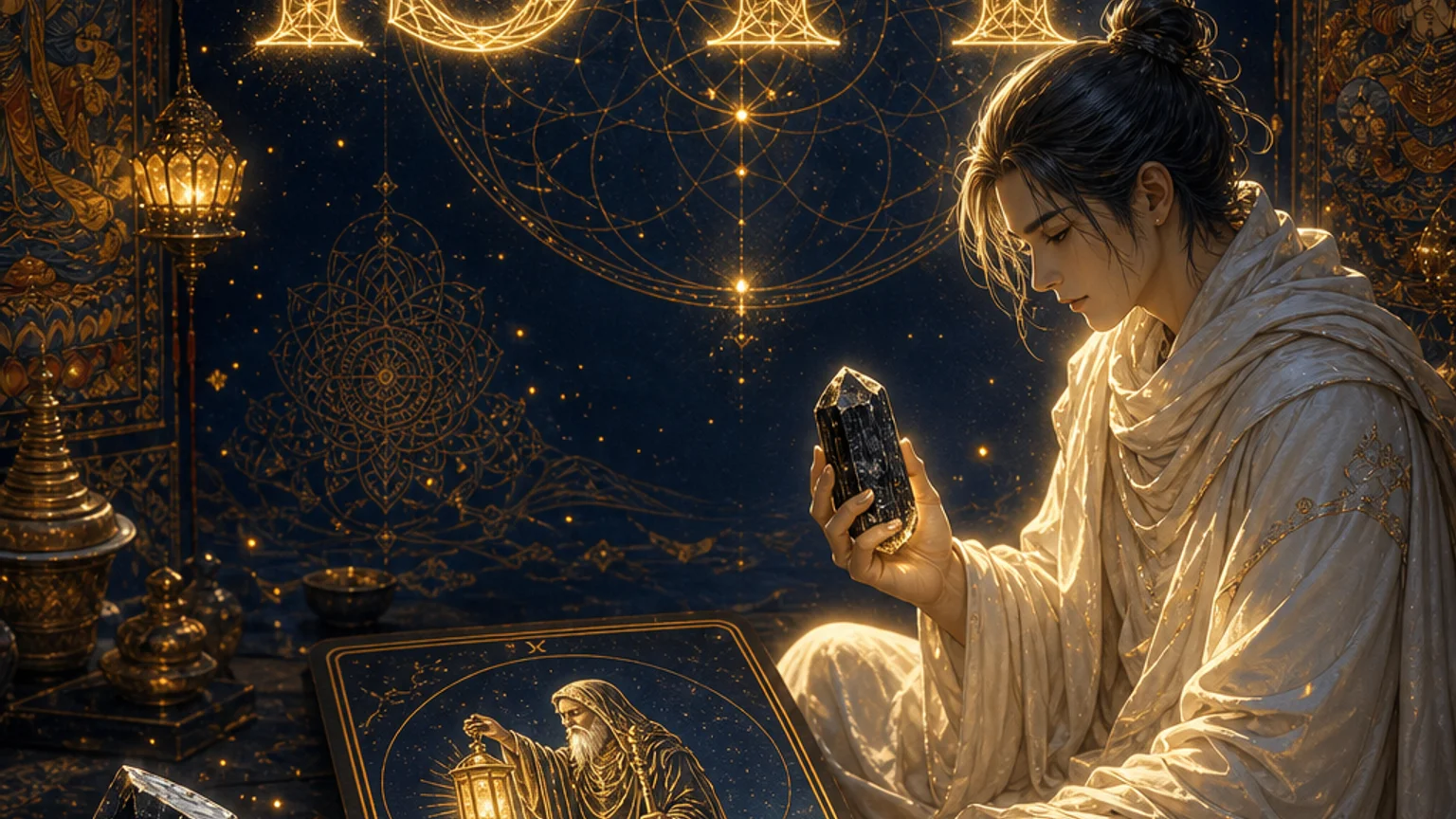
The Hermit’s archetype is The Seeker. In the Rider-Waite image, an old figure stands alone on an icy peak, holding a six-pointed lantern in front of him, a staff in his other hand. Here is where most “ISTP tarot card” articles collapse the work: they map ISTP to The Hermit because “both are independent,” and stop. The pairing is where the work begins. Three types share this card (INTJ, INTP, ISTP) — and the why differs for each. INTJ’s Hermit is sourced in Ni’s visionary synthesis. INTP’s Hermit is sourced in Ti’s conceptual disassembly. Yours is sourced in Ti-Se’s hands-on verification: you don’t trust a system until you’ve taken it apart with your own hands, and the lantern illuminates the broken mechanism that nobody else could see.
Why The Hermit Aligns with ISTP’s Ti-Se Dominance
Your dominant Ti is the function that does its best work in solitude, but a very specific kind of work — not synthesizing a vision (INTJ’s Ni) and not disassembling a concept (INTP’s Ti), but taking a physical or mechanical system apart, gear by gear, to verify how it actually works. Your auxiliary Se gives you your hands — the present-moment sensory engagement that lets you read the system through touch, sound, and the way the parts move. The Hermit’s lantern, for ISTP, illuminates the inside of the machine: the actual mechanism, the failed assumption embedded in the parts, the elegant fix that hands can find when the conceptual talk can’t.
This is why your independence isn’t the same as detachment, even though outsiders often conflate the two. The Hermit’s psychological lens for ISTP is solitude vs isolation — chosen workshop-time that produces verified understanding versus enforced alone-time that produces drift. ISTPs live this distinction viscerally. Your alone time isn’t antisocial behavior; it’s where the real diagnosis happens — the carburetor in pieces on the bench, the code in pieces in the editor, the problem in pieces in the hands. The diagnostic that nobody else could make, made in solitude, by hand.
An Anonymous Client Vignette (Illustrative, Not Predictive)
T., 36, an ISTP and an industrial maintenance technician, sat with The Hermit after he diagnosed a chronic line failure that three engineering teams had missed — a worn bushing deep in the assembly that produced a subtle misalignment only under specific load. He was genuinely certain the diagnosis was correct, had verified it with his own hands, and could fix it for $40 in parts and, in the same breath, aware that the engineering teams had stopped consulting him, that his name had become “the guy in the back,” and that the diagnosis would be credited to whichever engineer first wrote it up. Both facts were true at once. The Hermit wasn’t forecasting whether he’d get the credit — it was naming the gap between the verified understanding made in solitude and the social translation that lets the understanding land in the system, the gap Ti-Se dominance naturally creates when Fe hasn’t yet done its sharing work. The work wasn’t to predict; it was to ask the question he’d been circling: how does the guy in the back bring the diagnosis into the room?
That’s what a birth card does. It doesn’t tell you what will happen. It names the shape of the tension you keep returning to, so you can work with it consciously rather than reenact it blindly.
Three Concrete Manifestations of Hermit Energy in ISTP
- You take the system apart before you trust it. Any mechanism, process, or claim — you instinctively get your hands on it, disassemble it, verify each part. By the time you’ve endorsed a fix, you’ve tested it in your hands three ways.
- You wait to speak until the diagnosis is verified by hand. Where others theorize, you’ve already taken the thing apart. Your contributions, when they come, tend to be the load-bearing diagnosis nobody else could make.
- You retreat to the workshop. Under stress, your instinct isn’t to call someone — it’s to close the door, lay the problem out on the bench, and work it through with your hands. This is the Hermit’s lantern at work, pointed at the actual mechanism.
Your Growth Card: Death
Death’s archetype is The Transformer — not the literal death, but the card of profound transformation, the ending of one form and the beginning of another. In the Rider-Waite image, a skeleton in armor rides a pale horse, but in the background the sun rises between two towers, and a child watches. Death is the card of necessary ending, and the sunrise behind it is the load-bearing detail: something new is already on its way.
For ISTP, Death is the growth card — the archetype your tertiary Ni and inferior Fe reach toward when Hermit energy has over-matured into stagnation. The mapping logic is precise: where Ti-Se (dominant/auxiliary) verifies what is, Ni (tertiary) eventually sees what’s becoming, and Fe (inferior) eventually lets the old form end so the new one can land. Death’s sunrise is the image for exactly this — the new form that requires the old one to end.
The growth invitation surfaces when you’ve over-invested in The Hermit’s verified solitude. ISTPs under stress — particularly in a Ti-Ni loop — can stay in the workshop long after the old mechanism has been understood, avoiding the transformation that would let the understanding ship. Death appears at that moment with a quiet prompt: the diagnosis is made. Now let the old form end, so the new one can begin.
Three Concrete Growth Steps (Next 7–30 Days)
- End one mechanism you’ve outgrown. A tool, a habit, a role, a way of working that you’ve verified is past its sell-by date. Death’s sunrise requires the ending; let one form go this week.
- Name one conversation you’ve been avoiding. Fe develops through being used — even clumsily. The diagnosis has been made in solitude; the translation into the room requires the awkward act of saying it. Have one.
- Let one Ni-seen trajectory shape a decision. You’ve seen where this is going; you’ve been refusing to act on the seeing because the seeing isn’t yet verified by hand. Let one Ni pattern shape a decision this week, without requiring hand-verification first.
The growth card isn’t a destination. It’s the direction of travel when the primary card’s shadow has been sitting too long in the driver’s seat.
The Shadow Side: Reversed Hermit
The Hermit reversed, in an ISTP reading, points to three distinct shapes of reversal — not a single “bad” meaning, but three specific patterns to recognize.
Shape 1: Ti-Ni Loop (The Stalled Workshop)
When Ti and Ni loop without Se’s hands-on check, you can slide into a stall where the same diagnosis recombines without ever being tested against the actual mechanism, or without ever being brought into the room where it could ship. The felt sense is “I see what’s wrong,” but the cognitive mechanism is the seeing has replaced the doing and the sharing. The growth invitation isn’t to doubt your diagnosis; it’s to let Se back into the loop — get your hands on the actual thing, and let Fe bring the diagnosis into the room.
Shape 2: “I Don’t Need Anyone” as Connection-Avoidance
Fe is your inferior function, which means translating your verified understanding into shared language — and accepting the social cost of being the one who knew — is developmentally expensive. The shadow move is to use “I work better alone” as cover for avoiding the awkward act of being known. The Hermit’s workshop, in this shape, isn’t where the diagnosis happens — it’s a fortress that prevents the diagnosis from mattering to anyone else.
Shape 3: The Loner’s Drift
This is the shadow where solitude has hardened into a worldview — “people don’t get it, the system is broken, I’m better off in the workshop.” The growth edge here isn’t to become extroverted; it’s to notice when the drift is protecting a fear that your verified understanding won’t be valued rather than serving the work. The Hermit’s lantern, pointed too long at the same broken gear, becomes a way of avoiding the transformation that would let the gear matter.
The reversed reading is not a bad omen. It’s the card’s way of asking whether the solitude is still serving the work or has started substituting for it. The integration path runs straight into Death’s domain — the act of letting the old form end so the verified understanding can ship.
ISTP in Relationships
In intimate relationships, ISTPs bring the same quiet depth they bring to mechanical diagnosis — which is the gift and the friction. Your alone time isn’t negotiable; it’s where the hands do their thinking, the system gets verified, and you stay whole. A partner who reads this as distance will trigger your loner’s drift (shadow shape 3); a partner who reads it as the rhythm that makes your steadiness trustworthy gets the fullness of what you offer.
Three patterns to notice:
- You communicate through action, not declaration, which can feel opaque to a partner who needs words. Naming this rhythm early (“I show up by fixing the thing; ask me what I’m working on if you want to know what I’m thinking”) prevents months of misread silence.
- You hold high standards for competence and verifiable truth, which can land as criticism. The same diagnostic instinct that improves a system can wound a partner if delivered without Fe’s warmth.
- You express care through fixing and presence — the thing repaired, the problem solved, the obstacle removed without ceremony. This is genuine love in ISTP dialect; learning to also sit with your partner’s feelings without diagnosing them is the growth work.
None of this predicts whether a specific relationship will succeed. It names the shape of the dynamic so you can choose it consciously.
ISTP at Work
The workplace is where ISTP cognitive wiring is most often deeply effective — and most often invisible. Your Ti-Se combination is built for work that requires mechanical or system-level diagnosis, present-moment problem-solving, and the kind of hands-on verification that holds systems running when everyone else is theorizing. You thrive in roles that give you autonomy, real problems, and a workshop worth your full attention.
Three patterns to notice:
- You diagnose the failure before the org chart does. This means you’ll often spot the broken mechanism, the failed assumption embedded in the system, the fix that nobody else could find. The growth work is translating that diagnosis into language decision-makers can act on — Fe’s job, not just Ti-Se’s.
- You prefer depth over breadth in your work. A role that asks you to context-switch across many shallow systems will drain you faster than one deep problem three times as long.
- You lead through competence and quiet authority — being right, fixing the unfixable, holding the standard without needing to talk about it. This is honest leadership; the growth edge is learning that some team members need you to bring the diagnosis into the room, not just leave it on the bench.
This isn’t a forecast for your career. It’s a description of how your type tends to interact with work — so you can choose roles and environments that fit your wiring rather than fight it.
ISTP on the Growth Path
The growth path for ISTP is, in many ways, the integration of the inferior Fe — the social-sharing function that pure Ti-Se can quietly bypass. This isn’t about becoming an extrovert. It’s about completing the cognitive stack so the diagnoses you make in solitude actually reach the people and systems they could help.
Three threads of growth work:
- Translation practices. Anything that forces you to put one verified diagnosis into shared language — a write-up, a conversation, a training. Fe develops through use.
- Trajectory practices. Taking one Ni-seen pattern per week and acting on it without requiring hand-verification first. Ni develops through being trusted.
- Connection practices. Letting one or two people see the unfiltered version of the workshop, including the diagnoses that didn’t work. Fe develops through being witnessed, not just through private competence.
The growth path isn’t linear. It’s about rounding out the stack so the Hermit’s lantern and Death’s transformation work together rather than in sequence.
Crystals for ISTP
Three crystals map to the ISTP birth card configuration, each serving a distinct function. These are not “lucky stones for your type” — they are tactile anchors for specific cognitive moves, chosen because their traditional associations align with the work each part of your stack is doing.
Black Tourmaline — The Overall Companion (Ti × Hermit Protection)
Black Tourmaline carries the protective, boundary-setting quality The Hermit’s workshop demands in mineral form. For ISTP, it aligns with dominant Ti — the function that verifies in solitude, the function that needs a protected space to think. The traditional protective and grounding associations map to exactly the kind of boundary-keeping Ti-Se performs when the workshop is doing its work.
How to use it: Hold Black Tourmaline for five minutes before entering a workshop session — a tactile cue to drop into Ti’s diagnostic depth and Se’s hands-on engagement, without leaking attention to the social noise. It’s a physical reminder of which cognitive mode you’re choosing.
Shop: Black Tourmaline meaning · Black Tourmaline crystals
Hematite — The Upright Ally (Se × Grounded Hands)
Hematite supports the Se-driven grounded engagement that your auxiliary Se brings when it’s time to read the system through the hands. Where Black Tourmaline protects the workshop, Hematite supports the hands-on verification — the weight in the hand that anchors attention to the actual mechanism, not the theory of it.
How to use it: Carry Hematite on the day you’ve scheduled hands-on work — the disassembly, the diagnosis, the fix. It’s not an “enhancement”; it’s a grounding cue to keep Se in its verifying role rather than drifting back into Ti’s abstract loop.
Shop: Hematite meaning · Shop search
Bloodstone — The Growth Invitation (Ni × Death Transformation)
Bloodstone supports the Ni-driven trajectory-seeing and Death-driven transformation that your tertiary Ni and the growth card invite — the courage to let the old form end so the new one can begin. Where the first two crystals support the workshop and the hands, Bloodstone is the one that asks what is ending, and what is the sunrise behind it.
How to use it: Carry Bloodstone on the day you’ve scheduled a Death move — the ending of an outgrown mechanism, the conversation that ships the diagnosis, the act of letting the new form begin. It’s a tactile reminder that the verified understanding is complete enough to transform.
Shop: Bloodstone meaning · Shop search
ISTP: An Eastern Lens
The Chan (Zen) Buddhist tradition has a name for what ISTPs do in the workshop. It’s called (rúshí zhījiàn — “knowing and seeing things as they actually are”), and it refers to the contemplative discipline of verifying the nature of reality through direct, hands-on encounter, rather than through concept or theory. The monk in the garden isn’t theorizing about the cherry tree; he’s pruning it, and the pruning is the knowing.
This is the Eastern frame that resolves the loner-vs-connection tension at the heart of ISTP and The Hermit. Your hands-on solitude isn’t detachment; it’s a recognized contemplative practice with a name , a lineage (Chan), and a transformation clause (Death’s sunrise). The question isn’t whether to work alone — it’s whether your working alone has a structure that lets the verified understanding reach the world, or whether it has hardened into a private competence with no return.
The crystal tradition aligns here too. Black Tourmaline across Tibetan and Himalayan protective lineages is the stone of the solitary practitioner — the one who needs a strong boundary between the workshop and the noise so the work can happen. The function isn’t metaphysical; it’s the same function a hermitage’s wall serves: a tactile, energetic reminder that the work requires protected solitude, and that the solitude is in service of the work, not a defense against the world. When an ISTP holds Black Tourmaline before a workshop session, the stone isn’t changing the mind; it’s anchoring the question “what does the mechanism actually do?” — the question the Hermit’s lantern asks, pointed at the gear.
The Taoist principle (dà qiǎo ruò zhuō — “the greatest skill seems clumsy,” from the Tao Te Ching) adds another layer. The ISTP’s diagnostic virtuosity often looks, to outsiders, like stubbornness or slowness — the guy in the back, taking too long, refusing the meeting. Lao Tzu’s point is that the deepest skill is the one that doesn’t perform itself, and that the verification made in patience is worth more than the theory produced in haste. ISTPs who hold this don’t become more performative; they become the kind of skilled whose diagnosis survives the meeting it eventually has to land in.
The Chan principle (shēn xīn yī rú — “body and mind are one”) adds one more. ISTPs who master this don’t choose between the thinking and the doing — they recognize that the hands are the thinking, and the verified understanding made through the body is the most rigorous knowing there is. The Hermit’s lantern, for ISTP, is in the hands.
None of this is “Eastern traditions view crystals as energy amplifiers” — that’s the universal filler sentence. The actual Eastern frame for ISTP is specific: your hands-on solitude is a recognized practice with a name , a skill principle , a body-mind unity , and a transformation clause (Death’s sunrise). The crystals are anchors, not engines.
Shop Crystals for This Guide
Explore crystal jewelry and stones from our current collection.


Black Tourmaline Anklet


Black Tourmaline Tumbled Stone Set


Black Tourmaline Cube


Black Tourmaline Gold or Silver Bracelet
FAQ: ISTP Tarot Card
1. What tarot card is ISTP?
ISTP’s primary birth card is The Hermit — the archetype of The Seeker whose lantern illuminates the inside of the machine. The mapping aligns ISTP’s dominant Ti (introverted thinking) and auxiliary Se (extraverted sensing) with The Hermit’s psychological lens of solitude-versus-isolation. ISTP’s growth card is Death, which represents the Ni-Fe-driven transformation that lets the verified understanding ship.
2. Why is The Hermit the birth card for ISTP?
The alignment runs deeper than “both are independent.” ISTP’s dominant Ti does its best work taking systems apart to verify each mechanism; auxiliary Se gives you your hands — the present-moment engagement that reads the system through touch. The Hermit’s lantern illuminates the inside of the machine, the broken gear nobody else could see. Three types share this card (INTJ/INTP/ISTP), but the why differs: INTJ’s Hermit is sourced in Ni’s visionary synthesis, INTP’s in Ti’s conceptual disassembly, ISTP’s in Ti-Se’s hands-on verification.
3. What is the growth card for ISTP?
Death. The logic: where Ti-Se (dominant/auxiliary) verifies what is, Ni (tertiary) eventually sees what’s becoming, and Fe (inferior) eventually lets the old form end so the new one can land. Death’s sunrise is the image for exactly this — the new form that requires the old one to end. The growth invitation surfaces when Hermit energy has over-matured into a stalled workshop.
4. What does reversed Hermit mean for ISTP?
In an ISTP reading, reversed Hermit isn’t a bad omen — it points to three specific patterns: Ti-Ni loop (stalled workshop without Se’s hands-on check), “I don’t need anyone” as connection-avoidance (Fe inferior bypass), and the loner’s drift (solitude hardened into “the system is broken”). The growth invitation is to notice whether the solitude is still serving the work or substituting for it.
5. Which Jungian archetype is ISTP?
ISTP aligns with the Seeker/Craftsman archetype (Hermit) on the primary axis and the Transformer (Death) on the growth axis. Jung’s framework of cognitive functions — which MBTI is built on — describes Ti as introverted thinking, the judging function that verifies internal logical consistency, and Se as extraverted sensing, the perceiving function that engages the physical world directly.
6. What are the best crystals for ISTP?
Three crystals serve distinct ISTP functions: Black Tourmaline (overall companion, supporting Ti’s protected workshop), Hematite (upright ally, supporting Se’s grounded hands), and Bloodstone (growth invitation, supporting Ni-driven transformation). These are anchors for specific cognitive moves, not “lucky stones.”
7. How does the Eastern perspective view ISTP?
The Chan Buddhist tradition recognizes ISTP-style hands-on solitude as rúshí zhījiàn, knowing things as they actually are through direct encounter — a contemplative discipline of verifying through the hands, not the concept. Taoism’s dà qiǎo ruò zhuō, the greatest skill seems clumsy honors the diagnostic virtuosity that doesn’t perform itself. The transformation clause is Death’s sunrise — the ending that lets the verified understanding ship.
8. Is the ISTP tarot mapping official MBTI?
No. MBTI is a registered trademark of The Myers-Briggs Company, and this mapping is our independent editorial interpretation based on Jungian cognitive functions (Ti/Se/Ni/Fe). It is not affiliated with, endorsed by, or sponsored by The Myers-Briggs Company, and does not represent official MBTI doctrine. The mapping is offered as a self-reflection framework, not a personality diagnosis.
Explore More
- Tarot card meanings: The Hermit · Death
- Related Explorers types: INTP · ISFP · ESTP (same Ti dominant / Explorers group)
- Crystal meanings: Black Tourmaline · Hematite · Bloodstone
- Find your own MBTI birth card: MBTI Tarot Tool
- All MBTI × Tarot articles: MBTI Tarot Hub
> Tarot birth cards and crystals are mirrors for self-reflection, not personality diagnoses or fixed forecasts. The cards name the shape of the patterns your cognitive wiring keeps returning to — what you do with that naming is your free will.