Bloodstone Meaning: Healing Properties & Uses
Bloodstone (also called heliotrope) is a dark green chalcedony speckled with red spots that look like drops of blood. Long tied to courage, vitality, and strength, it has a richer history than most stones, from ancient seals to medieval legend. This guide covers what bloodstone is, what it means, and how people work with it. Crystal meanings reflect tradition and personal practice, not medical advice.
What Is Bloodstone Meaning?
At its simplest, bloodstone means courage, vitality, and steady strength. With its dark green body and vivid red speckles, it’s often described as a stone that stirs courage and grounds you at once — a presence for people who want to feel braver, more alive, and more rooted in their own strength.
For many, that’s the whole draw: a heavy, cool stone with a shot of red that nudges you toward courage and forward motion. You don’t need to hold any specific belief to get something from it — the value often comes from choosing, holding, or wearing the stone as a cue to return to a braver, stronger baseline.
Bloodstone Meaning and Symbolism

Few stones carry as much story as bloodstone. Its older name, heliotrope, means “sun-turning” in Greek, from an old belief that the stone could turn the sun red when placed in water. In the Middle Ages, the red spots gave rise to a Christian legend that they were drops of Christ’s blood fallen at the crucifixion — which is why it’s sometimes called the “martyr’s stone.” We read those as legends rather than fact, but they show how deeply bloodstone captured people’s imagination.
Across ancient and medieval practice, bloodstone was tied to courage, vitality, strength, and protection, and it was a favorite for carved signet rings and seals. Some old lapidary texts claimed it could stop bleeding, a medical belief we now read as history rather than proven therapy. In modern crystal practice, bloodstone keeps that courage-and-vitality meaning. How much of that strength you feel is up to you. To explore more stones, browse the full Kristalgids.
Bloodstone Properties

De wetenschap
Bloodstone (heliotrope) is a dark green chalcedony — microcrystalline quartz (SiO₂) — speckled with red spots. The green body comes from chlorite and other iron silicates trapped in the silica, and the red “blood” spots are iron oxide, usually hematite or red jasper, scattered through the stone. It’s trigonal, about 6.5–7 on the Mohs scale, opaque with a waxy-to-glassy shine, and fairly light at a specific gravity around 2.6. It takes a smooth polish, which is why it’s been carved into seals and signets for centuries. Major sources include India, Brazil, Australia, and Madagascar. None of this is mystical — it’s mineralogy, and the red-in-green look is genuinely striking.
Traditionele betekenis
Bloodstone carries one of the richer traditions of any stone. Across the ancient Mediterranean and medieval Europe it was tied to courage, vitality, strength, and protection — carved into signet rings and seals, and (in legend) linked to sacrifice and martyrdom. In modern crystal practice it’s tied to the root, sacral, and heart centers and described as a stone of courage, vitality, and resilience — many believe it helps you feel braver, more energized, and steadier under pressure. The deep green with red lends itself to life-force and courage. These associations draw on genuine ancient use and modern practice.
Mindfulness & psychologie
From a psychological angle, bloodstone works as a grounding, vitalizing anchor — a heavy, cool stone with a spark of red to hold when you want to feel braver or more energized. The act of choosing and carrying it can support intention-setting: you decide it stands for “be brave” or “find your drive,” and the feel of it draws you back. Green and red together read as grounded and vital in color psychology, and the simple ritual of noticing the stone creates a brief pause to reset into courage. These effects come from tradition and personal practice, not clinical research. Crystals complement — but never replace — professional care.
Bloodstone Benefits

People who work with bloodstone usually describe it in terms of feeling braver and more energized, not dramatic changes. The stone tends to show up when courage or drive is low — a moment with the heavy stone before something daunting, the glance at its red speckles when energy dips, the feel of it when you need to push through. A few benefits people mention most:
A courage lift
Holding bloodstone gives a hesitant, fearful mind a grounding focus point, which makes it easier to step forward and act instead of holding back.
More vitality
Many carry it during flat, low-energy stretches as a cue to find some drive and momentum rather than staying stuck.
Steady resilience
Carried through demanding periods, it works as a reminder of endurance — that you can absorb pressure and keep going.
A grounding meditation
Held during a sit, its heavy, cool feel gives your hand something to notice, which can quiet a restless mind and bring you down into the body.
The pattern underneath is the same: the stone isn’t doing the work for you, but it gives your day a small structure that makes courage and vitality more likely. If you’re exploring stones for specific needs, see our guides to crystals for courage en crystals for energy.
Bloodstone Chakra, Zodiac, and Element Associations
In traditional systems, bloodstone is most often linked to the root, sacral, en hart centers — grounding, vitality, and courage. It’s commonly paired with Aries en Pisces, and its elements are usually given as Aarde en Fire. Zie voor verwante stenen root chakra crystals.
These are correspondences built up across both ancient and modern tradition, not fixed rules. If your own sense of a piece points somewhere else, that’s completely fine. Many people work with stones intuitively, following what feels right rather than a chart.
How to Use Bloodstone
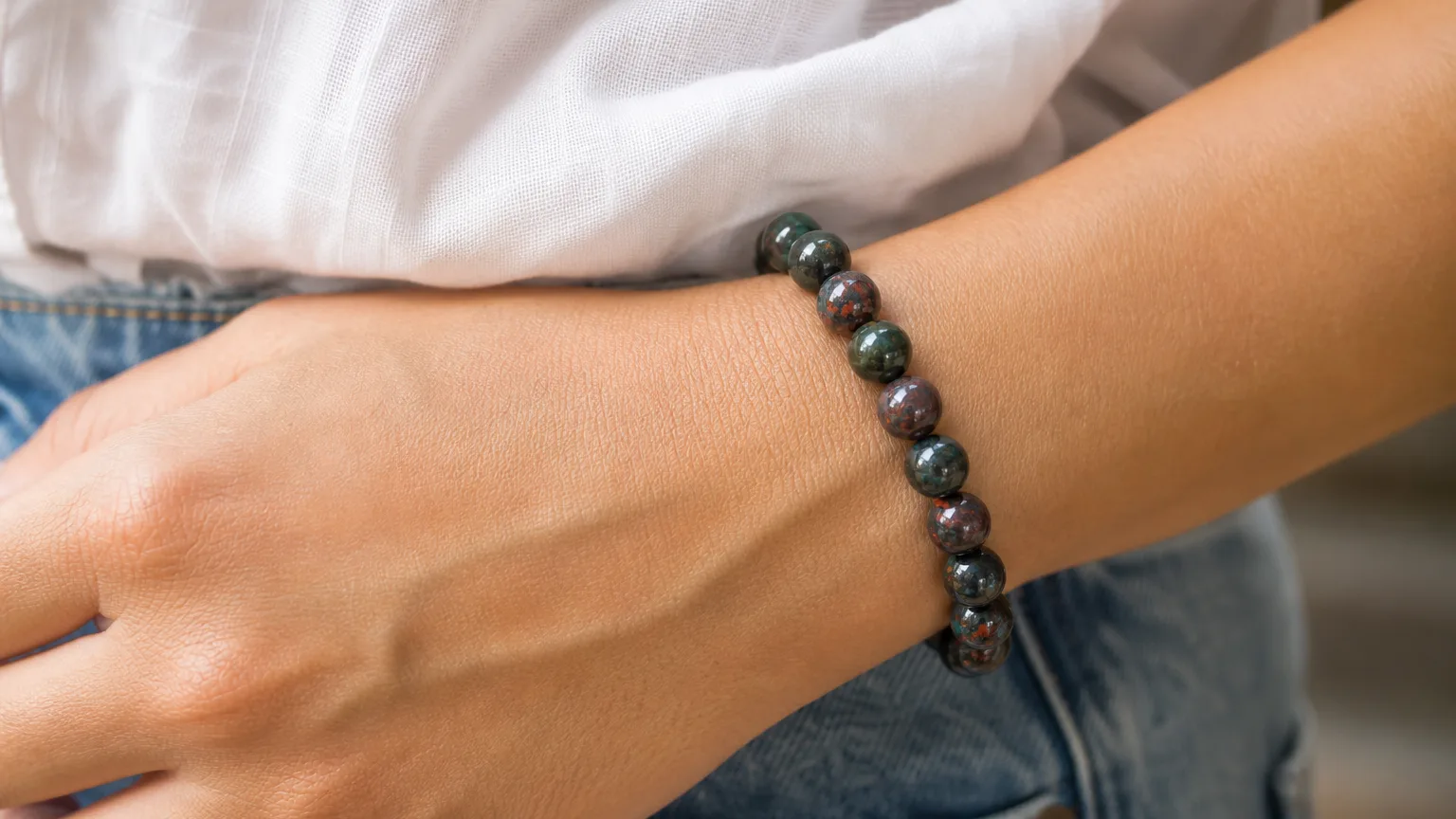
Bloodstone is flexible — there’s no single right way, only what fits your routine. The key is consistency: a stone you actually see and hold each day does far more than one that sits in a drawer.
Draag het. A signet ring, cabochon pendant, or beaded bracelet keeps the stone with you through the day. Pair one piece with a specific intention each morning — “be brave,” “find your drive.”
Mediteer ermee. Hold a tumbled stone in your palm while you sit. Its heavy, cool feel gives your attention somewhere to rest; a few focused minutes count.
Place it at home. A sphere or carved piece on a desk works as décor and a courage cue. The deep green-and-red brings a strong, grounded presence to a room.
Carry a tumbled piece. Its weight and polish make it a great pocket stone — something to hold when courage or energy dips and you need a steady, vital reset.
Which Bloodstone Form Is Right for You?

| Formulier | Het meest geschikt voor | Kies deze optie als |
|---|---|---|
| Signet ring / cabochon | Daily wearing, classic look | You want the traditional carved bloodstone on the hand |
| Kralenarmband | Dagelijks gebruik | You want a visible, wearable reminder through the day |
| Getrommelde steen | Zak of meditatie | You want something small, smooth, and easy to hold |
| Hanger | Persoonlijke betekenis | You want a polished stone worn near the chest |
| Carved seal / figurine | Altar or display | You like the historic carved-seal tradition |
| Sphere | Room display | You want a balanced shape as a grounding focal point |
How to Tell Real Bloodstone from Fakes
Because bloodstone’s red-in-green look is distinctive, the market has imitations — dyed chalcedony, dyed howlite, resin, and glass. A few checks help before you buy:
- The red spots. Real bloodstone has natural, irregular red iron-oxide spots scattered through green — never perfectly uniform or paint-like. Neat, even “dots” suggest dye or resin.
- Color. The green is dark and earthy, sometimes nearly black-green, with brick-red spots. Vivid neon green or bright uniform red is usually dyed.
- Hardness. At about Mohs 6.5–7, real bloodstone resists a fingernail and scratches glass. Resin and softer dyed stones won’t.
- The waxy look. It’s chalcedony, with that characteristic waxy-to-glassy shine and slightly cloudy body. Glass looks too crisp and clear.
- The dye test. Rub a cotton swab dampened with acetone on a hidden spot. Heavily dyed stones can leave color on the swab.
- Price and seller. Buy from sellers who name the material and source (India is classic). Vivid, flawless pieces at very low prices are usually dyed or resin.
A note on dye. Some “bloodstone” on the market is plain green chalcedony or howlite with red dye added. Dye isn’t dangerous but it isn’t the natural stone, and it can fade — so for genuine bloodstone, look for natural, irregular red spots and a reputable seller.
How to Cleanse and Charge Bloodstone
In crystal practice, “cleansing” clears accumulated energy and “charging” refreshes the stone. Bloodstone is a hard, stable chalcedony, so it’s low-maintenance. A few reliable methods:
- Water. A brief rinse under cool running water is a simple, effective cleanse — it’s hard enough (Mohs 6.5–7) to handle it fine.
- Maanlicht. Leave it out overnight under a full moon — gentle and effective.
- Smoke. Pass it through sage or palo santo smoke and let it drift over every side.
- Sound. A singing bowl or bell near the stone. At minimum, it’s a mindful pause.
Things to ease up on: salt water (salt can dull the polish and corrode metal findings). For the full routine, see our handleiding voor het reinigen van kristallen.
Best Crystals to Pair With Bloodstone
Pairing is about layering intentions — picking stones whose qualities complement rather than compete. A few combinations that work well with bloodstone’s courage-and-vitality energy:
- Bloodstone + Carnelian — two warm, vital stones layered for courage, drive, and steady, active energy.
- Bloodstone + Red Jasper — two red-toned grounding stones for stamina, strength, and resilience.
- Bloodstone + Zwarte toermalijn — courage meets protection; a grounding pair for feeling both brave and shielded.
Bij het samenstellen van combinaties draait het om complementaire bedoelingen, niet om strikte regels. Kies combinaties die aansluiten bij waar je op dat moment mee bezig bent, en vertrouw op je eigen gevoel voor evenwicht.
Who Should Use Bloodstone?
Bloodstone suits people who want a grounding, courage- and vitality-stirring presence — anyone facing something daunting, feeling low on drive, or pushing through a demanding stretch, who wants a solid reminder to be brave, find their energy, and keep going.
A few honest expectations: bloodstone isn’t a treatment for anemia, fatigue, anxiety, or any condition — and despite the old “stops bleeding” lapidary claim, that’s historical belief, not medicine. If you’re dealing with something persistent, a healthcare professional is the right call, and the stone can be a comfort alongside that. It won’t “do” anything on its own; its value comes from the intention and routine you build around it. If you go in expecting a stone to fix things for you, you’ll be let down. If you go in expecting a steady support for your own practice, it tends to fit well.
FAQ About Bloodstone Meaning
Why does bloodstone have red spots?
The red spots are iron oxide (usually hematite or red jasper) scattered through the green chalcedony. The green comes from chlorite and iron silicates. It’s all natural — not paint.
Is bloodstone the same as heliotrope?
Yes — heliotrope is the older name for bloodstone, from a Greek word meaning “sun-turning.” Both names refer to the same green chalcedony with red spots.
Did bloodstone really stop bleeding?
That’s an old lapidary belief, not proven medicine. Medieval and ancient texts credited bloodstone with stopping bleeding, but we now read that as history, not as a treatment you can count on.
Can bloodstone go in water?
Yes — a brief rinse under cool water is fine. It’s a hard chalcedony (Mohs 6.5–7). Avoid salt water and long soaks.
What chakra is bloodstone linked to?
Mostly the root, sacral, and heart centers — grounding, vitality, and courage.
How can I tell if my bloodstone is real?
Look for natural, irregular red spots in dark earthy green, a waxy chalcedony shine, and Mohs 6.5–7 hardness. Neat uniform dots, neon color, or dye on a swab suggest a fake.
Is bloodstone good for beginners?
Yes — it’s affordable, durable, widely available, and rich in history. A great first stone for courage and grounding.
Final Thoughts on Bloodstone
Bloodstone has earned its long place as a stone of courage and vitality — and it earns it again for each person who picks up a piece and gives it a job to do. If you’re curious, the simplest start is one piece, one intention, and a small daily moment to notice it. You don’t need the reddest specimen; you need a stone you’ll actually see and hold. Let the routine do the work, and let the bloodstone be the steady reminder that brings you back to courage and strength.
From there, bloodstone tends to open a door — to a braver step, a steadier drive, or simply a habit of pushing through with grounded energy. For more, explore the Kristalgids of blader door bloodstone jewelry and crystals.