
Celestite Meaning: Healing Properties & Uses
Celestite is a soft, sky-blue strontium sulfate mineral named for its heavenly color — from the Latin caelestis, “of the sky.” Long tied to angelic connection, deep calm, and spiritual awareness, it’s a stone people reach for peace and higher states. This guide covers what celestite is (and why it’s softer than it looks), what it has meant, and how people work with it. Crystal meanings reflect tradition and personal practice, not medical advice.
What Is Celestite Meaning?
At its simplest, celestite means deep calm and higher connection — the feeling of a quiet, lifted, peaceful state. As a pale sky-blue stone, it reads as serene and spiritual: linked to peace, angelic or higher awareness, and a calmer, more spacious mind.
For many people that’s exactly the appeal — a pale blue cluster or piece you keep on a nightstand or altar as a cue to settle and lift your attention. You don’t need to believe anything about energy to use it that way; the value often comes from choosing the piece, giving it a job (“help me feel peaceful”), and letting its soft blue color pull you toward calm. In that sense celestite is a cue to peace.
Celestite Meaning and Symbolism
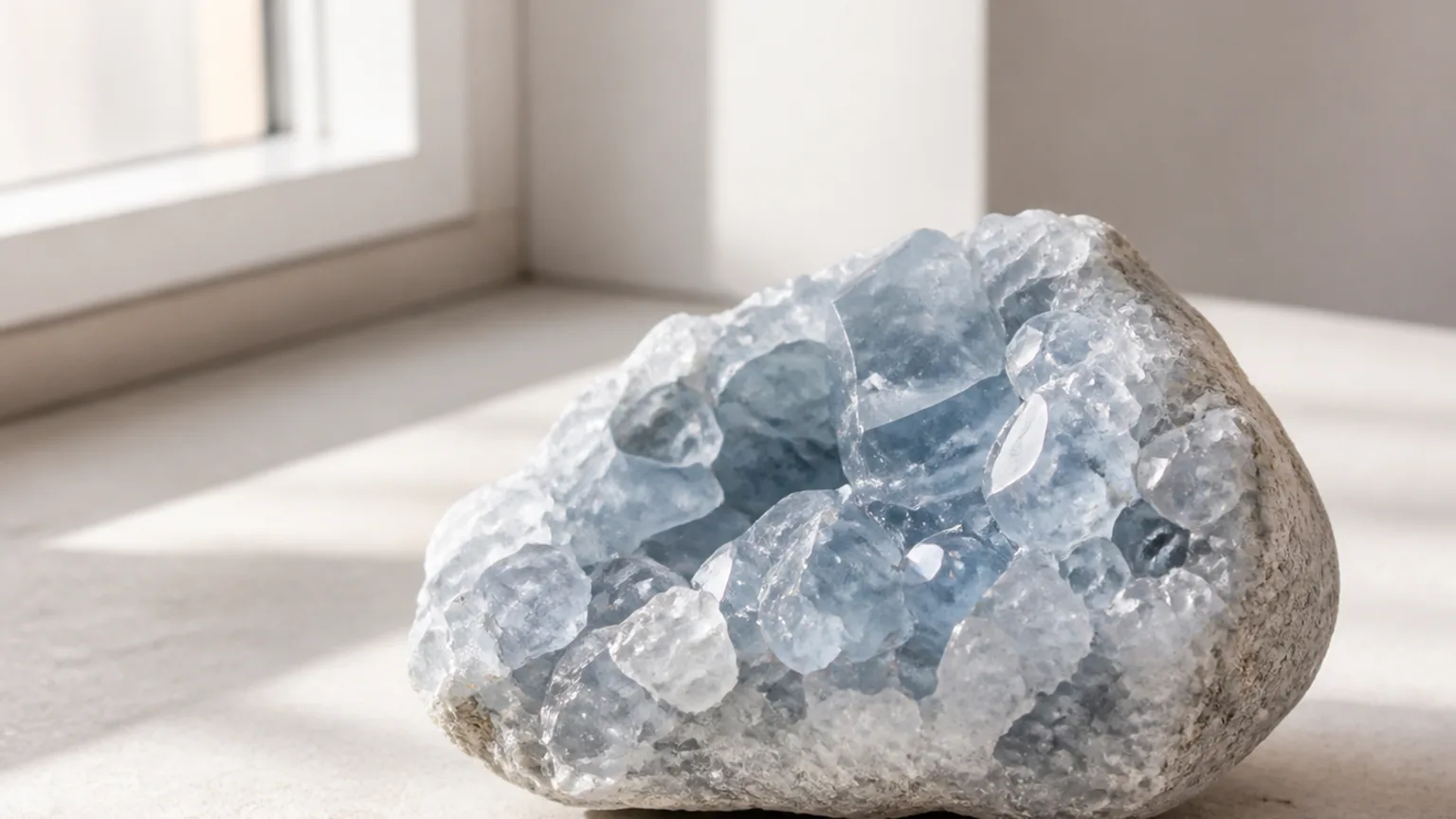
The name celestite (also called celestine) comes from the Latin caelestis, “heavenly” or “of the sky” — a nod to its pale sky-blue color. It’s strontium sulfate, SrSO₄, and its soft blue comes from natural irradiation acting on trace elements in the crystal (the color can fade with long sun exposure). It often forms delicate, glassy blue crystals in geodes and clusters.
Celestite doesn’t have an ancient mythological tradition — it was named in the late 1700s. Its meaning in modern crystal practice comes from its heavenly blue color: angelic connection, deep calm, and higher or spiritual awareness — the idea of a stone that brings peace and a sense of lifted, serene attention. It’s widely used as a stone for quiet spaces, bedside calm, or meditation. That peace-and-connection symbolism is consistent across modern practice, even though the stone itself is a relatively recent addition.
The thread through all of it is the same: angelic calm, peace, and higher connection. Today celestite is usually described as a deeply soothing, spiritual stone — reached for to calm a busy mind, to support peaceful rest, or to feel more connected and serene. How much of that lands for you personally is, honestly, up to you — and the “connection” is about a calm, lifted state, not a magical channel. To explore more stones, browse the full Crystal Guide.
Celestite Properties

The Science
Celestite (also called celestine) is strontium sulfate, SrSO₄, a relatively soft mineral at 3 to 3.5 on the Mohs scale — soft enough to scratch with a fingernail. It forms in orthorhombic crystals, often as delicate, glassy, pale-blue blades in geodes and clusters. Its sky-blue color comes from natural irradiation of trace elements in the crystal, and it can fade with prolonged sunlight. Major sources include Madagascar (famous for its deep blue geodes), Britain, Mexico, and the United States. None of this is mystical — it’s mineralogy — and the softness is why celestite is a display stone, not daily-wear jewelry.
Traditional Meaning
Tradition ties celestite to angelic connection, deep calm, and higher spiritual awareness. It’s most often linked to the crown, third eye, and throat centers and is described as a stone of peace — calming the mind, supporting serene meditation, and opening a sense of higher or angelic connection (in the symbolic sense of a lifted, peaceful state). Because it was named in the late 1700s, its tradition is modern and built around its heavenly color. These associations come from spiritual tradition and personal practice rather than clinical study.
Mindfulness & Psychology
From a psychological angle, celestite works as a soft, serene visual cue — the kind of object you place where you want peace. Pale sky-blue reads in color psychology as calm and spacious, and the act of keeping a cluster on a nightstand or desk and pairing it with an intention (“let me feel peaceful”) turns it into a small cue for calm. Part of its appeal is simply its soft, restful color — a visual signal to slow down. These effects come from tradition and personal practice, not clinical research. Crystals complement — but never replace — professional care.
Celestite Benefits

People who work with celestite usually describe it in terms of deep calm and peace, not dramatic shifts. It tends to show up as a quieter, more serene state — useful when the mind is busy, before rest, or for meditation. A few of the benefits people mention most:
Deep calm
A celestite cluster in a room you rest in acts as a soft, blue cue to settle — a visual reminder to let the day’s noise drop.
A peaceful night
Many keep it on a nightstand as part of a wind-down — its serene color is a cue to slow the mind before sleep.
A serene meditation
Held or placed nearby while you sit, its calm presence gives your attention somewhere soft to rest during meditation.
A quiet space
As a pale-blue specimen, it makes a corner feel more peaceful — a low-key presence that softens the mood of a room.
The pattern underneath all of these is the same: celestite isn’t calming you by magic, but it gives your day a cue toward peace and a quieter mind. If you’re exploring stones for specific needs, see our guide to crystals for anxiety.
Celestite Chakra, Zodiac, and Element Associations
In traditional systems, celestite is most strongly linked to the crown, third eye, and throat centers — higher awareness, insight, and calm expression. Astrologically, it’s often paired with Gemini and Libra. Its element is usually given as Air, fitting for a light, serene stone. For related stones, see crown chakra crystals.
These are correspondences built up through tradition, not fixed rules. If your own sense of celestite points somewhere else — a different chakra, a different element — that’s completely fine. Many people work with stones intuitively, following what feels right rather than a textbook chart, and there’s a long history of practitioners doing exactly that.
How to Use Celestite

Celestite is soft (Mohs 3–3.5) and its color can fade in sun, so it’s best as a display stone — kept in a calm spot, not worn daily or knocked around.
Keep it in a quiet space. A cluster on a nightstand, desk, or altar works as both décor and a soft cue to settle and feel peaceful.
Meditate with it. Hold a small piece in your palm or rest it on your crown (top of head) while you sit. Even a few minutes of focused attention counts; the goal is presence, not duration.
Use it for a wind-down. A piece on the nightstand becomes part of an evening routine — its serene blue is a cue to slow the mind before rest.
Place it where you feel tense. A cluster in a room where you tend to feel wound up acts as a gentle, calming presence.
Which Celestite Form Is Right for You?

| Form | Best for | Choose it if |
|---|---|---|
| Cluster / geode | Display, room calm | You want a blue specimen to soften the mood of a space |
| Tumbled stone | Hand-holding, meditation | You want something smooth to hold during a sit (it’s soft, so handle gently) |
| Raw crystal | Altar or shelf display | You like the natural, glassy blue blades on matrix |
| Small palm piece | Pocket (briefly) or display | You want a portable piece — but it’s soft, so keep it from knocks |
| Sphere | Display only | You want a rounded, polished piece for a serene corner |
| Thin blade crystal | Display only | You like the delicate single-crystal look for a shelf |
How to Tell Real Celestite from Fakes
Celestite is moderately priced, so glass, dyed quartz, and blue dyed stones sold as celestite do show up. A few checks help:
- Hardness. At Mohs 3–3.5, celestite is soft — a fingernail or copper coin can scratch it with pressure. A hard, unscratchable “celestite” is likely quartz, glass, or dyed stone.
- Crystal shape. Genuine celestite forms distinctive orthorhombic blades and tabular crystals, often in clusters on matrix. Glass or resin has no crystal structure.
- Color. Natural celestite is a soft, slightly uneven sky-blue. Vivid, uniform neon blue is more likely dyed quartz, glass, or resin.
- Weight. Celestite (strontium sulfate) is fairly dense for its size. A very light “celestite” may be resin or a dyed lighter mineral.
- Seller honesty. Blue dyed howlite or quartz is sometimes sold as celestite. A reputable seller will tell you what it actually is.
How to Cleanse and Charge Celestite
Celestite is soft (Mohs 3–3.5) and its blue color can fade in sun, so the care rules lean very gentle — keep it dry, shaded, and safe from knocks.
- Water — brief wipe only. Don’t soak celestite. Strontium sulfate is slightly soluble, and soaking can dull the surface. Clean it with a dry or barely damp soft cloth.
- Sunlight — avoid. Celestite’s blue can fade with prolonged light. Keep it out of direct sun; a shaded spot is best.
- Sound. A singing bowl or bell near the piece is a gentle, no-contact reset many prefer — ideal for a soft, fragile stone.
- Moonlight. A night under the moon is the most-recommended method — gentle, dry, and fitting for a serene “of the sky” stone.
Two things to keep in mind: store celestite away from harder stones (it scratches easily) and out of bright light (the color fades), and handle raw or thin crystals gently — they’re fragile and can chip. For the full routine, see our guide to cleansing crystals — and treat celestite as the soft, sun-shy, handle-with-care one in that guide.
Best Crystals to Pair With Celestite
Pairing is about layering intentions — picking stones whose qualities complement rather than compete. A few combinations that work well with celestite’s calm, spiritual energy:
- Celestite + Seleniet — two soft, calming stones; a gentle pairing many reach for to clear and calm a space.
- Celestite + Amethist — calm meets spiritual focus; a pairing for serene meditation and a quieter mind.
- Celestite + Angelite — two soft blue stones of peace and connection; a tender pairing for calm.
- Celestite + Helder kwarts — clear quartz is said to amplify; many use it to lift celestite’s calming intentions.
The logic of pairing is about complementary intentions, not strict rules. Pick combinations that match what you’re actually working on, and trust your own sense of what feels balanced.
Who Should Use Celestite?
Celestite suits people who want a soft, deeply calming stone for peace and a sense of higher connection — anyone with a busy mind, wanting peaceful rest, or drawn to its serene blue and the feeling of quiet it brings to a space. It’s approachable because it asks little: place it in a calm spot, and let it mark a quieter corner of your day.
A few honest expectations: celestite isn’t a treatment for anxiety, insomnia, or any condition — if you’re dealing with something persistent, a healthcare professional is the right call, and the stone can be a comfort alongside that. Its value comes from the intention and routine you build around it, and the calm of its presence. If you go in expecting a stone to bring peace for you by magic, you’ll be disappointed; if you go in expecting a soft, calming cue, it tends to fit well.
FAQ About Celestite Meaning
What is celestite good for?
Traditionally, deep calm, peace, and a sense of higher or angelic connection (in the symbolic sense). People reach for it to quiet a busy mind, support peaceful rest, or deepen meditation.
Why is celestite linked to angels?
Its name means “of the sky,” and its pale blue color suggested heaven to early crystal writers — so it became tied to angelic connection and peace. It’s a symbolic association, not a claim of actual angel contact.
Is celestite soft?
Yes — about Mohs 3–3.5, soft enough to scratch with a fingernail. That’s why it’s a display stone rather than everyday-wear jewelry.
Does celestite fade in sunlight?
Yes — its blue color can fade with prolonged light. Keep celestite out of direct sun and in a shaded spot.
What chakra is celestite linked to?
Mostly the crown, third eye, and throat centers — higher awareness, insight, and calm expression.
Can celestite go in water?
Only a brief wipe with a barely damp cloth. Strontium sulfate is slightly soluble, so soaking can dull the surface — keep it dry.
How can I tell real celestite?
Check softness (a fingernail can scratch it), look for natural orthorhombic blade crystals in clusters (not glass), and avoid vivid uniform neon blue, which suggests dye or glass.
Final Thoughts on Celestite
Celestite earns its place as a stone of peace and higher connection — the soft sky-blue piece people reach for when they want a quieter mind and a calmer space. If you’re curious, the simplest start is one cluster you’ll actually keep where you rest or sit, paired with a small moment to notice it. Let its color do the work, and handle it with care.
From there, celestite tends to open a calmer space — a quieter evening, a more serene sit, or simply a room that feels more peaceful. For more, explore the Crystal Guide or browse celestite pieces.