Opal Meaning: Healing Properties & Uses
Opal is a gemstone famous for its play-of-color — flashes of rainbow light that move across the surface as you turn it. It’s actually a mineraloid rather than a true crystal, made of hydrated silica, and it’s one of the modern October birthstones. If you’re drawn to its shifting colors for creativity or hope, this guide covers what opal is, its main types, how to tell a natural stone from synthetic and assembled opals, and how to care for it. Crystal meanings reflect tradition and personal practice, not medical advice.
What Is Opal Meaning?
At its simplest, opal means hope and creativity. With its shifting rainbow flashes, it reads as vivid and changeable — a stone people reach for inspiration, emotional expression, or a sense that many possibilities exist at once. It’s also one of the most personal of gems, since no two opals flash the same way.
For a lot of people that’s the whole appeal: one shifting piece, one intention, one small daily ritual. You don’t need to believe anything mystical to benefit — the value often comes from the act of choosing the stone and letting its moving color pull your attention back to a more creative, hopeful frame of mind. In that sense opal is a visual cue you train yourself to return to.
Opal Meaning and Symbolism
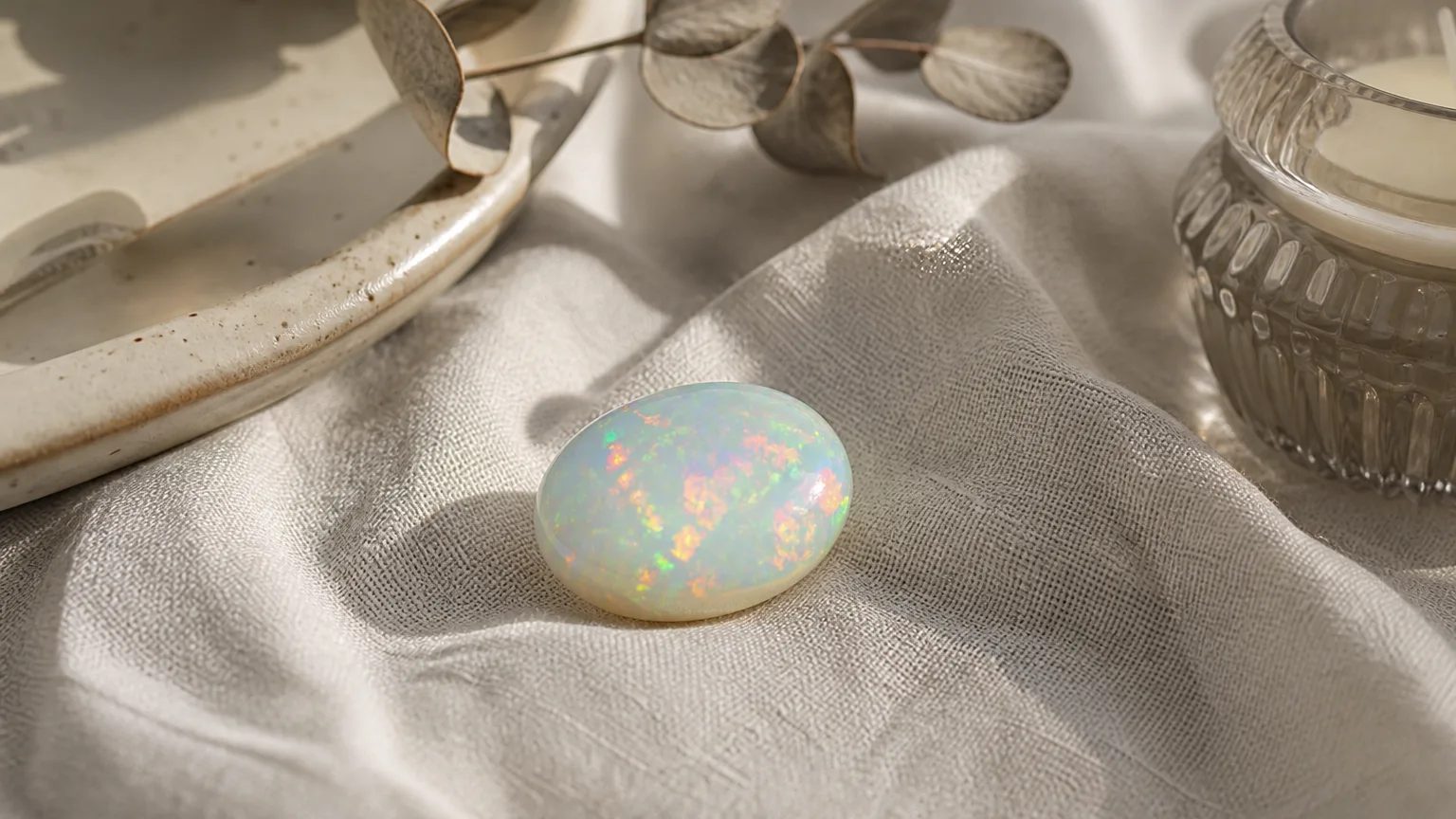
The first thing to know about opal is that it isn’t a crystal in the usual sense. It’s a mineraloid — hydrated silica (SiO₂·nH₂O), with water built into its structure. Rather than an orderly crystal lattice, opal is made of microscopic silica spheres packed together, and in precious opal those spheres are stacked so regularly that they diffract light into the rainbow flashes we call play-of-color. That’s the whole magic of the stone, and it’s pure optics, not pigment.
Opal has an old and warm reputation. The name comes from the Roman opalus, itself from a Sanskrit word for precious stone, and Romans prized it as a symbol of hope and purity. In Arabic tradition it was said to have fallen from the heavens in lightning. And despite a stubborn modern rumor that opal is “unlucky,” that idea is recent — largely traced to a 19th-century novel and, conveniently, to diamond merchants of the era. For most of its history, opal has been considered a stone of good fortune.
Today the common threads are consistent: hope, creativity, and emotional expression. You’ll see opal described as a stone for inspiration, for wearing many possibilities at once, and as the October birthstone. How much of that you experience personally is up to you, but the symbolism has a long, mostly happy record. To explore more stones, browse the full Crystal Guide.
Opal Properties
The Science
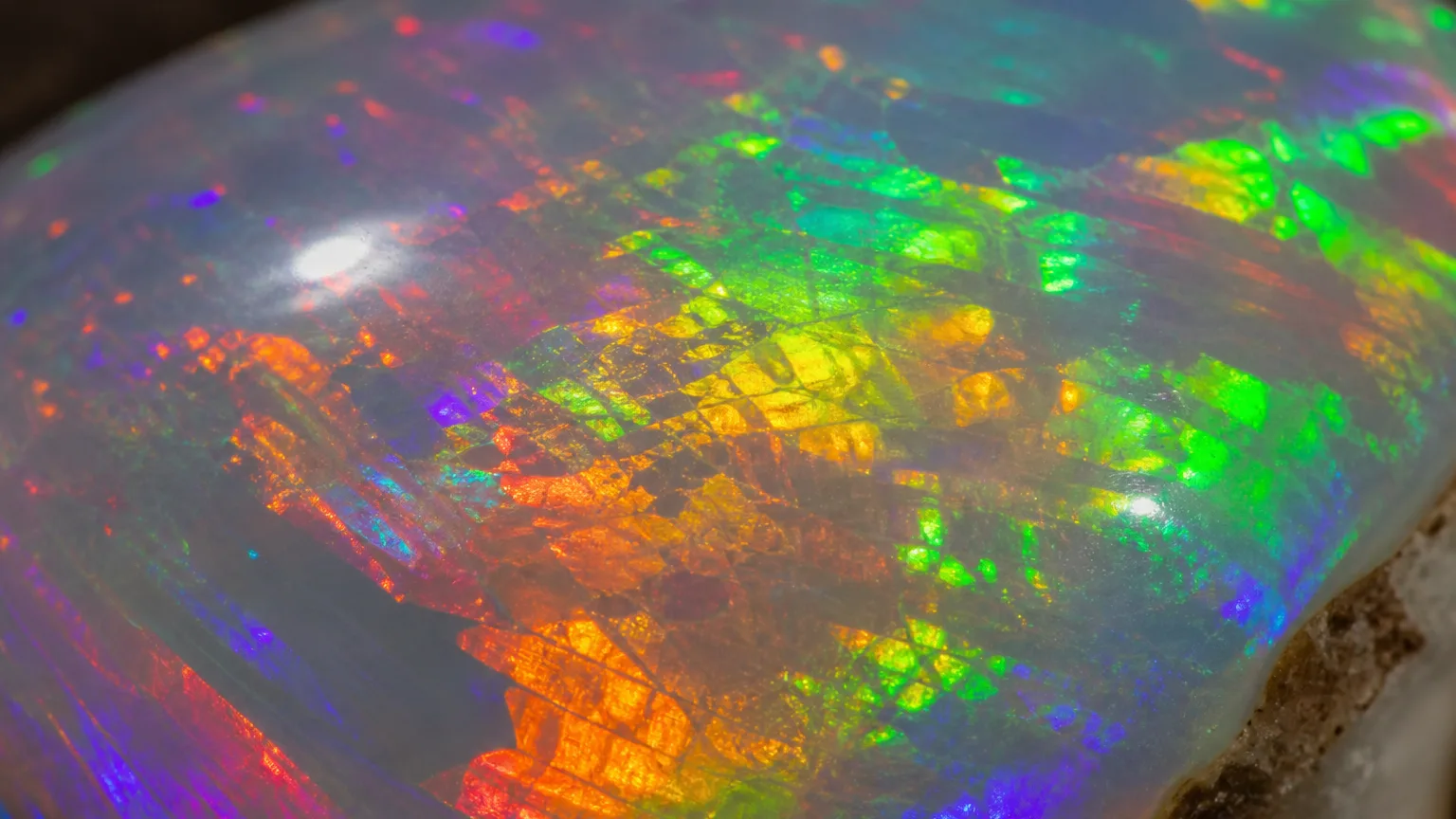
Opal is a mineraloid — hydrated silicon dioxide, SiO₂·nH₂O, containing anywhere from roughly 3% to 21% water. It has no crystal system because it isn’t truly crystalline; its silica is arranged as tiny spheres. In precious opal, those spheres are uniform and stacked in neat rows, so they act like a diffraction grating and split white light into moving rainbow flashes (play-of-color). In common opal, the spheres are irregular, so there’s no flash — just a soft body color. Opal is relatively soft at 5.5–6.5 on the Mohs scale, and because it holds water, it can crack or craze if it dries out or hits sudden temperature changes. Major sources include Australia (which supplies most of the world’s opal), Ethiopia, Mexico, Brazil, and the United States. None of this is mystical — it’s mineralogy and optics.
Traditional Meaning
Tradition ties opal to hope, purity, and creativity. It’s linked to all centers (its full-spectrum color suits it to any chakra) and is often described as a stone that magnifies whatever you bring to it — many believe it supports emotional expression, inspiration, and spontaneity. For most of its history it was carried as a token of good fortune and hope; the “unlucky” reputation is a recent myth worth ignoring. Opal is also one of the modern October birthstones, shared with tourmaline. These associations come from spiritual tradition and personal practice rather than clinical study.
Mindfulness & Psychology
From a psychological angle, opal works as a vivid, creative focal cue — its shifting color gives the eye something lively to rest on, and that motion can support a more flexible, imaginative frame of mind. The play-of-color is also a gentle lesson in perspective: the same stone shows different colors from different angles, a reminder that a situation can hold more than one truth at once. Holding that idea as a daily cue can soften rigid thinking. These effects come from tradition and personal practice, not clinical research. Crystals complement — but never replace — professional care.
Opal Benefits

People who work with opal usually describe it in terms of creativity, hope, and emotional expression, not dramatic effects. It tends to show up as a more imaginative, open mood. Here are a few of the benefits people mention most often:
A spark of creativity
Its shifting flashes make a vivid cue for imagination — a reminder that more than one possibility exists at once.
A lift of hope
Long a stone of hope, many keep it nearby during uncertain stretches as a small, encouraging presence.
Easier emotional expression
Its full-spectrum color is tied to expression; some wear it to feel more open and spontaneous in how they show up.
A personal, one-of-a-kind piece
No two opals flash alike, which makes each one feel personal — a stone that’s distinctly yours.
The pattern underneath all of these is the same: the stone holds meaning through the intention you bring, not through any effect on its own. If you’re exploring stones for specific needs, see our guide to crystals for anxiety.
Opal Chakra, Zodiac, and Element Associations
In traditional systems, opal is linked to all chakras — its full-spectrum play-of-color suits it to any center. It’s one of the modern birthstones for October, and it’s commonly paired with Libra. Its element is usually given as Water, fitting for a gem that holds water in its structure. For related stones, see sacral chakra crystals.
These are correspondences built up through tradition, not rules carved in stone. If your own sense of opal points somewhere else — a different chakra, a different element — that’s completely fine. Many people work with stones intuitively, following what feels right rather than a textbook chart, and there’s a long history of practitioners doing exactly that.
How to Use Opal

Opal is a soft, water-bearing gem (Mohs 5.5–6.5), so it needs more care than quartz — keep it away from heat, dry air, and harsh chemicals. The key is consistency: a piece you actually see and wear every day does far more than one stored away.
Wear it. A ring or pendant keeps the shifting color where you can tilt it in the light. Pair one piece with a specific intention — “stay open,” “see new possibilities.”
Tilt it in the light. The play-of-color only shows in motion — turning the stone is a small, grounding pause and the whole point of owning one.
Meditate with it. Hold a cabochon in your palm while you sit. Even a few minutes of soft focus on the moving color counts; the goal is presence, not duration.
Keep it as a birthstone. For an October birthday, a single opal is a meaningful, personal piece — no two are alike.
Which Opal Form Is Right for You?

| Form | Best for | Choose it if |
|---|---|---|
| Solid cabochon | Rings, pendants | You want a single piece of natural opal showing full play-of-color |
| Boulder opal | Statement pieces | You like thin opal in its natural ironstone backing for a rugged look |
| Doublet / triplet | Affordable opal | You want opal color at a lower price — a thin opal layer on a backing |
| Pendant | Daily wearing | You want the play-of-color worn where it’s easy to tilt and view |
| Fire opal (faceted) | Bright color jewelry | You prefer the warm orange-to-red transparent opal over rainbow flash |
| Tumbled common opal | Pocket or budget | You want an affordable piece with soft body color and no flash |
How to Tell Real Opal from Synthetic and Assembled
Opal is one of the most frequently faked and assembled stones, so knowing what you’re buying really matters here. The main things to tell apart are natural solid opal, synthetic opal, and assembled stones (doublets and triplets):
- Natural vs synthetic. Natural play-of-color flashes in irregular, patchy bursts that look organic. Synthetic opal often shows a too-regular “snake skin” or columnar pattern of color — neat and repeating in a way nature rarely does.
- Solid vs doublet/triplet. A solid opal is one piece. A doublet is a thin slice of opal glued to a dark backing; a triplet adds a clear quartz cap on top. Look at the side — a visible seam or layer line means it’s assembled, not solid.
- Pattern and color. Genuine opal’s color sits within the stone and moves as you tilt it. Surface-applied color that doesn’t shift, or a plastic-like look, points to an imitation.
- Weight and temperature. Real opal is cool and moderately dense. Plastic or glass imitations feel light or warm up fast in the hand.
- Price and disclosure. A reputable seller states whether a stone is natural solid, synthetic, or an assembled doublet/triplet. Each can be beautiful — you just shouldn’t pay solid-natural prices for a triplet.
None of these options are worthless — synthetic and assembled opals make the color affordable. The point is simply to know which one you have and pay accordingly. To go deeper on specific types, see our guides to black opal and white opal.
How to Cleanse and Care for Opal
Because opal is soft and holds water, it needs gentle care — more like a pearl than a quartz. The main risks are drying out, heat shock, and harsh chemicals:
- Avoid dry air and heat. Opal can crack or “craze” if it dries out or hits sudden temperature swings. Keep it away from hot water, direct heat, and very dry storage.
- Brief, gentle cleaning. Wipe it with a soft, barely damp cloth. Avoid ultrasonic and steam cleaners entirely — both can damage opal.
- Avoid chemicals. Perfume, soap, and harsh cleaners can harm the surface. Put opal jewelry on last, take it off first.
- Store it carefully. Keep it separate from harder stones that could scratch it (it’s only Mohs 5.5–6.5). For long storage, some keep solid opal in a lightly humid spot to prevent drying.
One thing worth knowing: older opals can slowly lose water and develop fine cracks over many years — a natural aging, not a sign of bad luck. For the full routine, see our guide to cleansing crystals.
Best Crystals to Pair With Opal
Pairing is about layering intentions — picking stones whose qualities complement rather than compete. A few combinations that work well with opal’s creative, shifting energy:
- Opal + Moonstone — two soft, light-shifting stones; a gentle pairing for intuition and emotional ease.
- Opal + Rose Quartz — creativity softened with warmth; a combination for self-expression and self-love.
- Opal + Aquamarine — two water-toned stones; a calming pairing for clear, gentle expression.
The logic of pairing is about complementary intentions, not strict rules. Pick combinations that match what you’re actually working on, and trust your own sense of what feels balanced.
Who Should Use Opal?
Opal suits people who want a vivid, personal stone for creativity and hope — anyone drawn to its shifting color, working on creative projects, or looking for a one-of-a-kind October birthstone. It rewards careful handling, but it offers a look no other gem can match.
A few honest expectations: opal is a soft, water-bearing mineraloid, so it needs gentle care and can crack if it dries or takes a knock. It isn’t a treatment for low mood or any condition; if you’re dealing with something persistent, a healthcare professional is the right call, and the stone can be a comfort alongside that. The market carries many synthetic and assembled opals, so it’s worth learning to tell them apart. And the “unlucky opal” idea is a myth — ignore it. Its value comes from the intention you bring. Go in expecting a beautiful, changeable stone that asks for some care, and it tends to fit well.
FAQ About Opal Meaning
What is opal made of?
Hydrated silica, SiO₂·nH₂O. It’s a mineraloid rather than a true crystal — its silica forms tiny spheres rather than an ordered lattice, and it contains several percent water.
Why does opal show rainbow colors?
Play-of-color. In precious opal, the silica spheres are uniform and stacked in neat rows, so they diffract white light into moving rainbow flashes. It’s structural color, like a diffraction grating — not pigment.
Is opal an October birthstone?
Yes. Opal is one of the modern October birthstones, shared with tourmaline.
Is opal bad luck?
No. For most of its history opal was a stone of good fortune and hope. The “unlucky” reputation is a recent myth, largely traced to a 19th-century novel and diamond-merchant rivalry.
What’s the difference between solid, doublet, and triplet opal?
A solid is one piece of natural opal. A doublet is a thin opal layer on a dark backing; a triplet adds a clear quartz cap on top. Assembled stones are more affordable — check the side for a seam.
How can I tell natural opal from synthetic?
Natural play-of-color flashes in irregular, organic patches. Synthetic opal often shows a too-neat “snake skin” or columnar pattern. Buy from a seller who discloses what it is.
How do I care for opal?
Keep it away from heat, dry air, and chemicals. Wipe with a soft, barely damp cloth, avoid ultrasonic and steam cleaners, and store it so it won’t dry out or get scratched.
What is pinfire opal?
Pinfire opal is opal with tiny, pin-point flashes of color across its surface. It is a pattern type of precious opal, not a separate mineral. Banded opal shows layers or bands of different colors or opal types. It is opal with a banded growth pattern. Virgin Valley opal is opal from the Virgin Valley area of Nevada, USA, known for vivid fire but often prone to cracking (crazing). It is opal from a famous locality. A Yowah nut is an opal-bearing concretion from Yowah, Australia, where opal forms inside an ironstone nodule. It is precious opal in matrix, from a famous locality.
Final Thoughts on Opal
Opal earns its place as the gem of shifting color — and it earns it again for each person who wears it and gives it meaning. If you’re curious, the simplest start is one honest piece (natural, synthetic, or assembled — clearly labeled), one intention, and a small daily moment to tilt it in the light. You don’t need the rarest black opal or the largest cabochon; you need a piece you’ll see and care for. Let the routine do the work, and let that moving color be the cue to stay open and creative.
From there, opal tends to open a more imaginative space — a spark of an idea, a lift of hope, or simply a one-of-a-kind stone you’re glad to wear. If that’s what you’re after, you’re in the right place. For more, explore the Crystal Guide or browse opal pieces.