Best Red Crystals: Names, Meanings, Properties & Uses
Quick Answer: Best Crystals for Red
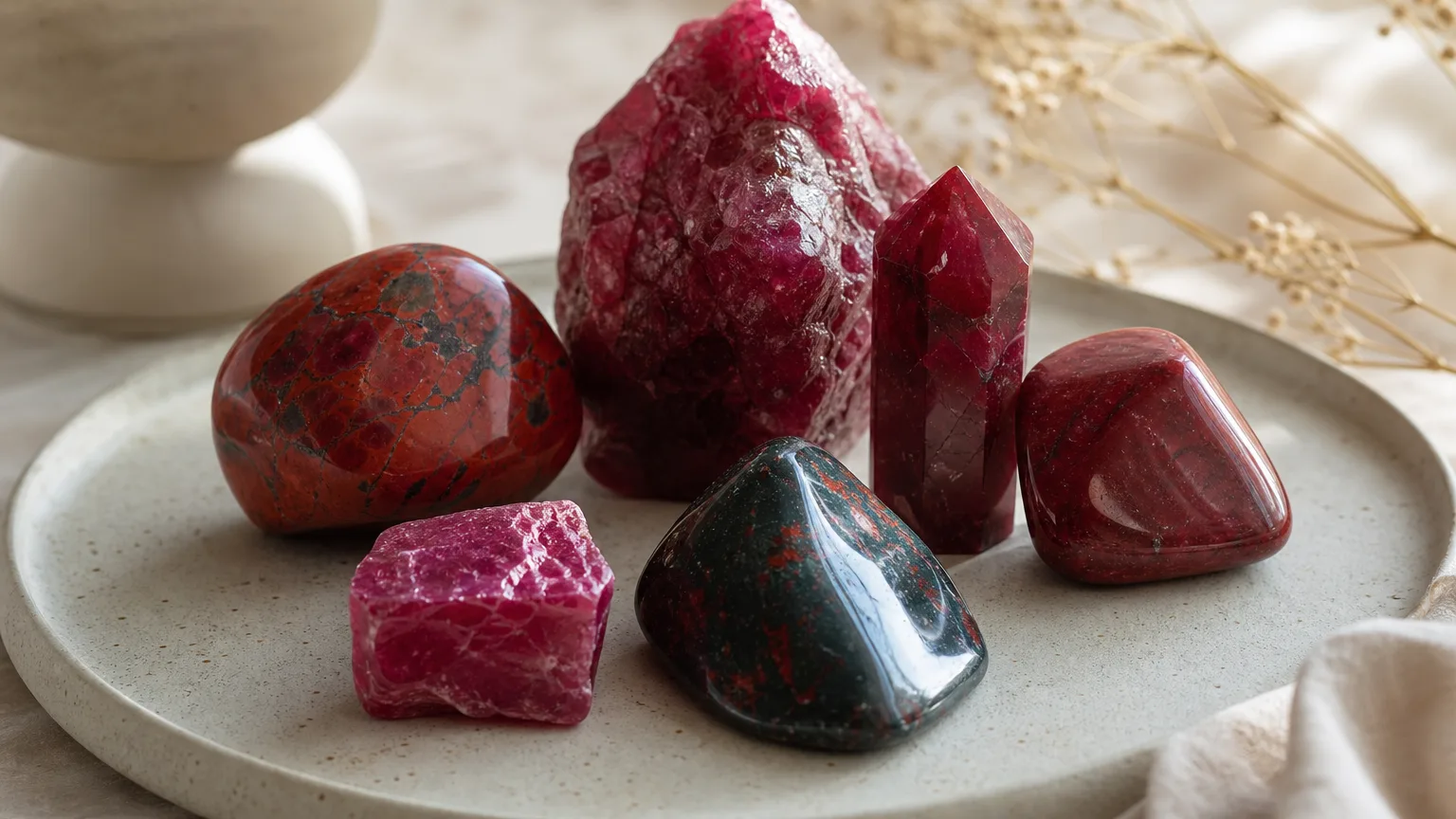
The best crystals for Red include Ruby, Red Jasper, Bloodstone, traditionally used in mindfulness and spiritual practices. Crystal properties are complementary wellness tools, not medical treatments.
Understanding Red Crystals
Red is the color we notice first. It sits at the long-wavelength end of the visible spectrum, and across cultures it has been bound up with blood, fire, sunrise and survival. That visibility is part of why red feels energizing to many people — it is the color the eye locks onto fastest, which may be one reason it tends to read as urgent, warm, and alive.
In mineral terms, red usually points to iron. Trace iron built into a crystal lattice, often oxidized over time, gives stones like Red Jasper and Brecciated Jasper their brick-to-terracotta tones. Chromium does the work in Ruby, producing the deep red gem buyers call “pigeon blood.” These causes are well documented; the energetic associations layered on top are matters of tradition rather than measurement.
Across older medical and spiritual systems, red was tied to the root of the body — the base of the spine, the legs, the sense of standing on solid ground. Red stones were traditionally associated with courage, stamina, and the will to act. Today, many people keep a red stone close when they want a tactile reminder to move forward with something difficult rather than overthink it.
Quick facts: Symbolism: Passion, vitality, courage. Psychology: Energy, strength, action. Associated chakra: Root, element: Fire.
Not sure which color is right for you? Try the Crystal Quiz ↗
How to Identify Red Crystals
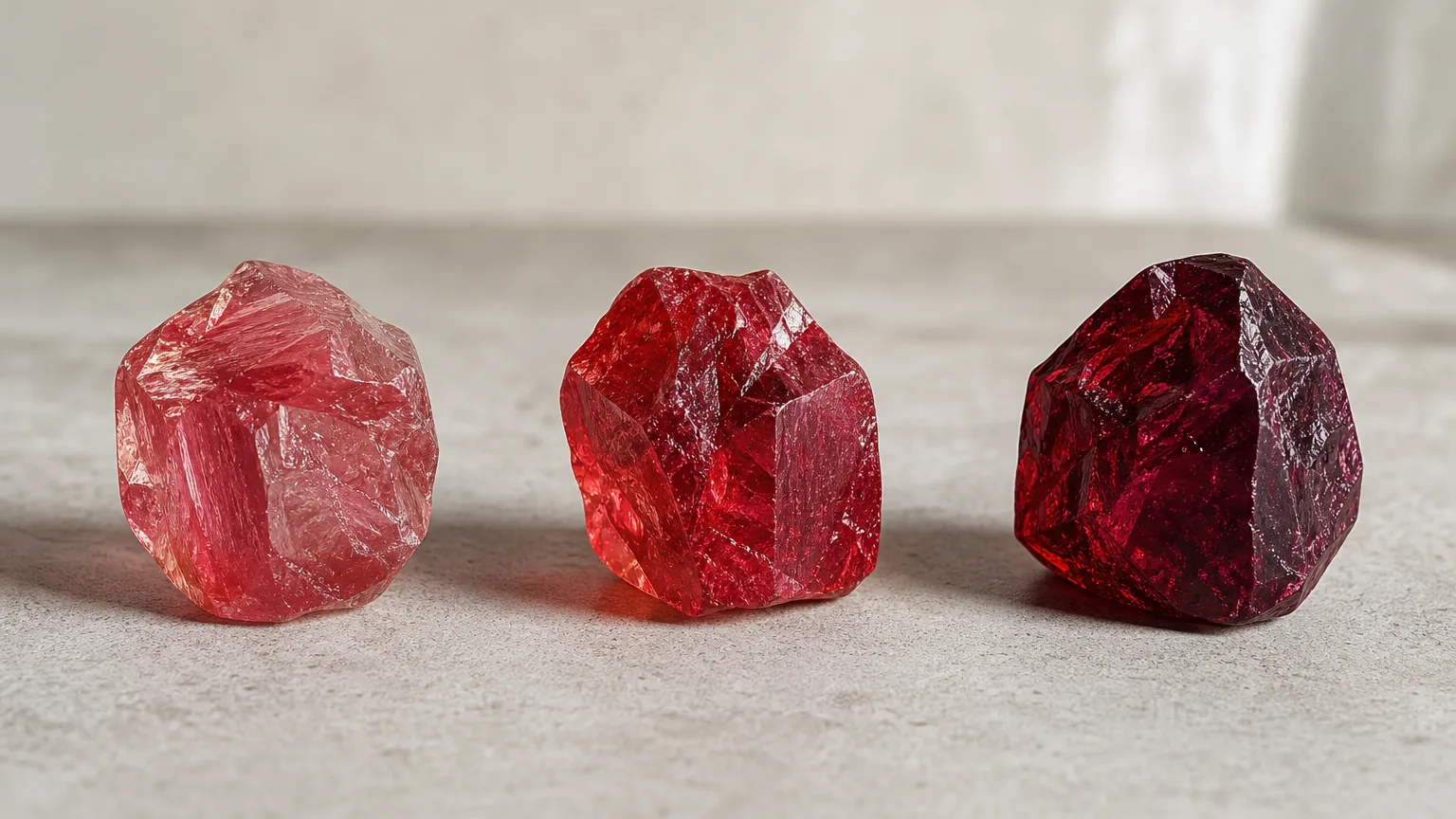
Red crystals span a wide tonal range, from the translucent, glowing red of a faceted Ruby to the opaque, earthy brick of Red Jasper. Hue tells you the most: a true, slightly purplish red with strong saturation usually points to corundum (Ruby), while orange-leaning or brownish reds more often belong to the jasper and quartz families. Translucency matters too — Ruby and Garnet let light travel inside the stone, whereas Jasper, Bloodstone and Brecciated Jasper stay opaque and look denser, more grounded.
Surface texture is the next clue. Glassy to vitreous luster (Ruby, Corundum) reads as bright and reflective; a waxy or dull finish (Red Jasper, Rhodonite in rough form) feels softer and more matte. Patterns help separate look-alikes: Bloodstone shows dark green with sharp red spots, Rhodonite carries pink-red with black manganese veining, and Brecciated Jasper has broken, angular fragments of red set in a lighter cream or tan matrix — a record of the stone having been shattered and re-cemented by mineral-rich water.
Two stones get confused often. Red Coral and Rhodochrosite can both be a soft coral-pink; coral’s organic branching structure and faint parallel lines distinguish it from a mineral’s crystalline grain. Dyed Howlite or dyed Agate is the bigger trap — the red looks flat and sits only in surface cracks, fading unevenly, whereas natural red tends to vary in depth across the stone. Light also shifts what you see: warm indoor bulbs push red stones toward orange, while daylight reveals cooler, truer tones, so check color in natural light before buying.
9 Best Crystals for Red
Ruby
Kleur: Deep red (“pigeon blood” is the classic)
Meaning: Passion, vitality, courage
Best for: Bravery, Vitality, Leadership
Chakra: Root, Heart
Element: Fire
Best way to use: Wear as jewelry
Affirmation: I act with courage and a full heart.
Ruby is the red variety of corundum (Al₂O₃), and its color comes from trace chromium replacing aluminum in the crystal structure — the same element, in different amounts, that turns the same mineral blue as sapphire. At 9 on the Mohs scale it is exceptionally hard, which is why it has carried value across centuries as a stone that survives. In color psychology, saturated red is read by the eye as urgent and alive, and many people describe wearing ruby as feeling like a quiet surge of warmth rather than a spike of agitation. Traditionally associated with the root and heart, ruby is often used as a focus stone for brave decisions — kept on the body, or held for a few breaths before something that asks for nerve. The simplest ritual: set an intention to act on one specific thing, then let the stone be the physical reminder that the decision is already made.
Red Jasper
Kleur: Brick red, terracotta, brown-red
Meaning: Passion, vitality, courage
Best for: Stamina, Focus, Stress relief
Chakra: Root, Sacral
Element: Earth
Best way to use: Wear as jewelry
Affirmation: I am steady, patient, and supported.
Red Jasper is an opaque chalcedony, a microcrystalline form of SiO₂ colored brick-red by iron oxide inclusions. Unlike glassy gems, it is granular and dense, which is part of why it has been carried as a grounding stone since antiquity — the weight itself feels anchoring. In color psychology, earthy reds read as warmth and endurance rather than excitement, suiting people who want sustained energy without the spike. Traditionally tied to the root, it was used by soldiers and workers as a stone for stamina and steady focus. Many people keep one in a pocket during long tasks and hold it when the mind starts to scatter, using the cool, smooth surface as a cue to slow the breath and return to the work in front of them.
Read full Red Jasper meaning →
Bloodstone
Kleur: Dark green with red spots
Meaning: Passion, vitality, courage
Best for: Courage, Vitality, Grounding
Chakra: Root, Sacral, Heart
Element: Earth, Fire
Best way to use: Wear as jewelry
Affirmation: I meet difficulty with a calm, steady heart.
Bloodstone, or heliotrope, is a dark green chalcedony (SiO₂) dotted with red jasper that looks like droplets against the green field. The red is iron oxide, the green is chlorite and other included minerals — so the two colors are really two stones grown together. The contrast is striking enough that the stone has carried strong associations since antiquity, often tied to courage and to facing hard things without flinching. Traditionally worked with across root and heart, it pairs the grounding of a dense opaque stone with a symbolic edge of resolve. A common practice is to hold it for a minute before a difficult conversation, letting the weight in the hand be a reminder to stay present and breathe evenly when the impulse is to react.
Read full Bloodstone meaning →
Rhodonite
Kleur: Pink-red with black veining
Meaning: Passion, vitality, courage
Best for: Forgiveness, Heart work, Self-worth
Chakra: Heart
Element: Earth
Best way to use: Carry or hold in meditation
Affirmation: I forgive myself and move forward with an open heart.
Rhodonite is a manganese inosilicate, and its soft pink-red comes from manganese while the black veins are manganese oxide staining the surface — the same metal showing two faces in one stone. It sits in a gentler register than the deep reds, which is why it is the red many people reach for when the work is emotional rather than physical. Traditionally associated with the heart, rhodonite is often used around forgiveness and self-worth, the kind of courage it takes to stay open after being hurt. Held in meditation or carried through a hard day, its weight in the palm can serve as a quiet reminder that softness and steadiness are not opposites — that remaining kind to yourself is itself a form of strength.
Brecciated Jasper
Kleur: Red, brown, with lighter matrix
Meaning: Passion, vitality, courage
Best for: Resilience, Grounding, Recovery
Chakra: Root, Sacral
Element: Earth, Fire
Best way to use: Wear as jewelry
Affirmation: I rebuild stronger after every setback.
Brecciated Jasper is the geological record of something breaking and coming back together. Original jasper was fractured by earth movement, then mineral-rich water cemented the sharp red fragments in a lighter cream or tan matrix of quartz and calcite. That visible history of rupture and repair is exactly why it is traditionally carried as a stone of resilience and recovery — the stone itself is proof that broken things can be re-bound. Opaque and dense like other jaspers, it has the same grounding weight, with the Fire element showing through in the warm red fragments. Many people keep one close during periods of rebuilding, holding it as a tactile reminder that recovery is not about erasing what happened but about finding a new, workable shape.
Read full Brecciated Jasper meaning →
Coral
Kleur: Red, pink, white, black, blue (rare)
Meaning: Passion, vitality, courage
Best for: Grounding, Protection, Meditation
Chakra: Root (red); Heart (pink)
Element: Water
Best way to use: Wear as jewelry
Affirmation: I stay calm and connected, even in moving water.
Red Coral is not a mineral but the calcium carbonate (CaCO₃) skeleton of tiny marine animals built up slowly over years in deep water. Its branching, organic structure — with faint parallel growth lines — is what separates genuine coral from shaped stones, and it is one of the few red materials traditionally tied to Water rather than Fire. Across the Mediterranean and South Asia it has long been associated with protection and with life-giving vitality, worn at the body’s base or over the heart. Color psychology reads its warm red as gentle and protective rather than aggressive. Many people wear it as a quiet daily talisman, a smooth organic surface against the skin that serves as a reminder to stay steady through emotional currents.
Corundum
Kleur: Red (ruby), blue, yellow, pink, green, colorless (sapphire)
Meaning: Passion, vitality, courage
Best for: Steadiness, Focus, Demanding work
Chakra: Root, Crown
Element: Fire / Earth
Best way to use: Wear as jewelry
Affirmation: I hold my focus steady through long effort.
Corundum (Al₂O₃) is one of the hardest natural minerals at 9 on the Mohs scale, and its red form is Ruby while every other color is grouped as sapphire. The toughness is real and measurable — it resists scratching and heat, which is why it has been used in bearings, watch movements, and cutting tools, not only jewelry. As a focus stone, corundum is often chosen for demanding, long-horizon work where steadiness matters more than a quick burst of drive. The Fire of its red form paired with the Earth-like durability of the mineral itself reads to many as a combination of passion and staying power. A simple practice is to set it on the desk during deep work as a physical anchor, returning the hand to it whenever attention drifts.
Eisenkiesel
Kleur: Red, orange, brown (iron-stained)
Meaning: Passion, vitality, courage
Best for: Grounding, Daily wear, Steady energy
Chakra: Root, Sacral
Element: Earth
Best way to use: Wear as jewelry
Affirmation: I move through my day with quiet, steady energy.
Eisenkiesel is quartz (SiO₂) stained a warm red to orange-brown by included iron oxide — the name is German for “iron pebble.” Unlike the saturated red of Ruby, its color is earthy and muted, which is why it tends to read as grounded rather than intense. The iron is the same element coloring Red Jasper and Brecciated Jasper, so the three share a family feeling of low, steady warmth. Traditionally used as a daily-wear stone for grounded, even energy, it suits people who want something robust and unflashy that can travel in a pocket or on a wrist. Many describe holding it as feeling like a small steadying weight that says “keep going” without the spike and crash of stronger stimulation.
Read full Eisenkiesel meaning →
Eudialyte
Kleur: Red, pink, magenta
Meaning: Passion, vitality, courage
Best for: Self-Love, Passion, Emotional Warmth
Chakra: Heart, Root
Element: Fire, Earth
Best way to use: Wear as jewelry
Affirmation: I treat myself with warmth and genuine care.
Eudialyte is a rare cyclosilicate whose red-to-magenta color comes from manganese, often set in a matrix of darker minerals that make the red patches glow by contrast. Found mostly in remote northern locales, it sits in a softer register than the deep reds — pink-leaning and warm — which is why it is often associated with the heart and with self-directed kindness rather than outward drive. Traditionally worked with across root and heart, it is the red many people reach for when the goal is emotional warmth and self-acceptance. Held during quiet reflection or worn close to the chest, its gentle color can serve as a reminder that care for oneself is not separate from strength but the ground it stands on.
How to Choose Red Crystals by Intention
Red covers a wide emotional range, from sharp courage to gentle self-kindness, so matching the stone to the intention matters more than picking the boldest color. The table below maps common goals to the red stones that fit them best.
| Intention | Best Red Crystals | Why |
|---|---|---|
| Courage and brave action | Ruby, Bloodstone, Red Jasper | Dense, warm reds traditionally tied to nerve and stamina for facing hard things. |
| Steady energy and focus | Red Jasper, Corundum, Eisenkiesel | Earthy, muted reds that read as endurance rather than a spike and crash. |
| Resilience and recovery | Brecciated Jasper, Bloodstone | Stones whose visible structure records rupture and repair — a physical model of bouncing back. |
| Heart work and forgiveness | Rhodonite, Eudialyte | Softer pink-reds that lean toward self-worth and emotional warmth rather than drive. |
| Protection and grounding | Red Coral, Red Jasper, Bloodstone | Opaque, weighty stones long carried as anchors and shields at the body’s base. |
| Self-love and kindness | Eudialyte, Rhodonite | Gentle manganese reds associated with the heart and care directed inward. |
How to Use Red Crystals
Red stones respond well to a few focused practices rather than a long generic list. These four suit the warming, action-oriented nature of the color.
1. Morning routine. Red is the color of sunrise and forward motion, so it fits the start of the day. Hold a Red Jasper or Eisenkiesel in your palm for thirty seconds while you set one concrete intention for the morning — not a goal, just the next physical action. Let the cool weight of the stone anchor the decision before the day’s noise begins.
2. Carrying through the day. A small tumbled Ruby, Bloodstone, or Brecciated Jasper in a pocket gives a discreet tactile reminder. When stress rises or attention scatters, reach for the stone and roll it between your fingers for a few breaths. The point is not the crystal itself but the small pause it creates — a cue to return to steady breathing and pick the next step.
3. Worn as jewelry. Red reads as warm and alive against the skin, which is why Ruby, Coral, and Red Jasper have been worn for centuries. A ring or bracelet keeps the stone in your peripheral vision and lets you touch it without drawing attention. Choose the piece you will actually put on daily over the most impressive one in the box.
4. Action ritual. Red belongs to doing, so pair the stone with a single committed act. Hold a Bloodstone or Corundum, name one task you have been avoiding, place the stone on your desk within view, and begin. The crystal becomes the physical marker that the decision was already made — the work now is simply to follow through.
Red Crystals for Motivation, Passion, and Action
Motivation, passion, and action are where red does its clearest work. The color is read by the eye as urgent and alive, and the stones that carry it have been tied for centuries to courage, stamina, and the will to move. The trick is using them at the moments when momentum is hardest to find.
Morning desk ritual for motivation. When a task feels too large to start, place a Red Jasper or Corundum on the desk where your eyes land first. Before opening any screen, hold the stone for ten breaths and name the single smallest step you could take — usually something that takes five minutes. Begin that step with the stone still in view. The cue is environmental: every time your gaze catches the red, it reminds you the decision to start has already been made, and the only thing left is to keep going.
Bedside reflection for passion. Passion fades when it has no attention paid to it. Keep a Ruby or Eudialyte on the bedside table. At the end of the day, hold it for a minute and recall one moment that actually felt alive — a conversation, a piece of work, a small win. Naming what genuinely moved you, even briefly, is a way of telling the mind what to look for again tomorrow. Over weeks this simple reflection often does more for sustained motivation than any single dramatic push.
For action specifically, Bloodstone and Brecciated Jasper are the traditional companions — stones whose own formation involves pressure, fracture, and repair. They suit the moments that ask less for inspiration than for plain steadiness: the long project, the difficult conversation, the task that has been put off for weeks.
Red Crystals at a Glance
| Crystal | Best for | Chakra | Best way to use |
|---|---|---|---|
| Ruby | Bravery and leadership | Root, Heart | Wear as jewelry; hold before brave decisions |
| Red Jasper | Stamina and focus | Root, Sacral | Carry in pocket; hold when scattered |
| Bloodstone | Courage and vitality | Root, Sacral, Heart | Hold before difficult conversations |
| Rhodonite | Forgiveness and self-worth | Heart | Carry or hold in meditation |
| Brecciated Jasper | Resilience and recovery | Root, Sacral | Wear daily during rebuilding periods |
| Coral | Protection and grounding | Root (red) | Wear as jewelry against the skin |
| Corundum | Steadiness in demanding work | Root, Crown | Place on desk during deep work |
| Eisenkiesel | Steady, grounded daily energy | Root, Sacral | Carry for low, even warmth |
| Eudialyte | Self-love and emotional warmth | Heart, Root | Hold during quiet heart reflection |
Shop Crystals for This Guide
Explore crystal jewelry and stones from our current collection.


Ruby Anklet


Ruby-Kyanite Tower


Ruby-Kyanite Pyramid

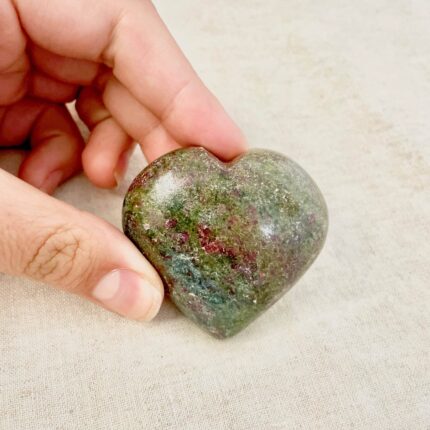
Ruby-Kyanite Heart
FAQ
What are red crystals good for?
Red crystals are traditionally associated with courage, vitality, stamina, and grounded action. Many people use them as focus tools when they want steady energy for demanding tasks, brave decisions, or periods of recovery. Crystal properties are complementary wellness supports, not medical treatments.
What do red crystals mean?
Across cultures, red has been tied to blood, fire, sunrise, and the root of the body, so red stones generally carry meanings of passion, life force, and the will to act. Softer pink-reds like Rhodonite and Eudialyte lean toward heart work and self-kindness, while deep reds like Ruby and Bloodstone lean toward courage and stamina.
What is the most powerful red crystal?
There is no single most powerful red crystal — “powerful” depends on the intention. For courage and vitality, Ruby and Bloodstone are the traditional choices. For endurance and focus, Red Jasper and Corundum. For emotional warmth and self-love, Rhodonite and Eudialyte. Match the stone to the goal rather than chasing the strongest-sounding name.
What is the rarest red crystal?
Among the stones here, fine “pigeon blood” Ruby and Red Coral of deep, even color are the rarest and most sought after. Eudialyte is also uncommon, found in a small number of remote northern localities. Red Coral is doubly limited because it is a living material that grows slowly and is carefully regulated.
What crystal is deep red and translucent?
A deep, slightly purplish red that glows with light inside the stone is most likely Ruby (red corundum). If the stone is opaque with no internal light, it belongs to the jasper family — Red Jasper or Brecciated Jasper. Translucency is the fastest clue: gem corundum lets light travel through it, jasper does not.
What crystal is dark green with red spots?
That is Bloodstone, also called heliotrope — a dark green chalcedony dotted with red jasper that looks like droplets. It is one of the easiest red stones to identify because the green-and-red contrast is distinctive and hard to imitate convincingly.
What crystal is pink-red with black veins?
That pattern belongs to Rhodonite — a soft pink-red manganese mineral veined with black manganese oxide. The black surface staining is a reliable identifier, since few other pink-red stones carry that sharp dark veining.
How do I cleanse and charge red crystals?
Most red stones clean well under cool running water and dry best with a soft cloth. Avoid prolonged soaking for softer or porous stones like Coral, and keep Ruby and Corundum away from harsh chemicals. To recharge them, many people place red stones in gentle morning sunlight for a short time — the same warm light that suits their character — though deeply colored stones like Ruby should not be left in strong sun for long, as some color enhancement can fade.
Are the benefits of red crystals scientifically proven?
The geological facts — mineral composition, hardness, what causes the red color — are well established by science. The energetic and emotional benefits (courage, vitality, grounding) are traditional and personal associations, not clinically proven effects. What research does support is the general benefit of mindful practices like brief breathing, intention-setting, and tactile grounding, which many people pair with holding a stone. The crystal is a focus aid, not a treatment.
Shop Red Crystals: What to Look For
- Shop Ruby
- Shop Red Jasper
- Shop Bloodstone
- Shop Rhodonite
- Shop Brecciated Jasper
- Shop Coral
- Shop Corundum
- Shop Eisenkiesel
- Shop Eudialyte