
Turquoise Meaning: Healing Properties & Uses
Turquoise is a blue-to-green phosphate mineral — one of the oldest gemstones in human use, tied across cultures to protection, communication, and friendship. It’s also the modern December birthstone. If you’re drawn to its sky-blue color for meaning or for a piece you’ll wear, this guide covers what turquoise is, its long history, and how to tell the real stone from look-alikes. Crystal meanings reflect tradition and personal practice, not medical advice.
What Is Turquoise Meaning?
At its simplest, turquoise means protection and clear communication. With its sky-blue to apple-green color, it’s been carried as a protective talisman and worn near the throat for honest expression for thousands of years. People reach for it as a sign of friendship, a focus for speaking truthfully, or simply a beloved blue stone.
For a lot of people that’s the whole appeal: one vivid blue piece, one intention, one small daily ritual. You don’t need to believe anything mystical to benefit — the value often comes from the act of choosing the stone, giving it a job, and letting its cool color pull your attention back to a calmer, more honest baseline. In that sense turquoise is a visual cue you train yourself to return to.
Turquoise Meaning and Symbolism
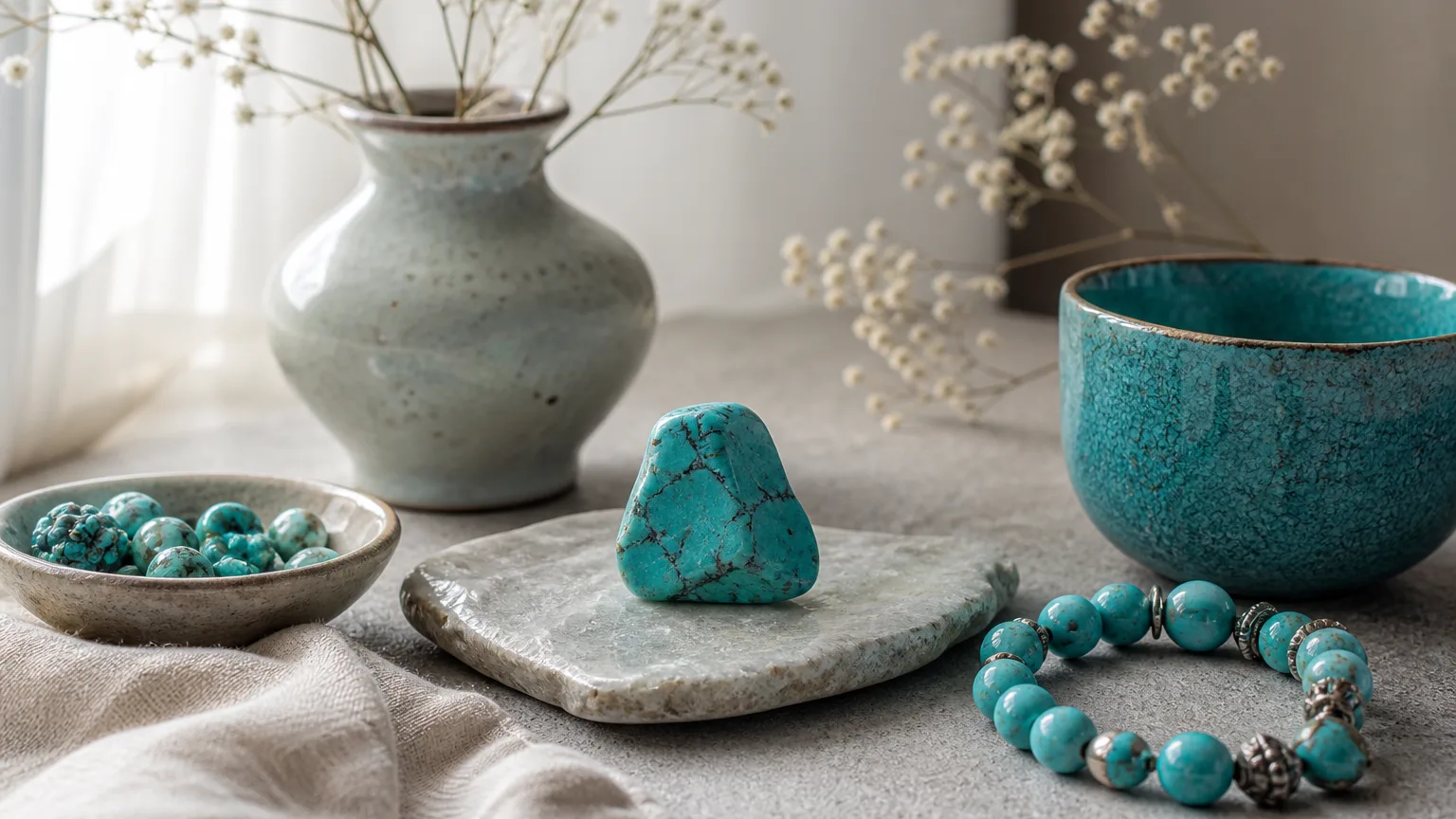
The name comes from trade routes. Turquoise derives from the French pierre tourquesque — “Turkish stone” — because the material reached Europe through Turkey, even though much of it was mined in Persia. The stone itself is far older than the name: it’s one of the first gemstones humans worked, with beads and inlay dating back thousands of years.
Its history spans continents. Ancient Egyptians mined turquoise in the Sinai and set it into royal jewelry — pieces were found in Tutankhamun’s tomb. Persian artisans worked the famous Nishapur deposits for centuries, valuing the pure blue material so highly that it decorated mosques and palaces. In China, turquoise has been carved and worn since ancient times. In the American Southwest, turquoise is central to the silver-and-stone jewelry traditions of Native American peoples such as the Navajo, Zuni, and Hopi — a living craft tradition that deserves to be appreciated on its own terms, not treated as a generic style to copy.
Today the common threads are consistent: protection, communication, and friendship. You’ll see turquoise described as a stone for honest expression, a protective charm, or a token between friends. How much of that you experience personally is up to you, but the symbolism has held across very different cultures for thousands of years. To explore more stones, browse the full Kristalgids.
Turquoise Properties

De wetenschap
Turquoise is a hydrated copper aluminum phosphate — CuAl₆(PO₄)₄(OH)₈·4H₂O — and its color comes from those metals: copper produces the blue, while iron substituting for aluminum shifts it toward green. It forms in the triclinic crystal system, but you almost never see actual crystals — turquoise occurs as opaque masses, veins, and nodules in arid, copper-rich rock. It’s a relatively soft stone at 5–6 on the Mohs scale, and it’s porous, which is why it so readily absorbs oils, dyes, and stabilizing resins. Major sources include Iran (the historic Persian mines), the American Southwest, China’s Hubei province, Mexico, and Egypt’s Sinai. None of this is mystical — it’s mineralogy, and the porosity explains both turquoise’s beauty and its care needs.
Traditionele betekenis
Tradition ties turquoise to protection, communication, and friendship. It’s linked to the throat center and is often described as a stone that supports honest, clear expression — many believe it acts as a protective charm, especially for travelers, and strengthens friendship and goodwill. Across cultures it was set into amulets, talismans, and ceremonial objects, and it remains a beloved December birthstone. These associations come from spiritual tradition and personal practice rather than clinical study.
Mindfulness & psychologie
From a psychological angle, turquoise works as a calm, communicative focal cue — something cool and blue to wear or hold near the throat as a reminder to speak honestly and listen well. In color psychology, blue-green tones are linked to calm and clear expression, and the act of wearing a piece you’ve paired with an intention (speak truthfully today) turns it into a small cue you keep returning to. Its familiar, cheerful color also makes it a comfortable everyday stone to live with. These effects come from tradition and personal practice, not clinical research. Crystals complement — but never replace — professional care.
Turquoise Benefits

People who work with turquoise usually describe it in terms of calm, honest expression and a sense of protection, not dramatic effects. It tends to show up as a steadier mood and a clearer voice. Here are a few of the benefits people mention most often:
Easier, clearer communication
Worn near the throat, turquoise is a cue to speak honestly and listen well — a gentle reminder in tense or important conversations.
A sense of protection
Long carried as a protective charm, many wear it through travel or demanding days as a steady, reassuring presence.
A token of friendship
Given between friends for centuries, turquoise makes a meaningful gift that carries the symbolism of goodwill and loyalty.
A calmer, steadier mood
Its cool blue-green color reads as calming; kept in view, it’s a low-key cue to soften tension through the day.
The pattern underneath all of these is the same: the stone isn’t doing the work for you, but it gives your day a cue toward calm and honest expression. If you’re exploring stones for specific needs, see our guide to crystals for anxiety.
Turquoise Chakra, Zodiac, and Element Associations
In traditional systems, turquoise is most often linked to the throat en third eye centers — the areas tied to clear expression and intuition. It’s a modern birthstone for December, and it’s commonly paired with Sagittarius, Pisces, en Aquarius. Het element ervan wordt meestal weergegeven als Aarde. Zie voor verwante stenen throat chakra crystals.
These are correspondences built up through tradition, not rules carved in stone. If your own sense of turquoise points somewhere else — a different chakra, a different element — that’s completely fine. Many people work with stones intuitively, following what feels right rather than a textbook chart, and there’s a long history of practitioners doing exactly that.
How to Use Turquoise

Turquoise is a soft, porous stone (Mohs 5–6), so it needs more care than quartz — a few habits keep it looking its best. The key is consistency: a piece you actually wear and notice every day does far more than one stored away.
Draag het. A pendant or beaded bracelet keeps turquoise near the throat or on the wrist through the day. Put it on after cosmetics and perfume, which can stain porous turquoise.
Mediteer ermee. Hold a tumbled piece or rest it near your throat while you sit. Even a few minutes of calm focus counts; the goal is presence, not duration.
Keep it on a shelf. A polished cabochon or small carving adds a calm blue presence to a desk or shelf — a quiet cue through the day.
Give it as a token. With its long friendship symbolism, a piece of turquoise makes a meaningful gift between close friends.
Which Turquoise Form Is Right for You?

| Formulier | Het meest geschikt voor | Kies deze optie als |
|---|---|---|
| Cabochon | Rings, pendants, display | You want the classic smooth, domed cut that shows the color |
| Beaded bracelet | Dagelijks gebruik | You want a wearable row of turquoise beads through the day |
| Hanger | Dagelijks gebruik | You want turquoise worn near the throat for communication |
| Inlay piece | Opvallende sieraden | You like the traditional inlaid look set in silver |
| Getrommelde steen | Zak of meditatie | You want a smooth, affordable piece to hold or carry |
| Carving | Shelf or altar display | You want a carved form that doubles as a room accent |
How to Tell Real Turquoise from Fakes
Because genuine turquoise is prized and porous, the market is full of look-alikes and treatments — more than almost any other stone. Knowing what you’re buying matters here. A few checks help:
- Dyed howlite and magnesite. These pale, porous stones take dye easily and are sold as “turquoise.” They’re lighter in weight, often too uniformly blue, and may have a different veining pattern. A drop of acetone (nail polish remover) on an unseen spot can lift dye from fakes.
- Stabilized turquoise. Much genuine turquoise is “stabilized” — infused with resin to harden it and deepen color. It’s real turquoise, just treated, and should be sold as such.
- Reconstituted turquoise. Some “turquoise” is ground stone powder bound with resin and pressed. It contains real turquoise but is a manufactured composite, not solid natural stone.
- Plastic and glass. A hot pin can reveal plastic (it melts or smells); glass feels colder and harder than porous turquoise. Both are common cheap imitations.
- Price and source. Solid, untreated turquoise in rich color costs more. A large, vivid “turquoise” piece at a bargain price is almost certainly dyed howlite, reconstituted, or plastic — buy from a seller who states what it is.
None of these treatments make a piece worthless — stabilized turquoise, in particular, is an honest, practical choice for jewelry. The only real problem is paying for natural turquoise and receiving something else. Ask, read the listing, and pay the right price for what it is.
How to Cleanse and Care for Turquoise
Turquoise is porous and soft, so it needs gentle, mostly dry care — think of it more like caring for a pearl than a quartz. A few reliable practices:
- Avoid water and chemicals. Keep turquoise away from water, soap, perfume, sunscreen, and cosmetics, which soak in and discolor it. Put jewelry on last, take it off first.
- Soft, dry cloth. For ordinary cleaning, wipe it gently with a soft dry cloth. Skip ultrasonic and steam cleaners entirely — they can damage porous turquoise.
- Avoid prolonged sun. Long exposure to strong light can fade turquoise over time. Store it out of direct sun when you’re not wearing it.
- Store it carefully. Keep it separate from harder stones that could scratch it (it’s only Mohs 5–6), ideally in a soft pouch.
One thing worth knowing: turquoise can change color slowly as it absorbs skin oils over years — a natural aging some owners appreciate as a “patina” and others prefer to avoid with careful wear. For more, see our handleiding voor het reinigen van kristallen.
Best Crystals to Pair With Turquoise
Pairing is about layering intentions — picking stones whose qualities complement rather than compete. A few combinations that work well with turquoise’s protective, communicative energy:
- Turquoise + Coral — a classic blue-and-red pairing from long jewelry tradition; warm protection meets calm communication.
- Turquoise + Citrien — calm communication meets warmth; a cheerful pairing for friendship and an upbeat mood.
- Turquoise + Lapis Lazuli — two blue stones; a layered pairing for communication, wisdom, and clear expression.
Bij het samenstellen van combinaties draait het om complementaire bedoelingen, niet om strikte regels. Kies combinaties die aansluiten bij waar je op dat moment mee bezig bent, en vertrouw op je eigen gevoel voor evenwicht.
Who Should Use Turquoise?
Turquoise suits people who want a vivid blue stone for communication, protection, or friendship — anyone who speaks or performs, wants a protective daily piece, or is drawn to its thousands of years of history. It’s also a natural choice as a December birthstone gift. It rewards a little care, but it’s deeply wearable and meaningful in return.
A few honest expectations: turquoise isn’t a treatment for anxiety, sore throats, or any condition — if you’re dealing with something persistent, a healthcare professional is the right call, and the stone can be a comfort alongside that. It’s soft and porous, so it needs gentle care (no water, no chemicals, no rough handling), and the market carries many treatments and look-alikes worth learning to spot. Its value comes from the intention you build around it and from knowing what you’re wearing. Go in expecting a beautiful, symbolic stone that asks for some care, and it tends to fit well.
FAQ About Turquoise Meaning
What is turquoise made of?
It’s a hydrated copper aluminum phosphate — CuAl₆(PO₄)₄(OH)₈·4H₂O. Copper gives it the blue; iron substituting for aluminum shifts it toward green.
Is turquoise a December birthstone?
Yes. Turquoise is one of the modern birthstones for December, alongside tanzanite and zircon.
Can turquoise go in water?
Avoid it. Turquoise is porous, so water, soap, and chemicals soak in and can discolor or damage it. Wipe it with a soft dry cloth instead.
How can I tell real turquoise from fakes?
Watch for dyed howlite (lighter, too uniform, dye lifts with acetone), reconstituted stone (powder + resin), and plastic (revealed by a hot pin). Stabilized turquoise is real but resin-treated and should be sold as such.
What chakra is turquoise associated with?
Traditionally the throat and third eye centers, linked to clear expression, honesty, and intuition.
Why is my turquoise changing color?
Turquoise is porous and slowly absorbs skin oils and moisture over time, which can shift its color. Careful wear slows this; some owners like the natural “patina” it creates.
How do I clean turquoise?
Wipe it gently with a soft dry cloth. Avoid water, soap, perfume, ultrasonic, and steam cleaners — all of which can harm porous turquoise.
What is Kingman turquoise?
Kingman turquoise is a well-known turquoise from the Kingman mine in Arizona, USA. It is the same turquoise mineral — just named for its famous locality, prized for its blue color with a dark matrix.
Final Thoughts on Turquoise
Turquoise has earned its place as one of humanity’s oldest and most beloved stones — and it earns it again for each person who wears it and gives it meaning. If you’re curious, the simplest start is one piece, one intention, and a small daily moment to notice it. You don’t need the rarest untreated specimen; you need a piece you’ll wear and care for. Let the routine do the work, and let that cool blue color be the cue that steadies your voice and your mood.
From there, turquoise tends to open a calmer, more honest space — a clearer word, a steadier presence, or simply a beautiful blue stone you’re glad to wear. If that’s what you’re after, you’re in the right place. For more, explore the Kristalgids of blader door turquoise jewelry and stones.