
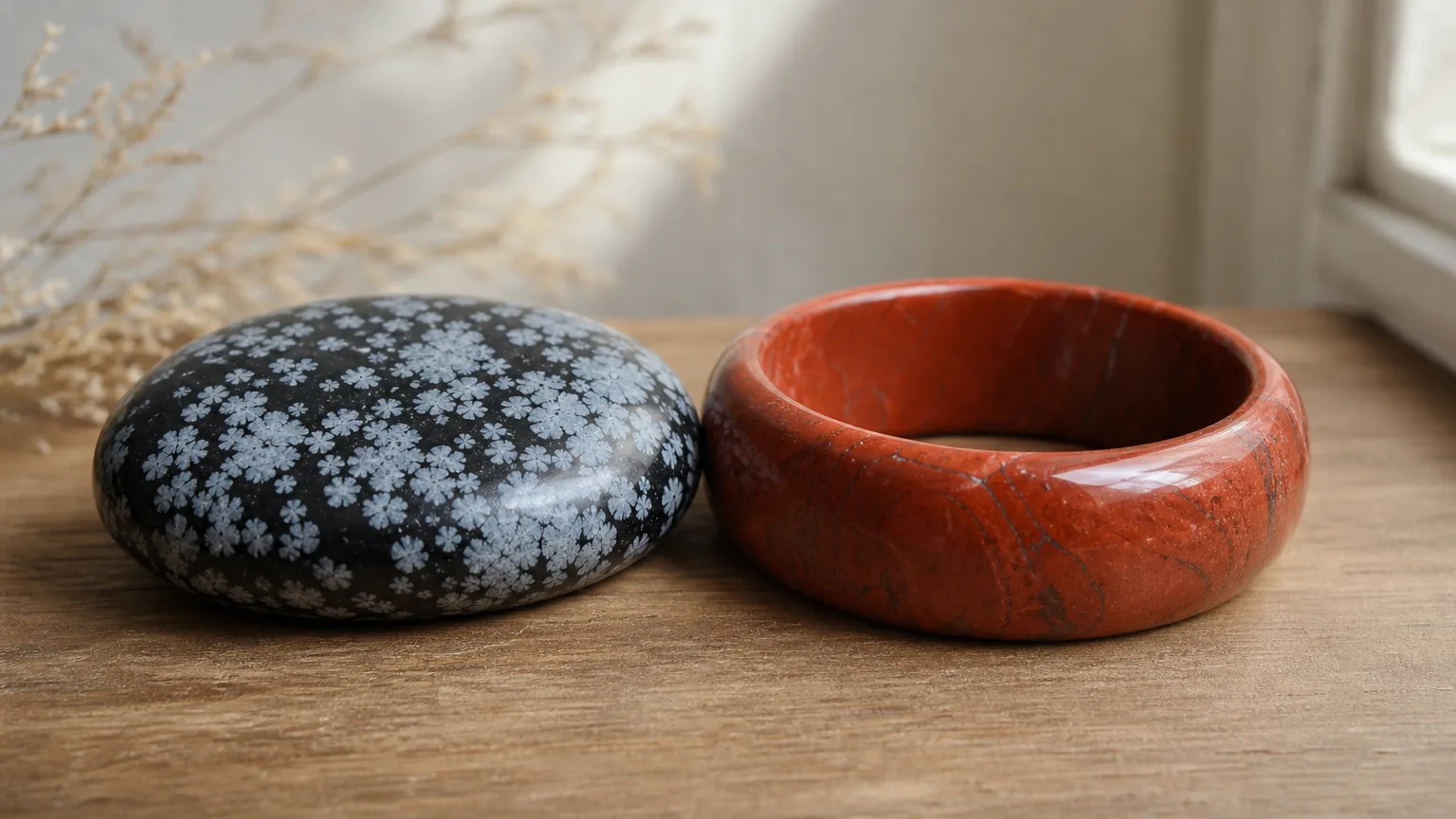
Obsidian and Red Jasper Together: Benefits, Meaning + How to Use
Obsidian and Red Jasper Together: Benefits, Meaning + How to Use
Quick Answer
Yes — Obsidian and Red Jasper can be worn together (compatibility score: 95/100 — Excellent). Both carry a protection intention, both sit in the earth element, and both anchor the Root chakra, which is why many people reach for this pair on days that ask them to stay steady and shielded at once.
About Obsidian
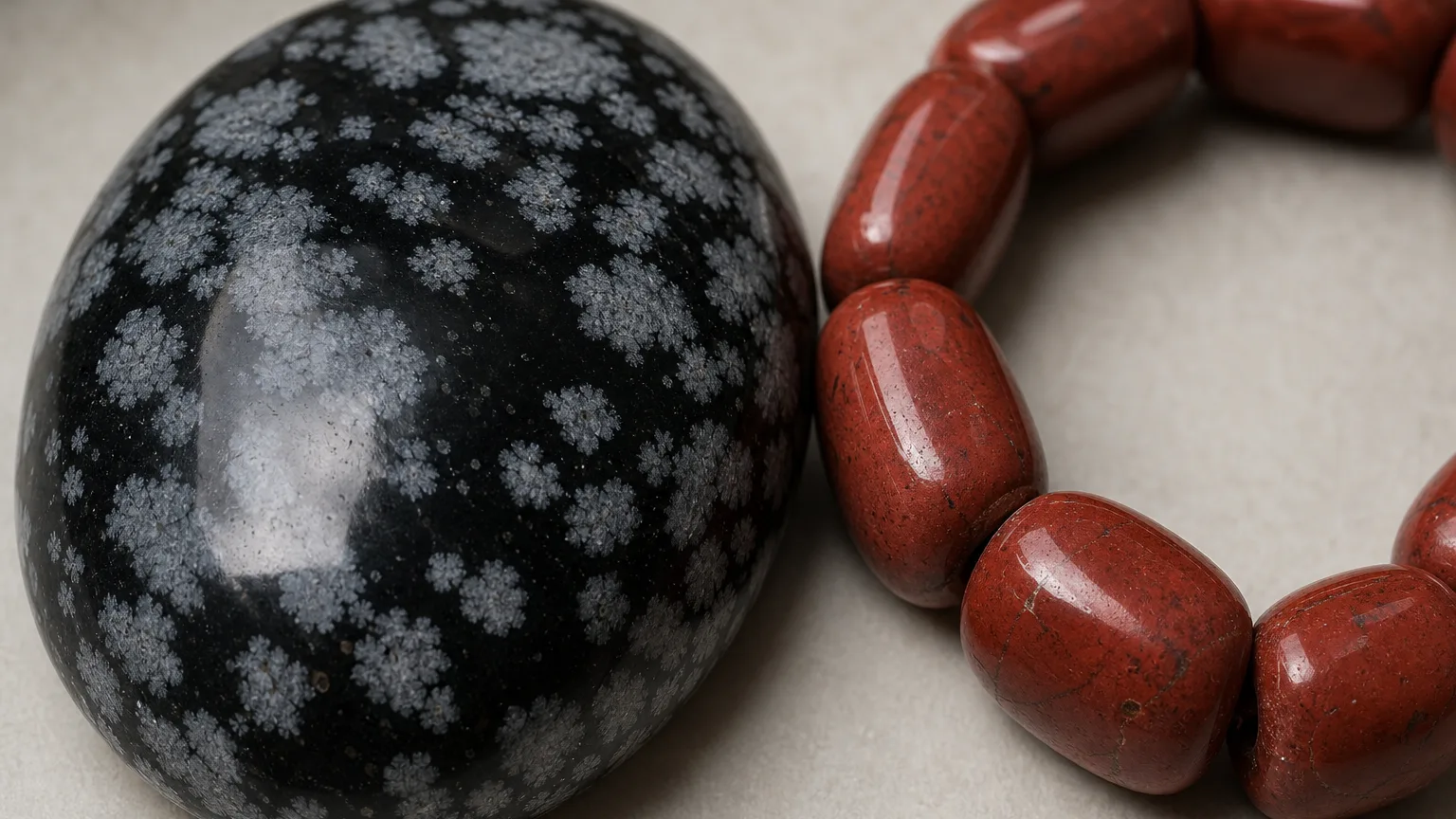
Obsidian is a natural volcanic glass, traditionally associated with protection, truth, and grounding. In crystal practice it’s often linked with the Root and Third Eye chakras, which makes it a popular stone for shadow work and for standing firmly grounded when life feels unsettled. It forms in black, snowflake, rainbow, and mahogany varieties, and common forms include palm stones, mirrors, spheres, and pendants.
Mineralogically, Obsidian is an amorphous (non-crystalline) volcanic glass with a Mohs hardness of 5–5.5 — softer than quartz-family stones. It tolerates only brief water contact and should be kept away from salt water. Because of its lower hardness and brittle, conchoidal fracture, it’s better suited to palm stones, spheres, and pendants than to everyday rings or stacking bracelets that take constant knocks. One small drop on a hard floor can nick it.
Obsidian Meaning → · Genuine, ethically sourced — not dyed, not glass.
About Red Jasper
Red Jasper is an opaque brick-red to terracotta form of chalcedony, traditionally associated with grounding, strength, endurance, and courage. In crystal practice it’s linked with the Root and Sacral chakras, which makes it a go-to stone for stamina, focus, and steady stress relief during demanding stretches. Its warm red tone comes from hematite (iron oxide), and common forms include bracelets, pendants, tumbled stones, palm stones, and raw pieces.
Mineralogically, Red Jasper is silicon dioxide (SiO₂) with a trigonal crystal structure and a Mohs hardness of 6.5–7, durable enough for everyday bracelets and pendants. It tolerates brief water contact and is sun- and salt-safe, making it one of the more low-maintenance stones in a daily collection.
Red Jasper Meaning → · Genuine, ethically sourced — not dyed, not glass.
Can You Wear Obsidian and Red Jasper Together?
Practically: Yes, but the two stones have different durability profiles, and that should drive how you wear them. Red Jasper is the harder of the two at 6.5–7 on the Mohs scale, so it handles a daily bracelet, pendant, or ring without complaint. Obsidian is a softer volcanic glass at 5–5.5 and will chip or scratch if stacked tightly against harder stones — so most people set it in a pendant or carry it as a palm stone instead of locking it into a tight bracelet stack. Their deep black and brick-red tones also read as grounded and intentional together. Both tolerate only brief water contact, and Obsidian in particular should stay away from salt water.
Energetically: In crystal tradition, both stones belong to the earth element and the Root chakra, so together they’re seen as a deeply grounding pair. Obsidian is said to draw off and shield heavy or unwanted energy; Red Jasper is believed to replenish stamina and keep energy moving in a steady, sustained way. Many practitioners describe the combination as one that keeps you protected and fueled through demanding days, with nothing left running on empty.
Psychologically: Because the two share protection and grounding intentions, the pairing works well as a single ritual anchor — one intention (feeling steady and shielded) carried by two stones that reinforce each other instead of competing. It’s a popular combination for people who want a daily wearable that quietly says “present, protected, and able to keep going.”
These properties are traditionally associated with crystal practice; many people find the pairing supportive, though the effects are not established by modern research.
Benefits of Obsidian + Red Jasper
Together, Obsidian and Red Jasper cover five complementary strengths:
1. Layered Protection
Both stones carry a protection intention, but they work it from opposite directions. Obsidian is traditionally used as a shield that absorbs and deflects heavy or unwanted energy from the outside; Red Jasper is chosen for steady, supportive protection that builds resilience from within. Worn together, the two are said to guard the outside and reinforce the inside at once — which is why this is a popular everyday pairing for people in demanding or high-visibility environments.
2. Deep, Steady Grounding
Obsidian and Red Jasper share the Root chakra, the energy center most associated with feeling safe, present, and connected to the physical world. Combined, they’re traditionally used to pull scattered energy back down to earth after an overstimulating day. Many people reach for this pairing when their thoughts feel flighty or their attention feels splintered — they tend to describe a slower, more deliberate sense of being “in their feet” instead of up in their head.
3. Double Earth-Element Stability
Both stones sit in the earth element, so together they reinforce the same quality instead of pulling in different directions. In crystal tradition, a double-earth pairing is valued for its quiet, stable weight — the kind of energy that supports long tasks, patient decision-making, and recovery after stress. Where air- or fire-heavy pairings can feel buzzy, this one reads as solid, unhurried, and dependable.
4. Sustained Stamina and Focus
Red Jasper is traditionally associated with endurance and the stamina to finish long efforts, while Obsidian is used to clear away mental fog and outside noise. Together they’re a common pairing for focus-heavy stretches — long workdays, study blocks, big projects — where the goal is to stay shielded from distraction and keep energy even, with no spike-and-crash. Many people describe it as a quiet “get-it-done” combination, without the jitteriness of more stimulating stones.
5. Calm Courage for Shadow Work
Obsidian is best known for shadow work and honest self-reflection, while Red Jasper is linked with courage and the steadiness to sit with what comes up. In crystal practice the two are often paired for inner work — Obsidian to surface what’s been avoided and Red Jasper to provide the grounded resolve to face it. It’s a combination many turn to for journaling, therapy-adjacent reflection, or any practice that asks for both honesty and self-compassion.
How to Use Obsidian and Red Jasper Together
Wear them
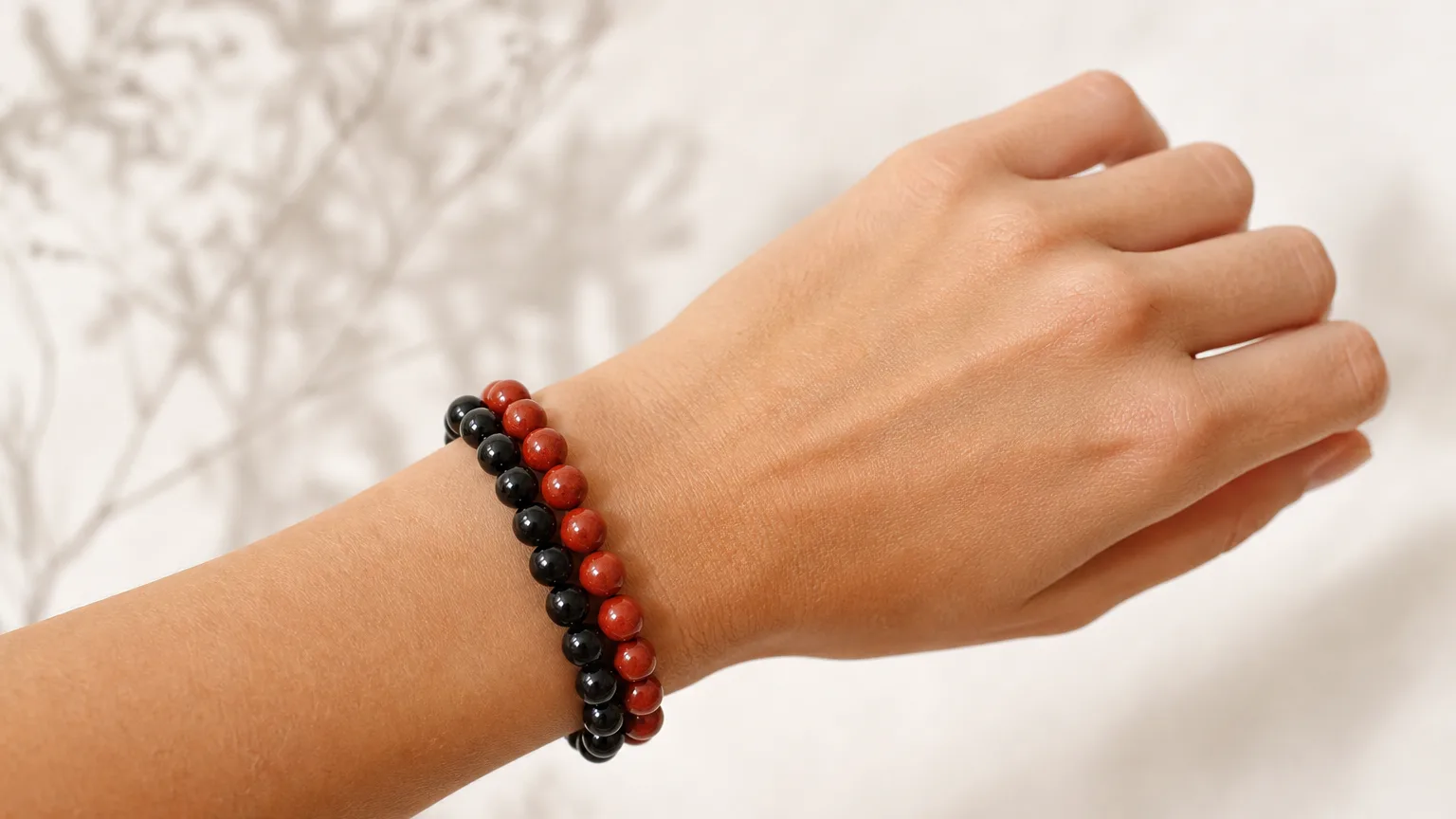
A common question is can I wear Obsidian and Red Jasper on the same hand? Yes — because both are earth-element stones, they’re traditionally considered comfortable together on the same wrist or in the same bracelet stack. A Red Jasper bracelet is the better everyday wearable, since it’s harder (6.5–7) and takes daily knocks well. Keep Obsidian as a pendant or a palm stone so the softer volcanic glass (5–5.5) doesn’t chip against it. For a calm or grounding intention, keep the pairing simple — one Red Jasper bracelet plus one Obsidian pendant is plenty.
Meditate
Hold Red Jasper in your receiving (non-dominant) hand and place Obsidian in front of you or on a low table, not directly against the skin, so its heavy, drawing energy stays gentle. Five to ten minutes is enough for a simple grounding sit, especially if you’re new to working with these two stones. The aim is a calmer, more present feeling — no particular physical sensation required.
Crystal grid
Place Obsidian at the center as the protective anchor and surround it with Red Jasper stones to set an intention of steady stamina. It’s a simple, classic grid for grounding, protection, or long-project focus — easy to build on a desk or small table when you want a grounding presence in a workspace.
Place in a room
Set Obsidian near the front door or entryway, where it’s traditionally positioned to shield a space from outside energy, and place Red Jasper on a desk or nightstand to support steady focus during the day. Together they turn an entry point or work corner into a grounded, protected zone — many people start here when they want a calmer, more shielded home or office.
Caring for Obsidian + Red Jasper
Each stone has its own care needs:
- Obsidian: Water: Brief rinse safe · Sun: Sun-safe · Salt: Avoid salt water.
- Red Jasper: Water: Brief rinse safe · Sun: Sun-safe · Salt: Salt-safe.
When in doubt, cleanse both with sound or moonlight — methods that are gentle across all stone types.
How to cleanse your crystals →
Shop Obsidian + Red Jasper
Every stone below is genuine, ethically sourced, and real — not dyed, not glass.
Bundle any 3 and save 20%.
Frequently Asked Questions
Can I wear Obsidian and Red Jasper together every day?
Many people do. If you’re new to combining stones, start with a few hours and notice how the pairing feels before making it a daily habit.
Can I wear Obsidian and Red Jasper on the same hand?
Yes — both are earth-element stones, so they’re traditionally considered comfortable together on the same wrist or in the same bracelet stack.
Can I sleep with Obsidian and Red Jasper?
You can keep them nearby while you sleep. Obsidian is often placed on the wrist or nightstand, while Red Jasper can rest on the nightstand or nearby.
How do I cleanse Obsidian and Red Jasper?
Obsidian: Water: Brief rinse safe · Sun: Sun-safe · Salt: Avoid salt water. Red Jasper: Water: Brief rinse safe · Sun: Sun-safe · Salt: Salt-safe. When in doubt, sound or moonlight cleansing is gentle across all stone types.
Can I add a third stone to Obsidian and Red Jasper?
Yes — Clear Quartz is a neutral amplifier that bridges most pairings without competing. Add one stone at a time so you can notice each shift.
Related
- Obsidian Meaning
- Red Jasper Meaning
- How to Cleanse Crystals
- Obsidian and Black Tourmaline
- Black Tourmaline and Red Jasper
- Red Jasper and Bloodstone
- Carnelian and Red Jasper
- Crystal Compatibility Checker
Crystal meanings are shared for entertainment and spiritual practice. They’re not a substitute for professional medical or mental-health care.