
Obsidian Meaning: Healing Properties & Uses
Obsidian is volcanic glass — a natural, non-crystalline silica glass formed when lava cools so fast no crystals grow. Long tied to protection, truth-telling, and grounded shadow work, it’s a stone people reach for to feel shielded and to face what’s hidden. This guide covers what obsidian is (and why its edges are famously sharp), what it has meant, and how people work with it. Crystal meanings reflect tradition and personal practice, not medical advice.
What Is Obsidian Meaning?
At its simplest, obsidian means protection and truth — the feeling of a clear, dark mirror that shields you and shows you what’s really there. As a dense, glassy stone born from fire and quenched in an instant, it reads as intense and grounding: linked to protection, honesty with yourself, and facing the parts you’d rather avoid.
For many people that’s exactly the appeal — a heavy, dark piece you keep nearby or hold when you want to feel shielded and grounded. You don’t need to believe anything about energy to use it that way; the value often comes from choosing the piece, giving it a job (“shield and show me truth”), and letting its dark, mirror surface pull you toward honesty and grounding. In that sense obsidian is a cue to grounded truth.
Obsidian Meaning and Symbolism
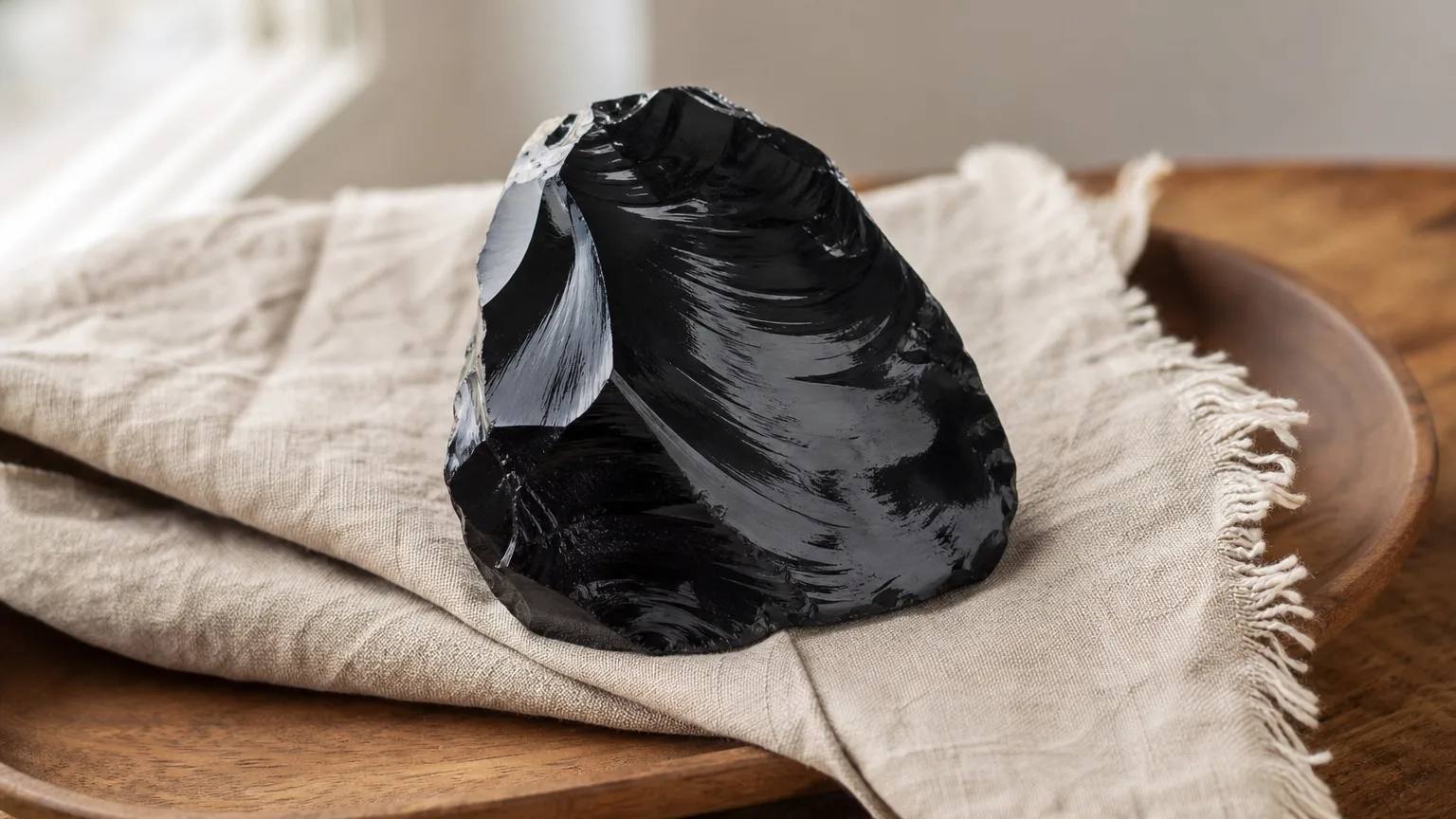
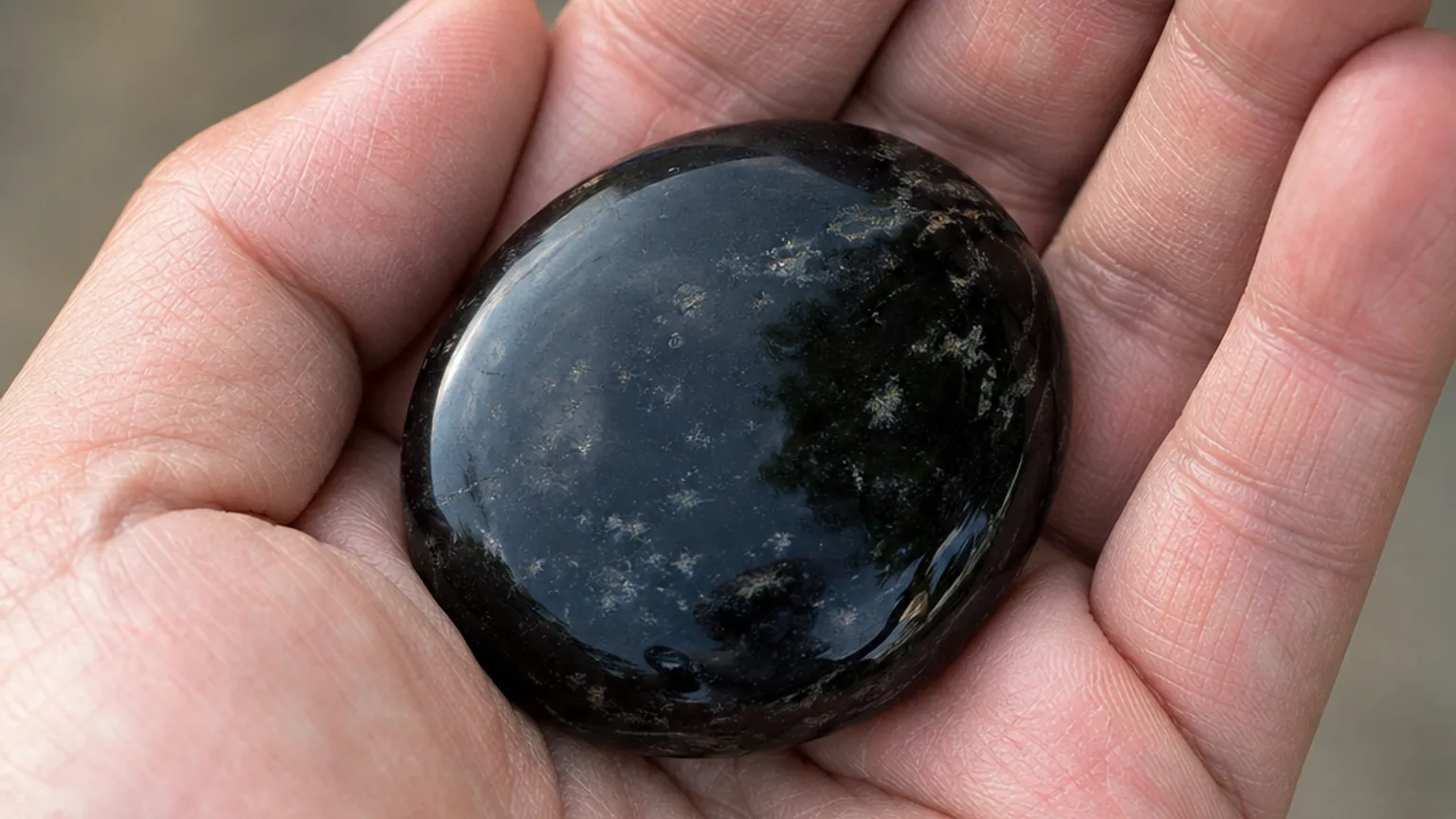
Obsidian is named after Obsidius, a Roman who reportedly first described it — but humans have used it far longer than that. It’s volcanic glass, not a mineral: when silica-rich lava cools almost instantly, no crystals have time to form, leaving a natural glass. Its most famous property is a conchoidal fracture — it breaks with smooth, curved, razor-sharp edges, which is why it was the world’s sharpest tool for most of human history.
Obsidian has one of the oldest tool histories of any stone. For hundreds of thousands of years, people across the world knapped it into knives, arrowheads, scrapers, and later mirrors and ceremonial blades — the Aztecs carved obsidian mirrors used for divination. In modern crystal practice, that old, sharp, mirror quality became its meaning: protection, truth-telling, and grounded shadow work — the idea of a stone that both shields you and shows you what you’d rather not see. That protective-and-truthful symbolism is consistent across modern practice.
The thread through all of it is the same: protection, truth, and grounded shadow work. Today obsidian is usually described as an intense, grounding, protective stone — reached for to feel shielded, to ground scattered energy, or to do honest inner work. How much of that lands for you personally is, honestly, up to you — and because obsidian can feel intense, many pair it with a gentler stone. To explore more stones, browse the full Crystal Guide.
Obsidian Properties
The Science
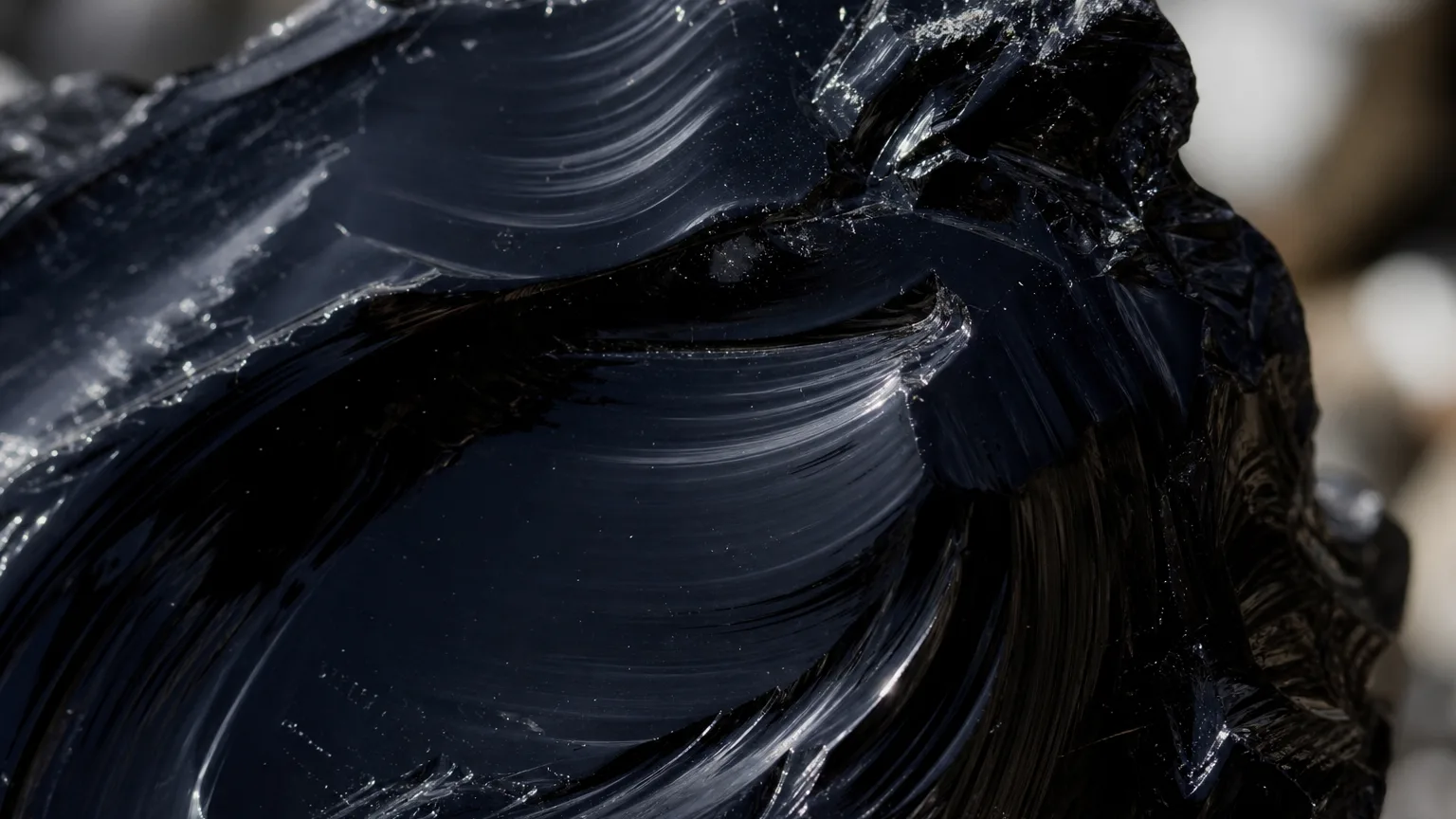
Obsidian is volcanic glass, not a mineral — it has no crystal structure because silica-rich lava cooled too fast for crystals to grow. Its chemistry is roughly SiO₂ with various impurities, and its hardness is about 5 to 5.5 on the Mohs scale. Its defining feature is a conchoidal fracture: it breaks with smooth, curved, extremely sharp edges (still used in some surgical blades today). Most obsidian is black, colored by tiny mineral inclusions; varieties include snowflake obsidian (white cristobalite spots), rainbow obsidian (color flashes from thin-film interference), mahogany (red-brown), and gold or silver sheen. It forms at volcanoes worldwide — Mexico, the United States, Iceland, Italy, Ethiopia, and Japan.
Traditional Meaning
Tradition ties obsidian to protection, truth-telling, and grounded shadow work. It’s linked to the root center and is often described as an intense, shielding stone that also reflects what’s hidden — supporting honesty with yourself and protection during difficult inner work. The Aztecs carved obsidian into mirrors used for divination, tying it to insight and truth. Across modern crystal practice it’s reached for to feel shielded, to ground heavy or scattered energy, or to face what you’ve been avoiding. These associations come from spiritual tradition and personal practice rather than clinical study.
Mindfulness & Psychology
From a psychological angle, obsidian works as a dark, mirror-like cue — the kind of object you hold when you want honesty and grounding rather than comfort. A dark, reflective surface reads as serious and focused, and the act of keeping a piece nearby and pairing it with an intention (“show me the truth”) turns it into a small cue for honest self-reflection. Because obsidian can feel intense, part of using it well is pairing that honesty with gentleness. These effects come from tradition and personal practice, not clinical research. Crystals complement — but never replace — professional care.
Obsidian Benefits
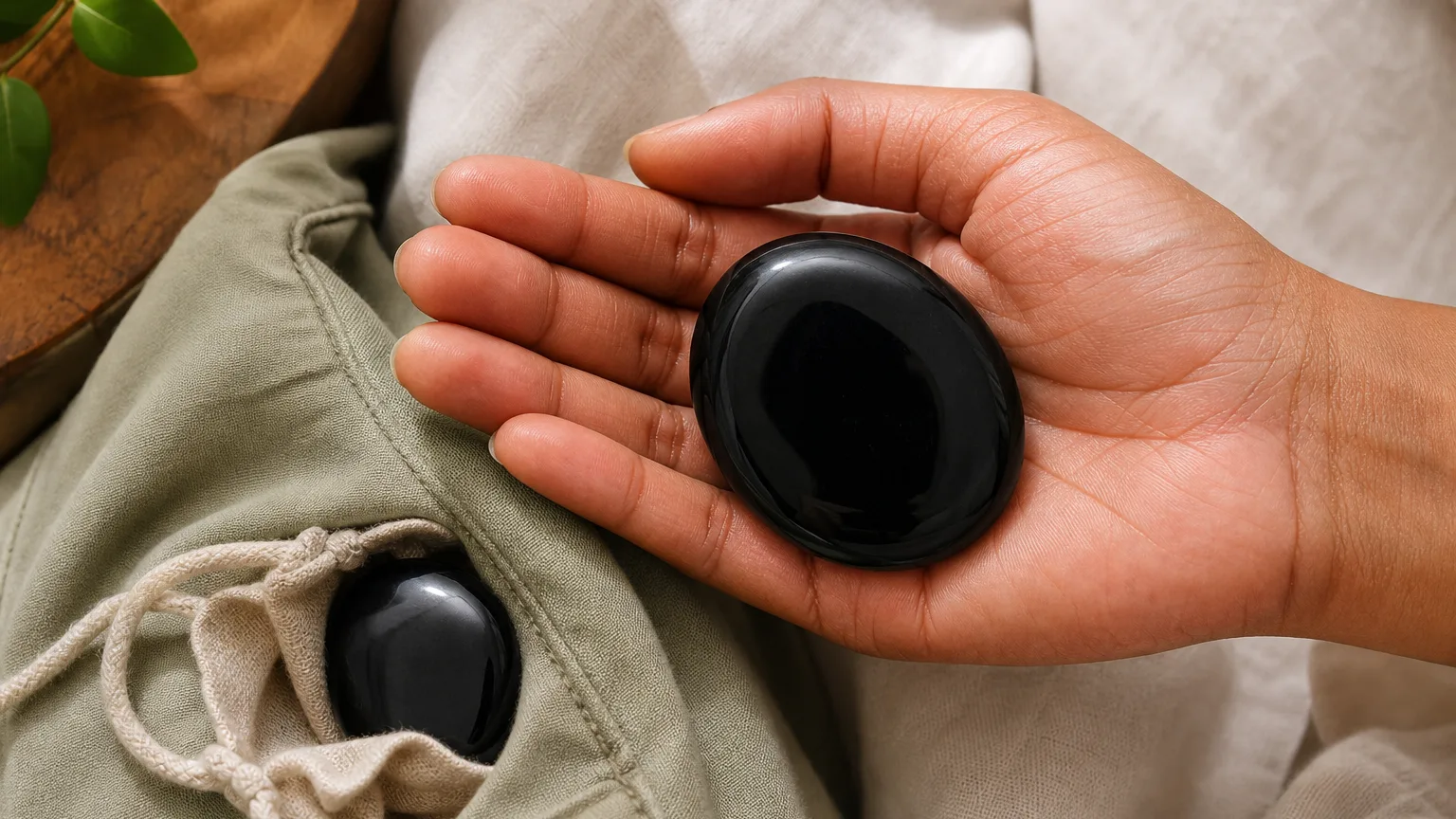
People who work with obsidian usually describe it in terms of protection, honesty, and grounding, not soft comfort. It tends to show up as a steadier, more focused feeling — useful when you feel exposed, scattered, or want to do honest inner work. A few of the benefits people mention most:
A protective shield
Keeping obsidian nearby is often described as feeling shielded — a steady, dark presence that helps you feel less exposed in demanding situations.
Honesty with yourself
Its mirror quality is a cue for honest self-reflection — a reminder to look at what’s really there instead of the comfortable version.
Grounded focus
The stone’s weight and density read as grounding — a cue to come back to your body and the present when your mind is scattered.
A release of heavy energy
Many use obsidian to help set down heavy or stuck emotion — not to fix it, but to feel grounded enough to face and release it.
The pattern underneath all of these is the same: obsidian isn’t shielding you by magic, but it gives your day a cue toward protection, honesty, and grounding. If you’re exploring stones for specific needs, see our guide to crystals for stress.
Obsidian Chakra, Zodiac, and Element Associations
In traditional systems, obsidian is most strongly linked to the root center — stability and grounding — with a secondary tie to the third eye (insight, truth, the mirror quality). Astrologically, it’s often paired with Scorpio and Sagittarius. Its elements are usually given as Earth and Fire — fitting for a stone born of fire and used to ground. For related stones, see root chakra crystals.
These are correspondences built up through tradition, not fixed rules. If your own sense of obsidian points somewhere else — a different chakra, a different element — that’s completely fine. Many people work with stones intuitively, following what feels right rather than a textbook chart, and there’s a long history of practitioners doing exactly that.
How to Use Obsidian
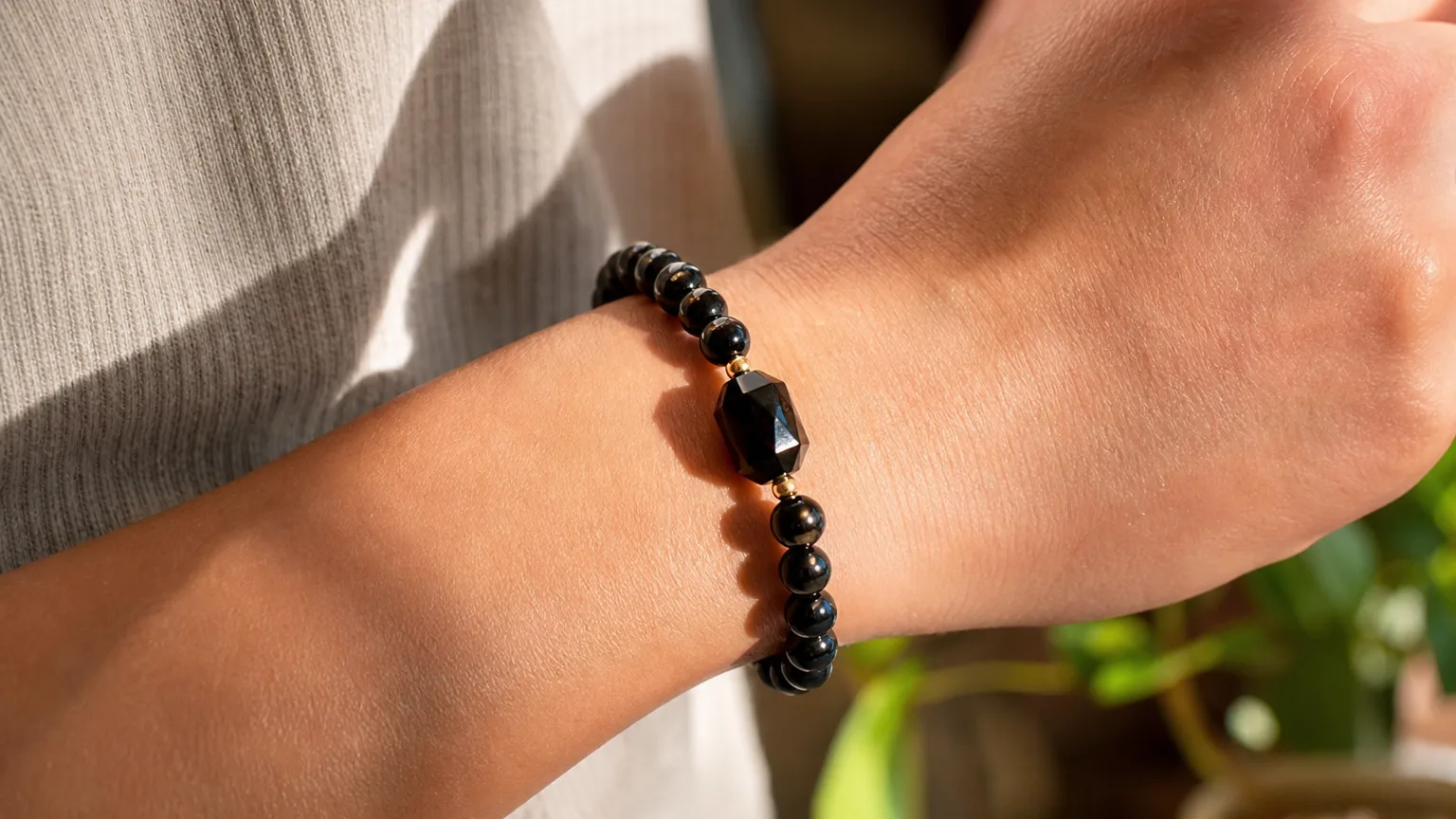
Obsidian is glass (Mohs 5–5.5) and breaks with sharp edges, so handle raw or broken pieces with care and choose tumbled or polished forms for everyday use. The key is consistency: a piece you actually see and hold does far more than one stored away.
Hold it as a grounding anchor. A tumbled or palm stone in your hand gives you weight to settle on when you feel scattered or exposed.
Keep it nearby for protection. A piece on a desk, by the door, or at the bedside is often used as a steady, shielding presence in a space.
Meditate with it. Rest a piece at the base of your spine (root area) or hold a small mirror and sit with it. Even a few minutes of focused attention counts; the goal is presence, not duration.
Use it for honest reflection. Hold the stone when journaling or sitting with something difficult — its mirror quality is a cue to look honestly rather than look away.
Which Obsidian Form Is Right for You?
| Form | Best for | Choose it if |
|---|---|---|
| Tumbled / palm stone | Hand-holding, meditation | You want something smooth and safe to hold or carry |
| Polished mirror | Reflection, scrying, display | You want the classic reflective surface for honest self-work |
| Sphere | Display, hand-holding | You want a rounded, polished piece for a desk or altar |
| Pendant | Daily wearing | You want a protective piece worn close to the body |
| Snowflake obsidian piece | Everyday jewelry or display | You prefer a softer look with white cristobalite patterns |
| Raw piece (handled with care) | Display only | You like the natural volcanic look — but handle edges with care |
How to Tell Real Obsidian from Fakes
Obsidian is natural glass, so the main fakes are ordinary glass, slag glass, or dyed stones sold as obsidian. A few checks help:
- Texture and inclusions. Real obsidian often has tiny mineral inclusions, flow banding, or (in snowflake) cristobalite spots — natural irregularities. Perfectly flawless, perfectly uniform “obsidian” is more likely factory glass.
- The sharp fracture. Genuine obsidian breaks with a conchoidal (smooth, curved) fracture and famously sharp edges. Man-made glass can be similar, but a seller offering “obsidian” that’s too uniform in color and texture is worth questioning.
- Translucency at the edges. Hold a thin edge to strong light: real black obsidian is often dark green to dark brown at very thin edges, not pure black glass.
- Varieties. Snowflake (white spots of cristobalite), rainbow (color flashes in bright light), mahogany (red-brown patches), and gold/silver sheen are all genuine types. If a “rainbow obsidian” shows no color shift in strong light, it may be plain black glass.
- Seller honesty. Slag glass (industrial waste glass) is sometimes sold as obsidian. A reputable seller will tell you the source and type.
How to Cleanse and Charge Obsidian
Obsidian is glass (Mohs 5–5.5) and easy to care for, with one main rule: handle raw or broken edges carefully, since they’re razor-sharp.
- Water. A brief wipe or rinse with cool water is fine. Avoid long soaks in salt water if the piece has metal settings.
- Sunlight. Obsidian is sun-stable — its color won’t fade. Brief sun cleansing is safe.
- Smoke or sound. Passing it through sage or palo santo smoke, or using a singing bowl nearby, is a no-contact option many prefer.
- Earth. Because it’s a grounding stone born of the earth, some rest it in soil for a few hours as a symbolic reset, then brush it off.
Two things to keep in mind: handle broken or raw edges with care (they’re sharp enough to cut), and store obsidian away from harder stones so its glass surface doesn’t get scratched. For the full routine, see our guide to cleansing crystals.
Best Crystals to Pair With Obsidian
Pairing is about layering intentions — and because obsidian is intense, the most common pairings soften or steady it. A few combinations that work well:
- Obsidian + Rose Quartz — protection and truth softened with warmth; a balanced pairing for honest but kind self-work.
- Obsidian + Amethyst — intensity meets calm; a popular pairing for grounding that doesn’t feel heavy.
- Obsidian + Clear Quartz — clear quartz is said to amplify; many use it to lift obsidian’s grounding intentions.
- Obsidian + Black Tourmaline — two protective, grounding stones; a heavy combo for feeling shielded and rooted.
The logic of pairing is about complementary intentions, not strict rules. Pick combinations that match what you’re actually working on, and trust your own sense of what feels balanced.
Who Should Use Obsidian?
Obsidian suits people who want an intense, grounding stone for protection and honest self-work — anyone feeling exposed or scattered, doing shadow work or inner reflection, or drawn to its dark, mirror quality. It’s approachable but best handled with respect: it can feel strong, so many people pair it with a gentler stone and use it in shorter, focused moments.
A few honest expectations: obsidian isn’t a treatment for anxiety, trauma, or any condition — if you’re dealing with something persistent, a healthcare professional is the right call, and the stone can be a support alongside that. Its value comes from the intention and routine you build around it. If you go in expecting a stone to fix things or do your inner work for you, you’ll be disappointed; if you go in expecting a grounding, protective cue you can return to, it tends to fit well.
FAQ About Obsidian Meaning
What is obsidian good for?
Traditionally, protection, truth, and grounded shadow work. People reach for it to feel shielded, to ground heavy energy, or to do honest inner reflection.
Is obsidian a mineral?
No — it’s volcanic glass, a natural non-crystalline silica glass formed when lava cools too fast for crystals to grow. It has no crystal structure.
Why is obsidian so sharp?
It breaks with a conchoidal fracture — smooth, curved edges that can be sharper than surgical steel. That’s why it was used for tools and blades for most of human history.
What’s the difference between black, snowflake, and rainbow obsidian?
All are the same volcanic glass. Black is plain; snowflake has white cristobalite spots; rainbow shows color flashes in strong light from thin-film interference inside the glass.
What chakra is obsidian linked to?
Mostly the root (grounding, protection), with a secondary tie to the third eye (insight, truth, the mirror quality).
Can obsidian go in water?
Yes. It’s a hard glass (Mohs 5–5.5), water-safe. A brief wipe or rinse is fine; avoid long salt-water soaks with metal settings.
Is obsidian too intense to use every day?
Some find it strong for constant wear. Many use it in focused moments or pair it with a gentler stone like rose quartz to balance its intensity — there’s no rule, only what feels right.
Final Thoughts on Obsidian
Obsidian earns its long reputation as a stone of protection and truth — the dark volcanic glass that shields you and shows you what’s real. If you’re curious, the simplest start is one smooth piece you’ll actually hold, paired with a small, focused moment to notice it. Let the routine do the work, and let the stone be the steady, honest anchor that reminds you to stay grounded and face what’s true.
From there, obsidian tends to open a steadier space — a quieter inner honesty, a more grounded presence, or simply a habit of facing things instead of looking away. For more, explore the Crystal Guide or browse obsidian pieces.