
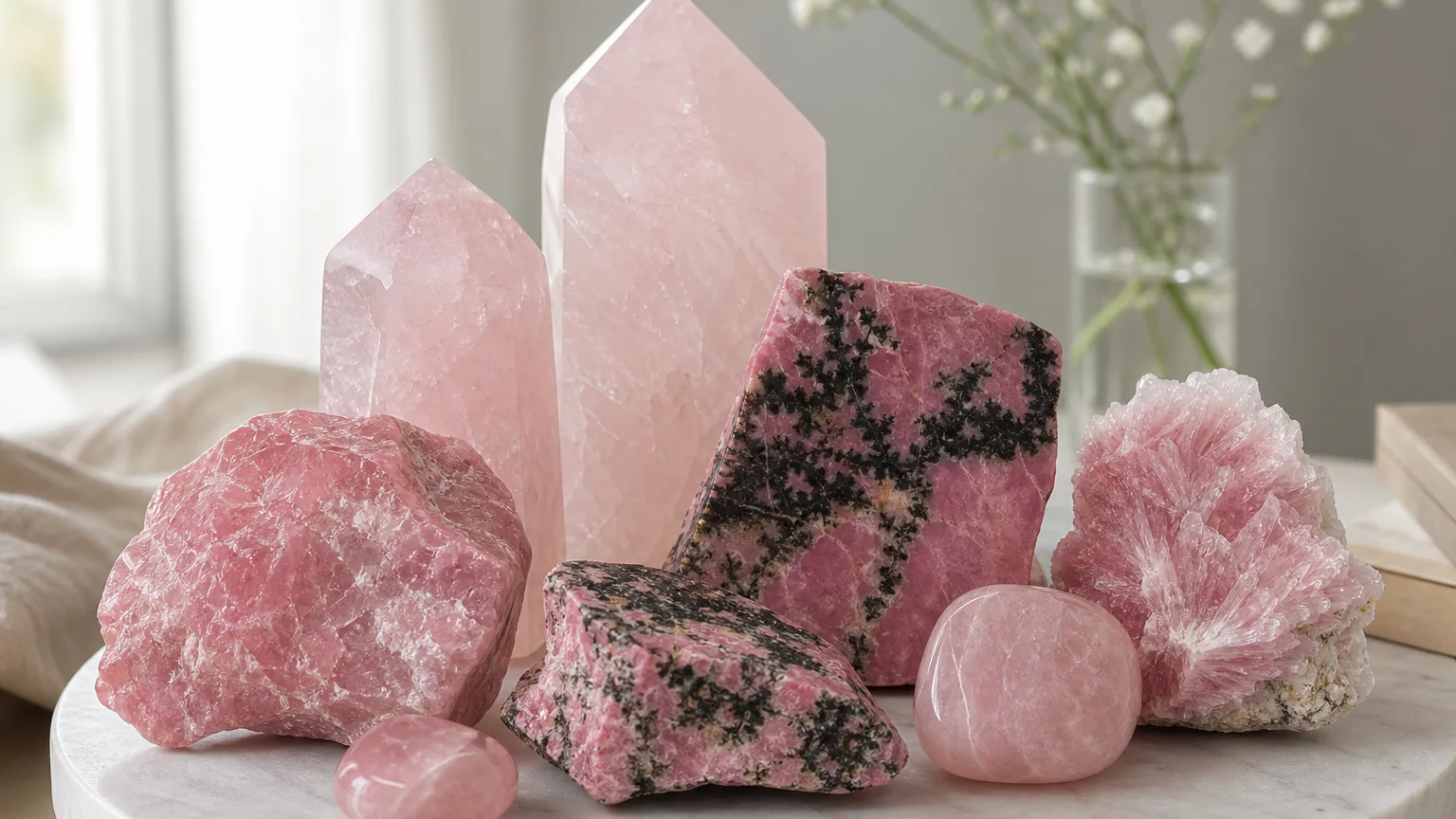
Best Pink Crystals: Names, Meanings, Properties & Uses
Quick Answer: Best Crystals for Pink
The best crystals for Pink include Rose Quartz, Rhodonite, Bustamite, traditionally used in mindfulness and spiritual practices. Crystal properties are complementary wellness tools, not medical treatments.
Understanding Pink
Pink sits at the soft edge of red — it borrows red’s warmth but trades its intensity for something quieter. In color psychology, pink is consistently linked with tenderness, approachability, and care, which is why it has been used for centuries to signal safety and affection. Unlike bolder hues that ask for attention, pink invites closeness, and that quality is exactly why people reach for it when they want to feel gentler with themselves.
Culturally, pink has carried the language of love across many traditions — from rose imagery in Persian poetry to the rose-pink robes worn for devotion in medieval Europe. In crystal practice, pink stones have long been turned to for matters of the heart: self-worth, forgiveness, and the slow work of mending after loss. Modern interest in self-care has only deepened that connection, framing pink crystals less as decoration and more as small anchors for daily kindness.
What makes pink minerals visually distinct is often trace elements rather than pigment. Manganese, titanium, and iron produce the delicate blush in quartz and beryl; the deeper rose-red tones in rhodonite and rhodochrosite come from manganese in higher concentration. So when you hold a pink crystal, you are holding a record of the exact chemistry that made it — a slow, geological kind of care.
Quick facts: Symbolism: Love, compassion, tenderness. Psychology: Emotional warmth, self-care, nurturing. Associated chakra: Heart, element: Water.
Not sure which color is right for you? Try the Crystal Quiz ↗
How to Identify Pink Crystals
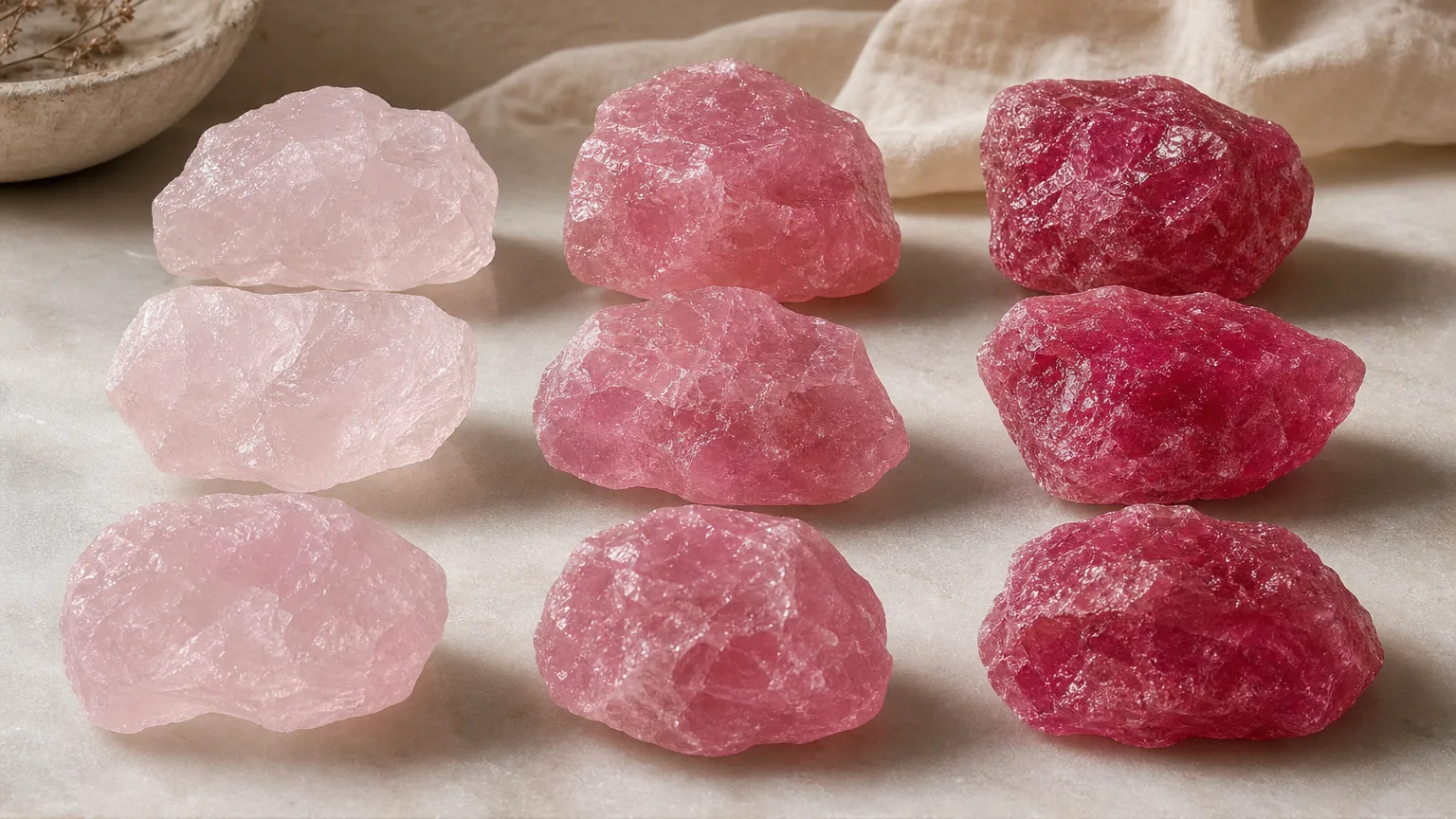
Pink crystals span a wide tonal range, so identification starts with how light or deep the color sits. Pale, milky pinks — think Rose Quartz — read as translucent to semi-opaque with a soft, glassy luster. Deeper rose-reds and magentas, like Rhodonite, Thulite, and Rhodochrosite, tend toward brighter, more saturated tones, often with banding, veining, or patchy color zones that hint at how the mineral grew in layers. Peachy and salmon pinks, common in Morganite and Inesite, lean warm and can look almost amber under low light.
Texture and luster help separate lookalikes. Rose Quartz is usually glassy and smooth; Kutnohorite often has a pearly to silky sheen typical of the carbonate family; Bustamite can show a slightly resinous surface. Rhodonite’s signature black manganese oxide veins are a strong tell — no other common pink stone carries those dark dendritic lines so prominently.
The most frequent confusion is between Rose Quartz and Pink Quartz. They look similar, but Pink Quartz is rarer, often more transparent, and notably light-sensitive — its color can fade with prolonged sun exposure, while Rose Quartz is generally stable. Pink Mangano Calcite is sometimes sold as Pink Quartz or Kutnohorite; check for a reaction to mild acid (calcites fizz) and a softer hardness around 3–4 on the Mohs scale. Under warm indoor light, many pink stones deepen; under daylight, cool pinks look cooler and peach tones shift toward orange — so confirm color in natural light before buying.
9 Best Crystals for Pink
Rose Quartz
Color: Soft pink, rosy pink
Meaning: Love, compassion, tenderness
Best for: Self-love, Relationships, Grief
Chakra: Heart
Element: Earth
Best way to use: Wear as jewelry
Affirmation: I am worthy of love, exactly as I am.
Rose Quartz is a silicon dioxide (SiO₂) variety whose soft pink comes from trace titanium, iron, or manganese embedded during formation. Its translucency and gentle glassy sheen make it feel calm to hold, and color psychology reads that muted rose as approachable and soothing — the same hue used in care environments to lower agitation. Tactilely, a polished piece is cool then warms in the hand, which is part of why people instinctively reach for it in difficult moments.
Spiritually, Rose Quartz has been tied to the heart chakra across many traditions and is often used as a focus stone for self-love and forgiveness practices. A common ritual is to place it on the chest during quiet breathing or set it by a mirror as a small daily reminder of self-kindness. Many people describe it as the stone they return to after loss or conflict, when tenderness toward themselves feels hardest to access.
Psychologically, its value is less mystical and more practical: a small, beautiful object you choose to keep close can serve as a mindful cue. Holding Rose Quartz for a minute of slow breathing can interrupt cycles of self-criticism and bring attention back to the body — a gentle act of care rather than a quick fix.
Read full Rose Quartz meaning →
Rhodonite
Color: Pink-red with black veining
Meaning: Love, compassion, tenderness
Best for: Forgiveness, Heart work, Self-worth
Chakra: Heart
Element: Earth
Best way to use: Carry or hold in meditation
Affirmation: I forgive myself and release what no longer serves me.
Rhodonite is a manganese inosilicate, and its color story is striking — vivid rose-pink from manganese, cut through by black veins of manganese oxide that formed as the stone weathered. Those dark dendritic lines are not flaws; they are the most reliable visual identifier and give each piece a one-of-a-kind map-like surface. The stone has a moderate weight and a glassy to pearly luster that feels solid and grounded in the palm.
In crystal traditions, Rhodonite is often described as a stone of compassionate action and emotional repair, associated with both heart and root concerns — moving love from feeling into doing. It is frequently turned to in forgiveness work, whether toward others or oneself, and many practitioners hold it while reflecting on old wounds that still feel tender. Unlike softer pink stones, Rhodonite carries a steadier, more anchoring quality that suits processing rather than dreaming.
On a self-care level, Rhodonite can function as a tactile reminder during stressful interactions — a pocket stone you press when conversations get charged, helping you pause and respond from a calmer place. That small physical anchor is where its real usefulness lives for many people.
Bustamite
Color: Pink, reddish-pink, brownish
Meaning: Love, compassion, tenderness
Best for: Self-Worth, Warmth, Gentle Healing
Chakra: Heart
Element: Earth, Water
Best way to use: Carry or hold in meditation
Affirmation: I meet myself with warmth and patience.
Bustamite is a calcium manganese iron silicate, a close relative of Rhodonite in the pyroxenoid group, and its color lands somewhere between soft pink and warm reddish-brown depending on manganese and iron content. It often shows a subtle translucent glow with glassy to resinous surfaces, and the muted brownish undertones give it an earthier, more lived-in feel than brighter pink stones. In the hand it has a satisfying density and smooth polish.
Metaphysically, Bustamite is regarded as a gentle heart stone — less intense than Rhodonite, but carrying a similar thread of manganese-linked compassion. It is traditionally associated with warmth, steady emotional support, and the slow rebuilding of self-worth after disappointment. People often choose it when they want heart-centered work without being overwhelmed by stronger energy.
As a wellness companion, Bustamite suits quiet evening routines: hold it during a few minutes of slowed breathing or keep it on a bedside table as a soft visual cue to wind down. Its understated color and grounded feel make it easy to live with day to day.
Inesite
Color: Pink, rose-pink, peach-pink, orange-pink
Meaning: Love, compassion, tenderness
Best for: Heart, Compassion, Self-kindness
Chakra: Heart
Element: Water
Best way to use: Place in your space
Affirmation: I treat myself with the kindness I offer others.
Inesite is a hydrated calcium manganese silicate prized by collectors for its delicate peach-pink to rose-orange hues and the bladed, fibrous crystal sprays it often forms. The color is gentle and warm, with a glassy to silky luster that catches light softly along its crystal faces. It is a less common stone, which gives each specimen a quietly distinctive character, and its translucent edges often glow when backlit.
Spiritually, Inesite is associated with tender-hearted compassion and self-kindness, sometimes described as a stone that softens an inner critic. Its water-element lean and heart-chakra connection make it a favorite for reflective practices centered on gentleness rather than drive. Many who work with it describe a calming, almost consoling quality during quiet meditation.
For everyday use, Inesite is best as a placement stone — set where you will see it during soft moments, such as a desk corner or reading nook. Because specimens can be fragile and somewhat rare, gentle handling suits it better than daily wear.
Kutnohorite
Color: Pink, pale-pink, white, yellow-white
Meaning: Love, compassion, tenderness
Best for: Heart, Emotional Balance, Calm
Chakra: Heart
Element: Water
Best way to use: Wear, carry, or place in your space
Affirmation: I stay calm and centered, even when emotions rise.
Kutnohorite is a rare calcium manganese carbonate, part of the dolomite group, and its colors range from pale blush pink to creamy white and warm yellow-white. It often shows a pearly to silky luster and subtle banding, with a softer, more powdery appearance than quartz-family stones. As a carbonate it is relatively soft — around 3.5–4 on the Mohs scale — which gives polished pieces a smooth, almost chalky-warm feel in the hand.
In metaphysical practice, Kutnohorite is associated with emotional balance and calm, often used as a soothing heart stone when feelings feel scattered. Its gentle, watery character suits practices aimed at steadying moods rather than intensifying them, and some connect it to self-care during hormonal or emotionally charged seasons. The manganese content links it symbolically to the wider pink-stone family of compassion.
For wellness routines, Kutnohorite works well placed in a calm corner or carried as a pocket stone for moments of overstimulation. Its softness means it is better suited to gentle handling than rings or bracelets that take knocks.
Read full Kutnohorite meaning →
Morganite
Color: Pink, peach, salmon
Meaning: Love, compassion, tenderness
Best for: Love, Self-Compassion, Relationships
Chakra: Heart
Element: Water, Air
Best way to use: Wear as jewelry
Affirmation: I give and receive love with an open heart.
Morganite is a pink to peach variety of beryl — the same mineral family as emerald and aquamarine — and its warm color comes from trace manganese within the beryllium-aluminum crystal structure. Fine Morganite is transparent with a glassy luster and a soft champagne glow, and it is hard enough (7.5–8 Mohs) to take a brilliant faceted cut, which is why it is a popular alternative pink gemstone in fine jewelry. Larger stones often show a deeper, more saturated pink.
Spiritually, Morganite is associated with the heart chakra and is often called a stone of compassionate, mature love — distinct from the soft self-care tone of Rose Quartz, leaning instead toward open-hearted relating and emotional courage. It is traditionally used in practices focused on attracting or deepening loving relationships, and on dissolving old defenses around giving and receiving affection.
As a wearable stone, Morganite excels: it is durable, luminous, and visible, which makes the daily-reminder function of a wellness practice effortless. A ring or pendant keeps a small, beautiful cue of openness close throughout the day without needing a separate ritual.
Pink Quartz
Color: Pink (light-sensitive)
Meaning: Love, compassion, tenderness
Best for: Love, Self-Compassion, Tenderness
Chakra: Heart, Crown
Element: Water, Air
Best way to use: Wear as jewelry
Affirmation: I welcome tenderness into my daily life.
Pink Quartz is a rarer, more transparent cousin of Rose Quartz, and its color comes from trace aluminum and phosphorus paired with natural irradiation — a different mechanism than the titanium-iron tint of Rose Quartz. Crystals often form as distinct pointed prisms rather than massive cloudy masses, and they can show a delicate, almost lit-from-within pink. Crucially, Pink Quartz is light-sensitive: prolonged sun exposure can fade its color, so it is best stored away from direct light.
Metaphysically, Pink Quartz is associated with both heart and crown, and is often described as a stone of tenderness that bridges emotional warmth with a quieter, more spacious awareness. It is traditionally used in heart-centered meditation when someone wants a sense of gentleness without heaviness. Its relative rarity gives it a special, almost delicate significance to collectors and practitioners.
For daily care, Pink Quartz suits jewelry and mindful placement but should be kept out of strong sunlight. Wearing it as a pendant under clothing, or placing it in a softly lit corner, preserves its color while keeping its quiet reminder of tenderness close.
Read full Pink Quartz meaning →
Rhodochrosite
Color: Pink, rose-red, banded pink-white
Meaning: Love, compassion, tenderness
Best for: Self-Love, Compassion, Mending
Chakra: Heart, Solar Plexus
Element: Fire, Water
Best way to use: Wear as jewelry
Affirmation: I am gentle with the parts of me still healing.
Rhodochrosite is a manganese carbonate whose vivid raspberry-rose to pink bands come from varying manganese concentration as it formed layer by layer. Those alternating pink and white bands are its signature — sometimes called the “Inca Rose” — and the stone takes a soft glassy polish with a slightly warmer, more resinous feel than quartz. It is moderately soft (around 4 Mohs), so polished cabochons show color beautifully but need care against scratches.
Spiritually, Rhodochrosite is strongly associated with self-love and emotional mending, and is often used by people working through old wounds, grief, or patterns of self-neglect. Its dual heart and solar plexus links speak to bringing warmth and will together — compassion paired with the courage to act on one’s own behalf. Many describe it as a stone of recovery rather than of first bloom.
For wellness, Rhodochrosite is most often worn as a pendant or held during reflective journaling, where its banded beauty can serve as a focus for self-compassionate reflection. Its softness means pendants and earrings outlast rings for daily wear.
Read full Rhodochrosite meaning →
Thulite
Color: Pink, rose-red, magenta
Meaning: Love, compassion, tenderness
Best for: Heart, Passion, Vitality
Chakra: Heart
Element: Water
Best way to use: Wear as jewelry
Affirmation: I live and love with an open, vital heart.
Thulite is a pink to magenta variety of zoisite, a calcium aluminum silicate, and its bright rose-red color comes from trivalent manganese distributed through the crystal. It often appears as mottled pink with occasional pale or grey patches, taking a glassy to vitreous polish, and the saturation can be striking — one of the most vivid pinks in the mineral world. The stone has a clean, lively feel in the hand, lighter than it looks.
Metaphysically, Thulite is associated with passionate, expressive love — a more outgoing energy than the soft compassion of Rose Quartz. It is traditionally used to encourage warmth, vitality, and the courage to show affection openly, which is why some call it a stone of relationship and creative spark. Its vivid color mirrors that theme of liveliness.
For self-care, Thulite suits people who want to re-engage with life after a flat or withdrawn period — worn as jewelry or carried as a reminder to participate. A small Thulite kept on a desk can act as a cue to break out of routine and reconnect with people and projects that feel alive.
How to Choose Pink Crystals by Intention
| Intention | Best Crystals | Why |
|---|---|---|
| Self-love & daily kindness | Rose Quartz, Rhodochrosite | The classic heart stones — soft, accessible, and tied to self-compassion across traditions |
| Forgiveness & emotional repair | Rhodonite, Bustamite | Manganese-rich pinks traditionally used in forgiveness and slow mending work |
| Open-hearted relationships | Morganite, Thulite | Wearables associated with mature love, warmth, and expressing affection |
| Calm & emotional balance | Kutnohorite, Inesite | Gentle, water-leaning carbonates and silicates for steadying scattered feelings |
| Tenderness & spacious awareness | Pink Quartz | Rare, light-sensitive quartz linked to both heart and crown for delicate reflection |
How to Use Pink Crystals
Pink crystals lend themselves to a few focused practices rather than a long checklist. Four approaches cover most of what people find useful.
1. Wear as jewelry
For durable stones — Morganite, Rose Quartz, Thulite, Rhodochrosite, Pink Quartz — jewelry is the easiest way to keep a heart-stone close. A pendant resting near the chest places it at heart-chakra level, which is traditionally associated with love and compassion. A ring or bracelet turns the stone into a constant, low-effort cue for self-kindness throughout the day.
2. Self-care ritual
Set aside two minutes for a small ritual: hold your pink crystal, breathe slowly for several counts, and name one thing you are offering yourself this moment — patience, rest, forgiveness. Rhodonite and Bustamite suit forgiveness work; Rose Quartz and Rhodochrosite suit gentleness. The value is in the pause, not perfection.
3. Bedside placement
Place a pink stone on your nightstand or under your pillow area (set beside the bed, not buried where it could be lost). Rose Quartz is the traditional choice for evening wind-down, and Kutnohorite’s calming associations suit overstimulated evenings. Seeing the stone last thing at night and first thing in the morning reinforces a kinder inner tone.
4. Heart meditation
Lie down and rest a pink crystal on the center of your chest while you breathe for five to ten minutes. This placement is associated with the heart chakra in many traditions and is a common practice for self-love and grief. Pink Quartz and Rose Quartz work well here; keep a blanket over the stone if it feels cold.
Care note: Pink Quartz fades in direct sunlight — cleanse it with moonlight, sound, or smoke instead. Carbonates like Kutnohorite and Rhodochrosite should be kept away from water and acids; a soft dry cloth is enough. Quartz-family stones can be rinsed briefly and dried.
Pink Crystals for Self-Love and Relationships
Self-love and relationships are where pink crystals earn their reputation, and pairing the right stone with a specific moment makes the practice more concrete. Two rituals work especially well.
Morning desk ritual — for self-love. Begin the day by setting Rose Quartz or Rhodochrosite on your desk or workspace where you will see it. Before opening email, place a hand over the stone for three slow breaths and set one kind intention for the day, such as “I will speak to myself with patience today.” The stone becomes a visual anchor you return to whenever self-criticism surfaces during work.
Bedside reflection — for relationships. In the evening, hold Morganite or Thulite for a few minutes and reflect on one relationship you want to nurture — including your relationship with yourself. You might name something you appreciate, or notice where you have been holding back affection. Over weeks, this small habit often shifts how openly you express care day to day.
For couples, placing two Rose Quartz stones — one each — on a shared bedside table is a gentle, non-verbal gesture of mutual care. For forgiveness work after conflict, Rhodonite is the traditional choice; hold it while you name what hurt and what you are ready to release, whether toward another person or yourself.
Pink Crystals at a Glance
| Crystal | Best for | Chakra | Best way to use |
|---|---|---|---|
| Rose Quartz | Self-love, daily kindness | Heart | Wear as jewelry; bedside placement |
| Rhodonite | Forgiveness, emotional repair | Heart | Carry as a pocket stone; hold in meditation |
| Bustamite | Self-worth, steady warmth | Heart | Hold during evening wind-down |
| Inesite | Self-kindness, softening the inner critic | Heart | Place in a calm corner |
| Kutnohorite | Calm, emotional balance | Heart | Place bedside; carry for overstimulation |
| Morganite | Open-hearted relationships | Heart | Wear as a pendant or ring |
| Pink Quartz | Tenderness, spacious reflection | Heart, Crown | Wear as jewelry; keep out of sunlight |
| Rhodochrosite | Self-love, mending after loss | Heart, Solar Plexus | Wear as a pendant; hold in journaling |
| Thulite | Passion, vitality, expression | Heart | Wear as jewelry; keep on desk |
FAQ
What are pink crystals good for?
Pink crystals are traditionally associated with love, compassion, and emotional care. Many people use them for self-love practices, relationship work, and as gentle anchors during stress or grief. They are complementary wellness tools, not medical treatments.
What do pink crystals mean?
Across many traditions, pink stones symbolize tenderness, nurturing, and the softer side of love — care given and received. They are linked with the heart chakra and the element of water, and often turned to when someone wants to feel gentler with themselves or others.
What is the most powerful pink crystal?
There is no single “most powerful” pink crystal — different stones suit different needs. Rose Quartz is the most popular for everyday self-love, Rhodonite is favored for forgiveness work, and Morganite is chosen for open-hearted relating. Choose by intention rather than by perceived strength.
What is the rarest pink crystal?
Pink Quartz is considered rarer than Rose Quartz and is notable for being light-sensitive. Fine Morganite and gem-quality Rhodochrosite with vivid banding are also uncommon. Inesite and Kutnohorite are rarer still and prized by mineral collectors.
What crystal is light pink and translucent?
Light pink, translucent stones are most commonly Rose Quartz (usually cloudy-translucent) or Pink Quartz (more transparent and rarer). Pale Morganite and Kunzite can also appear as light pink transparent gems — check hardness and luster to tell them apart.
What crystal is deep pink with black veins?
That is almost certainly Rhodonite. Its rose-pink body crossed by black manganese oxide dendrites is distinctive and is the most reliable way to identify it. No other common pink stone shows those dark branching veins so clearly.
What crystal is pink with white bands?
Rhodochrosite is the classic pink-and-white banded stone, with alternating raspberry-rose and pale layers. Pink Mangano Calcite and Kutnohorite can also show subtle pink-white banding, but Rhodochrosite’s bands are usually more vivid and regular.
Are pink crystals scientifically proven to heal?
No. There is no scientific evidence that pink crystals cure or treat medical conditions. Their benefits are experiential and symbolic — many people find that holding or wearing a beautiful stone supports mindfulness, calmer breathing, and a kinder inner tone, which can complement but never replace professional care.
Shop Pink Crystals: What to Look For
- Shop Rose Quartz
- Shop Rhodonite
- Shop Bustamite
- Shop Inesite
- Shop Kutnohorite
- Shop Morganite
- Shop Pink Quartz
- Shop Rhodochrosite
- Shop Thulite