
Howlite Meaning: Healing Properties & Uses
Howlite is a white stone with dark, web-like veins — a soft calcium borosilicate often dyed to imitate turquoise. Long tied to calm, patience, and restful sleep, it’s a stone people reach for to quiet a busy mind. This guide covers what howlite is (and why so much “turquoise” is actually dyed howlite), what it has meant, and how people work with it. Crystal meanings reflect tradition and personal practice, not medical advice.
What Is Howlite Meaning?
At its simplest, howlite means calm and patience — the feeling of a quieter, slower mind. As a soft, white stone with dark veining, it reads as gentle and soothing: linked to calm, patience, and a more settled, restful state.
For many people that’s exactly the appeal — a white-veined piece you keep by the bed or on a desk as a cue to slow down and settle. You don’t need to believe anything about energy to use it that way; the value often comes from choosing the piece, giving it a job (“help me calm down”), and letting its soft, quiet look pull you toward patience. In that sense howlite is a cue to calm.
Howlite Meaning and Symbolism

Howlite is named after the 19th-century Canadian chemist Henry How, who first described it. It’s a calcium borosilicate hydroxide, Ca₂B₅SiO₉(OH)₅, a soft, porous stone (Mohs 3.5) that’s naturally white to grey with dark, web-like veins. That porous nature is exactly why it soaks up dye so well — which is why a great deal of cheap “turquoise” and “lapis” on the market is actually dyed howlite.
Howlite doesn’t have an ancient mystical tradition — it was identified in the 1800s. Its meaning in modern crystal practice comes from its calm, soft, white-and-grey character: calm, patience, and restful sleep — the idea of a stone that quiets a busy, racing mind and supports settling down. It’s widely used as a bedtime stone and to soothe stress. That calm-and-patience symbolism is consistent across modern practice, even though the stone itself is a relatively recent addition.
The thread through all of it is the same: calm, patience, and restful sleep. Today howlite is usually described as a soothing, calming stone — reached for to quiet the mind, support sleep, or settle a stressed mood. How much of that lands for you personally is, honestly, up to you — and the “calm” is about a settled state, not a sedative effect. To explore more stones, browse the full Crystal Guide.
Howlite Properties
The Science
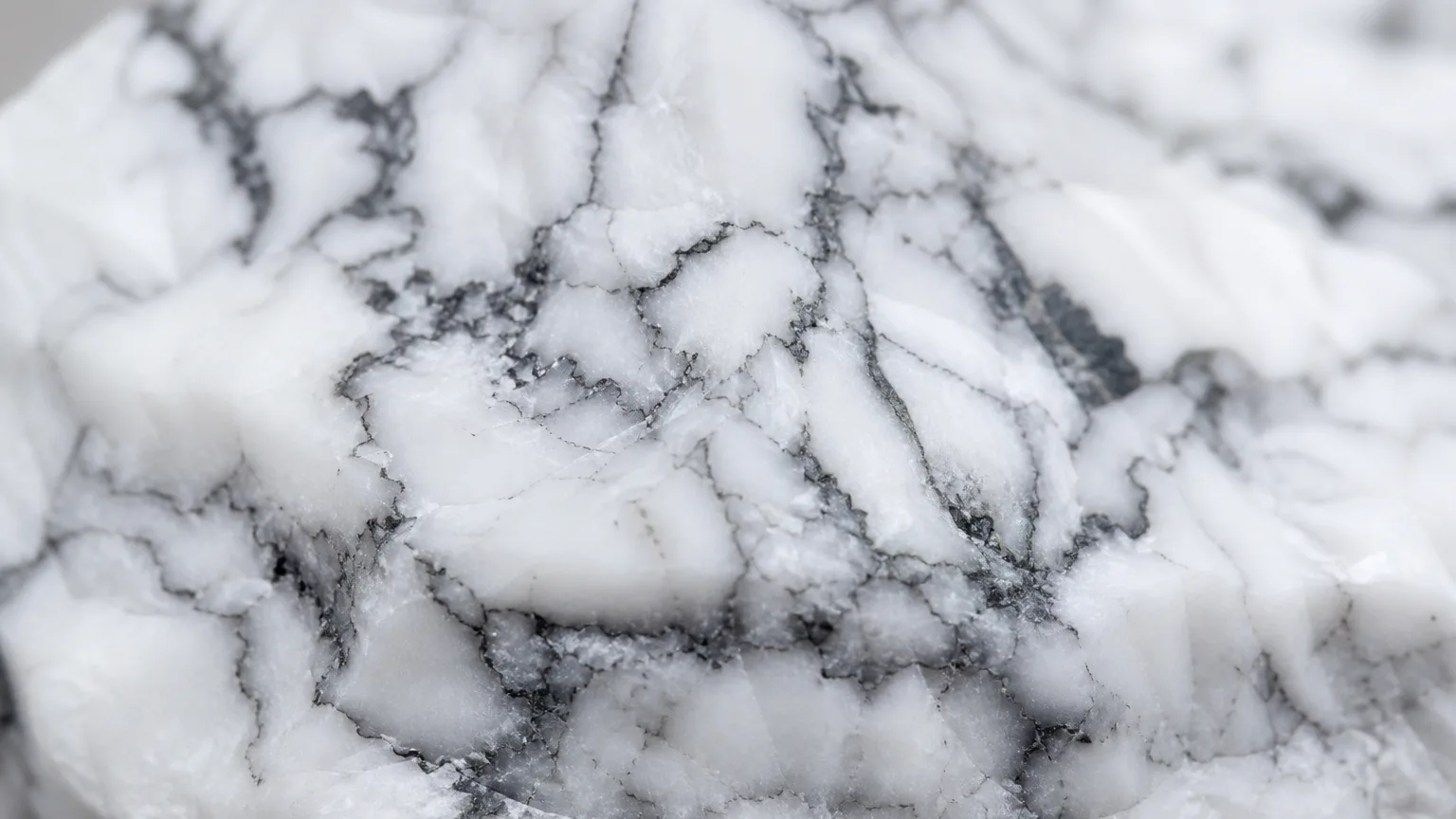
Howlite is a calcium borosilicate hydroxide — Ca₂B₅SiO₉(OH)₅ — a relatively soft mineral at about 3.5 on the Mohs scale. It’s naturally white to grey with dark, spider-web-like veins of other minerals, and it’s noticeably porous, which is why it takes dye so readily (and why so much dyed “turquoise” is actually howlite). It forms in nodules and masses rather than visible crystals, mostly in evaporite deposits. Major sources include Canada (Nova Scotia, its type locality) and the United States (California). None of this is mystical — it’s mineralogy — and the porosity is the key fact behind its common use as a turquoise lookalike.
Traditional Meaning
Tradition ties howlite to calm, patience, and restful sleep. It’s most often linked to the crown center and is described as a soothing stone that quiets a racing mind, supports patience, and helps with settling down for rest. Because howlite was only identified in the 1800s, its tradition is modern and built around its calm, soft character. Across modern crystal practice it’s reached for as a bedtime stone, to ease stress, or to support a more patient state of mind. These associations come from spiritual tradition and personal practice rather than clinical study.
Mindfulness & Psychology
From a psychological angle, howlite works as a soft, calming visual cue — the kind of object you keep where you want to slow down. Its white-and-grey, veined look reads as quiet and restful, and the act of keeping a piece by the bed or on a desk and pairing it with an intention (“slow down, settle”) turns it into a small cue for patience and calm. Part of its appeal is simply its soft, unbothered look — a visual signal to ease up. These effects come from tradition and personal practice, not clinical research. Crystals complement — but never replace — professional care.
Howlite Benefits
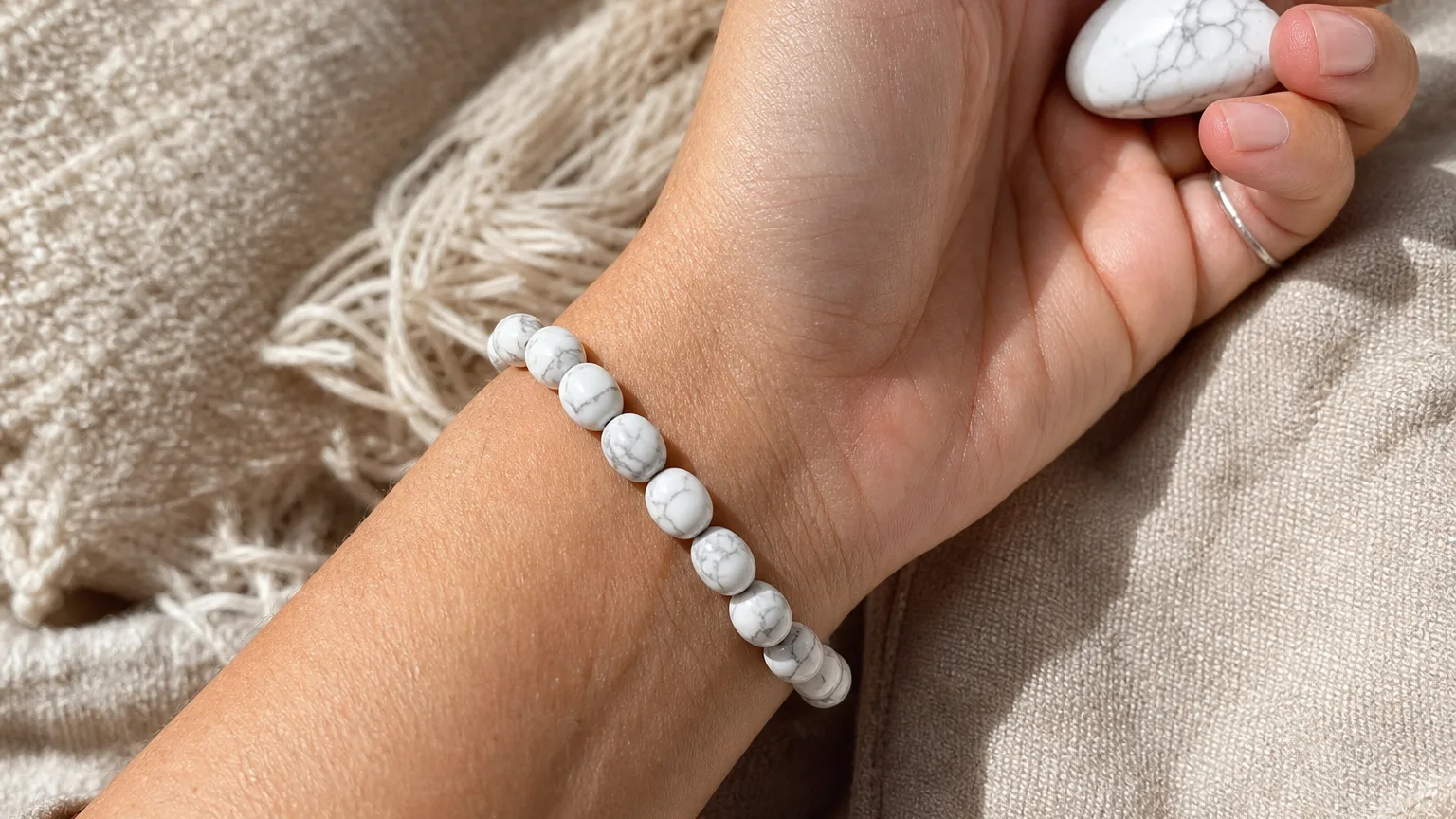
People who work with howlite usually describe it in terms of calm and patience, not dramatic shifts. It tends to show up as a quieter, more settled mind — useful when thoughts race, when you’re wound up, or before rest. A few of the benefits people mention most:
A quieter mind
Keeping howlite nearby when thoughts race gives you a soft, calm cue to slow down — a small reminder that not everything needs solving right now.
Patience under stress
Many hold a piece when they’re wound up as a cue to pause and respond patiently rather than react on impulse.
A calmer bedtime
Placed on a nightstand, howlite becomes part of a wind-down — a soft, quiet cue that the doing part of the day is over.
A soothing desk piece
A tumbled piece where you work is a low-key presence — a gentle reminder to stay patient and not spiral when pressure builds.
The pattern underneath all of these is the same: howlite isn’t calming you by magic, but it gives your day a cue toward patience and a quieter mind. If you’re exploring stones for specific needs, see our guide to crystals for anxiety.
Howlite Chakra, Zodiac, and Element Associations
In traditional systems, howlite is most strongly linked to the crown center — calm, clarity, and a quieter mind. Astrologically, it’s often paired with Virgo and Gemini. Its element is usually given as Air, fitting for a light, calming stone. For related stones, see crown chakra crystals.
These are correspondences built up through tradition, not fixed rules. If your own sense of howlite points somewhere else — a different chakra, a different element — that’s completely fine. Many people work with stones intuitively, following what feels right rather than a textbook chart, and there’s a long history of practitioners doing exactly that.
How to Use Howlite

Howlite is soft (Mohs 3.5) and porous, so it’s best as a display and handling stone — kept where you’ll see it, not soaked in water or worn daily.
Keep it by the bed. A piece on the nightstand is the classic use — a soft, calm cue to wind down and quiet the mind before rest.
Hold it when wound up. A smooth tumbled piece in your hand is a cue to pause and breathe when stress or impatience builds.
Meditate with it. Hold a piece in your palm or rest it on your crown (top of head) while you sit. Even a few minutes of focused attention counts; the goal is presence, not duration.
Keep it on a desk. A piece where you work is a gentle, low-key reminder to stay patient under pressure.
Which Howlite Form Is Right for You?

| Form | Best for | Choose it if |
|---|---|---|
| Tumbled stone | Pocket, hand-holding, bedside | You want something smooth and easy to hold or carry |
| Palm stone | Hand-holding under stress | You want a larger, smooth piece to grip when wound up |
| Raw nodule | Display | You like the natural white-and-veined look for a shelf |
| Pendant | Occasional wear | You want a calm piece near the body sometimes (it’s soft, so take care) |
| Bracelet / beads | Everyday jewelry (natural color) | You want a visible white-veined reminder at your wrist |
| Carved shape | Personal meaning, display | You like a small carved form (skull, animal, sphere) for a shelf |
How to Tell Real Howlite (and Spot Dyed Turquoise)
Howlite itself is common and affordable — the real issue is that it’s very often dyed and sold as turquoise or lapis. Knowing this changes both price and expectations.
- Dyed howlite is everywhere. Much of the cheap “turquoise” on the market — especially perfectly uniform blue with black webbing — is dyed howlite. Real turquoise is harder (Mohs 5–6) and more valuable, with natural color variation.
- The porosity tell. Howlite is porous, so dye often sinks into it unevenly — pooling in cracks or sitting on the surface. Natural turquoise has color within the stone, not just on it.
- Hardness. At Mohs 3.5, howlite is softer than real turquoise (5–6). A scratching test helps tell them apart.
- Color test. If a piece labeled “turquoise” has a flat, perfectly uniform blue with suspiciously neat black webbing, it’s likely dyed howlite. Natural turquoise has mottled, varied color.
- Seller honesty. A reputable seller will tell you whether a piece is natural howlite, dyed howlite, or genuine turquoise. Dyed howlite is fine to enjoy — just don’t pay turquoise prices for it.
Bottom line: dyed howlite is still howlite (a real stone), just colored to look like turquoise. It’s a beautiful, affordable look — but it should be sold and priced as dyed howlite, not natural turquoise.
How to Cleanse and Charge Howlite
Howlite is soft (Mohs 3.5) and porous, so the care rules lean gentle — keep it dry and out of harsh chemicals, especially if it’s dyed.
- Water — brief wipe only. Don’t soak howlite. Its porous surface absorbs water (and can leach dye if it’s dyed). Clean it with a dry or barely damp soft cloth.
- Sunlight. Natural howlite is fairly stable, but dyed howlite can fade in strong light. Indirect light is the safer choice.
- Smoke or sound. Passing it through sage or palo santo smoke, or using a singing bowl nearby, is a gentle, no-contact option many prefer — ideal for a soft, porous stone.
- Moonlight. A night under the moon is the most-recommended method — gentle, dry, and fitting for a calming bedtime stone.
Two things to keep in mind: keep howlite away from water soaks and harsh chemicals (porous + often dyed), and store it away from harder stones so its soft surface doesn’t get scratched. For the full routine, see our guide to cleansing crystals — and treat howlite as the soft, keep-it-dry one in that guide.
Best Crystals to Pair With Howlite
Pairing is about layering intentions — picking stones whose qualities complement rather than compete. A few combinations that work well with howlite’s calming energy:
- Howlite + Amethyst — the classic sleep pairing; two calming stones many reach for together at bedtime.
- Howlite + Selenite — calm meets clearing; a gentle combo for a quiet, fresh mind.
- Howlite + Rose Quartz — calm softened with warmth; a heart-centered pairing for gentle self-care.
- Howlite + Kwarc przezroczysty — clear quartz is said to amplify; many use it to lift howlite’s calming intentions.
The logic of pairing is about complementary intentions, not strict rules. Pick combinations that match what you’re actually working on, and trust your own sense of what feels balanced.
Who Should Use Howlite?
Howlite suits people who want a soft, calming stone for patience and restful sleep — anyone with a racing mind, wanting to wind down, or simply drawn to its quiet, white-and-grey beauty. It’s approachable because it’s affordable and asks little: place it where you rest or work, and let it mark a calmer corner of your day.
A few honest expectations: howlite isn’t a treatment for anxiety, insomnia, or any condition — if you’re dealing with something persistent, a healthcare professional is the right call, and the stone can be a comfort alongside that. Its value comes from the intention and routine you build around it. If you go in expecting a stone to calm you down by magic, you’ll be disappointed; if you go in expecting a soft, calming cue you can return to, it tends to fit well.
FAQ About Howlite Meaning
What is howlite good for?
Traditionally, calm, patience, and restful sleep. People reach for it to quiet a racing mind, to wind down before bed, or to settle a stressed mood.
Is howlite the same as turquoise?
No. They’re different minerals. But howlite is porous and takes dye well, so a lot of cheap “turquoise” on the market is actually dyed howlite. Real turquoise is harder and more valuable.
How can I tell if my “turquoise” is dyed howlite?
Dyed howlite is softer (Mohs 3.5 vs turquoise’s 5–6), has perfectly uniform blue color with neat black webbing, and may show dye pooled in cracks. Natural turquoise has mottled, varied color.
What chakra is howlite linked to?
Mostly the crown center — calm, clarity, and a quieter mind.
Can howlite go in water?
Only a brief wipe with a barely damp cloth. Howlite is porous and absorbs water (and can leach dye), so soaking can dull or discolor it.
Does dyed howlite fade in sunlight?
It can. Natural howlite is fairly light-stable, but dyed howlite may fade with prolonged sun. Keep bright, dyed pieces in indirect light.
Is dyed howlite still a real stone?
Yes — it’s still genuine howlite, just colored with dye to look like turquoise or lapis. It’s an affordable, accepted practice, as long as it’s sold and priced as dyed howlite.
Final Thoughts on Howlite
Howlite earns its place as a stone of calm and patience — the soft, white-veined piece people reach for when they want a quieter mind and a more settled state. If you’re curious, the simplest start is one piece you’ll actually keep where you rest or work, paired with a small moment to notice it. Let the routine do the work, and let the stone be the soft anchor that reminds you to slow down.
From there, howlite tends to open a calmer space — a quieter evening, a more patient moment, or simply a habit of pausing before you react. For more, explore the Crystal Guide or browse howlite pieces.