Best Third Eye Chakra Crystals: Stones for Balance, Energy & Mindful Rituals
Quick Answer: Best Crystals for the Third Eye Chakra
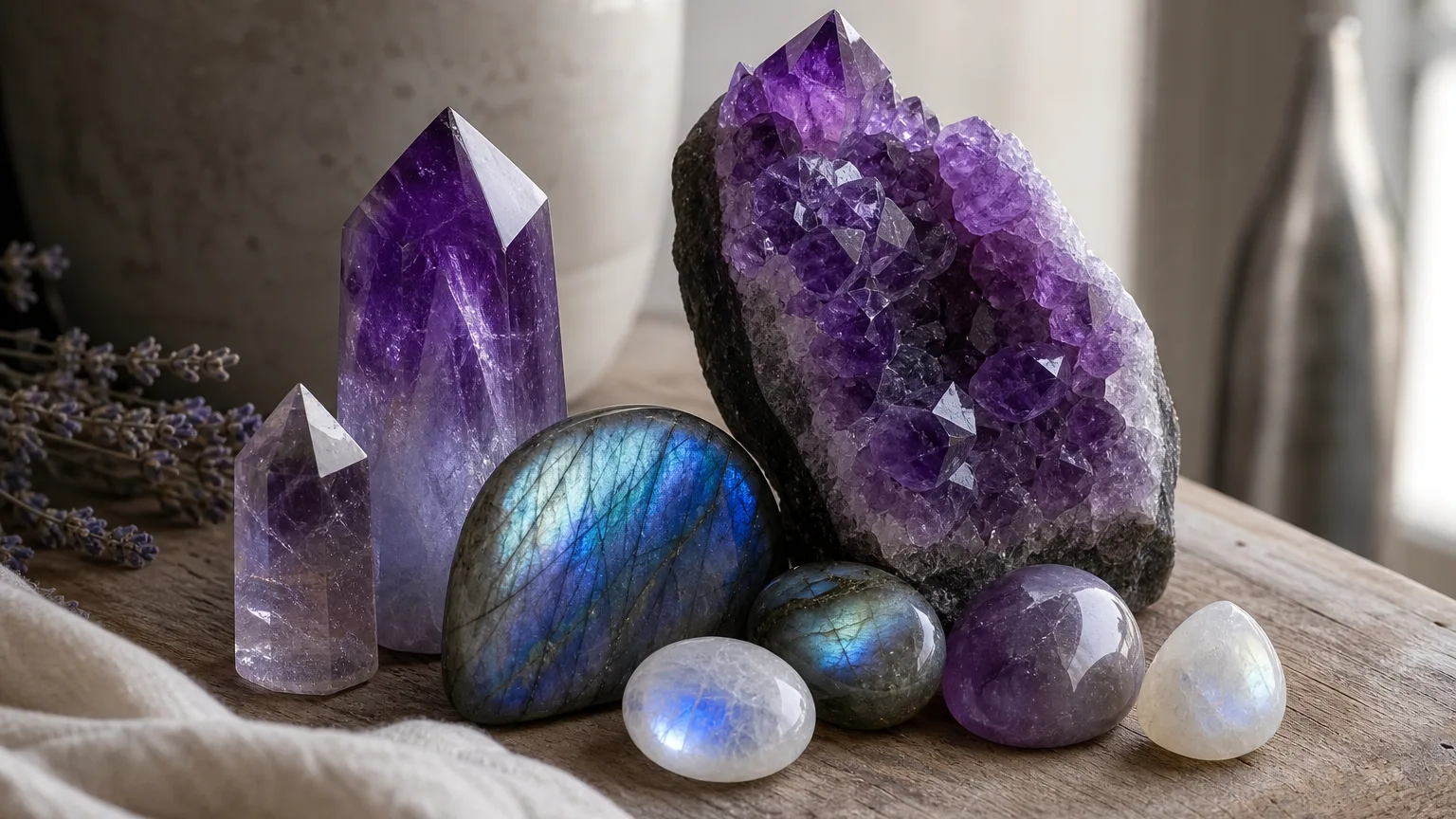
The best crystals for the Third Eye Chakra include Amethyst, Labradorite, Moonstone, traditionally used in mindfulness and spiritual practices. Crystal properties are complementary wellness tools, not medical treatments.
Understanding the Third Eye Chakra
The Third Eye Chakra, known in Sanskrit as Ajna, sits at the center of the forehead, just between the eyebrows. Across many traditions it is treated as the seat of perception, imagination, and discernment — the inner sense that helps you read a situation before logic catches up. Think of a moment when you “just knew” something was off about a choice, a person, or a room. That quiet signal is exactly the kind of awareness this chakra is said to govern.
In classical Indian yoga and Tantra, Ajna marks the bridge between the lower, body-centered chakras and the more abstract upper centers. Its symbol is a two-petaled lotus, sometimes holding a small triangle, and it is paired with the indigo band of the visible spectrum. Tibetan, Nepalese, and Chinese subtle-energy systems describe a comparable point — often near the same location — linked to inner vision and mental clarity, though the frameworks are not identical.
Modern readers often translate the Third Eye in practical terms: the ability to step back from overthinking, notice patterns in your own behavior, and make decisions with a calmer, steadier mind. You do not need to adopt any spiritual belief to work with it. For many people, Third Eye practices simply become a structure for slowing down, paying closer attention, and trusting their own judgment a little more.
Quick facts: Sanskrit Ajna · Position: Between the eyebrows · Color: Indigo · Element: Light. Balanced: Clarity, discernment, trust in intuition. Out of balance: Confusion, lack of direction, dismissing gut feelings.
Not sure which chakra to focus on? Take the free Chakra Test ↗
12 Best Crystals for the Third Eye Chakra
Amethyst
Chakra: Crown, Third Eye
Color: Purple
Element: Air
Najlepiej nadaje się do: Meditation, Sleep, Stress relief
Best way to use: Wear as jewelry
Zodiac: Pisces, Aquarius
Affirmation: I trust the quiet clarity rising within me.
A purple variety of quartz (SiO₂), amethyst gets its color from trace iron and natural irradiation during formation — a slow geological process that gives each stone a slightly different violet depth. Held in the hand, it is cool and smooth, and many people find its weight naturally steadies a busy mind. At the Third Eye, amethyst is often used to quiet mental noise so subtle impressions can surface, and it has a long history in meditation practice from Tibetan malas to European bedside stones. Psychologically, the soft purple tone is linked to calm and reflection, and pausing with a piece each evening can become a simple ritual of noticing what you actually sensed and felt through the day.
Labradorite
Chakra: Throat, Third Eye
Color: Grey-black body with blue/gold/green flash
Element: Water
Najlepiej nadaje się do: Change, Intuition, Creativity
Best way to use: Wear as jewelry
Zodiac: Leo, Sagittarius
Affirmation: I move through change guided by my own insight.
Labradorite is a feldspar prized for labradorescence — flashes of blue, gold, and green that appear as light moves across its surface, caused by light bouncing between thin internal layers. The play of color is changeable and never quite the same twice, which is why it has long been associated with perception and hidden things coming to light. At the Third Eye, many use labradorite when life feels uncertain, holding it as a focus for trusting instincts over second-guessing. Its shifting surface also mirrors the way real clarity often arrives gradually rather than all at once — a gentle reminder that insight can unfold.
Read full Labradorite meaning →
Moonstone
Chakra: Third Eye, Crown, Sacral
Color: White/cream with blue-white sheen
Element: Water
Najlepiej nadaje się do: Intuition, Emotional balance, June birthstone
Best way to use: Wear as jewelry
Zodiac: Cancer
Affirmation: I receive my own knowing with softness.
Moonstone is another feldspar, but its signature is adularescence — a floating blue-white glow that drifts across the stone as you turn it, created by light scattering between microscopic layers. The effect looks like moonlight moving through mist, and it has been tied to intuition, cycles, and the inner life across Indian, Roman, and Sinhalese traditions. For the Third Eye, moonstone is often chosen for a gentler kind of clarity — the kind that helps you notice a feeling rather than force an answer. Many people keep one close during reflective moments or times of transition, when a softer, more patient attention is what they need.
Obsidian
Chakra: Root, Third Eye
Color: Black (also snowflake, rainbow, mahogany)
Element: Earth, Fire
Najlepiej nadaje się do: Shadow work, Protection, Grounding
Best way to use: Wear as jewelry
Zodiac: Scorpio, Sagittarius
Affirmation: I see clearly, even what I would rather not.
Obsidian is not a true crystal but a natural volcanic glass, formed when lava cools so fast that minerals cannot organize into a crystal lattice. This gives it a glassy, mirror-like surface that has been used for actual mirrors since pre-Columbian Mesoamerica — a fitting match for the Third Eye’s work of honest self-seeing. Where stones like amethyst soften, obsidian sharpens, and many use it when they want to look at uncomfortable truths rather than look away. It is often described as protective and grounding, which can help balance the more abstract quality of Third Eye practice and keep insight tied to real life rather than daydream.
Selenite
Chakra: Crown, Third Eye
Color: White, pale, luminous
Element: Air
Najlepiej nadaje się do: Cleansing, Space clearing, Focus
Best way to use: Carry or hold in meditation
Zodiac: Taurus, Cancer
Affirmation: I clear away mental clutter and see plainly.
Selenite is a form of gypsum (CaSO₄·2H₂O) named after the Greek word for moon, and its fibrous structure gives it a silky, light-catching sheen. It is soft enough to scratch with a fingernail, which means it is best carried gently rather than soaked in water. At the Third Eye, selenite is widely used to clear space and settle the mind before deeper work — many people place a wand or slab on their desk or meditation spot as a visual cue to pause and reset. Its clean, bright tone pairs well with the idea of clearing mental fog, and simply having it within view can serve as a small, repeatable reminder to return to a clearer frame of mind.
Turquoise
Chakra: Throat, Third Eye
Color: Blue to green
Element: Earth
Najlepiej nadaje się do: Communication, Protection, December birthstone
Best way to use: Wear as jewelry
Zodiac: Sagittarius, Pisces, Aquarius
Affirmation: I speak what I truly perceive.
Turquoise is a copper-bearing phosphate whose color ranges from sky blue to green, depending on copper, iron, and moisture in its setting. It is one of the oldest stones used by humans, with a long protective tradition across Persian, Native American, and Tibetan cultures. For the Third Eye, turquoise is often turned to when perception needs to be spoken rather than kept silent — it bridges insight and honest expression. Many people wear it for steady, grounded awareness through the day, and its cool blue-green color is widely linked to calm, open communication and a balanced state of mind.
Lapis Lazuli
Chakra: Third Eye, Throat
Color: Deep blue with gold and white
Element: Air
Najlepiej nadaje się do: Meditation, Communication, Focus
Best way to use: Wear as jewelry
Zodiac: Sagittarius, Libra
Affirmation: I trust the clear voice of my own judgment.
Lapis lazuli is technically a rock rather than a single mineral — a mix of lazurite, calcite, and golden pyrite flecks that together look like a night sky scattered with stars. Ancient Mesopotamia and Egypt treasured it for seals, amulets, and royal ornament, and it has carried a long association with wisdom and inner vision. At the Third Eye, lapis is often used for focused, clear-headed discernment: the kind that helps you weigh a decision without spiraling into overthinking. Its deep blue is linked in color psychology to concentration and steadiness, which makes it a popular companion for study, writing, or any task that needs quiet, sustained attention.
Read full Lapis Lazuli meaning →
Fluorite
Chakra: Third Eye, Throat, Heart (color-linked)
Color: Purple, green, blue, yellow, rainbow
Element: Air
Najlepiej nadaje się do: Study, Concentration, Work
Best way to use: Carry or hold in meditation
Zodiac: Pisces, Capricorn
Affirmation: I focus my mind on what truly matters.
Fluorite (CaF₂) is famous for its wide color range — purple, green, blue, and yellow often banded together in a single piece — and for being soft enough that it is best kept away from water and rough handling. At the Third Eye it is associated with mental order: sorting signal from noise, prioritizing, and holding a complex thought without losing the thread. Many students, analysts, and writers keep fluorite on the desk for exactly this reason. Psychologically, the act of assigning one clear task to a chosen stone can itself reduce mental clutter, giving the mind a tangible anchor when attention starts to drift.
Lepidolite
Chakra: Heart, Third Eye, Crown
Color: Lavender, Purple
Element: Air
Najlepiej nadaje się do: Calm, Stress relief, Transitions
Best way to use: Wear as jewelry
Zodiac: Libra, Aquarius
Affirmation: I calm my thoughts and listen beneath them.
Lepidolite is a mica that contains lithium, the same element used in some mood-stabilizing medications, and it naturally grows in flaky, scaly sheets with a soft lavender-pink color. Its smooth, layered surface feels almost papery under the thumb, which is part of why many people fidget with it during stressful moments. At the Third Eye, lepidolite is often chosen to settle an overactive mind before any real clarity can arrive — when thoughts are racing too fast to perceive anything beneath them. The stone does not treat any condition, but for many it offers a quiet, tactile anchor that helps shift attention away from worry and back toward a steadier, more reflective state.
Read full Lepidolite meaning →
Kyanite
Chakra: Throat, Third Eye
Color: Blue (also black, green, orange)
Element: Air
Najlepiej nadaje się do: Communication, Meditation, Focus
Best way to use: Wear as jewelry
Zodiac: Aries, Libra
Affirmation: I align my words with what I perceive.
Kyanite is an aluminum silicate that forms in long, bladed crystals with a pearly blue sheen, and it has the unusual property of varying in hardness along different axes — a quirk mineralogists call directional hardness. At the Third Eye it is often associated with clearing away scattered attention and aligning what you think, say, and do. Many meditators place a blade on the forehead during quiet practice as a focus point. Its calm, linear form also gives the eye somewhere gentle to rest, which can be a small but real help for anyone whose mind tends to wander the moment they sit still.
Apatite
Chakra: Throat, Third Eye
Color: Blue-green, blue, green, yellow, violet
Element: Fire
Najlepiej nadaje się do: Motivation, Creative work, Expression
Best way to use: Wear as jewelry
Zodiac: Gemini, Libra
Affirmation: I act on the ideas I clearly see.
Apatite is a calcium phosphate that appears in vivid blue-green and teal shades reminiscent of tropical water — the name even comes from the Greek for “to deceive,” because it was historically confused with other stones. At the Third Eye it is often used to turn perception into action: insight that stays abstract is of little use, and apatite is associated with motivation, creative drive, and the courage to follow through on what you have sensed. Its bright color is energizing rather than calming, which suits people who already see clearly but struggle to act. For these users, a piece on the desk can serve as a visual prompt to move from thinking into doing.
Angelite
Chakra: Throat, Third Eye
Color: Soft blue
Element: Air
Najlepiej nadaje się do: Gentle expression, Meditation, Calm
Best way to use: Wear as jewelry
Zodiac: Aquarius, Pisces
Affirmation: I receive gentle insight and share it kindly.
Angelite is a form of anhydrite (calcium sulfate) with a soft, powdery blue color, and because it can absorb water it should be kept dry rather than soaked. Its muted, pastel tone feels quiet to the eye, which is exactly why many choose it for Third Eye work that needs softness rather than intensity. Angelite is often associated with calm, compassionate perception — the kind of awareness that notices without judging. For anyone whose inner vision tends to turn harsh or self-critical, it offers a gentler focus, and many people keep a small piece beside the bed for quiet evening reflection or for settling the mind before sleep.
How to Choose by Your Third Eye Need
Different Third Eye needs call for different stones. The table below groups the twelve crystals by what they do best, so you can match a stone to the kind of clarity you are after rather than choosing by color alone.
| Need | Best Crystals | Why |
|---|---|---|
| Quiet an overactive mind | Amethyst, Lepidolite, Angelite | Soft, calming tones that help racing thoughts settle before any perception can surface. |
| Deepen intuition | Labradorite, Moonstone, Lapis Lazuli | Associated with inner vision, hidden patterns, and trusting subtle impressions. |
| Honest self-seeing | Obsidian, Kyanite | Sharpen perception and help you look at what is true rather than what is comfortable. |
| Focus and study | Fluorite, Selenite | Linked to mental order, clearing clutter, and holding attention on one task. |
| Insight into action | Apatite, Turquoise | Help translate what you perceive into motivation, words, or movement. |
How to Use Third Eye Crystals
There is no single correct way to work with these stones, but a few simple approaches show up again and again. Choose what fits your day, and let the practice stay easy rather than rigid.
Wear as jewelry. A pendant that rests at the center of the forehead or between the collarbones keeps the stone close to the Third Eye area through the day. Rings and bracelets work too — the point is regular, gentle contact that reminds you to pause and notice. Amethyst, moonstone, and lapis lazuli are popular choices for jewelry because they are durable enough for daily wear.
Hold in meditation. Sit comfortably, rest a stone in your palm or place it gently on the center of your forehead, just between the eyebrows — the traditional location of the Third Eye. Close your eyes and let your attention rest on the breath for a few minutes. Selenite, fluorite, and kyanite are common picks for this practice because of their quiet, focused associations.
Place in your space. A stone on the desk, beside the bed, or on a meditation shelf gives the eye somewhere calm to land. Selenite towers and slabs are especially popular for space clearing, while a small obsidian or labradorite by the screen can serve as a reminder to look up and reset during long work.
Where to place on the body: the Third Eye sits between the eyebrows. Lying down with a smooth, flat stone (never a pointed one) at this spot is the classic placement for focused, eyes-closed practice. If a stone feels too stimulating — particularly obsidian or apatite — keep sessions short and pair it with a grounding stone near the feet or at the base of the spine.
Not sure which chakra to focus on? Take the free Chakra Test ↗
Beyond Crystals: Other Ways to Balance the Third Eye
Crystals work best alongside simple daily habits that train the same quality of attention. A few practices are especially well matched to the Third Eye.
Dream journaling. Keep a notebook by the bed and write down whatever you remember from dreams as soon as you wake — even a single image or feeling. Over time this trains you to take subtle impressions seriously rather than dismiss them, which is the core muscle the Third Eye is said to govern. Two minutes a morning is enough to start.
Screen breaks. The Third Eye sits between the eyebrows, exactly where the eyes strain during hours of close screen work. Brief breaks — looking at something twenty feet away for twenty seconds every twenty minutes — give the small muscles around the eyes a chance to rest and can reduce the foggy, overstimulated feeling that blocks clear perception.
Alternate nostril breathing. A classic yogic practice (nadi shodhana) in which you gently close one nostril at a time and breathe slowly through the other. Many people find it steadies a busy mind within a few minutes and is a simple way to shift into a calmer, more observant state before meditation or a difficult decision.
Dark, quiet meditation. Sitting in low light with eyes closed removes external input and lets attention turn inward. Even five to ten minutes can be enough to notice the quiet signals that normally get drowned out by noise and brightness. This pairs naturally with holding a Third Eye stone on the forehead.
FAQ
Where do I place a crystal for the Third Eye Chakra?
For focused practice, lie down and rest a smooth, flat stone gently on the center of your forehead, between the eyebrows — the traditional location of the Third Eye. For everyday wear, a pendant that hangs near the upper chest or a stone you hold in meditation works just as well.
How do I cleanse Third Eye crystals?
Most can be cleansed by resting them on a selenite slab, in moonlight, or in a bowl of dry brown rice overnight. Keep water-sensitive stones like selenite, angelite, and fluorite dry, and avoid salt, which can scratch softer pieces. Trust your own sense of when a stone feels “full” and ready for a reset.
Which crystal is best for beginners working with the Third Eye?
Amethyst is the most popular starting point — widely available, affordable, and gentle enough that it rarely feels overwhelming. Lepidolite is a close second for anyone whose main barrier is a racing, overstimulated mind.
Can Third Eye crystals be worn every day?
Yes. Durable stones like amethyst, lapis lazuli, moonstone, and turquoise are well suited to daily jewelry. Softer stones such as selenite, angelite, and fluorite are better carried in a pouch or kept on a shelf, since they scratch or absorb water more easily.
How often should I meditate with Third Eye stones?
There is no fixed rule. A short, regular practice — five to ten minutes a few times a week — tends to feel more sustainable than long, intense sessions. Consistency matters more than duration, especially when you are training attention rather than seeking a single dramatic experience.
What are the signs a Third Eye practice is working?
People commonly report noticing their own patterns more clearly, making decisions with less second-guessing, and trusting gut feelings rather than dismissing them. These are subjective experiences, not measurable outcomes — but for many, that gradual shift in self-trust is the real point of the practice.
Are Third Eye crystals scientifically proven to work?
No. Crystal properties are part of spiritual and wellness traditions, not established by scientific evidence. The benefits people report — calm, focus, a sense of clarity — are real to them, but studies have not shown that crystals themselves produce these effects beyond a placebo or ritual benefit. Treat them as a complementary support, not a medical treatment, and consult a qualified professional for any health concern.
Can I use more than one Third Eye crystal at a time?
Yes, but it often helps to start with one. Combining stones like amethyst and selenite is popular for a calm, clearing effect, while pairing obsidian with a gentler stone can balance its intensity. If a combination feels overstimulating, simplify back to a single stone.