Best Crystals for Air Energy: Meaning, Uses & Zodiac Signs
Quick Answer: Best Crystals for the Air Element
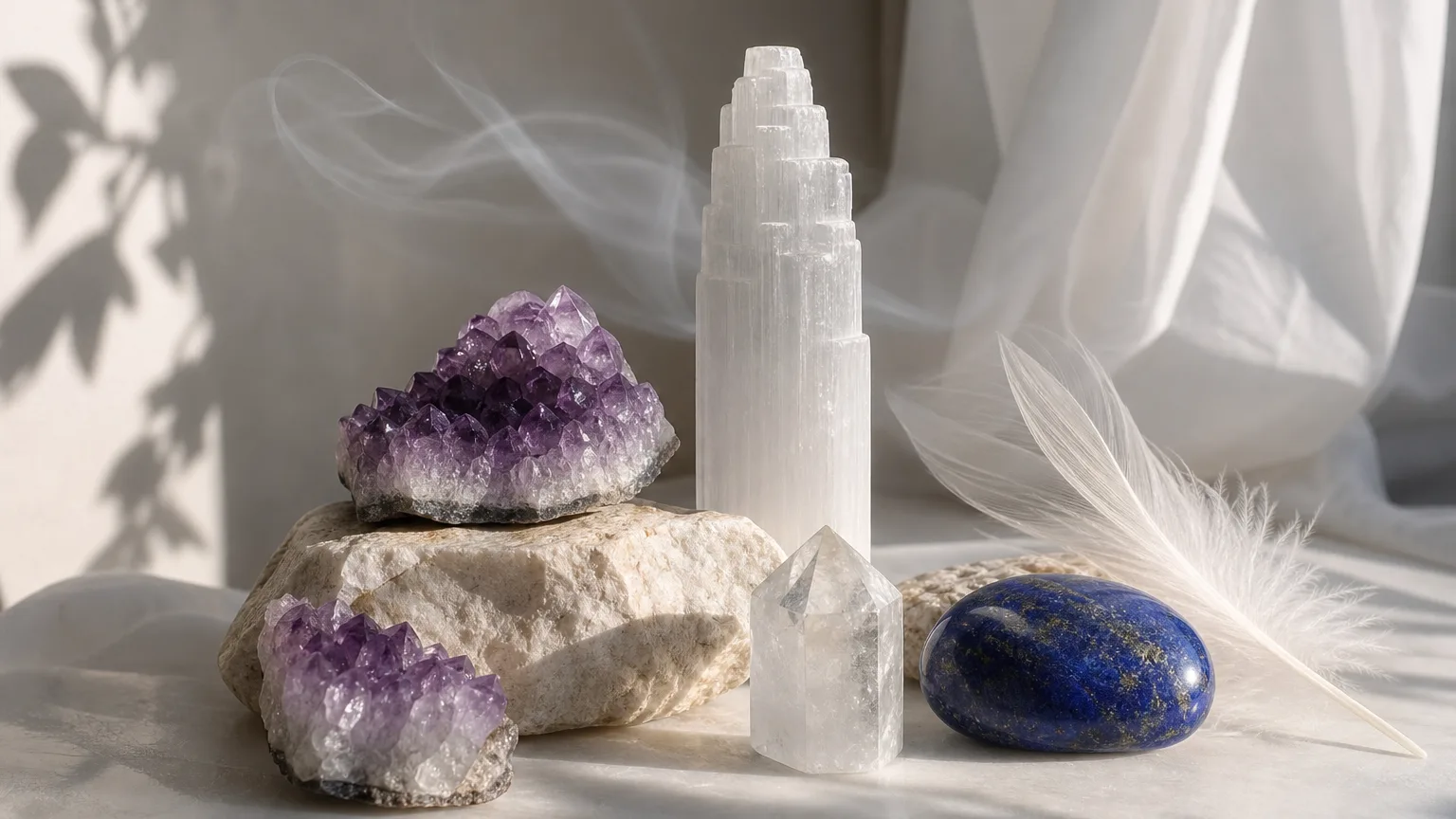
The best crystals for the Air Element include Amethyst, Selenite, Lapis Lazuli, traditionally used in mindfulness and spiritual practices. Crystal properties are complementary wellness tools, not medical treatments.
Understanding the Air Element
In the classical Western four-element system — Earth, Water, Air, Fire — Air is the element of the mind. It governs thought, language, learning and the constant movement of ideas. Where Earth is heavy and rooted, Air is light and quick; it wants to move, to question, to connect one thing to another. People with strong Air energy tend to be curious, articulate and reflective, the ones who read three books at once and finish other people’s sentences.
That same speed has a shadow side. When Air is overactive, the mind spins: overthinking at night, looping conversations, scattered attention. When it is underactive, you may feel foggy, tongue-tied or closed to new viewpoints. The aim is not to silence Air but to give it shape — clear channels rather than fast ones.
Culturally, Air has long carried this meaning. The Greek word pneuma meant both breath and spirit; in Ayurveda, prana is the life force carried on the breath; the Sanskrit vāta dosha is the air-and-space constitution associated with movement and the nervous system. Across these traditions, breath, wind and thought are treated as aspects of the same thing.
Modern readers can read this two ways. Psychologically, Air maps to cognitive function — focus, articulation, openness to new information. Practically, it maps to the rituals that steady a busy mind: slow breathing, journaling, naming what you feel. Crystals used for Air do not add intelligence; they are tangible objects that help you pause, settle and direct attention — a focus point for practices you already know work.
Quick facts: Traits: Intellect, communication, freedom, clarity. Balanced: Clear-thinking, articulate, open-minded. Out of balance: Scattered, detached, overthinking. Western zodiac: Gemini, Libra, Aquarius. Feng Shui: Southeast/East, wisdom area.
Not sure if your Air is balanced? Take the Element Test ↗
12 Best Crystals for the Air Element
Ametista
Elemento: Air
Elemental link: Traditionally linked to the crown and higher thinking; its violet color and clarity mirror Air’s calm, contemplative quality.
Element action: Settles an overactive Air mind toward clearer focus.
Cor: Purple
Chakra: Crown, Third Eye
Zodiac: Pisces, Aquarius
Ideal para: Meditation, Sleep, Stress relief
Best way to use: Wear as jewelry
Affirmation: I think clearly and rest my mind with ease.
A variety of quartz (SiO₂), amethyst gets its purple from iron traces and natural irradiation during formation. On an Air page we lean into its cooler, mental side: the color violet sits at the calm end of the spectrum, often read as the color of deep concentration. In crystal traditions it is associated with the crown and third eye — the head, the seat of thought. People hold it during evening meditation or place it on a bedside table to support a slower, less tangled wind-down. Psychologically it works as a gentle anchor: a smooth, cool surface to rest your hand on while you breathe, giving the busy mind somewhere to land.
Selenita
Elemento: Air
Elemental link: Named for Selene, the Greek moon; its pale luminosity and light-reflecting surface read as the most “airy” of minerals.
Element action: Clears mental static and refreshes a stale workspace.
Cor: White, pale, luminous
Chakra: Crown, Third Eye
Zodiac: Taurus, Cancer
Ideal para: Cleansing, Space clearing, Focus
Best way to use: Carry or hold in meditation
Affirmation: I clear my space and my thoughts with each breath.
Selenite is a crystalline form of gypsum (CaSO₄·2H₂O) that forms in long, fibrous columns with a glassy satin sheen. It is unusually soft and light, which is part of why it feels so open and clean to hold — there is no density to it. On this page its Air quality comes through as clarity and movement: many people use selenite wands or towers to “sweep” a desk or room, a ritual that is really about resetting attention after a heavy task. Keep it dry (it can dissolve in water) and use it as a visual cue to take one slow breath before the next piece of work.
Lapis Lazuli
Elemento: Air
Elemental link: Deep celestial blue historically tied to sky, truth and speech; links the third eye to the throat.
Element action: Turns thought into clear, honest words.
Cor: Deep blue with gold and white
Chakra: Third Eye, Throat
Zodiac: Sagittarius, Libra
Ideal para: Meditation, Communication, Focus
Best way to use: Wear as jewelry
Affirmation: I speak my truth clearly and with care.
Lapis lazuli is a rock rather than a single mineral — mostly lazurite, flecked with golden pyrite and white calcite that look like stars in a night sky. That deep blue has carried meaning for thousands of years, from Mesopotamian cylinder seals to Renaissance ultramarine paint, almost always standing for insight and truthful speech. For Air, its value is the bridge between thinking (third eye) and saying (throat): a focus object before a hard conversation or a written reply. As a self-care practice, holding lapis and naming one true thing you want to say can loosen the tongue without forcing it.
Read full Lapis Lazuli meaning →
Fluorita
Elemento: Air
Elemental link: Famous for ordering scattered attention; its banded, multi-color layers mirror structured, layered thinking.
Element action: Organizes a scattered Air mind into ordered focus.
Cor: Purple, green, blue, yellow, rainbow
Chakra: Third Eye, Throat, Heart (color-linked)
Zodiac: Pisces, Capricorn
Ideal para: Study, Concentration, Work
Best way to use: Carry or hold in meditation
Affirmation: I focus on one task and follow it through.
Fluorite (CaF₂) grows in striking banded crystals — purple beside green beside clear — and that visual order is exactly how it is used. Among Air stones it is the classic “study” crystal, the one students reach for when attention is fragmented across too many tabs. Color psychology reads purple-blue tones as concentrative and calm, which fits. In practice it works as a commitment device: place it on the desk, switch off notifications, and the stone becomes the physical signal that this block of time is for one thing only. Keep it out of long direct sun, which can fade the bands.
Lepidolite
Elemento: Air
Elemental link: Lithium-bearing lavender mica that softens racing thoughts; pairs Air’s mind with a calming mineral presence.
Element action: Slows an overstimulated Air mind toward calm.
Cor: Lavender, Purple
Chakra: Heart, Third Eye, Crown
Zodiac: Libra, Aquarius
Ideal para: Calm, Stress relief, Transitions
Best way to use: Wear as jewelry
Affirmation: I let my thoughts settle like leaves on still water.
Lepidolite is a mica that contains natural lithium, the same element used in mood-stabilising medicine — though a crystal delivers none of it to the body; its effect, if any, is symbolic and tactile. Its scaly lavender plates feel soft and slightly cool, pleasant to rub between thumb and finger. For Air it shines during transitions: the end of a work day, a long flight, a restless evening. Many people keep a small piece as a worry stone, a grounding physical action that interrupts a thought loop and brings attention back to the hand.
Read full Lepidolite meaning →
Kyanite
Elemento: Air
Elemental link: Blade-like blue crystals said to need no cleansing — a self-clearing Air stone for speech and insight.
Element action: Aligns thought and voice without forcing.
Cor: Blue (also black, green, orange)
Chakra: Throat, Third Eye
Zodiac: Aries, Libra
Ideal para: Communication, Meditation, Focus
Best way to use: Wear as jewelry
Affirmation: My words and my thoughts move in the same direction.
Kyanite (Al₂SiO₅) forms in long, flat, blade-shaped crystals with a blue that ranges from pale sky to deep denim. A persistent tradition holds that it never needs energetic cleansing — a convenient claim you can take or leave. What is real is its shape: the smooth blade is satisfying to hold along its length and is often used as a focusing object before speaking, meditating or writing. On an Air page it stands for aligned communication, the feeling that your words and your meaning are pointing the same way. Handle it gently; the blades can splinter along the grain.
Angelite
Elemento: Air
Elemental link: Soft sky-blue stone tied to gentle expression and a quiet, open mind.
Element action: Softens sharp words into calm, patient speech.
Cor: Soft blue
Chakra: Throat, Third Eye
Zodiac: Aquarius, Pisces
Ideal para: Gentle expression, Meditation, Calm
Best way to use: Wear as jewelry
Affirmation: I express myself gently and with patience.
Angelite is a compact form of anhydrite (CaSO₄) in a chalky, soft sky blue that gives it its modern name. It is porous and should never be soaked in water — a quick wipe with a dry cloth is enough. For Air, its role is the gentle end of communication: the difficult email you would rather not send, the conversation that needs a softer tone. As a self-care object it pairs well with a slow-breath practice; many people hold it while they pause before replying, choosing words instead of reacting. Its calm color does part of the work by setting a quieter mood.
alamosite
Elemento: Air
Elemental link: Rare lead silicate with a quiet, structural energy that supports ordered, methodical thinking.
Element action: Supports methodical, step-by-step thinking.
Cor: White, grey, blue-grey, yellow
Chakra: Third Eye
Zodiac: Virgo
Ideal para: Clarity, Structure, Focus
Best way to use: Wear, carry, or place in your space
Affirmation: I work through each step in clear order.
Alamosite (PbSiO₃) is a rare lead silicate, usually found in small grey to blue-grey aggregates rather than showy crystals. Its Air connection is less about colour and more about structure — a quiet, ordered stone for methodical work like editing, coding or planning. Because it contains lead, keep it as a display or occasional piece, not a daily palm stone, and wash your hands after handling. As a focus object it suits long, careful tasks: a reminder to slow down and build one step at a time rather than rush the whole structure at once.
albite
Elemento: Air
Elemental link: Pale feldspar that promotes clear, unhurried thinking and patient speech.
Element action: Encourages clear, patient thought and speech.
Cor: Colorless, white, pale
Chakra: Throat, Third Eye
Zodiac: Libra, Aquarius
Ideal para: Clear thinking, Patient speech, Calm
Best way to use: Wear as jewelry
Affirmation: I think clearly and speak with patience.
Albite is the sodium end-member of the plagioclase feldspar family (NaAlSi₃O₈), common in granite but cut into pale, glassy gems for collectors. Its Air quality is plainness — colourless to white, calm, no drama — which reads as the kind of clear-headed steadiness useful in careful conversation. Hold a piece before a meeting where you want to listen more than talk, or keep one on a writing desk as a visual cue to slow the first draft. Its quiet look also makes it an easy stone to wear daily without competing with other jewellery.
ametrine
Elemento: Air, Fire
Elemental link: Natural bicolor quartz blending Air’s clarity (amethyst) with Fire’s drive (citrine) — thought plus momentum.
Element action: Turns clear ideas into confident action.
Cor: Purple and gold (bicolor)
Chakra: Solar Plexus, Crown, Third Eye
Zodiac: Libra, Pisces, Gemini
Ideal para: Focus, Creativity, Confidence
Best way to use: Wear as jewelry
Affirmation: I move from idea to action with confidence.
Ametrine is a naturally occurring bicolor quartz (SiO₂) in which purple amethyst and gold citrine grow in the same crystal — a blend that needs no dye, only the right heat history during formation. Its double element (Air and Fire) makes it a bridge stone: the clear thinking of Air joined to the forward push of Fire. People reach for it when ideas are ready to leave the notebook and become something real. As a daily practice, holding ametrine while naming one next step is a simple way to turn planning into momentum without overthinking the whole plan first.
amphibole
Elemento: Air
Elemental link: Milky quartz with feathery inclusions, valued for quiet, contemplative focus and gentle wind-down.
Element action: Deepens quiet, contemplative focus.
Cor: Milky white with peach, green, brown inclusions
Chakra: Third Eye, Crown
Zodiac: —
Ideal para: Meditation, Wind-down, Quiet focus
Best way to use: Wear as jewelry
Affirmation: I let my mind grow quiet and still.
“Amphibole quartz” is rock crystal (SiO₂) carrying feathery inclusions of amphibole minerals — often actinolite or tremolite — that paint soft peach, green and brown wisps through a milky base. The look is calm and clouded, which is how it is used: a contemplative stone for evening meditation, journaling or a slow wind-down rather than sharp daytime focus. Held during a body scan or a few minutes of slow breathing, it gives the eye somewhere soft to rest while the mind settles. It is best treated gently and kept away from hard knocks.
analcime
Elemento: Air
Elemental link: Clear, structured zeolite whose geometric form supports sharp perception and orderly thinking.
Element action: Sharpens perception and structured thinking.
Cor: White, grey, pale pink/yellow
Chakra: Third Eye, Crown
Zodiac: Aquarius, Virgo
Ideal para: Clarity, Mental Focus, Perception
Best way to use: Wear, carry, or place in your space
Affirmation: I see clearly and think in an orderly way.
Analcime (NaAlSi₂O₆·H₂O) is a zeolite that often forms tidy trapezohedral crystals — small, geometric shapes that look almost cut. That built-in order is the root of its Air association: a stone for sharp perception and structured thinking, useful when you are learning something new or untangling a complicated problem. Place a piece on the desk while you study, or hold it during a short planning session. Because it is a zeolite, keep it dry; the structure can absorb water and oils over time. Its pale colour makes it easy to overlook, but its clean shape rewards close attention.
Choosing Air Crystals by Goal
Air energy can run two ways. When it is too thin — foggy thinking, hard to find words, stuck on a problem — you want to boost it. When it races — overthinking, scattered tabs, talking before listening — you want to calm it. Sometimes you want to channel Air toward a single aim, and sometimes to build the habit over time. Use the matrix below to match a goal to the right stone.
| Goal | Pattern | Best Air Crystals | Por que |
|---|---|---|---|
| Mental clarity (boost) | Foggy, slow, can’t focus | Fluorite, Selenite | Fluorite orders scattered attention; Selenite clears mental static and refreshes the workspace. |
| Communication (channel) | Thoughts won’t become words | Aquamarine, Lapis Lazuli | Both bridge third-eye thinking to throat expression — calm, truthful speech rather than reaction. |
| Ideas (boost / channel) | Dry, no new angle | Citrine, Labradorite | Citrine warms a cold mind; Labradorite’s flash is a traditional symbol of inspiration and new sight. |
| Focus (build) | Attention too scattered to finish | Fluorite, Clear Quartz | Fluorite commits attention to one task; Clear Quartz is a simple, neutral anchor for daily practice. |
| Calm overactive Air (calm) | Racing thoughts, overthinking at night | Amethyst, Lepidolite | Amethyst slows the mind toward rest; Lepidolite softens looping thoughts during transitions. |
| Confident expression (channel) | Know what to say, can’t say it | Kyanite, Angelite, Ametrine | Kyanite aligns thought and voice; Angelite softens tone; Ametrine adds the push to actually speak. |
Tip: if you can name the pattern, the choice mostly picks itself. “Boost” suits thin Air; “calm” suits racing Air; “channel” and “build” are about directing a steady mind toward one thing.
How to Use Air Crystals Safely
Air work is mostly mental and breath-based, so the safety notes here are practical rather than dramatic — but a few stones in this group need real care.
Best ways to use Air crystals
Breathwork. Air’s natural practice is the breath. Hold a smooth stone (amethyst or lepidolite) in your palm and slow your breathing to a four-count in, six-count out for two minutes. The stone is the anchor that keeps attention on the breath; the long exhale is what settles the nervous system.
Journaling. Place selenite or fluorite beside an open notebook. Name one thought you keep returning to, write it down, then write one true sentence about it. The crystal marks the moment as deliberate — a small ritual that turns a looping thought into a line on the page.
Communication practice. Before a hard conversation or reply, hold lapis, kyanite or angelite and state out loud what you actually want to say. Choosing the words first, in private, is a reliable way to soften tone and avoid the version you would regret.
Study and workspace. Keep fluorite on the desk during focused blocks and a piece of clear quartz for general anchoring. Treat the stone as the signal to switch off notifications — the object and the habit go together.
Safety notes
- Water — not all Air stones tolerate it. Selenite (gypsum) dissolves over time; angelite (anhydrite) is porous and can flake; analcime is a zeolite that absorbs water. Clean these with a dry or barely damp soft cloth, never a soak. Kyanite can be rinsed briefly but handle gently along the blade.
- Sunlight — colour can fade. Amethyst, fluorite and ametrine can lose their colour with long sun exposure. Charge them in indirect light or moonlight rather than on a bright windowsill.
- Lead-bearing minerals — handle with care. Alamosite contains lead. Keep it as a display piece, avoid prolonged skin contact, and wash your hands after handling. Do not use it in elixirs or any practice that involves the mouth.
- Heat and Fire element crossover. Ametrine bridges Air and Fire; do not heat any of these stones or place them near an open flame. Sudden heat can crack quartz and shatter selenite.
- Not a medical treatment. Crystals support a mindfulness or self-care practice — they do not diagnose, treat or cure any condition. If you are struggling with persistent worry, low mood or sleep problems, please speak to a qualified health professional.
Air Element and the Zodiac
In Western astrology, Gemini, Libra and Aquarius are the Air signs — and Air stones are traditionally used to support each sign’s particular flavour of mental and social energy. The pairings below follow common practice; think of them as helpful starting points, not fixed rules, since your full birth chart shapes how any sign shows up for you.
| Sign | Air need | Crystals often paired with it | How to use them |
|---|---|---|---|
| Gemini (May 21 – Jun 20) | Focus for a quick, restless mind | Aquamarine, Citrine | Carry aquamarine during conversation to stay present rather than jumping topics; hold citrine before a creative task to warm up new ideas. |
| Libra (Sep 23 – Oct 22) | Clear, balanced, honest speech | Lapis Lazuli, Rose Quartz | Wear lapis near the throat when weighing a decision; keep rose quartz close to soften self-judgement while you talk it through. |
| Aquarius (Jan 20 – Feb 18) | Grounding big, abstract ideas | Amethyst, Labradorite | Meditate with amethyst to settle an over-full mind; carry labradorite to spark fresh insight when a vision feels stuck. |
If your Sun is not an Air sign but your Mercury, Venus or a busy eleventh house is, you may still feel Air strongly — the same crystals apply. Many readers simply choose by current need (clarity, calm, expression) rather than by sign, and that works just as well.
Air, Feng Shui, and Chinese Five Elements
This is the part where two different systems get confused, so it is worth being precise.
The Western four elements and the Chinese five elements are not the same framework. The Western system is Earth, Water, Air, Fire. The Chinese system (wǔ xíng, often translated as Five Elements or better, Five Phases) is Wood, Fire, Earth, Metal and Water. Air does not appear in the Chinese system at all. The two frameworks developed separately, use different logic, and should not be mixed as if one maps neatly onto the other.
So what do Chinese traditions do with what Westerners call Air? The closest analogue is qì — the vital breath or life force that moves through all things. Qì is sometimes compared to Air because both carry the meaning of breath and movement, but qì is broader: it includes the flow of energy through the body, the landscape and the seasons, not just the physical atmosphere. If you want a Chinese counterpart to the Air element, qì and its quality of flow is the honest comparison — not a one-to-one element swap.
In Feng Shui, Air-themed qualities (clarity, calm thinking, study) are often associated with the wisdom and knowledge area, commonly placed in the southeast or east of a room or home. You might place a selenite tower, a clear quartz cluster or a piece of fluorite on a desk in that area as a focus for study and clear thinking. These are directional associations drawn from practice rather than fixed physics.
On the generating cycle of the Five Phases — if you ever apply it alongside crystal work — the order is Wood → Fire → Earth → Metal → Water → Wood. On the controlling cycle it is Wood → Earth → Water → Fire → Metal → Wood. These cycles describe relationships among Wood, Fire, Earth, Metal and Water only; Air is not a node in either, because it is not part of the system. [Note: if you are working with a specific Feng Shui lineage, please verify the directional placements with that school’s guidelines, as they vary.]
The short version: enjoy Air crystals for the Western element they belong to, and if you also work with the Five Phases, treat them as a separate map. Trying to force Air into Wood, Fire, Earth, Metal or Water tends to produce more confusion than insight.
Shop Crystals for This Guide
Explore crystal jewelry and stones from our current collection.


Amethyst Angel


Tornozeleira de ametista


Amethyst Mala


Amethyst Stone Set
FAQ
What makes a crystal an Air element crystal?
There is no scientific test for an element assignment — it is a traditional reading based on a stone’s colour, properties and use. Air crystals tend to be light in colour (white, pale blue, lavender, clear), associated with the mind and communication, and linked to the upper chakras (third eye, crown, throat). Selenite, fluorite, amethyst and lapis are common examples.
Which Air crystals are best for mental clarity?
Fluorite and selenite are the most popular choices for clear thinking. Fluorite is used to organise scattered attention, while selenite is used to clear mental static and refresh a workspace. Many people keep both on a desk during focused work.
How do I use Air crystals for communication?
Hold a throat-area stone like lapis lazuli, kyanite or angelite before a difficult conversation. State out loud, in private, what you want to say. The stone is a focus point; the value comes from choosing your words slowly rather than reacting in the moment.
Where should I place Air crystals in my home?
In Feng Shui practice, Air qualities such as wisdom and clear thinking are often associated with the knowledge area, commonly placed in the southeast or east of a room. A selenite tower, clear quartz or fluorite on a desk or shelf works well. Placement is directional tradition, not fixed physics.
How do I cleanse Air crystals?
It depends on the stone. Selenite, angelite and analcime should stay dry — clean with a dry cloth or a brief wipe, never a soak. Amethyst, fluorite and ametrine are fine under running water but should be kept out of long direct sun, which fades their colour. Kyanite can be rinsed briefly. Sound (a bell or singing bowl) and moonlight are gentle options that suit almost all Air stones.
Is the Air element the same as the Chinese element of Wind?
No. The Chinese Five Phases (wǔ xíng) are Wood, Fire, Earth, Metal and Water — Air is not one of them. The closest Chinese concept to Western Air is qì, the vital breath or life force, which shares the meanings of breath and flow but is much broader. The two systems should not be treated as interchangeable.
Are the properties of Air crystals scientifically proven?
No. Crystal properties are part of spiritual and mindfulness traditions, not established science. There is no solid clinical evidence that a particular stone improves focus or communication. The benefits people report usually come from the practices the crystal supports — slow breathing, mindful pauses, intentional attention — rather than from the stone itself. Crystals are complementary wellness tools, not medical treatments.
Can I combine Air crystals with other elements?
Yes. Many readers pair Air stones with a grounding Earth crystal (like hematite or smoky quartz) when an Air practice feels too ungrounded. Ametrine naturally bridges Air and Fire. The goal is balance — use an Earth stone to steady racing Air, or a Fire stone to add momentum to clear but slow thinking.