Fire Agate Meaning: Healing Properties & Uses
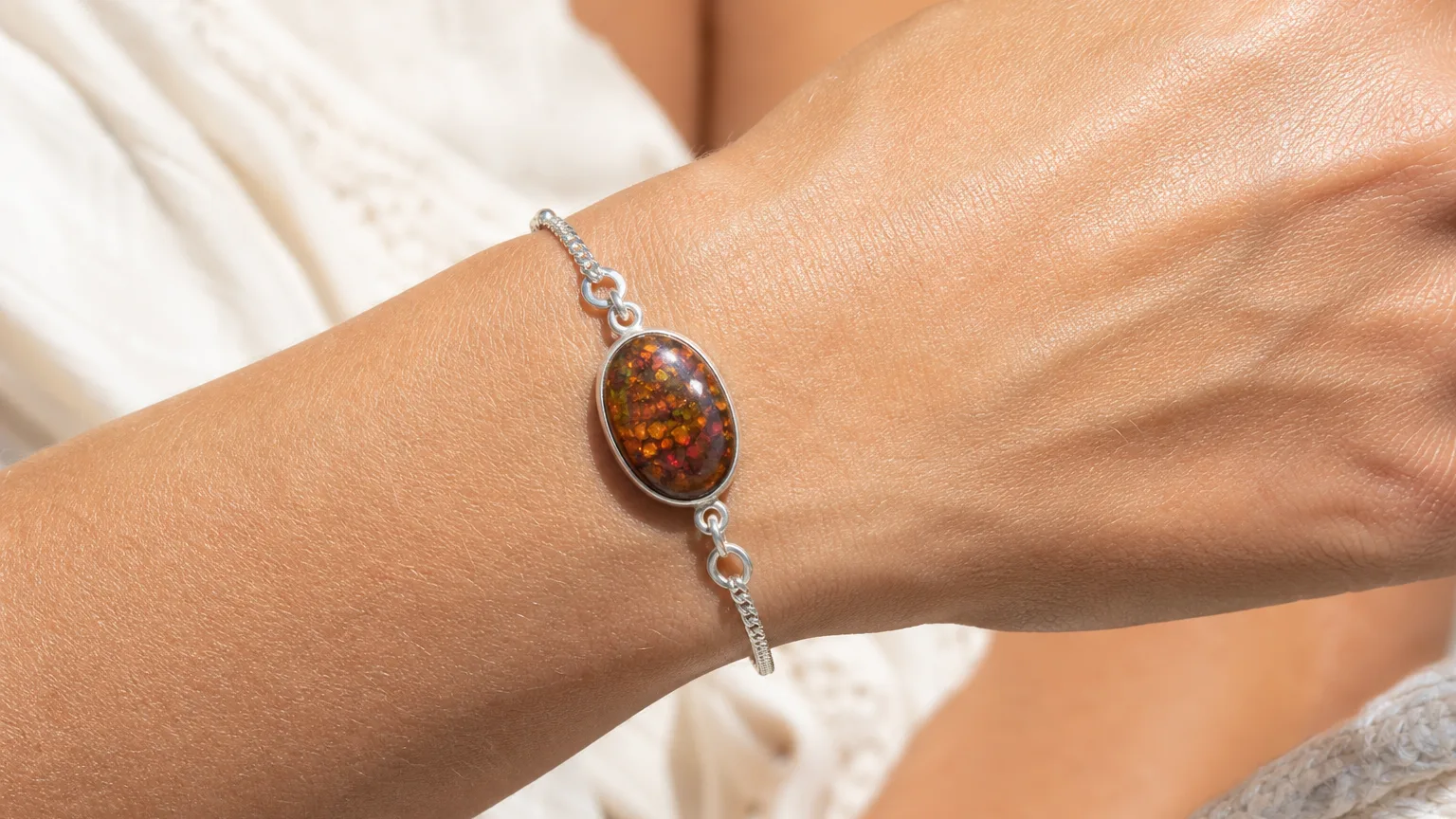
Fire agate is a brown chalcedony that flashes an iridescent “fire” of red, orange, green, and gold from within. That glow comes from thin layers of iron minerals, not pigment, and the stone has long been tied to passion, vitality, and courage. If you’re drawn to its warm, glowing look for energy or motivation, this guide covers what fire agate is, why it glows, and how to tell a genuine stone from look-alikes. Crystal meanings reflect tradition and personal practice, not medical advice.
What Is Fire Agate Meaning?
At its simplest, fire agate means passion and vitality. With its warm, glowing flash of color, it reads as alive and bold — a stone people reach for motivation, courage, or a creative spark. Its inner fire lends it an easy association with energy and the drive to act.
For a lot of people that’s the whole appeal: one glowing piece, one intention, one small daily ritual. You don’t need to believe anything mystical to benefit — the value often comes from the act of choosing the stone and letting its warm flash pull your attention back to a more energized frame of mind. In that sense fire agate is a visual cue you train yourself to return to.
Fire Agate Meaning and Symbolism

Fire agate is a variety of chalcedony — microcrystalline quartz — and its glow comes from a quirk of its formation. As the chalcedony grew in layers, thin films of iron minerals (like goethite and limonite) were trapped between them. Those films are so thin that light bounces off their top and bottom and interferes with itself, producing the shifting reds, oranges, greens, and golds we see as “fire.” It’s the same physics as a soap film — structural color, not pigment.
The stone has links to the Americas, where most of it is found. The best-known deposits sit in northern Mexico and the southwestern United States (especially Arizona), with some material from Brazil. Because the iridescent layers sit buried under ordinary chalcedony, a skilled cutter has to carefully grind away the overlying stone to reveal the fire without destroying it — a slow, deliberate process that makes fine fire agate relatively uncommon.
Today the common threads are consistent: passion, vitality, and courage. You’ll see fire agate described as a stone for energy, creative drive, and the boldness to act on what matters. How much of that you experience personally is up to you, but the warm symbolism matches its look. To explore more stones, browse the full Crystal Guide.
Fire Agate Properties

The Science
Fire agate is chalcedony — microcrystalline quartz, SiO₂ — with a special feature: thin layers of iron-oxide minerals (chiefly goethite and limonite) trapped between the chalcedony layers as it formed. Those films are so thin that light reflecting off their front and back surfaces interferes with itself, producing iridescent flashes of red, orange, green, and gold. This is thin-film interference — the same physics behind a soap bubble or an oil slick — and it’s a structural color, not a pigment. Fire agate forms in the trigonal crystal system, rates about 6.5–7 on the Mohs scale, and is opaque to translucent. The main sources are Mexico, the southwestern United States (Arizona), and Brazil. None of this is mystical — it’s mineralogy and optics.
Traditional Meaning
Tradition ties fire agate to passion, vitality, and courage. It’s linked to the sacral, solar plexus, and root centers and is often described as a stone of inner fire — many believe it supports energy, creative drive, and the boldness to act, while keeping you grounded through it. Its warm glow has also lent it an association with protection and steady motivation. These associations come from spiritual tradition and personal practice rather than clinical study.
Mindfulness & Psychology
From a psychological angle, fire agate works as a warm, energizing focal cue — something glowing and bold to hold when you want a lift of drive or the courage to begin. In color psychology, warm reds and golds read as vital and confident, and the act of carrying a piece and pairing it with an intention (act on this today) turns it into a small cue you keep returning to. For anyone feeling stalled or low on motivation, its inner fire can be a gentle nudge into motion. These effects come from tradition and personal practice, not clinical research. Crystals complement — but never replace — professional care.
Fire Agate Benefits

People who work with fire agate usually describe it in terms of passion, vitality, and courage, not dramatic effects. It tends to show up as a warmer, more driven mood. Here are a few of the benefits people mention most often:
A lift of vitality
Its warm, glowing flash reads as energizing; kept in view, it’s a low-key cue for drive and forward motion.
Courage to act
Tied to boldness, some keep it nearby when they need the nerve to act on something that matters.
A creative spark
Its shifting fire is a cue for imagination — a reminder to bring fresh, lively energy to a task.
Grounded motivation
Its warm, earthy base reads as grounded; many find it lifts drive without the jitter of brighter stones.
The pattern underneath all of these is the same: the stone holds meaning through the intention you bring, not through any effect on its own. If you’re exploring stones for specific needs, see our guide to crystals for anxiety.
Fire Agate Chakra, Zodiac, and Element Associations
In traditional systems, fire agate is most often linked to the sacral, solar plexus, and root centers — the areas tied to creativity, willpower, and grounding. It’s commonly paired with Aries and Leo. Its element is Fire. For related stones, see sacral chakra crystals.
These are correspondences built up through tradition, not rules carved in stone. If your own sense of fire agate points somewhere else — a different chakra, a different element — that’s completely fine. Many people work with stones intuitively, following what feels right rather than a textbook chart, and there’s a long history of practitioners doing exactly that.
How to Use Fire Agate

Fire agate is a hard quartz (Mohs 6.5–7), so it takes daily wear well. The key is consistency: a piece you actually see and touch every day does far more than one stored away.
Wear it. A cabochon ring or pendant keeps the glowing fire where you can tilt it in the light. Pair one piece with a specific intention — “act with energy,” “find my drive.”
Meditate with it. Hold a tumbled piece in your palm or rest it at your sacral or solar plexus while you sit. Even a few minutes of calm focus counts; the goal is presence, not duration.
Carry a tumbled stone. A smooth piece in a pocket is a discreet touchstone — something to hold when you want a nudge of vitality.
Keep it on a desk. A polished freeform or sphere adds a warm, grounding presence to a workspace — a quiet cue for energy and focus.
Which Fire Agate Form Is Right for You?
| Form | Best for | Choose it if |
|---|---|---|
| Cabochon | Rings, pendants, display | You want the classic smooth dome that shows the fire at its best |
| Freeform / nodule | Display, collection | You want a natural polished piece with glowing patches of fire |
| Pendant | Daily wearing | You want the warm fire worn near the chest through the day |
| Tumbled stone | Pocket or meditation | You want a smooth, affordable piece to hold or carry |
| Beaded bracelet | Daily wearing | You want a wearable row of warm-toned stones |
| Specimen nodule | Shelf, collection | You like the rough, natural nodule form for a shelf |
How to Tell Real Fire Agate from Look-Alikes
Because genuine fire agate is uncommon and striking, look-alikes turn up — usually glass, resin, or dyed chalcedony. A few checks help:
- Shifting fire. Real iridescence moves and shifts as you tilt the stone — colors appear and fade with the angle. A fixed, painted-looking glow that doesn’t move points to glass or a coating.
- Depth. Fire agate’s glow comes from within, beneath layers of chalcedony. A surface-only color, sitting flat on top, suggests a coating or imitation.
- Natural variation. Real fire appears in patches and veins, not as a perfect, even sheet. Too-uniform color can mean treatment or glass.
- Hardness. At Mohs 6.5–7, real chalcedony scratches glass and resists a steel knife. Glass imitations are softer.
- Price and source. Fine fire agate from Mexico or the US Southwest costs accordingly, because revealing the fire takes skilled cutting. A cheap, vividly uniform “fire agate” is likely glass or resin.
For everyday fire agate, a reputable seller who lets you see the shifting glow is usually enough. The honest test is simple: real fire moves when you move the stone.
How to Cleanse and Care for Fire Agate
Fire agate is a hard, stable quartz, so it’s easy to care for. A few reliable practices:
- Water. A brief rinse under cool water is fine — it’s a hard stone (Mohs 6.5–7). Avoid long salt-water soaks, especially with metal settings.
- Sunlight. The iridescence is structural, not dyed, so sun cleansing is safe and won’t fade the fire.
- Moonlight. A night under the moon is a popular gentle method, often paired with setting an intention.
- Smoke or sound. Passing it through sage or palo santo smoke, or using a singing bowl nearby, is a no-contact option many prefer.
One practical note: store fire agate away from harder stones that could scratch it, and avoid harsh chemical cleaners, which can dull the polish. For the full routine, see our guide to cleansing crystals.
Best Crystals to Pair With Fire Agate
Pairing is about layering intentions — picking stones whose qualities complement rather than compete. A few combinations that work well with fire agate’s warm, vital energy:
- Fire Agate + Cornalina — two warm, vital stones; a layered pairing for motivation and creative drive.
- Fire Agate + Tiger’s Eye — fire meets courage; a bold combo for energy and steady nerve.
- Fire Agate + Citrino — warm fire meets bright optimism; a cheerful pairing for vitality and an upbeat mood.
The logic of pairing is about complementary intentions, not strict rules. Pick combinations that match what you’re actually working on, and trust your own sense of what feels balanced.
Who Should Use Fire Agate?
Fire agate suits people who want a warm, energizing stone for passion, vitality, and courage — anyone wanting motivation, a creative spark, or a bold daily piece that can be worn for years. It’s a rewarding stone because genuine fire agate is uncommon and striking.
A few honest expectations: fire agate isn’t a treatment for low energy, fatigue, or any condition — if you’re dealing with something persistent, a healthcare professional is the right call, and the stone can be a comfort alongside that. Its iridescence is natural (structural, not dyed), but the market carries glass and resin look-alikes, so it’s worth learning to spot the shifting glow. Its value comes from the intention and routine you build around it. Go in expecting a hard, glowing, symbolic stone you can wear daily, and it tends to fit well.
FAQ About Fire Agate Meaning
What is fire agate?
A variety of chalcedony (microcrystalline quartz) that flashes iridescent reds, oranges, greens, and golds. The glow comes from thin films of iron-oxide minerals trapped between the chalcedony layers.
Why does fire agate glow?
Thin-film interference. Light reflects off the front and back of the very thin iron-oxide layers and interferes with itself, producing shifting color — the same physics as a soap bubble. It’s structural color, not pigment.
Is fire agate natural?
Yes — the iridescence is natural and structural. But look-alikes exist (glass, resin, dyed chalcedony). Real fire shifts as you tilt the stone; imitations tend to look flat and fixed.
What chakra is fire agate associated with?
Traditionally the sacral, solar plexus, and root centers, linked to creativity, willpower, and grounding.
Can fire agate go in water?
Yes. At Mohs 6.5–7 it’s a hard, water-safe stone. A brief rinse is fine; avoid long salt-water soaks with metal settings.
How can I tell real fire agate from fake?
Look for fire that shifts with the angle, color that comes from within (not a flat surface coating), and natural patchy variation. Glass and resin look-alikes tend to be fixed, surface-level, and too uniform.
What does fire agate symbolize?
Most often passion, vitality, and courage — a warm, glowing stone for energy, creative drive, and the boldness to act.
Final Thoughts on Fire Agate
Fire agate earns its place as a stone of passion and vitality — and it earns it again for each person who wears it and gives it meaning. If you’re curious, the simplest start is one glowing piece, one intention, and a small daily moment to tilt it in the light. You don’t need the largest nodule or the rarest fire; you need a stone whose warmth you can feel. Let the routine do the work, and let that inner fire be the cue to act with energy and courage.
From there, fire agate tends to add a warmer note — a lift of drive, a spark of creativity, or simply a glowing stone you’re glad to wear. If that’s what you’re after, you’re in the right place. For more, explore the Crystal Guide or browse fire agate pieces.