
Red Jasper Meaning: Healing Properties & Uses
Red Jasper is an opaque, earth-red variety of chalcedony — microcrystalline quartz — long tied to grounding, stamina, and quiet strength. If you’re drawn to it for staying steady under pressure, anchoring a meditation, or adding a grounded note to your day, this guide covers what red jasper means, what it’s actually made of, and how people work with it. Crystal meanings reflect tradition and personal practice, not medical advice.
What Is Red Jasper Meaning?
At its simplest, red jasper means grounded strength — the feeling of planting your feet and holding steady. Where some stones lean calming or airy, red jasper sits low and solid: linked to endurance, courage, and the kind of stability you reach for when the ground feels unsteady.
For a lot of people that’s the whole point — a dense, warm-to-hold stone you keep in a pocket or wear at the wrist as a physical reminder to stay rooted. You don’t need to believe anything mystical for it to work that way; the value usually comes from choosing the stone, giving it a job (“keep me grounded today”), and letting its weight and color pull your attention back to something solid. In that sense red jasper is less a magic rock and more a cue you train yourself to return to.
Red Jasper Meaning and Symbolism

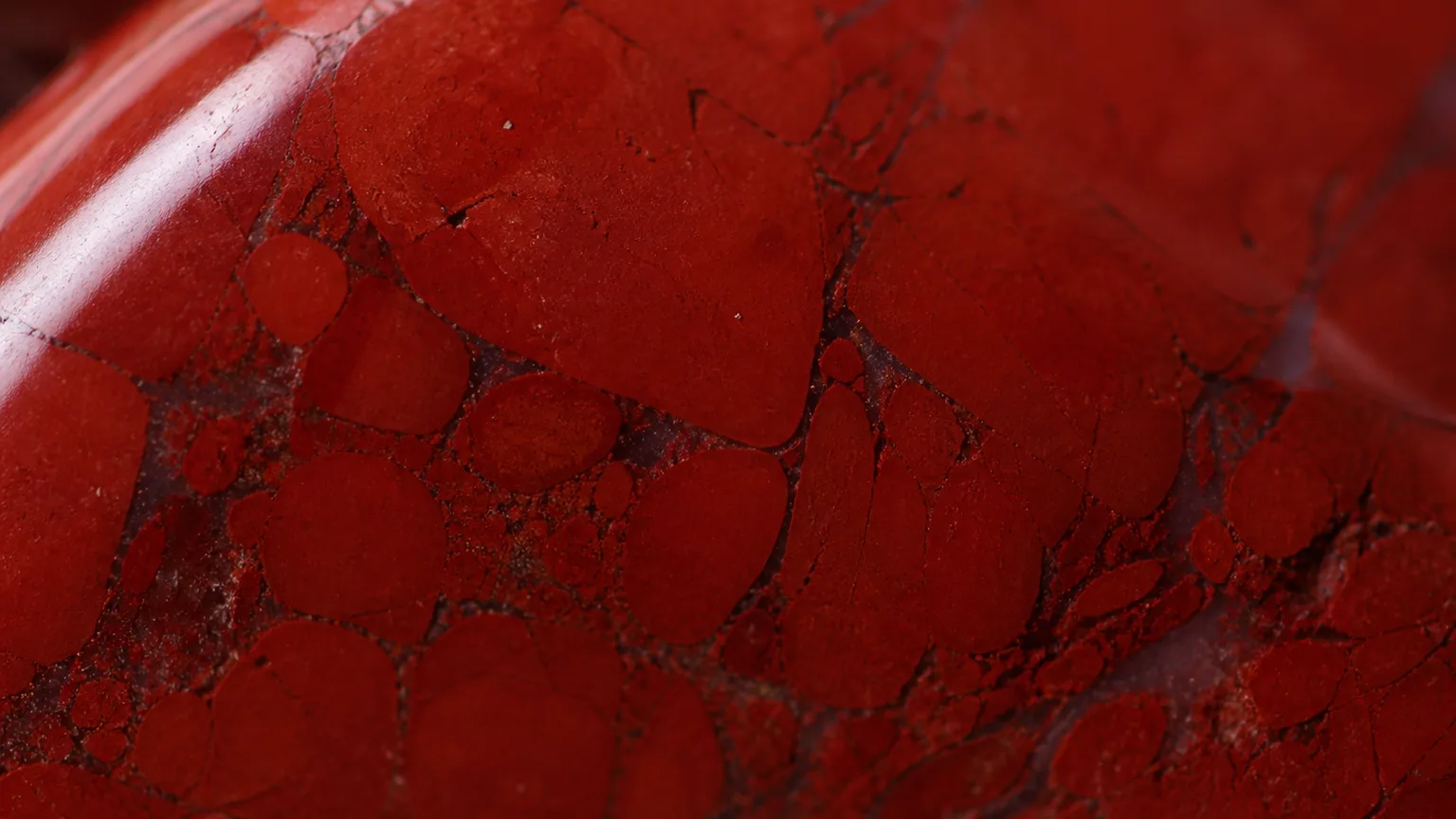
The name tells you where it sits. Jasper traces back through Old French and Latin to the ancient Greek iaspis, itself tied to a Semitic root meaning something close to “speckled stone” — a nod to jasper’s grainy, mineral-flecked texture. Red Jasper is the iron-rich member of the family, its brick-to-terracotta color coming from fine hematite (iron oxide) scattered through the silica.
That earthy red made it a working stone across a lot of cultures. Ancient Egyptians carved it into scarab amulets and seals. It turns up in Mesopotamian and Minoan beadwork, and Greek and Roman lapidaries valued it for carved intaglios. In many traditions it was carried as a protective and grounding talisman — the kind of stone a traveler, soldier, or farmer might keep close during long, hard work. Some modern crystal writers describe it as the “blood of the Earth”; whether you take that literally or poetically, the image captures why people have reached for this stone when they needed to feel solid and sustained.
The thread running through all of that is the same: grounding, stamina, and steady courage. Today red jasper is usually described as a stone of endurance — reached for during long efforts, stressful stretches, or any time the body and nerves feel frayed and untethered. How much of that lands for you personally is, honestly, up to you — but the stone has carried that reputation across very different eras, which counts for something on its own. To explore more stones, browse the full Crystal Guide.
Red Jasper Properties
The Science
Red Jasper is chalcedony — microcrystalline quartz — so its chemistry is silicon dioxide (SiO₂) with a Mohs hardness of about 6.5 to 7, tough enough to take a polish and hold up in everyday jewelry. Its color comes from microscopic hematite (iron oxide) particles spread through the silica, which is why it reads as brick red rather than the translucent red of carnelian, a related chalcedony with a finer grain and less iron. It’s opaque, with a slightly grainy texture and a waxy-to-vitreous luster when polished. Major sources include Brazil, India, Russia, Madagascar, and the United States. None of this is mystical — it’s standard mineralogy that also explains the stone’s toughness in everyday wear.
Traditional Meaning
Tradition ties red jasper to grounding, vitality, and quiet courage. It’s most strongly associated with the root chakra — the base center linked to stability, safety, and a sense of belonging on the earth — and it’s often described as a stone that “helps you stay put” when everything feels up in the air. Across modern crystal practice it’s reached for during endurance work, recovery from burnout, or moments when someone needs to feel anchored and resourced rather than scattered. Many also carry it as a protective talisman. These associations come from spiritual tradition and personal practice rather than clinical study.
Mindfulness & Psychology
From a psychological angle, red jasper works as a heavy, tactile anchor for grounding practice — the kind of object you reach for when you want to drop out of a racing, scattered headspace and back into your body. Warmer reds read in color psychology as energizing and stabilizing, tied to alertness and physical presence rather than rest, which is why people often pair it with movement, breath, or a morning “get going” ritual instead of a wind-down. Holding a dense stone and pairing it with a simple intention (“stay rooted”) turns it into a repeatable cue. These effects come from tradition and personal practice, not clinical research. Crystals complement — but never replace — professional care.
Red Jasper Benefits

People who work with red jasper usually describe it in terms of steady footing and staying power, not dramatic shifts. It tends to show up in the moments where you need to hold your ground rather than float away from it — the stressful meeting, the long workout, the afternoon slump. A few of the benefits people mention most:
A steadier base under stress
Holding or wearing red jasper when pressure builds gives you a physical cue to drop your shoulders and plant your feet — a small reset that keeps you from spinning into reaction.
Stamina for long efforts
Many keep it nearby during drawn-out work — a long shift, a training block, a hard week — as a reminder that endurance is about pacing, not pushing harder every minute.
A warm-up cue before effort
Held for a minute before a workout, a long walk, or a physically demanding task, it marks the shift into doing — a small ritual that sets a steadier pace instead of charging in wired.
A grounding morning ritual
Held for a minute at the start of the day with one intention (“stay grounded”), it becomes a cue that sets a steadier tone before the rush pulls you off center.
The pattern underneath all of these is the same: red jasper isn’t steadying you by magic, but it gives your day a structure that makes groundedness more likely. If you’re exploring stones for specific needs, see our guide to crystals for stress.
Red Jasper Chakra, Zodiac, and Element Associations
In traditional systems, red jasper is most strongly linked to the root chakra — the base center tied to stability, safety, and feeling grounded in your body — with a secondary connection to the sacral center. Astrologically, it’s often paired with Aries and Scorpio, and sometimes Leo or Virgo. Its element is usually given as Earth, with some traditions also connecting it to Fire on account of its warm, energizing color. For related stones, see root chakra crystals.
These are correspondences built up through spiritual tradition, not fixed rules. If your own sense of red jasper points somewhere else — a different chakra, a different element — that’s completely fine. Many people work with stones intuitively, following what feels right rather than a textbook chart, and there’s a long history of practitioners doing exactly that.
How to Use Red Jasper

Red jasper is straightforward — there’s no single “right” way, only what fits your routine. The key is consistency: a stone you actually see and touch does far more than one that sits in a drawer.
Wear it. A red jasper bracelet or pendant keeps the stone against your skin through the day. For a grounding practice, pair it with one intention each morning — “stay rooted through whatever comes.”
Meditate with it. Hold a tumbled piece in your palm or rest it at the base of your spine (root chakra area) while you sit. Even a few minutes of focused attention counts; the goal is presence, not duration.
Place it at home. A piece on your desk or by the entryway works as both décor and a grounding cue — somewhere you tend to feel rushed or scattered.
Build a grounding ritual. At the start of the day, hold the stone, feel its weight, and name one thing you want to stay steady through. Repetition is what turns it from a gesture into a habit.
Which Red Jasper Form Is Right for You?

| Form | Best for | Choose it if |
|---|---|---|
| Bracelet | Daily wearing | You want a visible grounding reminder at your wrist all day |
| Tumbled stone | Pocket or meditation | You want something small, smooth, and easy to hold |
| Palm stone | Hand-holding under stress | You want a larger, heavier piece to grip when pressure builds |
| Pendant | Worn near the chest | You prefer a single statement stone close to the body |
| Raw piece | Desk or altar display | You like natural texture and a more rugged look |
| Beads / mala | Meditation counting | You want grounding built into a breath or mantra practice |
How to Tell Real Red Jasper from Fakes
Because red jasper is common and affordable, outright fakes are rarer than for pricier stones — but dyed lookalikes and mislabeled material still show up. A few checks help:
- Color and texture. Genuine red jasper is opaque with a slightly grainy, mineral-flecked surface and natural color variation — banding, speckles, or uneven patches. If the red is perfectly uniform, sits only on the surface, or collects in cracks, it may be dyed howlite, quartzite, or marble.
- Weight and temperature. Real chalcedony has some heft and stays cool in your hand. Resin or plastic imitations feel light and warm up fast; dyed stone still feels cool but fails the color test above.
- Hardness. At Mohs 6.5–7, red jasper scratches glass and resists a steel knife. A soft, easily scratched “jasper” is a giveaway.
- Seller honesty. Red jasper is sometimes confused with carnelian (finer-grained, more translucent, more orange) or sold generically as “red stone.” A reputable seller will tell you what it actually is.
Carnelian vs. red jasper. The two are cousins — both iron-bearing chalcedony — but carnelian is more translucent and skews orange, while red jasper is opaque and skews brick-to-brown. If a “red jasper” looks glassy and orange-red when held to the light, it’s probably carnelian.
How to Cleanse and Charge Red Jasper
As a hard, stable quartz-family stone, red jasper is one of the easier crystals to care for — it tolerates more than soft or porous stones.
- Water. A brief rinse under cool water is fine, and many use running water as part of a cleansing routine. Avoid long soaks or hot water.
- Sunlight. Red jasper is generally sun-stable — the hematite color holds far better than dyed stones — so a short sun cleanse is fine. Indirect light is still the gentler long-term choice.
- Smoke or sound. Passing it through sage or palo santo smoke, or using a singing bowl nearby, is a no-contact option many prefer.
- Earth. Because it’s a grounding stone, some rest it in soil or on a bed of dry salt for a few hours as a symbolic “reset.” If you use salt, brush it off after; for finished jewelry, avoid salt water so it doesn’t tarnish the metal.
Two things to watch: avoid harsh chemical cleaners, and if your piece is set in jewelry, treat the metal — not just the stone — as the more sensitive part. For the full routine, see our guide to cleansing crystals.
Best Crystals to Pair With Red Jasper
Pairing is about layering intentions — picking stones whose qualities complement rather than compete. A few classic combinations that work well with red jasper’s grounded, steady energy:
- Red Jasper + Carnelian — grounding meets creative drive; a warm, energizing pairing many reach for when they want both stability and motivation.
- Red Jasper + Turmalina preta — two grounding stones layered; a popular combo for feeling both rooted and protected through a demanding day.
- Red Jasper + Smoky Quartz — steady grounding paired with gentle release; many use it when they want to stay anchored while letting go of tension.
- Red Jasper + Ametista — earth meets calm; a balanced pairing for people who want grounding without feeling overstimulated.
The logic of pairing is about complementary intentions, not strict rules. Pick combinations that match what you’re actually working on, and trust your own sense of what feels balanced.
Who Should Use Red Jasper?
Red jasper suits people who want a grounding anchor for stamina and steady courage — anyone under sustained pressure, building an endurance habit, or simply feeling scattered and wanting to feel more planted. It’s approachable because it asks little of you: pick it up, give it a job, and let it do its quiet work in the background of your day.
A few honest expectations: red jasper isn’t a treatment for anxiety, fatigue, or any condition — if you’re dealing with something persistent, a healthcare professional is the right call, and the stone can be a comfort alongside that. Its value comes from the intention and routine you build around it. If you go in expecting a stone to fix things for you, you’ll be disappointed; if you go in expecting a steady, grounded cue you can return to, it tends to fit well.
FAQ About Red Jasper Meaning
What is red jasper good for?
Traditionally, grounding, stamina, and quiet courage. People reach for it to feel more rooted under stress, to anchor meditation, or to keep close during long, demanding stretches.
Which chakra is red jasper?
Mostly the root chakra (stability and grounding), with a secondary tie to the sacral center.
Can red jasper go in water?
Yes — a brief rinse is fine. It’s a hard quartz-family stone (Mohs 6.5–7). Avoid long soaks or hot water, and if it’s set in jewelry, keep the metal out of the water.
Does red jasper fade in sunlight?
Not easily. The hematite color is quite sun-stable compared with dyed stones, though indirect light is still the gentler long-term choice.
How can I tell real red jasper?
Look for an opaque, slightly grainy surface with natural color variation. Perfectly uniform red, surface-only color, or a soft, easily scratched stone are signs of dyed material or a fake.
Is red jasper the same as carnelian?
No. Both are iron-bearing chalcedony, but carnelian is more translucent and orange-red, while red jasper is opaque and brick-to-brown-red.
Can I sleep with red jasper?
You can, though some find its energizing, grounding tone better suited to the day than to winding down. If it keeps you alert, try amethyst or howlite at night instead.
Final Thoughts on Red Jasper
Red jasper earns its place as a stone of steady grounding — not by making your problems disappear, but by giving you something solid to hold while you stay in the work. If you’re curious, the simplest start is one piece, one intention, and a small daily moment to notice it. Let the routine do the work, and let the stone be the weight that reminds you to stay rooted when everything else is moving.
From there, red jasper tends to open a steadier space — a calmer meeting, a longer effort, or simply a habit of planting your feet before you react. For more, explore the Crystal Guide or browse red jasper pieces.