
Best Root Chakra Crystals: Stones for Balance, Energy & Mindful Rituals
Quick Answer: Best Crystals for the Root Chakra
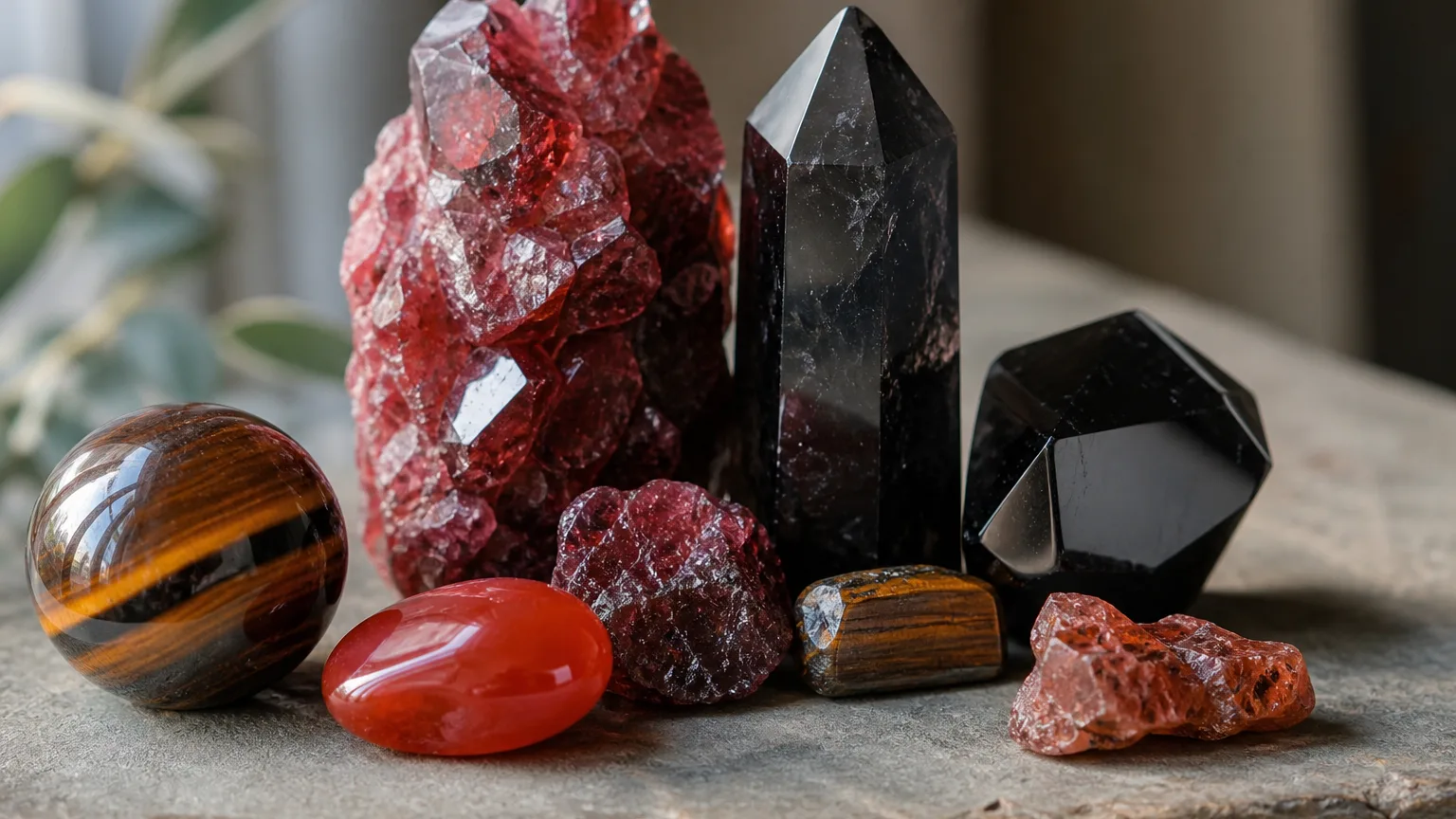
The best crystals for the Root Chakra include Tiger Eye, Carnelian, Obsidian, traditionally used in mindfulness and spiritual practices. Crystal properties are complementary wellness tools, not medical treatments.
Understanding the Root Chakra
The Root Chakra, or Muladhara in Sanskrit, sits at the very base of the spine and is the foundation of the body’s subtle energy system. From a structural standpoint, it governs the legs, feet, and the base of the torso—the parts of us that meet the ground and carry our weight. When teachers describe this center as the root of a tree, they mean that everything higher up draws stability from it: a sense of safety, the feeling of having enough, the ability to be present without bracing for the next blow.
Across cultures, red and black stones have been carried as symbols of protection and belonging. Roman soldiers etched signs into Tiger Eye and Bloodstone before battle; Tibetan and African traditions set Obsidian and Black Tourmaline at thresholds to mark a protected boundary. These practices share a simple logic: the Root Chakra concerns survival and security, and dense, earthy minerals have long served as physical reminders of that ground.
In practical terms, the Root Chakra shows up as a question about footing rather than feeling: do I have solid ground beneath me right now, or am I bracing through the day? When that footing feels secure, the body lets go — sleep deepens, decisions stop being replayed, and small setbacks no longer register as threat. When it slips, the symptoms tend to be physical and specific: shallow breath, a clenched jaw, money worries that surface at 3 a.m., or the diffuse sense of watching your own life from a slight distance. Dense, earth-toned stones are one accessible way to redirect attention back into the feet, the base of the spine, and the present moment — not because the mineral itself changes anything, but because the act of holding something heavy and noticing the breath is a deliberate interrupt to the loop of floating.
Quick facts: Sanskrit Muladhara · Position: Base of the spine · Color: Red · Element: Earth. Balanced: Security, stability, presence, confidence. Out of balance: Anxiety, fear, feeling ungrounded, financial worry, disconnection.
Not sure which chakra to focus on? Take the free Chakra Test ↗
12 Best Crystals for the Root Chakra
Tiger Eye
Chakra: Solar Plexus, Root, Sacral
Color: Golden brown (also blue/red)
Element: Fire
Best for: Confidence, Willpower, Grounding
Best way to use: Carry or hold in meditation
Zodiac: Leo, Capricorn
Affirmation: I stand steady in my own strength.
A variety of quartz (SiO₂) crossed with fibrous crocidolite, Tiger Eye earns its shimmer from a chatoyant effect—parallel fibers reflect light into a single moving band. For the Root Chakra, that golden-brown body reads as warmth held close to the earth rather than heat rising away from it. Traditionally carried as a stone of courage and clear judgment, it is often used by people who feel pulled between action and hesitation. Holding one in meditation invites a simple shift: noticing the weight of the stone, the steadiness of the breath, and the choice to stay rather than scatter. The Roman link to soldiers gave it a long association with bravery; today it tends to show up for anyone wanting a firmer foothold before a difficult conversation or decision.
Carnelian
Chakra: Sacral, Solar Plexus, Root
Color: Orange, red-orange, reddish-brown
Element: Fire
Best for: Confidence, Starting projects, Creative work
Best way to use: Wear as jewelry
Zodiac: Aries, Taurus, Virgo
Affirmation: I have the courage to begin.
Carnelian is a chalcedony (microcrystalline SiO₂) whose red-orange tones come from iron impurities within a translucent, waxy body. Though often called a fire stone, its lower-frequency warmth is what places it at the Root Chakra: a slow, embodied heat rather than scattered enthusiasm. Across ancient Egypt, Greece, and Rome it was worn for courage and used in signet rings, signaling confidence one could stand behind. Many people reach for it when procrastination or self-doubt stall a project—kept on the desk or worn at the wrist, it acts as a tactile prompt to take the next small step. The stone rewards contact; rolling a smooth bead between the fingers is itself a grounding gesture.
Obsidian
Chakra: Root, Third Eye
Color: Black (also snowflake, rainbow, mahogany)
Element: Earth, Fire
Best for: Shadow work, Protection, Grounding
Best way to use: Wear as jewelry
Zodiac: Scorpio, Sagittarius
Affirmation: I am safe to face what arises.
Obsidian is not a true mineral but a natural volcanic glass—silica-rich lava cooled too quickly for crystals to grow. That origin gives it a deep, mirror-dark surface and a vitreous, conchoidal fracture that prehistoric peoples worked into blades and mirrors. For the Root Chakra, its density is the point: a stone that feels unambiguously present in the hand, often used as a protective boundary at the edge of one’s space or attention. Mesoamerican cultures polished it into scrying mirrors, and it has a long-standing association with honest self-inquiry. Many people hold it during reflection, letting what feels chaotic settle before responding—simple, deliberate presence rather than avoidance.
Black Tourmaline
Chakra: Root
Color: Black
Element: Earth
Best for: Protection, Grounding, Boundaries
Best way to use: Wear as jewelry
Zodiac: Capricorn, Scorpio
Affirmation: I am grounded and shielded.
Black Tourmaline, or schorl, is a complex sodium-iron borosilicate that forms long striated columns, often lightly charged with static when rubbed—a small physical reminder of why it has a reputation for absorbing and redirecting. Its jet-black body sits squarely at the Root Chakra, and it is one of the most commonly chosen stones for boundaries, both energetic and practical. Traditionally placed at entryways or worn at the body’s center line, it is often used by people who feel over-extended by environments or crowds. Beyond symbolism, simply holding a piece and setting an intention to filter what comes in can reframe the day as a series of chosen, rather than endured, moments.
Read full Black Tourmaline meaning →
Ruby
Chakra: Root, Heart
Color: Deep red (“pigeon blood” is the classic)
Element: Fire
Best for: Bravery, Vitality, Leadership
Best way to use: Wear as jewelry
Zodiac: Cancer, Leo
Affirmation: I meet life with a steady, warm heart.
Ruby is the red variety of corundum (Al₂O₃), colored by trace chromium, and its hardness—second only to diamond—gives it a durability that has carried symbolic weight for millennia. For the Root Chakra, the deep red speaks to life force held in reserve rather than spent; it has been associated across South Asian and European traditions with courage, leadership, and the will to protect what matters. Worn at the body’s center or held during a difficult task, ruby is often used as a focal point for commitment—the felt sense that one’s energy is being poured into something chosen. A mindful pause before action, stone in hand, can turn reactive pressure into deliberate effort.
Red Jasper
Chakra: Root, Sacral
Color: Brick red, terracotta, brown-red
Element: Earth
Best for: Stamina, Focus, Stress relief
Best way to use: Wear as jewelry
Zodiac: Aries, Scorpio, Leo, Virgo
Affirmation: I have the endurance to see this through.
Red Jasper is an opaque, microcrystalline quartz (SiO₂) tinted by iron, with a matte, earthen texture that literally feels like fired clay. Its connection to the Root Chakra is direct: this is a stone of stamina and steady pace, not sudden spikes. Across many folk traditions it was carried for endurance in long labor, travel, or recovery. People often turn to it when energy runs in fits and starts and a steadier rhythm is needed—placed in a pocket or held during slow breathing, it serves as a grounding cue to return to one task at a time. Its unshowy surface suits the work it represents: quiet, consistent, repeatable.
Read full Red Jasper meaning →
Bloodstone
Chakra: Root, Sacral, Heart
Color: Dark green with red spots
Element: Earth, Fire
Best for: Courage, Vitality, Grounding
Best way to use: Wear as jewelry
Zodiac: Aries, Pisces
Affirmation: I act with courage when it matters.
Bloodstone, or heliotrope, is a dark green chalcedony (SiO₂) speckled with red iron-oxide inclusions—the visual source of its long association with courage and vitality. The green-black base grounds it firmly at the Root Chakra, while the red flecks read as life force distributed through a stable body. Roman and medieval traditions carried it as a talisman for bravery in confrontation, and it remains a common choice for people facing demanding situations who want to stay composed. Held during a deliberate pause before speaking or acting, it can support the small internal shift from reaction to chosen response.
Read full Bloodstone meaning →
Hematite
Chakra: Root, Earth Star
Color: Steel gray / black, metallic
Element: Earth
Best for: Grounding, Protection, Focus
Best way to use: Wear as jewelry
Zodiac: Aries, Aquarius
Affirmation: I am calm, focused, and firmly placed.
Hematite is an iron oxide (Fe₂O₃) with a metallic sheen and notable heft—noticeably heavier than comparably sized stones, which is exactly why it reads as the most physically grounding piece in a Root Chakra kit. Ancient cultures used its red streak as pigment, and across traditions it has been associated with drawing scattered attention back to the body. Many people wear it when overthinking runs ahead of action: the weight on the wrist or in the pocket becomes a constant, low-key reminder to return to the present task. Its cool surface also suits a simple grounding exercise—holding it and noticing temperature, weight, and breath in turn.
aegirine
Chakra: Root, Sacral, Solar Plexus
Color: Dark green to black
Element: Earth, Fire
Best for: Protection, Boundaries, Breakthrough
Best way to use: Carry or hold in meditation
Zodiac: Aries, Scorpio, Capricorn
Affirmation: I hold my ground and move at my own pace.
Aegirine is a sodium-iron pyroxene that forms slender, dark prismatic crystals—visually sharp and structurally upright, which suits its reputation as a stone of firm boundaries and breakthrough. At the Root Chakra it works against the urge to collapse or accommodate past the point of comfort. Less commercially common than the others on this list, it is often chosen by people doing focused inner work around self-worth and protection. Held during meditation, its dark, vertical form can support a simple intention: to stay present to difficulty without dissolving into it. The stone rewards slow, deliberate attention rather than quick fixes.
agate
Chakra: Root, Sacral
Color: Banded browns, greys, blues, oranges, whites
Element: Earth
Best for: Grounding, Balance, Daily wear
Best way to use: Wear as jewelry
Zodiac: Gemini, Taurus
Affirmation: I move through my day steady and balanced.
Agate is a banded chalcedony (SiO₂) laid down in concentric layers, and those layered bands are the key to its Root Chakra role: a visible record of slow, rhythmic accumulation—the opposite of urgency. Earthy brown and grey varieties sit most naturally at this center, long carried as stabilizing stones in European and Middle Eastern traditions. Because it is durable, affordable, and tactile, agate is one of the easiest stones to keep in daily contact—worn, pocketed, or placed on a desk as a low-pressure grounding companion. Its gentle presence suits people who want consistency without intensity, a quiet reminder to return to the body many times a day.
agatized-coral
Chakra: Root, Sacral, Heart
Color: Grey, brown, pink, red, yellow (natural/dyed)
Element: Earth, Water
Best for: Patience, Longevity, Grounding
Best way to use: Wear as jewelry
Zodiac: Taurus, Cancer
Affirmation: I trust the slow timing of my life.
Agatized coral began as a living coral colony, then over geological time was replaced molecule by molecule with silica (SiO₂), preserving the original pattern in stone. That process alone gives it a Root Chakra character: a tangible lesson in patience and longevity. The muted natural greys, browns, and soft pinks connect it to slow growth and steady belonging. It is often chosen by people working with long arcs—recovery, rebuilding, or projects measured in years rather than weeks. Held during reflection, it can support a calmer relationship with time, gently reminding the holder that grounded things are built slowly and in season.
Read full agatized-coral meaning →
alabandite
Chakra: Root
Color: Black, dark brown, greenish-black, dark grey
Element: Earth
Best for: Grounding, Steady Strength, Vitality
Best way to use: Place in your space
Zodiac: Capricorn
Affirmation: I draw strength from solid ground.
Alabandite is a manganese sulfide (MnS) with a dense, dark body and a metallic-to-submetallic look—a rarer collector stone than the others here, included for the particular steadiness it represents. At the Root Chakra it is associated with grounded vitality: strength that holds rather than flares. Traditionally placed in a fixed spot rather than worn, it functions as an anchor in a space—one steady point to return to. Because it is softer and less common, it suits mindful placement on a desk or bedside, where its quiet, weighty presence can mark a small daily ritual of pausing, breathing, and re-centering before continuing.
Read full alabandite meaning →
How to Choose by Your Root Chakra Need
Different Root Chakra needs call for different stones. Use this table to match what you are feeling with the crystals that traditionally support it.
| Need | Best Crystals | Why |
|---|---|---|
| Grounding & presence | Hematite, Black Tourmaline, Obsidian, Agate, Alabandite | Dense, heavy, earthy stones that draw attention back into the body and the present moment. |
| Protection & boundaries | Black Tourmaline, Obsidian, Aegirine, Hematite | Dark stones traditionally used to mark edges—thresholds, entryways, the line between self and others. |
| Confidence & courage | Tiger Eye, Carnelian, Ruby, Bloodstone | Warm-toned stones long associated with bravery, clear judgment, and the courage to act. |
| Stamina & steady energy | Red Jasper, Bloodstone, Ruby, Alabandite | Earthen reds and dense blacks linked to endurance, pacing, and consistent effort. |
| Patience & long rebuilding | Agatized Coral, Agate, Red Jasper | Layered, slowly formed stones that mirror steady accumulation rather than quick results. |
How to Use Root Chakra Crystals
The Root Chakra sits at the base of the spine, so the way you work with these stones is physical and embodied. Three approaches work well, and you can combine them.
Wear it at the lower body. A bracelet, anklet, or stone carried in a pocket keeps contact near the body’s base, where it can act as a low, steady reminder throughout the day. Hematite, Tiger Eye, and Carnelian suit daily wear; Black Tourmaline is often chosen for harder environments.
Hold it in meditation, placed low. Sit with your feet flat on the floor and hold a stone in both hands, or place it on the floor between your feet. Five to ten minutes of slow breathing, attention on the weight and temperature of the stone, is enough. Obsidian, Aegirine, and Red Jasper are common choices for seated practice.
Place it in your space. A heavier piece—Obsidian, Black Tourmaline, or Alabandite—near the front door, at the foot of the bed, or on the desk marks a protected, grounded point you return to. Placement matters more than perfection here; choose a spot you actually pass and notice.
Where to place on the body: the Root Chakra is located at the base of the spine, between the genitals and the anus, opening downward toward the earth. In a lying-down practice you can rest a small stone on the tailbone area or just below it. If that feels awkward, holding the stone against the soles of the feet works just as well—both points connect directly to the ground.
Not sure which chakra to focus on? Take the free Chakra Test ↗
Beyond Crystals: Other Ways to Balance the Root Chakra
Crystals are one support, not the only one. The Root Chakra responds especially well to physical, body-based practices—anything that brings awareness down into the feet, legs, and the sensation of contact with the ground. The following are simple additions you can fit into an ordinary day.
Barefoot walking. A few minutes on grass, soil, sand, or even an uncarpeted floor brings immediate attention to the soles of the feet and the base of the body. If going barefoot outdoors is not practical, standing and slowly pressing each part of the foot into the floor works indoors.
Mountain pose (Tadasana). Stand with feet hip-width apart, weight evenly distributed, spine long, and arms at your sides. Hold for one to three minutes of slow breathing. It is the most direct posture for the Root Chakra—steady, vertical, and firmly placed—and needs no equipment.
Root vegetables. Carrots, beets, sweet potatoes, onions, and garlic are foods that literally grow in the ground. A simple, grounding meal centered on these is a gentle daily ritual; the connection is symbolic, but the act of cooking and eating slowly supports presence.
Drumming. A steady, low drumbeat has been used across cultures to shift attention into the body. You do not need an instrument—a hand on the chest or thigh, tapped at a slow, even tempo for two minutes, has a similar effect of drawing awareness downward.
Slow breathing. Lengthen the exhale. A simple pattern—inhale for four counts, exhale for six—practiced for two to five minutes signals safety to the nervous system and is one of the most accessible ways to settle a scattered root.
FAQ
Where should I place Root Chakra crystals on my body?
The Root Chakra is at the base of the spine, so the most direct placement is the tailbone area when lying down. Many people find it just as effective to place a small stone at the soles of the feet, hold one between cupped hands low in the lap, or carry one in a pocket near the lower body.
How do I cleanse Root Chakra crystals?
Most root stones—Black Tourmaline, Hematite, Obsidian, Red Jasper—are durable and can be rinsed under running water and dried, or placed on or near the earth for a few hours. Avoid water with softer or porous stones, and avoid long sun exposure for any deeply colored stone that may fade. Smoke from sage or palo santo is a gentle option for all of them.
How often should I work with Root Chakra crystals?
There is no fixed rule. Daily contact—even a few minutes—tends to feel more supportive than occasional long sessions. Many people keep one stone in regular wear or on a desk and rotate others as needs shift.
Which Root Chakra crystal is best for beginners?
Hematite, Black Tourmaline, and Red Jasper are common starting points because they are affordable, durable, and have a clear, steadying feel. Tiger Eye is also popular for beginners who want a warmer, confidence-focused stone.
Can I combine Root Chakra crystals?
Yes. A grounding base like Black Tourmaline or Hematite pairs well with a warmer stone like Tiger Eye or Carnelian when you want both steadiness and forward movement. Two or three stones are usually plenty; more is not better.
Are the benefits of Root Chakra crystals scientifically proven?
The traditional meanings and effects of crystals are not scientifically proven. What is well documented is that mindful, tactile practices—holding an object, slowing the breath, returning attention to the body—can help people feel calmer and more present. Crystals are best understood as supports for that kind of attention, not as medical treatments.
What does it feel like when the Root Chakra is balanced?
People often describe it as a sense of steadiness, presence, and enough-ness—decisions come more easily, the body feels relaxed, and the day feels manageable. Signs of imbalance commonly include restlessness, low-grade fear, financial worry, and a sense of disconnection from the body.
Do Root Chakra crystals have to be red or black?
Red and black stones are the traditional colors for this chakra, but a stone’s weight, texture, and the felt sense of grounding matter as much as its color. Smoky and earthy browns work just as well, which is why Tiger Eye and Agate appear in many root collections despite their lighter tones.
Shop Root Chakra Chakra Crystals: What to Look For
- Shop Tiger Eye
- Shop Carnelian
- Shop Obsidian
- Shop Black Tourmaline
- Shop Ruby
- Shop Red Jasper
- Shop Bloodstone
- Shop Hematite
- Shop Aegirine
- Shop Agate
- Shop Agatized Coral
- Shop Alabandite