
Rose Quartz Meaning: Healing Properties & Uses
Rose Quartz is the pink variety of quartz — a soft, rosy stone long tied to unconditional love, compassion, and gentle emotional care. If you’re drawn to it for love, self-care, or a softer heart, this guide covers what rose quartz is (and why some pieces show a star), what it has meant across cultures, and how people work with it. Crystal meanings reflect tradition and personal practice, not medical advice.
What Is Rose Quartz Meaning?
At its simplest, rose quartz means unconditional love — not just romantic love, but the broader kind: compassion for yourself, warmth toward others, and a softer, more open heart. Where some stones read as energizing or grounding, rose quartz sits on the gentle side: linked to tenderness, emotional softening, and a sense of being kind to yourself.
For many people that’s exactly the appeal — a smooth, pink piece you keep on a nightstand, desk, or beside the bed as a cue to soften. You don’t need to believe anything about energy to use it that way; the value often comes from choosing the piece, giving it a job (“be gentler today”), and letting its soft color pull you toward kindness. In that sense rose quartz is a gentle cue to compassion.
Rose Quartz Meaning and Symbolism

The name is plain — rose quartz describes the soft pink quartz itself. Unlike most colored quartz, rose quartz rarely forms visible crystal points; it usually occurs in massive, translucent blocks with a gentle, cloudy look caused by microscopic inclusions. The pink comes from trace amounts of titanium and manganese, often combined with natural irradiation.
Rose quartz has been carved into beads, amulets, and ornaments for thousands of years — Assyrians, Romans, and many later cultures all worked it. Its tie to love, beauty, and emotional warmth is one of the oldest and most consistent associations in the whole crystal world, and it shows up across very different traditions rather than belonging to one culture. That consistency is part of why rose quartz is still the first stone people reach for when they think of a “love stone.”
The thread through all of it is the same: unconditional love, compassion, and emotional softening. Today rose quartz is usually described as the stone of the heart — reached for to soften anger, to support self-love, or to invite more warmth into relationships. How much of that lands for you personally is, honestly, up to you — but few stones have kept such a clear, consistent meaning for so long. To explore more stones, browse the full Crystal Guide.
Rose Quartz Properties

The Science
Rose quartz is quartz — silicon dioxide, SiO₂ — with a Mohs hardness of 7, durable enough for everyday jewelry. Its soft pink color comes from trace titanium and manganese, often combined with natural irradiation. Unlike most colored quartz, it rarely forms visible crystals; it usually occurs in massive, translucent blocks with a gentle cloudy look caused by microscopic fibrous inclusions. Some rose quartz shows asterism — a six-rayed star — when cut into a cabochon, caused by aligned rutile needles inside the stone. A few specimens fade in strong sunlight. Major sources include Brazil, Madagascar, South Africa, India, and the United States.
Traditional Meaning
Tradition ties rose quartz to unconditional love, compassion, and emotional softening. It’s most strongly linked to the heart center and is often called the classic “love stone” — softening anger, supporting self-love, and inviting warmth into relationships. Across modern crystal practice it’s reached for during grief, heartbreak, or any time someone wants to be gentler with themselves and others. The love-and-compassion meaning is one of the most consistent in crystal tradition. These associations come from spiritual tradition and personal practice rather than clinical study.
Mindfulness & Psychology
From a psychological angle, rose quartz works as a soft, soothing visual cue — the kind of object you place where you want to invite gentleness. Pink is linked in color psychology to calm, warmth, and reduced tension, and the act of keeping a rose quartz piece nearby and pairing it with an intention (“be kind to yourself”) turns it into a small, repeatable cue for self-compassion. Part of its appeal is simply its soft, warm presence — a visual signal to soften. These effects come from tradition and personal practice, not clinical research. Crystals complement — but never replace — professional care.
Rose Quartz Benefits
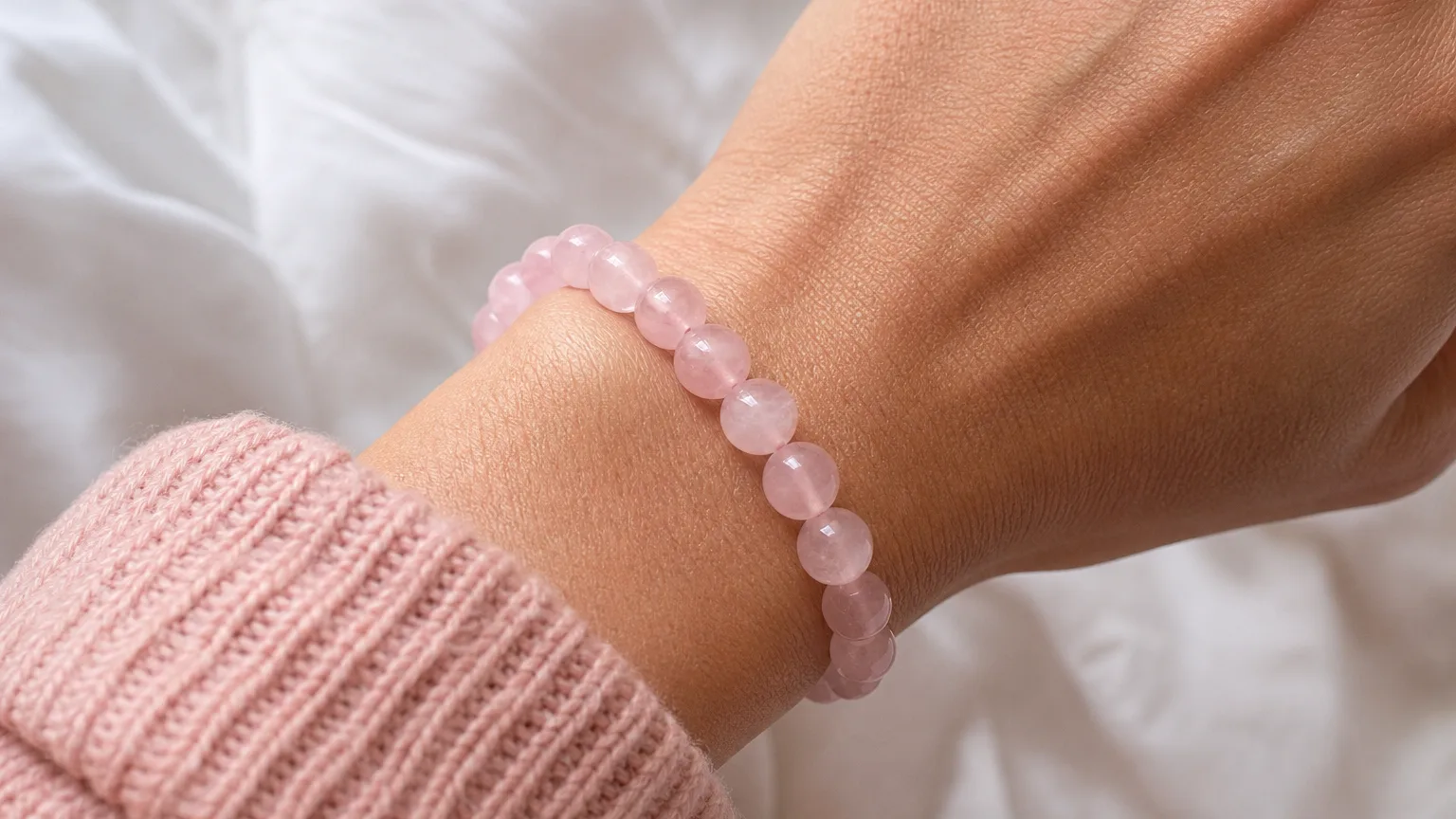
People who work with rose quartz usually describe it in terms of softness and warmth, not dramatic shifts. It tends to show up as a gentler, more open feeling — useful when you’re hard on yourself, holding a grudge, or just want more warmth in your day. A few of the benefits people mention most:
A softer heart
Holding or wearing rose quartz when you feel guarded gives you a gentle cue to soften — a small reminder that warmth is an option, not a weakness.
A kinder relationship with yourself
Many keep a piece where they’ll see it during a hard day — a low-effort cue to speak to yourself the way you’d speak to a friend.
A gentler mood under stress
Its soft pink tone gives your eyes somewhere calm to land when tension builds — a small visual cue to slow down before reacting.
A warmer presence in a room
A piece on a nightstand or shelf is often described as making a space feel gentler — a quiet, soft presence rather than a sharp one.
The pattern underneath all of these is the same: rose quartz isn’t softening your heart by magic, but it gives your day a gentle cue toward compassion and warmth. If you’re exploring stones for specific needs, see our guide to crystals for anxiety.
Rose Quartz Chakra, Zodiac, and Element Associations
In traditional systems, rose quartz is most strongly linked to the heart center — the area tied to love, compassion, and emotional balance. Astrologically, it’s often paired with Taurus and Libra, and sometimes Scorpio. Its element is usually given as Earth, with some traditions adding Water for its emotional quality. For related stones, see heart chakra crystals.
These are correspondences built up through tradition, not fixed rules. If your own sense of rose quartz points somewhere else — a different chakra, a different element — that’s completely fine. Many people work with stones intuitively, following what feels right rather than a textbook chart, and there’s a long history of practitioners doing exactly that.
How to Use Rose Quartz

Rose quartz is durable (Mohs 7) and easy to live with — there’s no single right way, only what fits your routine. The key is consistency: a stone you actually see and touch every day does far more than one stored away.
Wear it. A rose quartz bracelet or pendant keeps the stone against your skin through the day. For a self-compassion practice, pair it with one intention each morning — “be gentle with myself today.”
Meditate with it. Hold a tumbled piece in your palm or rest it on your chest (heart area) while you sit. Even a few minutes of focused attention counts; the goal is presence, not duration.
Place it at home. A piece on the nightstand or a shared shelf works as both décor and a soft visual cue — somewhere you tend to be hard on yourself.
Build a self-kindness ritual. Hold the stone, name one thing you’re being harsh about, and let the act mark a shift toward gentler self-talk. Repetition is what makes it stick.
Which Rose Quartz Form Is Right for You?

| Form | Best for | Choose it if |
|---|---|---|
| Bracelet | Daily wearing | You want a soft, visible reminder of self-compassion at your wrist |
| Pendant | Worn near the chest | You prefer a single stone near the heart center |
| Tumbled stone | Pocket or meditation | You want something smooth and easy to hold or carry |
| Palm stone | Hand-holding under stress | You want a larger, smooth piece to grip when emotions build |
| Raw chunk | Desk or nightstand display | You like the natural, massive form for a soft presence in a room |
| Sphere | Altar or shelf display | You want a polished, rounded piece that reads gently from any angle |
How to Tell Real Rose Quartz from Fakes
Rose quartz is popular, so dyed and imitation stones show up. The main fakes are glass and dyed quartz sold to look more vividly pink than natural material. A few checks help:
- Color. Natural rose quartz is a soft, slightly cloudy pink — never a bright, saturated, or neon rose. If the color looks too vivid or too uniform, it may be dyed quartz, glass, or resin.
- Clarity and inclusions. Real rose quartz is usually translucent with a cloudy, slightly fibrous look from microscopic inclusions. Perfectly clear, flawless “rose quartz” is more likely glass.
- Hardness. At Mohs 7, real rose quartz scratches glass and resists a steel knife. Glass won’t scratch glass.
- Temperature. Crystal stays cool longer than glass when warmed in your hand.
- Dye test. If color sits mainly in cracks or looks uneven in suspicious ways, it may be dyed. A reputable seller will tell you.
- A note on “star rose quartz.” Some natural rose quartz shows a six-rayed star (asterism) under a light, caused by rutile needles. It’s a genuine, desirable feature — not a flaw — and usually costs more.
How to Cleanse and Charge Rose Quartz
Rose quartz is a hard, stable quartz (Mohs 7), but a few specimens fade in strong light, so the care rules lean gentle on sunlight.
- Water. A brief rinse under cool water is fine, and many use running water as part of a cleansing routine. Avoid long soaks in salt water if the piece has metal settings.
- Sunlight — avoid prolonged. Some rose quartz fades with long exposure to bright sun. Indirect light or moonlight is the safer long-term choice.
- Moonlight. A night under the moon — especially a full moon — is the most-recommended method for rose quartz, gentle and on-theme.
- Smoke or sound. Passing it through sage or palo santo smoke, or using a singing bowl nearby, is a no-contact option many prefer.
Two things to keep in mind: store rose quartz so it’s not in direct sun for long hours (to protect the color), and if your piece is set in jewelry, treat the metal as the more sensitive part. For the full routine, see our guide to cleansing crystals — and treat rose quartz as the soft, sun-shy one in that guide.
Best Crystals to Pair With Rose Quartz
Pairing is about layering intentions — picking stones whose qualities complement rather than compete. A few classic combinations that work well with rose quartz’s gentle, loving energy:
- Rose Quartz + Amethyst — love meets calm; a gentle pairing many reach for at night to soften the day.
- Rose Quartz + Clear Quartz — clear quartz is said to amplify; many use it to lift rose quartz’s loving intention.
- Rose Quartz + Moonstone — two soft, gentle stones; a tender pairing for emotional self-care.
- Rose Quartz + Smoky Quartz — warmth meets grounding; a combo for releasing heavy emotion while staying soft.
The logic of pairing is about complementary intentions, not strict rules. Pick combinations that match what you’re actually working on, and trust your own sense of what feels balanced.
Who Should Use Rose Quartz?
Rose quartz suits people who want a gentle stone for self-compassion, love, and emotional softening — anyone hard on themselves, working through grief or heartbreak, or simply wanting more warmth in their day. It’s one of the most approachable stones because it asks little: place it, wear it, and let it mark a kinder, softer corner of your day.
A few honest expectations: rose quartz isn’t a treatment for depression, grief, or any condition — if you’re dealing with something persistent, a healthcare professional is the right call, and the stone can be a comfort alongside that. Its value comes from the intention and routine you build around it. If you go in expecting a stone to fix a relationship or heal a heartbreak for you, you’ll be disappointed; if you go in expecting a gentle cue toward compassion, it tends to fit well.
FAQ About Rose Quartz Meaning
What is rose quartz good for?
Traditionally, unconditional love, compassion, and emotional softening. People reach for it to be gentler with themselves, to soften anger, or to invite more warmth into relationships.
Does rose quartz fade in sunlight?
Some specimens do fade with long exposure to bright sun. Keep rose quartz out of direct sun for long periods and prefer indirect light or moonlight.
Why does some rose quartz show a star?
Asterism — a six-rayed star seen under a light — is caused by aligned rutile needles inside the stone. It’s a genuine, desirable feature, usually found in cabochon-cut pieces.
What chakra is rose quartz linked to?
Mostly the heart center (love, compassion, emotional balance).
Can rose quartz go in water?
Yes. At Mohs 7 it’s a hard, water-safe stone. A brief rinse is fine; avoid long salt-water soaks with metal settings.
How can I tell real rose quartz?
Look for a soft, slightly cloudy pink (not vivid or neon), check for microscopic inclusions, and test hardness — real rose quartz scratches glass. Too-bright, flawless pink suggests glass or dye.
Is rose quartz only for romantic love?
No. Its traditional meaning is unconditional love in the broad sense — self-compassion, warmth toward others, and a softer heart — not only romance.
Final Thoughts on Rose Quartz
Rose quartz earns its long reputation as the stone of unconditional love — the soft, pink piece people reach for when they want a gentler heart and a kinder relationship with themselves. If you’re curious, the simplest start is one piece you’ll actually see every day, paired with a small moment to notice it. Let the routine do the work, and let the stone be the gentle anchor that reminds you to be kind.
From there, rose quartz tends to open a softer space — a kinder inner voice, a warmer room, or simply a habit of pausing before you’re harsh with yourself. For more, explore the Crystal Guide or browse rose quartz pieces.