
Tiger Eye Meaning: Healing Properties & Uses
Tiger’s eye is a golden-brown quartz famous for a silky band of light that glides across its surface as you turn it — an effect called chatoyancy. Long tied to courage, confidence, and protection, it’s a durable, everyday stone. If you’re drawn to its warm gold for motivation or a steadier nerve, this guide covers what tiger’s eye is, where that moving eye comes from, its asbestos safety, and how to tell the real stone from fakes. Crystal meanings reflect tradition and personal practice, not medical advice.
What Is Tiger Eye Meaning?
At its simplest, tiger’s eye means courage and confidence. With its warm gold and moving band of light, it reads as bold and steady — a stone people reach for motivation, willpower, or a sense of being protected and grounded. It’s often carried as a reminder to act with nerve rather than hesitation.
For a lot of people that’s the whole appeal: one warm piece, one intention, one small daily ritual. You don’t need to believe anything mystical to benefit — the value often comes from the act of choosing the stone and letting its gold tone pull your attention back to a steadier, more confident baseline. In that sense tiger’s eye is a visual cue you train yourself to return to.
Tiger Eye Meaning and Symbolism
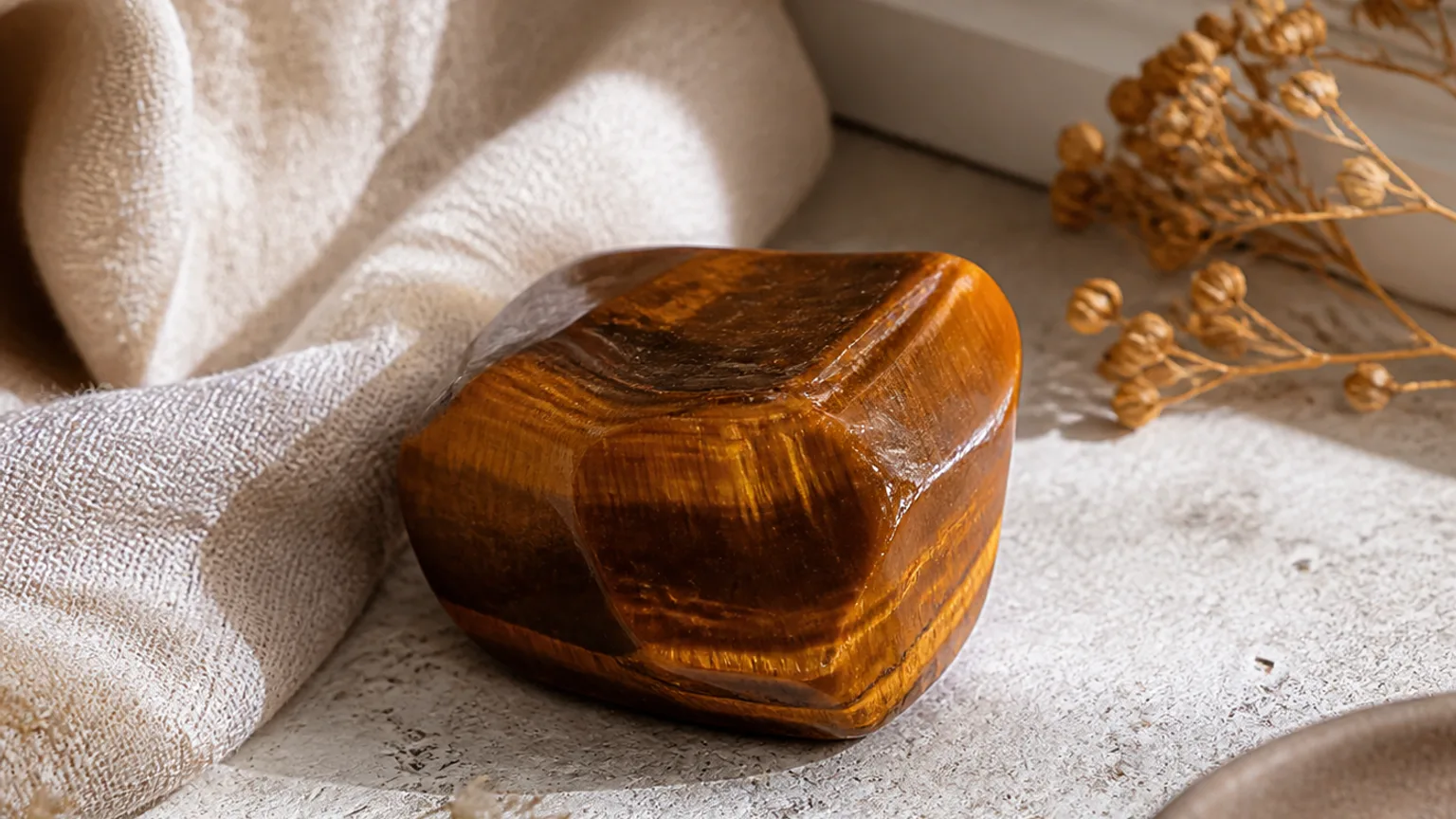
Tiger’s eye is quartz with a backstory. It began as a blue asbestos mineral called crocidolite; over time, silica-rich groundwater seeped through and replaced the original fibers with quartz, while keeping their parallel, fibrous structure. That preserved fiber layout is the secret of its look — when light hits those aligned fibers, it reflects into a single silky band that moves as you turn the stone. The golden-brown color comes from iron oxide picked up along the way.
The stone’s popularity is fairly modern. Large deposits were found in South Africa in the 1800s, and from there tiger’s eye spread into jewelry and carving across Europe and beyond — carved into cameos, beads, and polished cabochons that show off the moving eye. The name comes from its resemblance to a tiger’s eye, warm and watchful.
Today the common threads are consistent: courage, confidence, protection, and willpower. You’ll see tiger’s eye described as a stone for motivation, a protective charm, and a cue to act with nerve and steady focus. How much of that you experience personally is up to you, but the symbolism has built steadily since the stone became widely known. To explore more stones, browse the full Crystal Guide.
Tiger Eye Properties
The Science
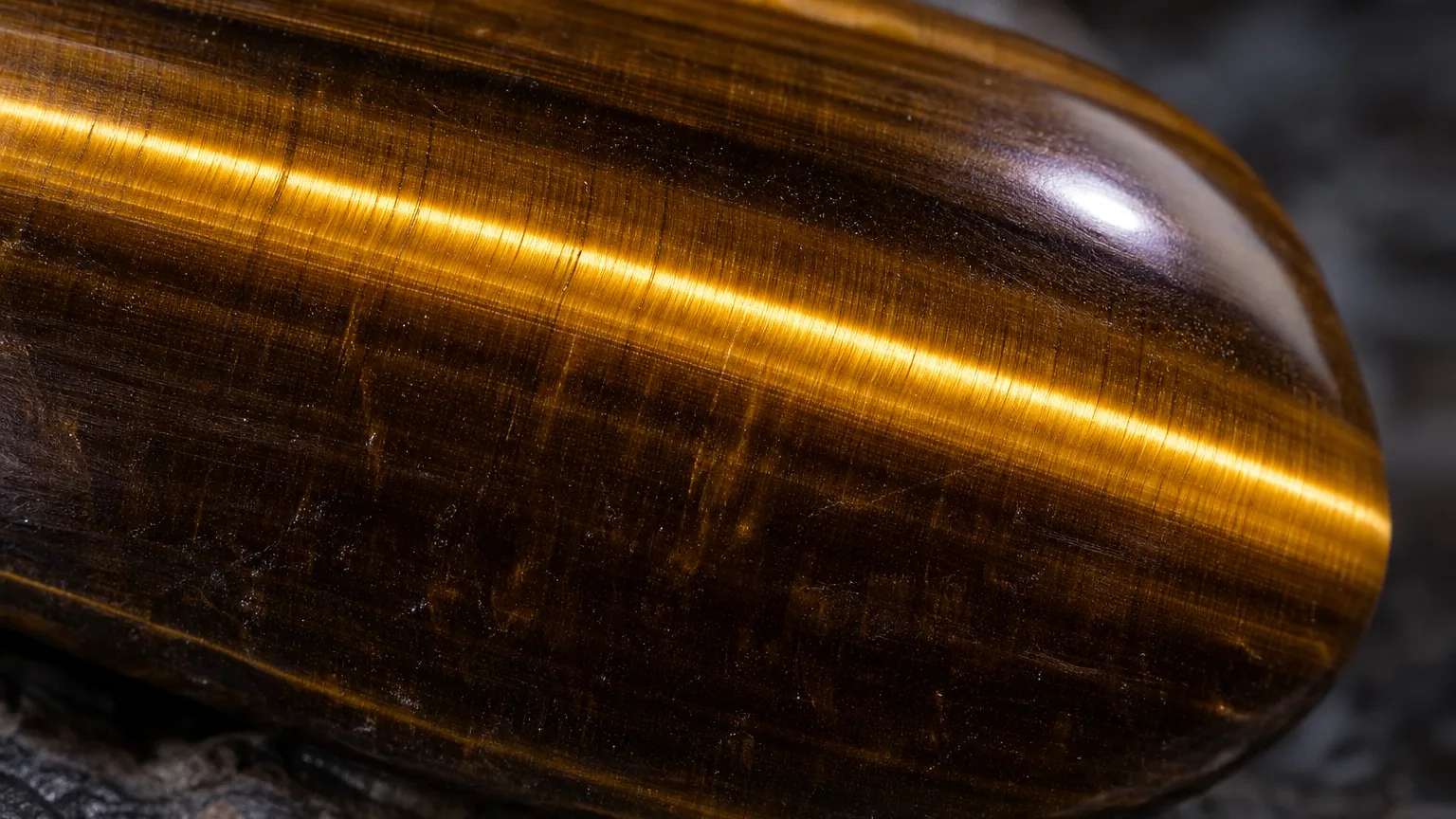
Tiger’s eye is quartz (SiO₂) that has replaced the fibers of crocidolite, a blue asbestos mineral, while keeping their parallel structure. Those preserved, aligned fibers reflect light into a single moving band — the cat’s-eye effect called chatoyancy. It’s a hard stone at 6.5–7 on the Mohs scale, so it wears well, and it’s opaque with a silky to vitreous luster. The classic golden-brown color comes from iron oxide. A related form, hawk’s eye, is the less-oxidized blue-gray version; red tiger’s eye is usually golden material gently heated to deepen its tone. None of this is mystical — it’s mineralogy, and the moving band is a real optical effect of aligned fibers.
Traditional Meaning
Tradition ties tiger’s eye to courage, confidence, and protection. It’s linked to the solar plexus and root centers and is often described as a stone of willpower and steady nerve — many believe it grounds scattered energy, supports motivation, and shields against negativity. Across modern practice it’s carried as a protective charm and reached for when courage and follow-through are needed. These associations come from spiritual tradition and personal practice rather than clinical study.
Mindfulness & Psychology
From a psychological angle, tiger’s eye works as a warm, grounding focal cue — something bold and steady to hold when you want nerve and focus. In color psychology, warm gold and brown tones read as grounded and confident, and the act of carrying a piece and pairing it with an intention (act with nerve today) turns it into a small cue you keep returning to. The moving band of light is also a satisfying thing to watch — a tiny, grounding pause. These effects come from tradition and personal practice, not clinical research. Crystals complement — but never replace — professional care.
Tiger Eye Benefits
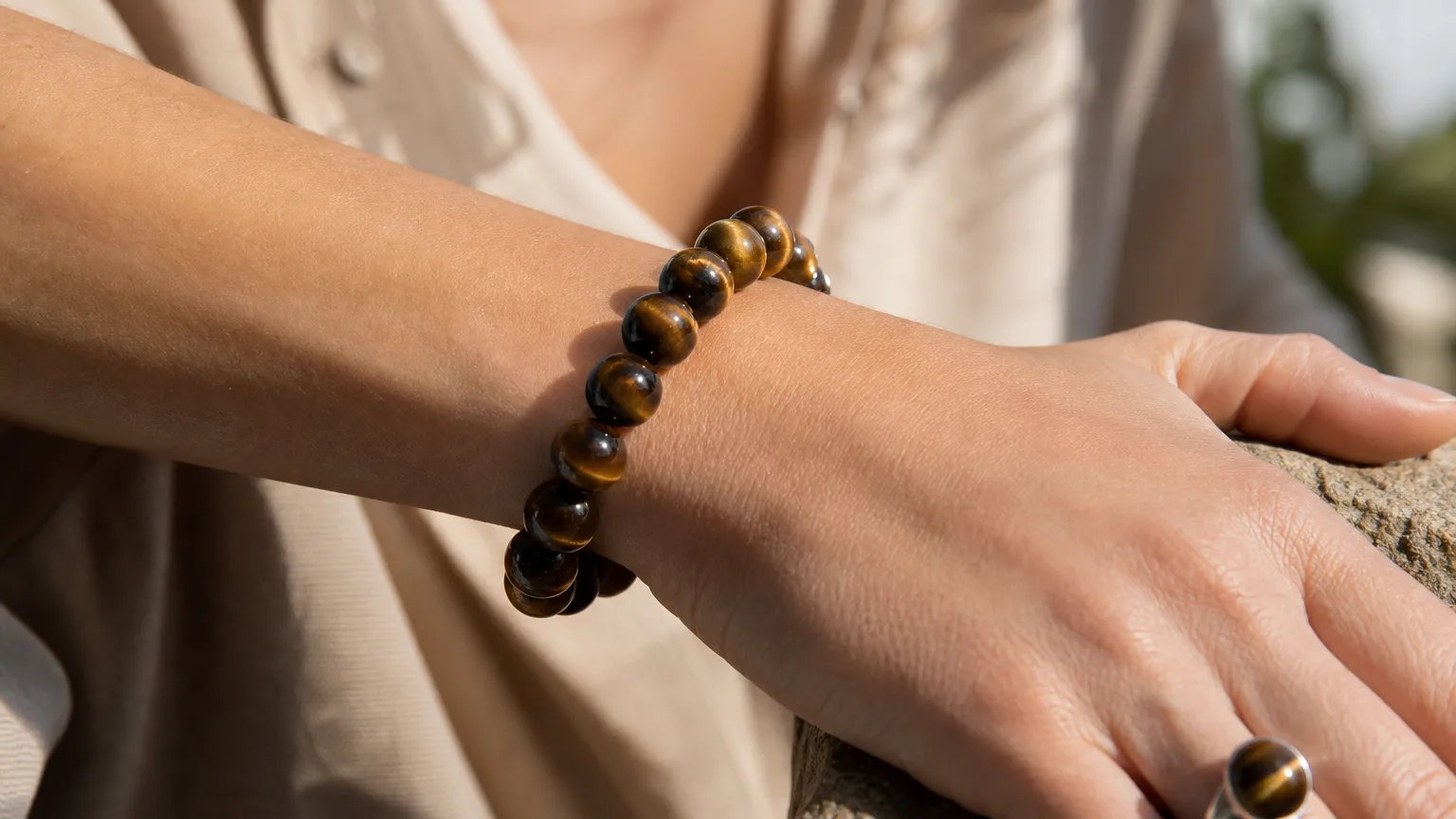
People who work with tiger’s eye usually describe it in terms of courage, confidence, and protection, not dramatic effects. It tends to show up as a steadier, more motivated mood. Here are a few of the benefits people mention most often:
A lift of courage
Its warm gold reads as bold; many keep it nearby when they need nerve — a reminder to act rather than hesitate.
Steadier confidence
Carried through demanding days, tiger’s eye is a cue to trust yourself and stay grounded when pressure builds.
A sense of protection
Long carried as a protective charm, many wear it through travel or hard stretches as a reassuring presence.
Focus and follow-through
Tied to willpower, some keep it on a desk as a cue to stay on task and see things through.
The pattern underneath all of these is the same: the stone isn’t doing the work for you, but it gives your day a cue toward confidence and steady nerve. If you’re exploring stones for specific needs, see our guide to crystals for anxiety.
Tiger Eye Chakra, Zodiac, and Element Associations
In traditional systems, tiger’s eye is most often linked to the solar plexus, root, and sacral centers — the areas tied to willpower, grounding, and drive. It’s commonly paired with Leo and Capricorn. Its element is usually given as Fire. For related stones, see solar plexus chakra crystals.
These are correspondences built up through tradition, not rules carved in stone. If your own sense of tiger’s eye points somewhere else — a different chakra, a different element — that’s completely fine. Many people work with stones intuitively, following what feels right rather than a textbook chart, and there’s a long history of practitioners doing exactly that.
How to Use Tiger Eye
Tiger’s eye is a hard quartz (Mohs 6.5–7), so it’s a forgiving, everyday stone that takes daily wear well. The key is consistency: a piece you actually see and touch every day does far more than one stored away.
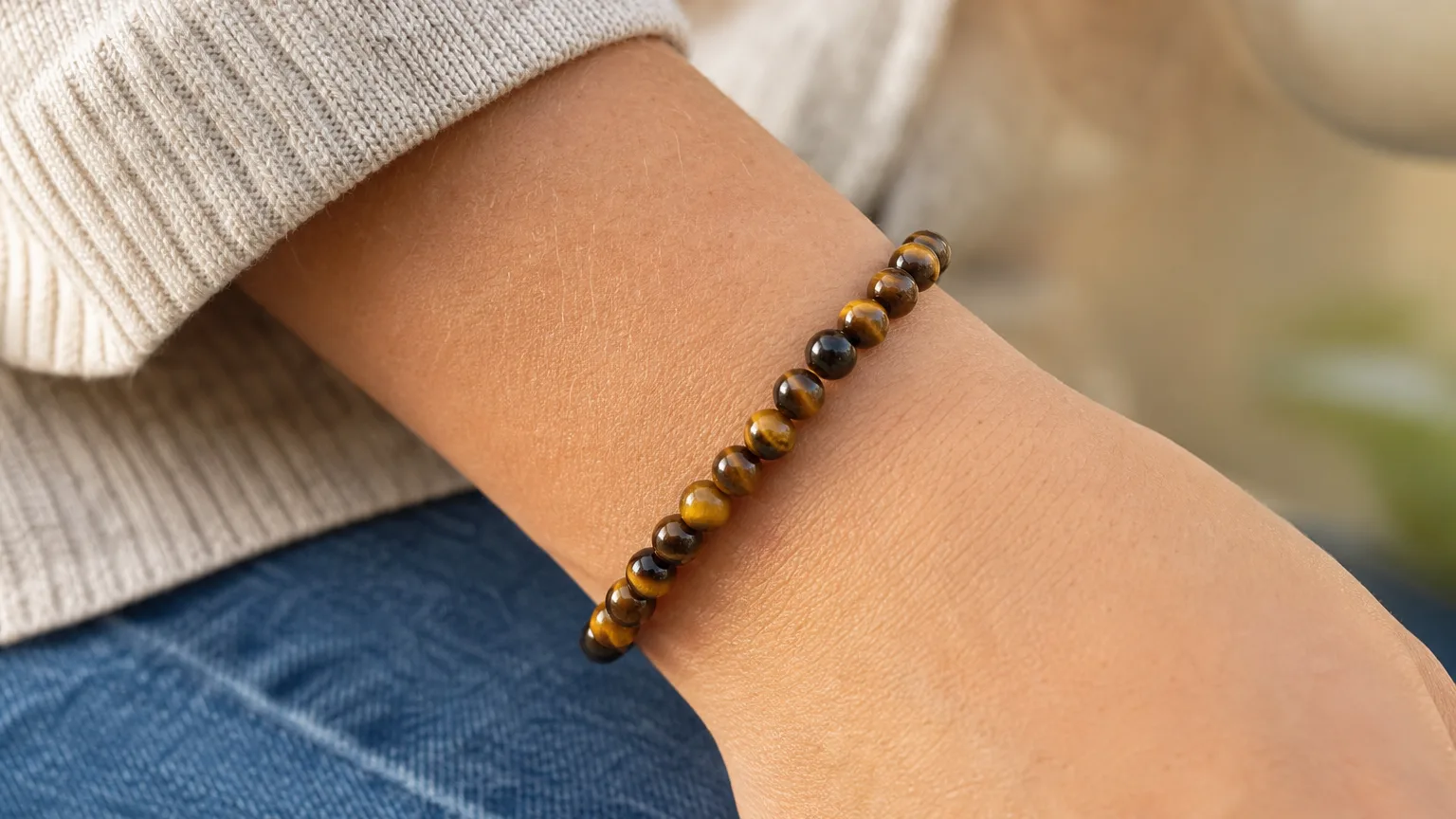
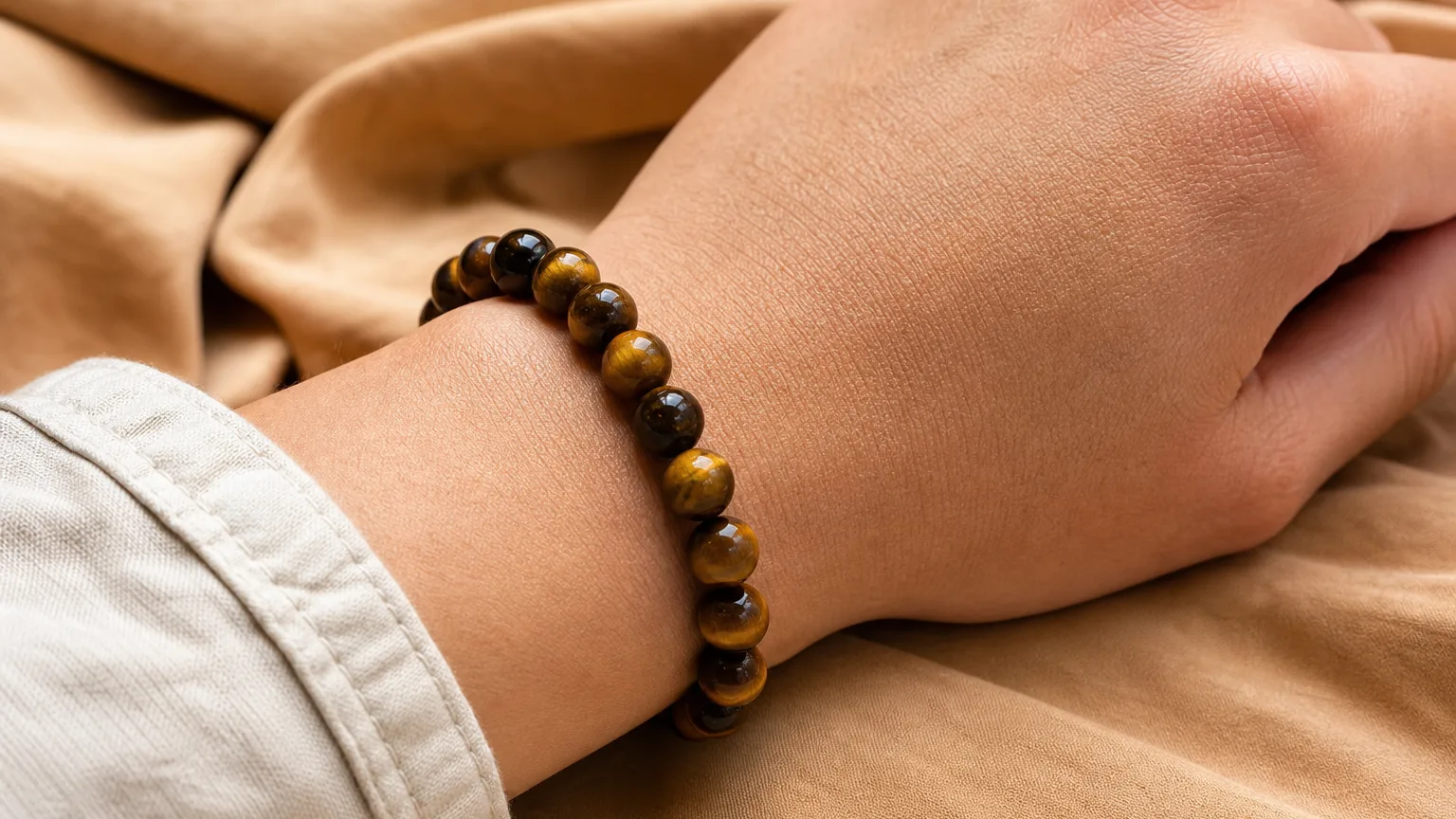
Wear it. A beaded bracelet or ring keeps the warm gold with you through the day. Pair one piece with a specific intention — “act with nerve,” “stay grounded and confident.”
Meditate with it. Hold a tumbled stone in your palm or rest it at your solar plexus while you sit. Even a few minutes of calm focus counts; the goal is presence, not duration.
Carry a tumbled stone. A smooth piece in a pocket is a discreet touchstone — something to hold when you want a steadying nudge of nerve.
Keep it on a desk. A polished sphere or freeform adds a bold, grounding presence to a workspace — a cue to focus and follow through.
Which Tiger Eye Form Is Right for You?
| Form | Best for | Choose it if |
|---|---|---|
| Cabochon | Rings, pendants, display | You want the classic smooth dome that shows the moving eye best |
| Beaded bracelet | Daily wearing | You want an affordable, wearable row of tiger’s eye through the day |
| Tumbled stone | Pocket or meditation | You want a smooth, affordable piece to hold or carry |
| Sphere | Desk, meditation, display | You want a polished focal orb that shows the chatoyancy |
| Freeform / palm stone | Holding, display | You want a larger, comforting piece that fits the hand |
| Pendant | Daily wearing | You want the warm gold worn near the chest through the day |
How to Tell Real Tiger Eye from Fakes
Tiger’s eye is common and usually sold as natural stone, so outright fakes are less of an issue than with rarer gems — but dyed glass and plastic copies do turn up, and it helps to know the related natural varieties. A few checks:
- Watch the eye move. Real chatoyancy glides across the surface as you turn the stone. A fixed, painted-looking band that doesn’t move points to glass or resin.
- Color. Natural golden-brown has subtle variation and depth. Perfectly uniform, neon-bright color can mean dye.
- Hardness. At Mohs 6.5–7, real tiger’s eye scratches glass and resists a steel knife. Glass imitations are softer.
- Related varieties. Blue-gray hawk’s eye and red tiger’s eye are natural (red is often gently heat-treated) — not fakes, just different forms.
- Price and source. Tiger’s eye is affordable and honest at fair prices. Very cheap, vividly uniform pieces are worth a second look.
A note on asbestos safety. Tiger’s eye contains crocidolite, an asbestos mineral — but the fibers have been fully sealed inside quartz during formation, so finished, polished tiger’s eye is safe to handle and wear. The only caution is for anyone cutting or grinding raw stone, whose dust should be controlled with proper protection. Worn jewelry poses no asbestos risk.
How to Cleanse and Care for Tiger Eye
Tiger’s eye is a hard, stable quartz, so it’s easy to care for — one of the more forgiving stones for daily wear. A few reliable practices:
- Water. A brief rinse under cool water is fine, and a little mild soap works for routine cleaning.
- Sunlight. The color is stable, so sun cleansing is safe and won’t fade the stone.
- Moonlight. A night under the moon is a popular gentle method, often paired with setting an intention.
- Smoke or sound. Passing it through sage or palo santo smoke, or using a singing bowl nearby, is a no-contact option many prefer.
One practical note: store tiger’s eye away from harder stones that could scratch it, and avoid harsh chemical cleaners, which can dull the polish. For the full routine, see our guide to cleansing crystals.
Best Crystals to Pair With Tiger Eye
Pairing is about layering intentions — picking stones whose qualities complement rather than compete. A few combinations that work well with tiger’s eye’s bold, grounding energy:
- Tiger’s Eye + Citrine — courage meets motivation; a warm, energetic pairing for confidence and an upbeat drive.
- Tiger’s Eye + Hematite — confidence meets deep grounding; a popular combo for feeling both bold and rooted.
- Tiger’s Eye + Black Tourmaline — two protective stones; a steady combination for courage and shielding through demanding days.
The logic of pairing is about complementary intentions, not strict rules. Pick combinations that match what you’re actually working on, and trust your own sense of what feels balanced.
Who Should Use Tiger Eye?
Tiger’s eye suits people who want a warm, grounding stone for courage, confidence, and protection — anyone wanting motivation, a steadier nerve, or a protective daily piece that can be worn for years. It’s an approachable stone because it’s affordable, widely available, and tough enough to live in.
A few honest expectations: tiger’s eye isn’t a treatment for anxiety, low confidence, or any condition — if you’re dealing with something persistent, a healthcare professional is the right call, and the stone can be a comfort alongside that. Finished, polished tiger’s eye is safe to wear (the asbestos fibers are sealed inside quartz); only raw-stone cutting dust needs care. Its value comes from the intention and routine you build around it. Go in expecting a durable, bold, symbolic stone you can wear daily, and it tends to fit well.
FAQ About Tiger Eye Meaning
What is tiger’s eye made of?
It’s quartz that has replaced the fibers of crocidolite, a blue asbestos mineral, while keeping their parallel structure. Those aligned fibers reflect light into the moving cat’s-eye band.
Is tiger’s eye safe, given the asbestos?
Yes, for finished stones. The crocidolite fibers are fully sealed inside quartz during formation, so polished tiger’s eye is safe to handle and wear. Only the dust from cutting raw stone needs protection.
Why does tiger’s eye have a moving band?
Chatoyancy. Light reflects off the parallel preserved fibers as you turn the stone, forming a single silky band that glides across the surface. It’s a real optical effect.
Is red tiger’s eye natural?
Often it’s gently heat-treated golden tiger’s eye, which deepens the tone to red-brown. Hawk’s eye, the blue-gray form, is the less-oxidized natural version.
What chakra is tiger’s eye associated with?
Traditionally the solar plexus, root, and sacral centers, linked to willpower, grounding, and drive.
Can tiger’s eye go in water?
Yes. At Mohs 6.5–7 it’s a hard, water-safe stone. A brief rinse is fine; avoid long salt-water soaks with metal settings.
What does tiger’s eye symbolize?
Most often courage, confidence, protection, and willpower — a bold, grounding stone carried as a charm for nerve and steady focus.
What is Arizona tiger’s eye?
Arizona tiger’s eye is a trade name for a chatoyant stone from Arizona. It may be true tiger’s eye (silicified crocidolite) or a similar chatoyant mineral.
Final Thoughts on Tiger Eye
Tiger’s eye earns its place as a stone of courage and confidence — and it earns it again for each person who wears it and gives it meaning. If you’re curious, the simplest start is one warm piece, one intention, and a small daily moment to notice it. You don’t need the largest sphere or the rarest variety; you need a stone you’ll wear and use. Let the routine do the work, and let that moving gold band be the cue to act with nerve and stay grounded.
From there, tiger’s eye tends to open a steadier space — a lift of confidence, a sense of protection, or simply a bold stone you’re glad to wear. If that’s what you’re after, you’re in the right place. For more, explore the Crystal Guide or browse tiger’s eye pieces.