
Sodalite Meaning: Healing Properties & Uses
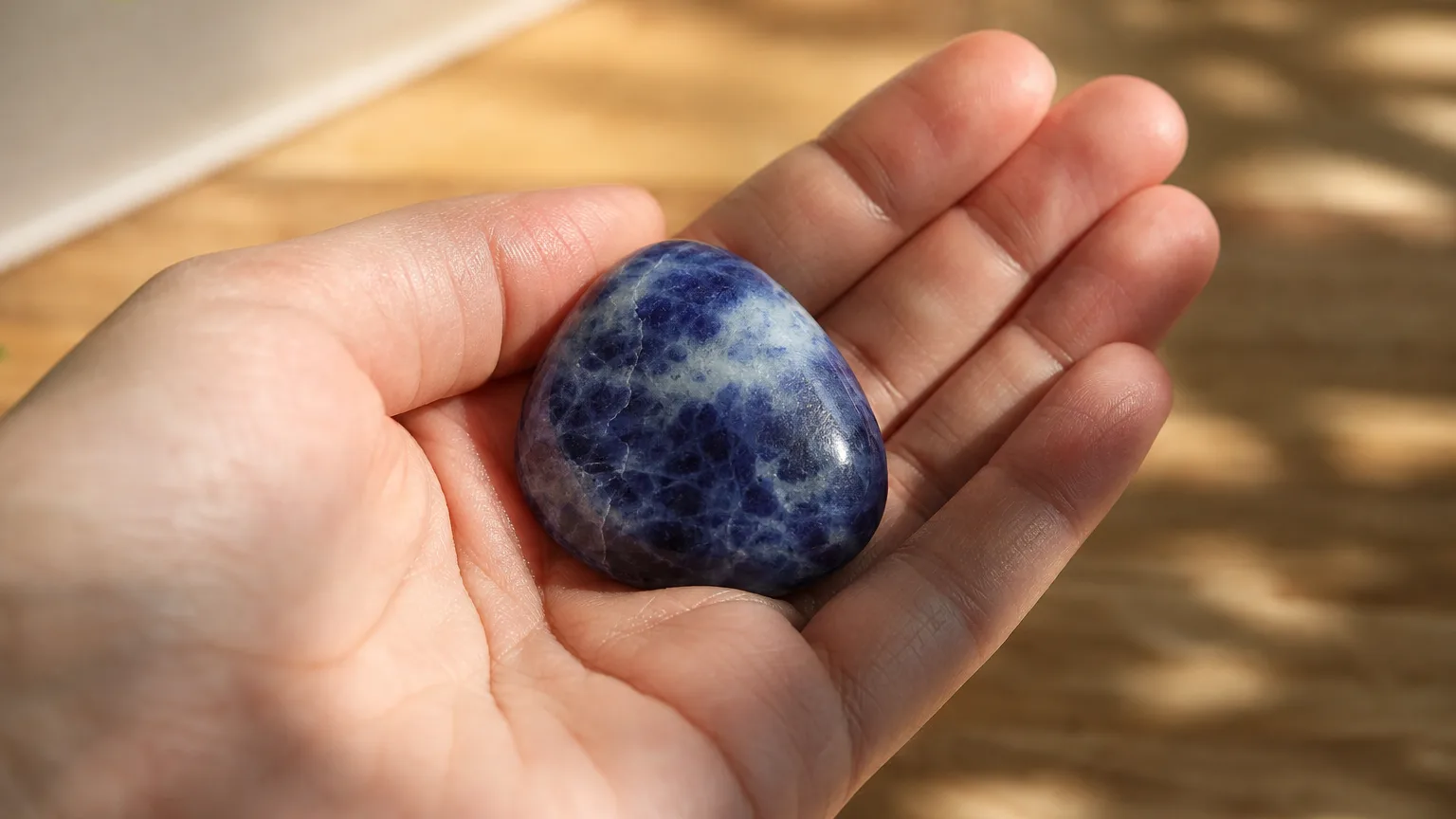
Sodalite is a deep-blue mineral streaked with white calcite — a sodium aluminum silicate often confused with lapis lazuli. Long tied to clear thinking, logic, and honest expression, it’s a stone people reach for when they want a calmer, more rational mind. This guide covers what sodalite is (and how it differs from lapis), what it has meant, and how people work with it. Crystal meanings reflect tradition and personal practice, not medical advice.
What Is Sodalite Meaning?
At its simplest, sodalite means clear thinking and honest expression — the feeling of a calmer, more logical mind that says what it means. As a deep-blue stone with white veining, it reads as clear and steady: linked to reason, truth, and a more measured way of thinking and speaking.
For many people that’s exactly the appeal — a blue-and-white piece you keep on a desk or hold when you want to think clearly and speak honestly. You don’t need to believe anything about energy to use it that way; the value often comes from choosing the piece, giving it a job (“help me think clearly”), and letting its cool blue tone pull you toward reason. In that sense sodalite is a cue to clear, honest thought.
Sodalite Meaning and Symbolism
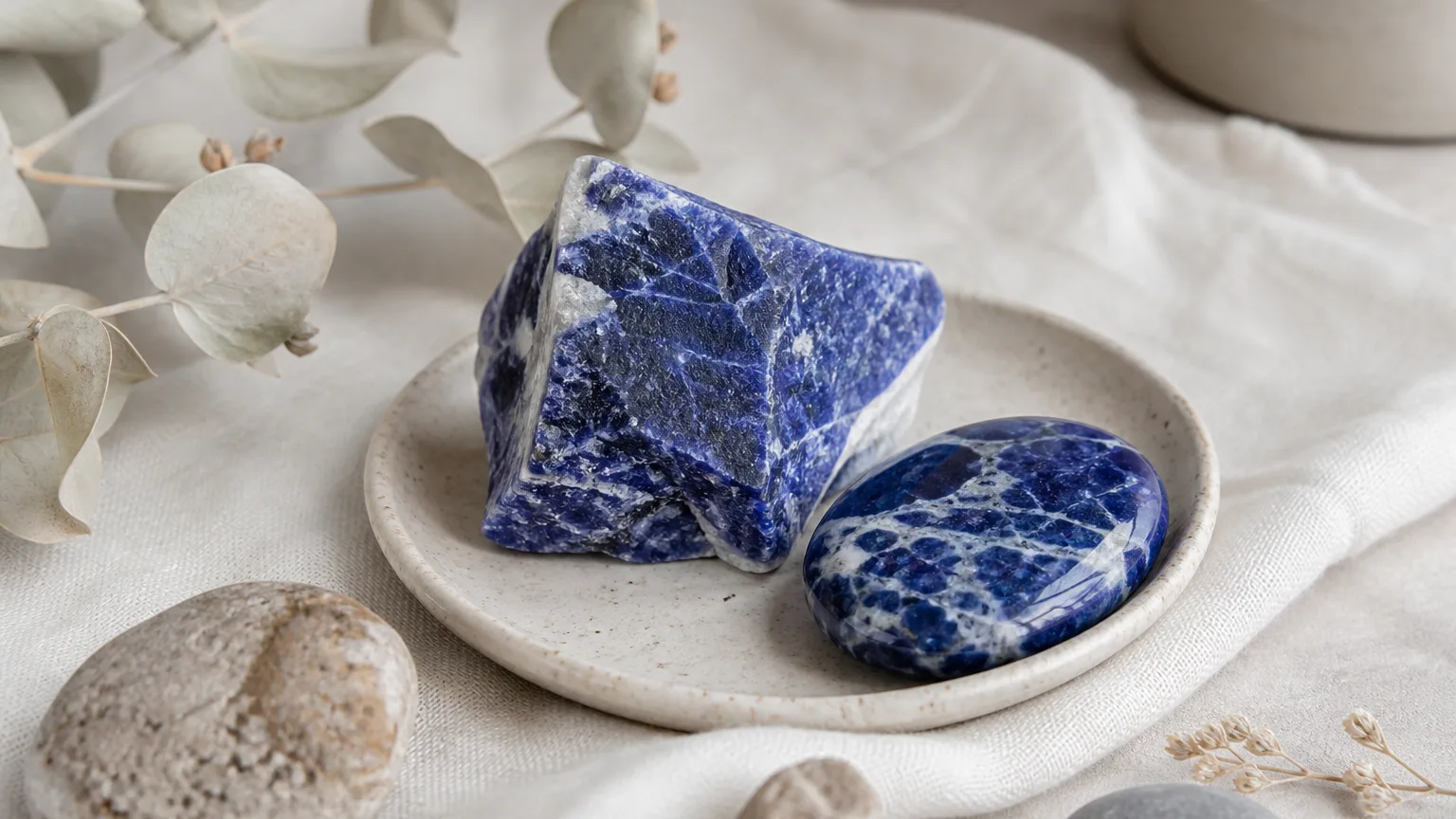
The name sodalite comes from its high sodium content — a plain, chemical naming by the mineralogists who first described it in Greenland in 1811. It’s a sodium aluminum silicate chloride mineral, Na₈(Al₆Si₆O₂₄)Cl₂, and its deep blue color (with white calcite streaks) is why it’s so often confused with lapis lazuli — though the two are different stones, and lapis usually carries gold-flecked pyrite that sodalite lacks.
Sodalite doesn’t have an ancient mythological tradition — it was only identified in the early 1800s. Its meaning in modern crystal practice comes from its clear, blue-and-white character: clear thinking, logic, and honest expression — the idea of a stone that supports a rational, truthful mind and the courage to speak it. That clarity-and-truth symbolism is consistent across modern practice, even though the stone itself is a relatively recent addition.
貫穿所有這些的共同主線是: clear thinking, logic, and honest expression. Today sodalite is usually described as a clarifying stone — reached for to quiet mental noise, support clear decisions, or speak more honestly. How much of that lands for you personally is, honestly, up to you — but the stone has held that clear-thinking reputation across modern practice. To explore more stones, browse the full 水晶指南.
Sodalite Properties
科學
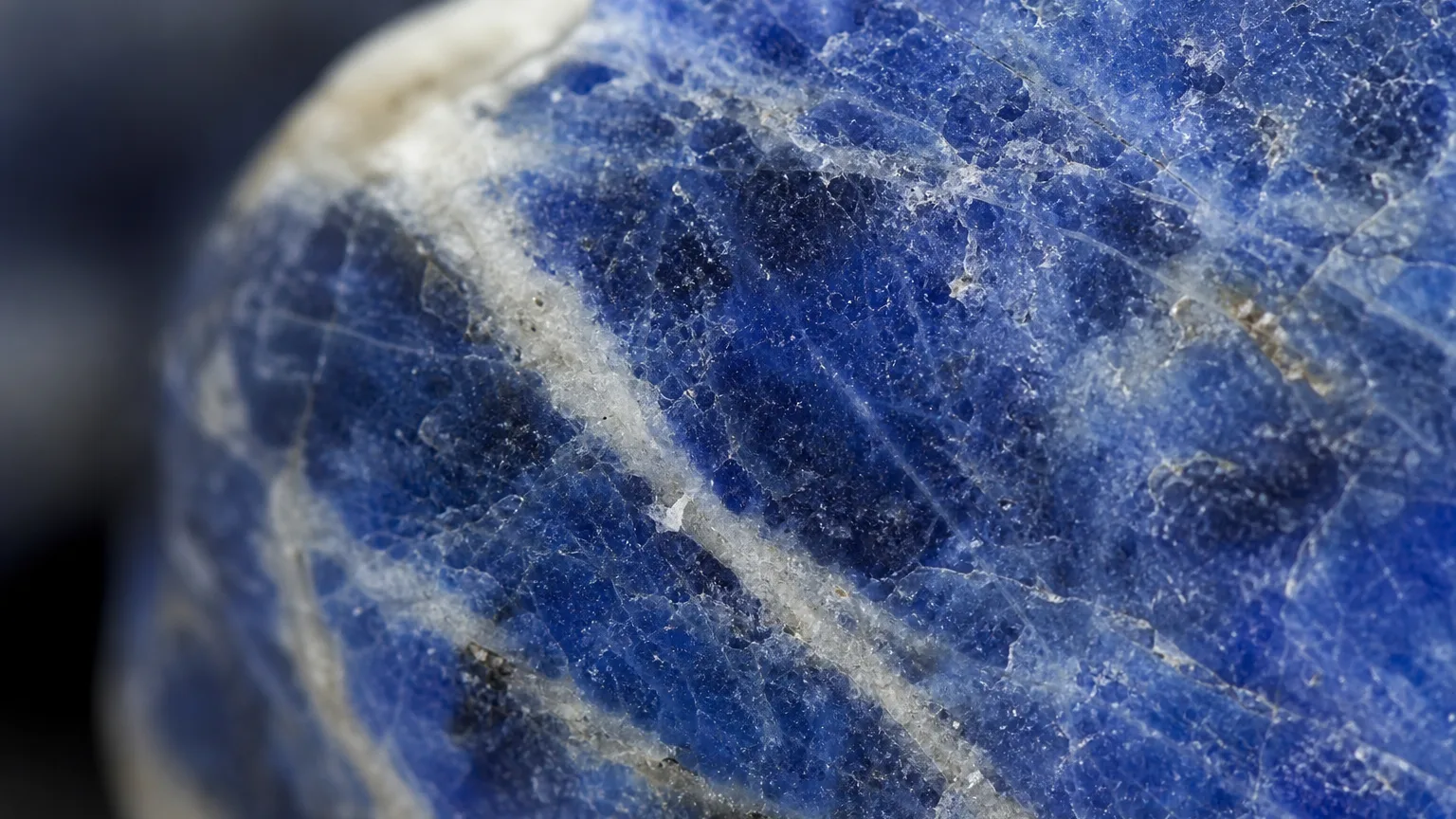
Sodalite is a sodium aluminum silicate chloride — Na₈(Al₆Si₆O₂₄)Cl₂ — a framework mineral in the feldspathoid group, with a Mohs hardness of about 5.5 to 6. Its deep blue color comes from sulfur-bearing radicals in the crystal, and most pieces are streaked with white calcite, giving that classic blue-and-white look. It’s usually opaque, sometimes slightly translucent at thin edges, and takes a smooth polish. Sodalite is closely related to lazurrite (the main mineral in lapis lazuli) and haüyne, which is why the three are so easily confused. Major sources include Brazil, Canada, Namibia, and Greenland (its type locality). None of this is mystical — it’s mineralogy.
傳統含義
Tradition ties sodalite to clear thinking, logic, and honest expression. It’s most often linked to the throat and third eye centers and is described as a stone that quiets mental noise, supports rational decisions, and helps you speak your truth calmly and clearly. Because it was only identified in the 1800s, its tradition is modern and built around its clear blue-and-white character rather than any ancient myth. Across modern crystal practice it’s reached for during study, demanding decisions, or to communicate more honestly. These associations come from spiritual tradition and personal practice rather than clinical study.
正念與心理學
From a psychological angle, sodalite works as a cool, steadying visual cue — the kind of object you hold when you want to slow racing thoughts and think more clearly. Blue reads in color psychology as calm and focused, and the act of keeping a piece on a desk and pairing it with an intention (“think it through, then speak”) turns it into a small cue for measured reason. Part of its appeal is simply its clear, uncluttered look — a visual signal to settle the mind. These effects come from tradition and personal practice, not clinical research. Crystals complement — but never replace — professional care.
Sodalite Benefits
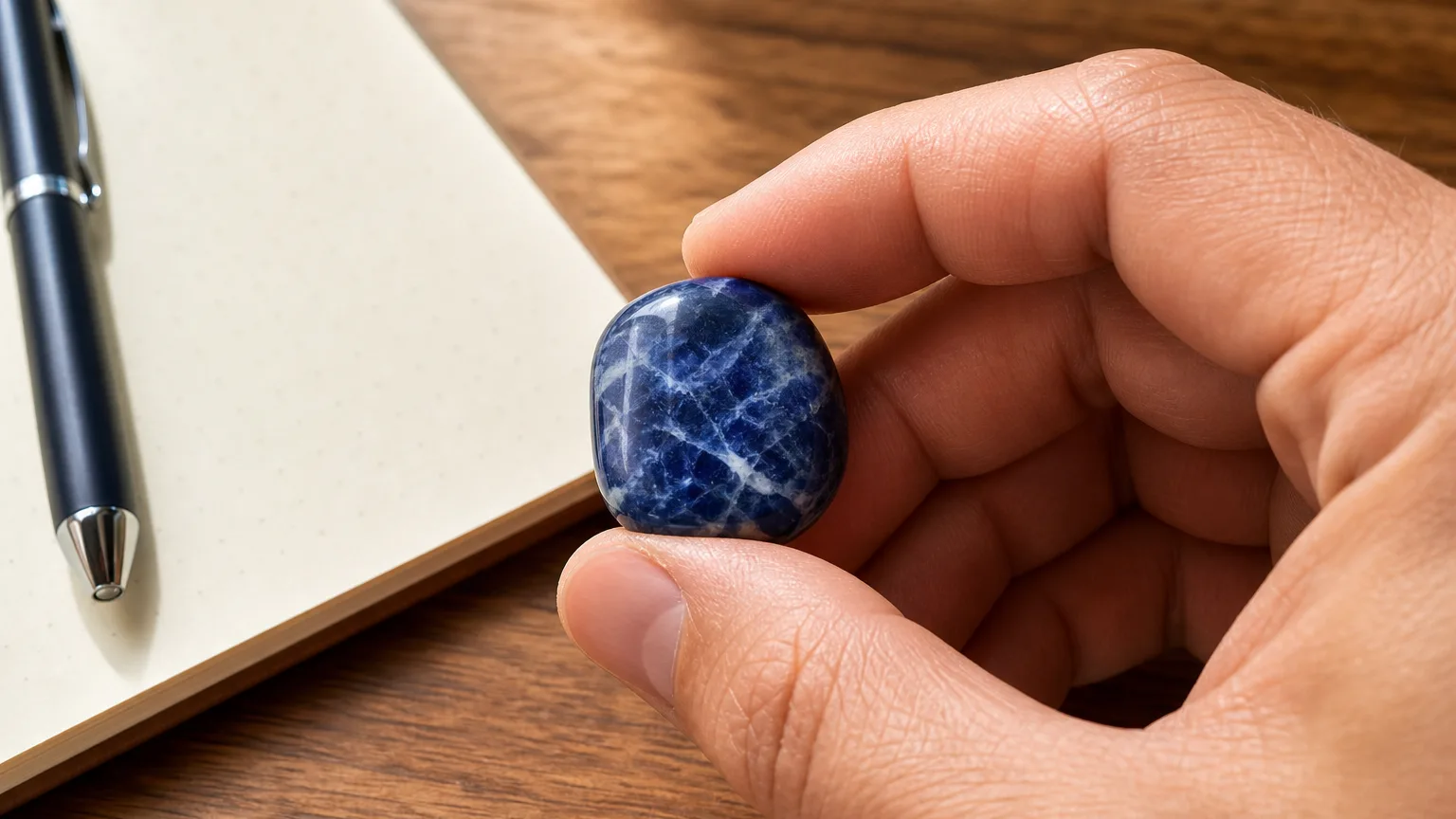
People who work with sodalite usually describe it in terms of clearer thinking and steadier communication, not dramatic shifts. It tends to show up as a calmer, more logical mind — useful when thoughts race, when you need to decide, or when you want to speak honestly. A few of the benefits people mention most:
A quieter, clearer mind
Keeping sodalite nearby when thoughts race gives you a cool, steadying cue to slow down and think one thing through at a time.
Clearer decisions
Many hold a piece when weighing a choice, as a reminder to step back and reason it through rather than react on impulse.
Honest expression
Its throat-and-third-eye meaning is a cue to say what’s actually true for you — calmly, without the heat that scrambles honest speech.
A focus cue for study
Kept on a desk during learning or demanding work, its clear blue tone is a low-key cue to stay logical and on task.
The pattern underneath all of these is the same: sodalite isn’t clearing your mind by magic, but it gives your day a cue toward reason and honest expression. If you’re exploring stones for specific needs, see our guide to crystals for stress.
Sodalite Chakra, Zodiac, and Element Associations
In traditional systems, sodalite is most strongly linked to the throat 以及 third eye centers — expression and insight, which together support honest, clear communication. Astrologically, it’s often paired with Sagittarius 以及 Virgo. 其元素通常表示為 Air, fitting for a stone tied to the mind. For related stones, see throat chakra crystals.
These are correspondences built up through tradition, not fixed rules. If your own sense of sodalite points somewhere else — a different chakra, a different element — that’s completely fine. Many people work with stones intuitively, following what feels right rather than a textbook chart, and there’s a long history of practitioners doing exactly that.
How to Use Sodalite
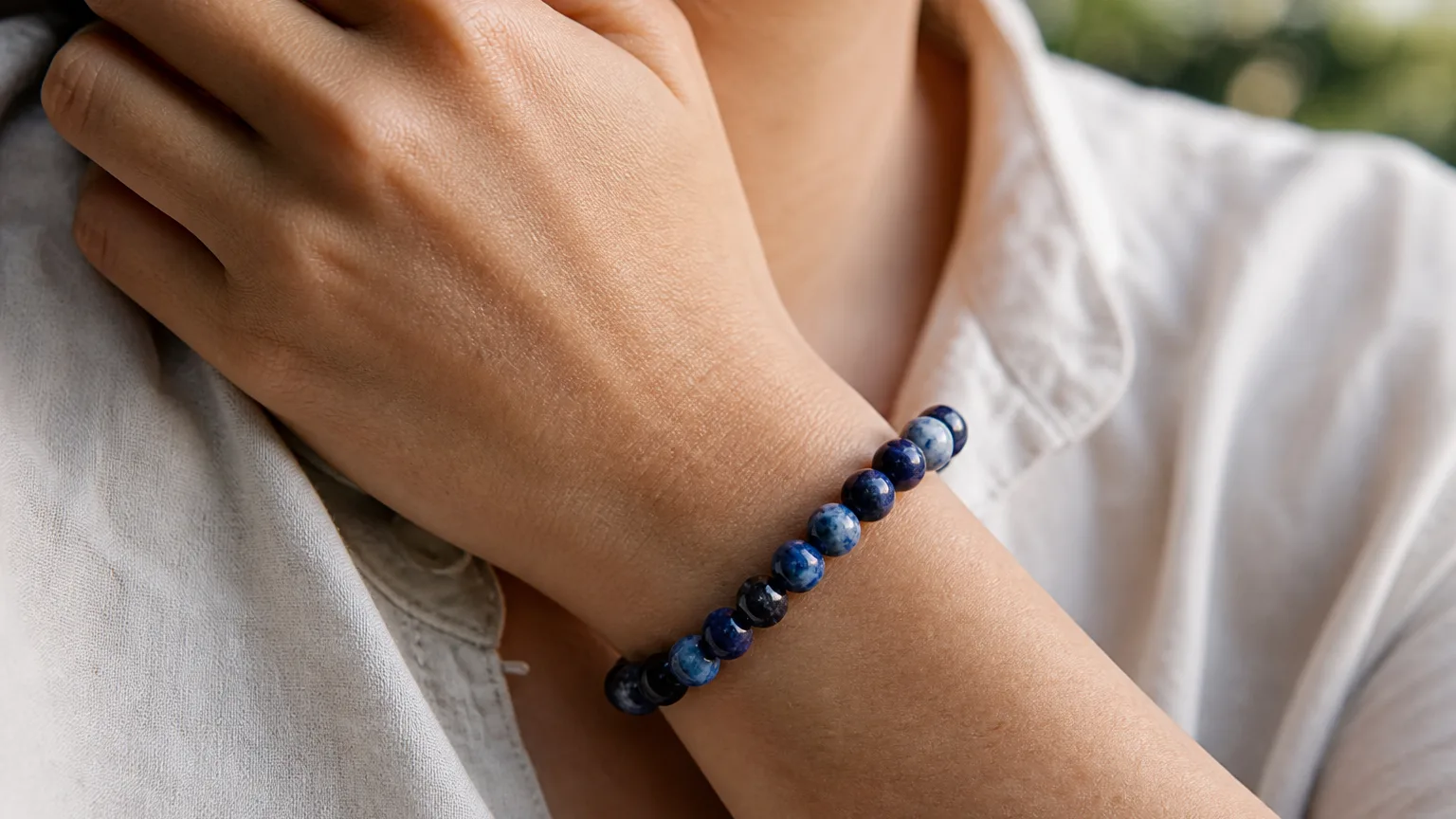
Sodalite is moderately hard (Mohs 5.5–6) and easy to live with — there’s no single right way, only what fits your routine. The key is consistency: a piece you actually see and use does far more than one stored away.
Keep it on a desk. A tumbled piece or polished slab where you work or study acts as a cool, steady cue to stay logical and on task.
Hold it before a hard talk. A smooth stone in your hand is a cue to slow down and think through what you actually want to say.
藉此進行冥想。. Hold a piece in your palm or rest it on your throat (throat center) while you sit. Even a few minutes of focused attention counts; the goal is presence, not duration.
Carry a tumbled piece. A small stone in a pocket is a discreet touchstone — something to hold when you want to settle racing thoughts.
Which Sodalite Form Is Right for You?
| 表單 | 最適合 | 若符合以下情況,請選擇此選項: |
|---|---|---|
| 滾磨石 | Pocket or meditation | You want something smooth and easy to hold or carry |
| Palm stone | Hand-holding under stress | You want a larger, smooth piece to grip when thoughts race |
| Polished slab / freeform | Desk display | You want a clear blue-and-white specimen where you work |
| 吊墜 | Worn near the chest | You prefer a single stone near the throat center |
| Bracelet / beads | Everyday jewelry | You want a visible blue reminder at your wrist |
| 未加工件 | 僅供顯示 | You like the natural, unpolished blue-and-white look |
How to Tell Real Sodalite from Fakes
Sodalite is moderately priced, so dyed stones and lookalikes do show up — most often sodalite sold as pricier lapis, or dyed howlite sold as sodalite. A few checks help:
- No gold flecks. Sodalite is deep blue with white calcite streaks, but it lacks the gold pyrite flecks that real lapis lazuli usually has. If a “lapis” piece has no gold flecks, it may be sodalite.
- Color. Natural sodalite is a deep, slightly uneven royal blue with white veining. Vivid, uniform ultramarine is more likely dyed howlite or reconstituted lapis.
- 硬度。. At Mohs 5.5–6, sodalite is softer than quartz and won’t easily scratch glass. A very hard “sodalite” may be dyed quartz or glass.
- Dye test. Dyed howlite or marble often has color sitting in cracks or too-uniform patches. A reputable seller will tell you what you’re getting.
- UV fluorescence. Many sodalite specimens fluoresce orange under UV light — a useful tell that’s hard to fake.
How to Cleanse and Charge Sodalite
Sodalite is a moderately hard stone (Mohs 5.5–6) and fairly easy to care for, though its color can be sensitive to long sun exposure.
- Water. A brief wipe with a damp soft cloth is fine. Avoid long soaks, hot water, and salt water.
- 陽光。. Some sodalite can fade with prolonged direct sun. Indirect light is the safer long-term choice.
- 煙霧或聲音。. 將物品置於鼠尾草或帕洛桑托的煙霧中,或在附近擺放一個頌缽,是許多人偏好的非接觸式方法。.
- Moonlight. A night under the moon is a popular gentle method that fits sodalite’s calm, clear character.
Two things to keep in mind: store sodalite away from harder stones so it doesn’t pick up scratches, and avoid harsh chemical cleaners, which can dull the polish. For the full routine, see our 水晶淨化指南.
Best Crystals to Pair With Sodalite
Pairing is about layering intentions — picking stones whose qualities complement rather than compete. A few combinations that work well with sodalite’s clear, logical energy:
- Sodalite + Amethyst — clear thinking meets calm; a balanced pairing for a focused, settled mind.
- Sodalite + 透明石英 — clear quartz is said to amplify; many use it to lift sodalite’s clarity intentions.
- Sodalite + Lapis Lazuli — two blue truth-and-wisdom stones; a pairing many reach for honest expression and insight.
- Sodalite + 黃水晶 — logic meets motivation; a bright combo for clear, confident action.
搭配的邏輯在於意圖的互補,而非嚴格的規則。選擇與你實際工作內容相符的組合,並相信自己對「平衡感」的判斷。.
Who Should Use Sodalite?
Sodalite suits people who want a clarifying stone for clear thinking and honest expression — students, anyone making demanding decisions, or people who want to communicate more truthfully and calmly. It’s approachable because it’s affordable, durable enough for daily wear, and asks little: place it, hold it, and let it mark a clearer, more logical corner of your day.
A few honest expectations: sodalite isn’t a treatment for anxiety, ADHD, or any condition — if you’re dealing with something persistent, a healthcare professional is the right call, and the stone can be a comfort alongside that. Its value comes from the intention and routine you build around it. If you go in expecting a stone to clarify your mind for you, you’ll be disappointed; if you go in expecting a steady, logical cue you can return to, it tends to fit well.
FAQ About Sodalite Meaning
What is sodalite good for?
Traditionally, clear thinking, logic, and honest expression. People reach for it to quiet mental noise, make clearer decisions, or speak more honestly.
Is sodalite the same as lapis lazuli?
No. They look similar (both deep blue), but they’re different minerals. Lapis lazuli usually has gold pyrite flecks and is a rock made mostly of lazurrite; sodalite is a single mineral with white calcite streaks and no gold flecks.
What gives sodalite its blue color?
Sulfur-bearing radicals in the crystal structure. The white streaks are calcite, not part of the sodalite itself.
What chakra is sodalite linked to?
Mostly the throat and third eye centers — expression and insight, which together support honest, clear communication.
Can sodalite go in water?
A brief wipe with a damp cloth is fine. Avoid long soaks, hot water, and salt water, which can dull the surface.
Does sodalite fade in sunlight?
Some sodalite can fade with prolonged direct sun. Keep it in indirect light for the long term.
How can I tell real sodalite?
Look for deep blue with white calcite streaks and no gold flecks (which would suggest lapis), and note that many real specimens fluoresce orange under UV light.
Final Thoughts on Sodalite
Sodalite earns its place as a stone of clear thinking and honest expression — the blue-and-white piece people reach for when they want a calmer, more logical mind and the courage to speak it. If you’re curious, the simplest start is one piece you’ll actually use, paired with a small daily moment to notice it. Let the routine do the work, and let the stone be the clear anchor that reminds you to think it through, then speak.
From there, sodalite tends to open a clearer space — a quieter mind, a more honest moment, or simply a habit of pausing to reason before you react. For more, explore the 水晶指南 或瀏覽 sodalite pieces.