
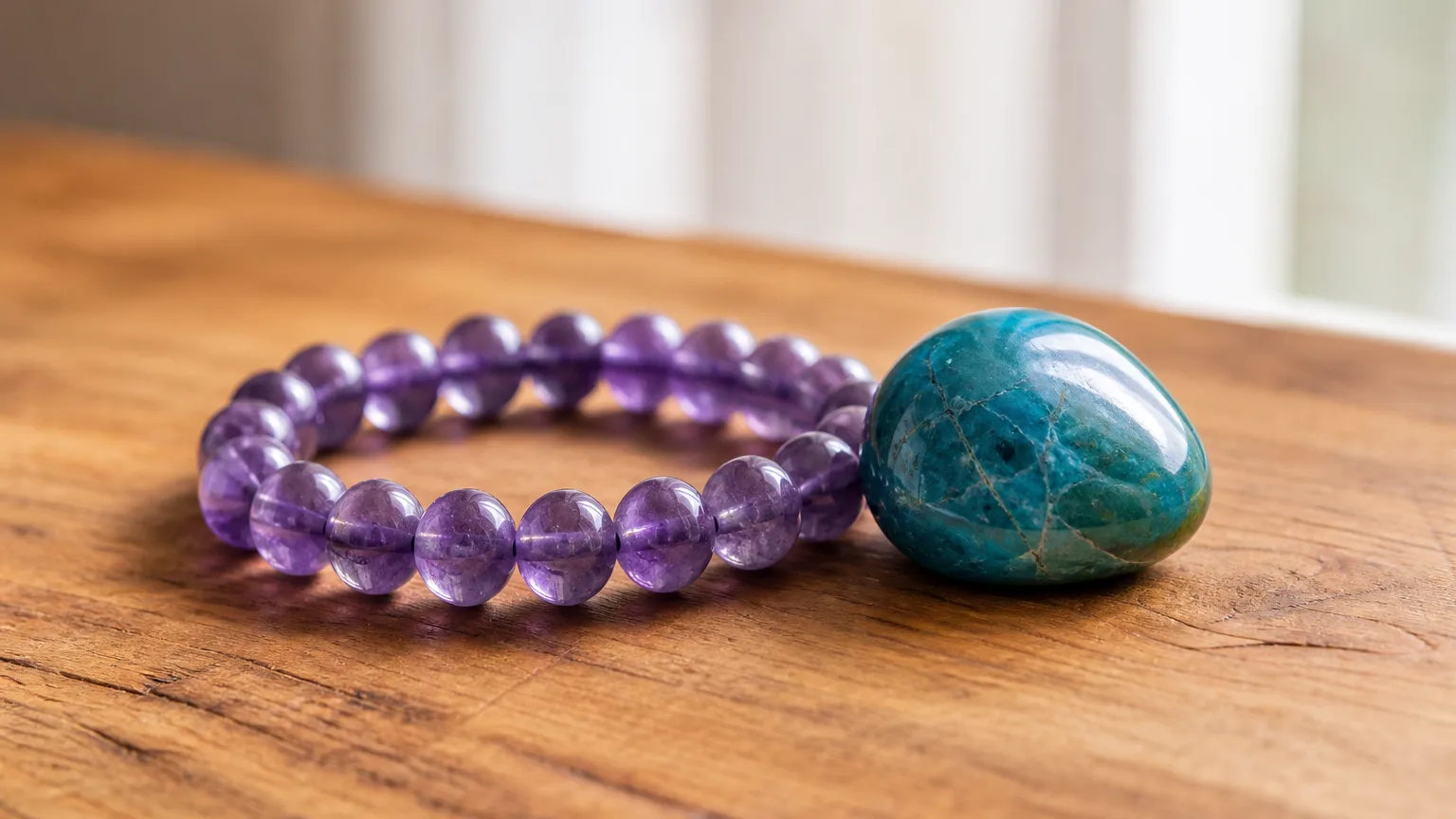
Amethyst and Apatite Together: Benefits, Meaning + How to Use
Amethyst and Apatite Together: Benefits, Meaning + How to Use
Quick Answer
Yes — Amethyst and Apatite can be worn together (compatibility score: 100/100 — Excellent). They sit at the same chakra but pull in opposite directions: one settles the mind, the other stirs it into action.
About Amethyst
Amethyst is a purple variety of quartz, traditionally associated with calm, spiritual awareness, and protection. In crystal practice it’s often linked with the Crown and Third Eye chakras, which makes it a natural fit for meditation, sleep rituals, and stress relief. Common forms include bracelets, pendants, earrings, anklets, and tumbled clusters.
Mineralogically, Amethyst is silicon dioxide (SiO₂) with a Mohs hardness of 7, durable enough for everyday bracelets, pendants, and rings. Its purple color comes from iron and natural irradiation. Amethyst tolerates only brief contact with water and should be kept away from salt water and prolonged direct sun.
Amethyst Meaning → · Genuine, ethically sourced — not dyed, not glass.
About Apatite
Apatite is a bright blue-green to teal crystal, sometimes found in yellow or violet, traditionally associated with motivation, creativity, and clear communication. In crystal practice it’s often linked with the Throat and Third Eye chakras, which makes it a favorite for creative work, public speaking, and turning ideas into action. Common forms include tumbled stones, raw crystals, pendants, and palm stones.
Mineralogically, Apatite is calcium phosphate (Ca₅(PO₄)₃(F,Cl,OH)) with a Mohs hardness of 5 — noticeably softer than quartz-family stones like Amethyst. That softer rating means it’s better suited to gentle wear (pendants and palm stones) or to wands, plates, and towers kept in a dedicated practice space. Keep it away from salt water and avoid long soaks; a brief wipe is the safer way to clean it.
Apatite Meaning → · Genuine, ethically sourced — not dyed, not glass.
Can You Wear Amethyst and Apatite Together?
Practically: Amethyst and Apatite can be used together, but they sit at different points on the durability scale. Amethyst is a quartz at 7 on the Mohs scale, well suited to everyday bracelets and rings. Apatite is softer at 5 and more vulnerable to scratches, chips, and dulling from harder stones or rough contact. So Amethyst becomes the everyday wearable, while Apatite is often better as a pendant, palm stone, or a wand and tower kept in your practice space. Visually, deep purple against bright blue-green gives a rich, jewel-toned contrast that reads as intentional in a bracelet-and-pendant pair.
Energetically: In crystal tradition, Amethyst is linked to the air element and the crown and third-eye chakras, while Apatite is tied to the fire element and the throat and third-eye chakras. They meet at the third eye — the center associated with insight and intuition. The pairing is often described as a balance of stillness and momentum: Amethyst is said to settle the mind, Apatite to spark motivation and expression. Many people reach for this combination when they want a quieter focus that still moves them into action rather than deeper inward.
Psychologically: The two carry complementary intentions — calm and protection from Amethyst, motivation and communication from Apatite. That makes the pairing a useful single anchor for creative work or a focused project. One intention (turning a quiet idea into spoken, finished work) carried by two stones that reinforce each other rather than compete.
These properties are traditionally associated with crystal practice; many people find the pairing supportive, though the effects are not established by modern research.
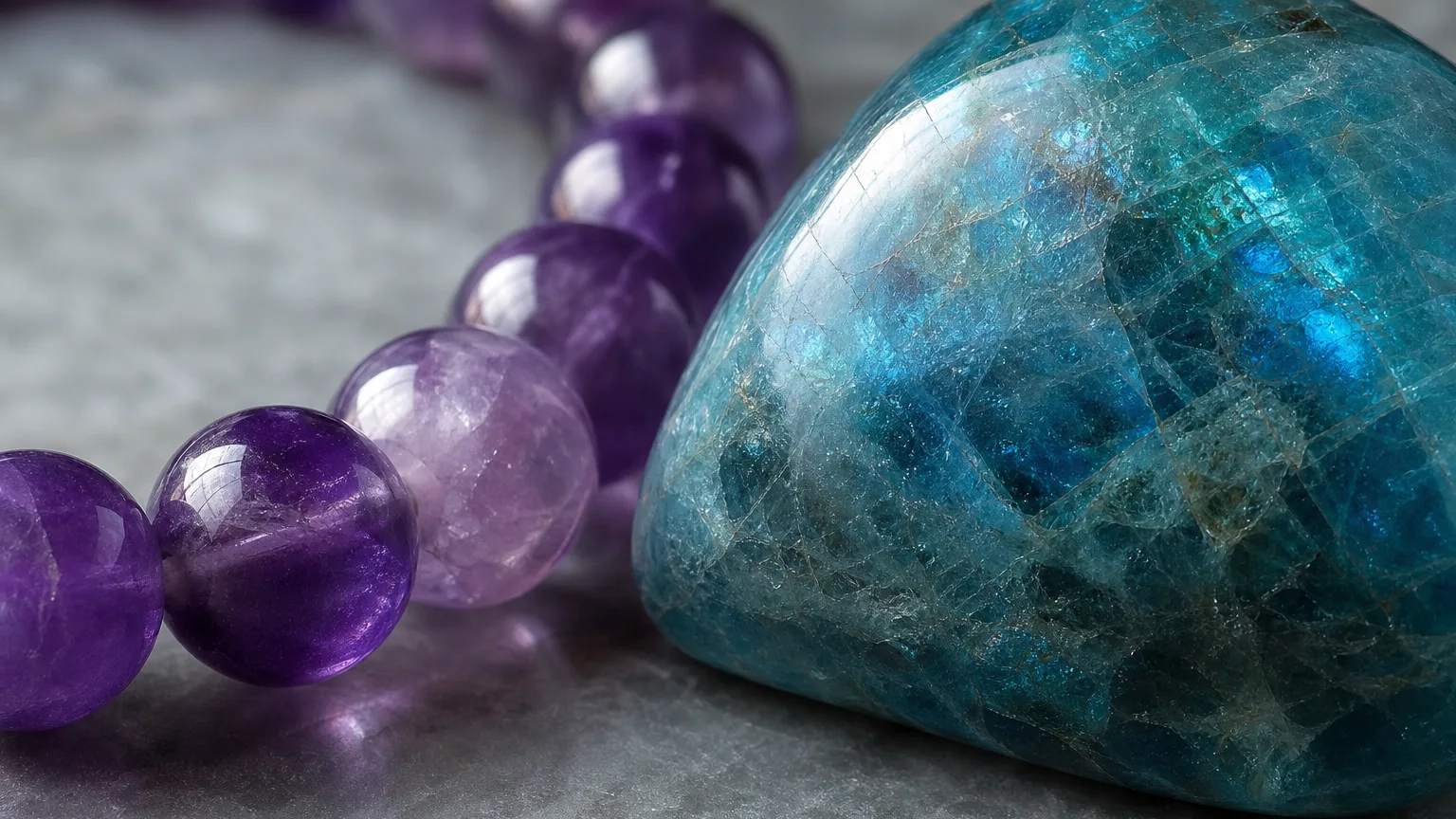
Benefits of Amethyst + Apatite
What makes this pair different from Amethyst’s calmer partners is the contrast: stillness paired with spark. Together the two cover six complementary strengths:
1. Insight Meets Expression
Both stones are linked to the third-eye chakra, the center traditionally associated with insight and intuition. Combined, they’re used to bridge seeing and saying — Amethyst is said to clarify what you sense, while Apatite is believed to help put it into words. People reach for this pairing before a creative session, a hard conversation, or any moment where a quiet idea needs to become something spoken and shared.
2. Calm Motivation
Amethyst is traditionally used to quiet a busy mind. Apatite is chosen for the spark of motivation it brings. Together they offer a steadier kind of drive — focused rather than scattered. Instead of the push-and-pull between restlessness and inertia, the pairing is often described as a calmer entry into action. That suits long creative sessions or focused project work where steady pace matters more than bursts of energy.
3. Air and Fire in Balance
The two stones pair complementary elements — Amethyst’s air and Apatite’s fire. In crystal tradition, air is linked to thought and clarity, fire to will and momentum, so the combination is used to balance reflection with action. Many practitioners like this pairing for breaking out of overthinking without losing the considered, intentional quality that air brings to a decision or a piece of creative work.
4. Stronger Creative Focus
This is a pairing our site already recognizes, and it’s a popular one around creative practice. Apatite is traditionally associated with creativity and expression, while Amethyst is valued for the calm, clear space it creates. Kept together on a desk — Amethyst as a cluster, Apatite as a palm stone — the two support a simpler, less scattered routine for getting into and staying in creative flow.
5. A Clearer Inner Voice
The shared third-eye link, combined with Apatite’s throat-chakra connection, makes this a traditional pairing for honest self-expression. Amethyst is said to settle the noise that crowds out a quieter inner voice, while Apatite is believed to lend it confidence and clarity. Many people work with the two when journaling, setting intentions, or preparing to communicate something that has felt hard to say.
6. A Two-Part Day: Make, Then Wind Down
Because Amethyst is traditionally used for evening calm and Apatite is valued for resetting motivation, the pairing can bookend a single day. Apatite to rekindle focus during a creative afternoon. Amethyst to settle the same mind before rest. It’s a simple two-stone rhythm rather than a single-purpose combination — useful for people whose work blends making and reflecting and who want one pairing to serve both halves of the day.
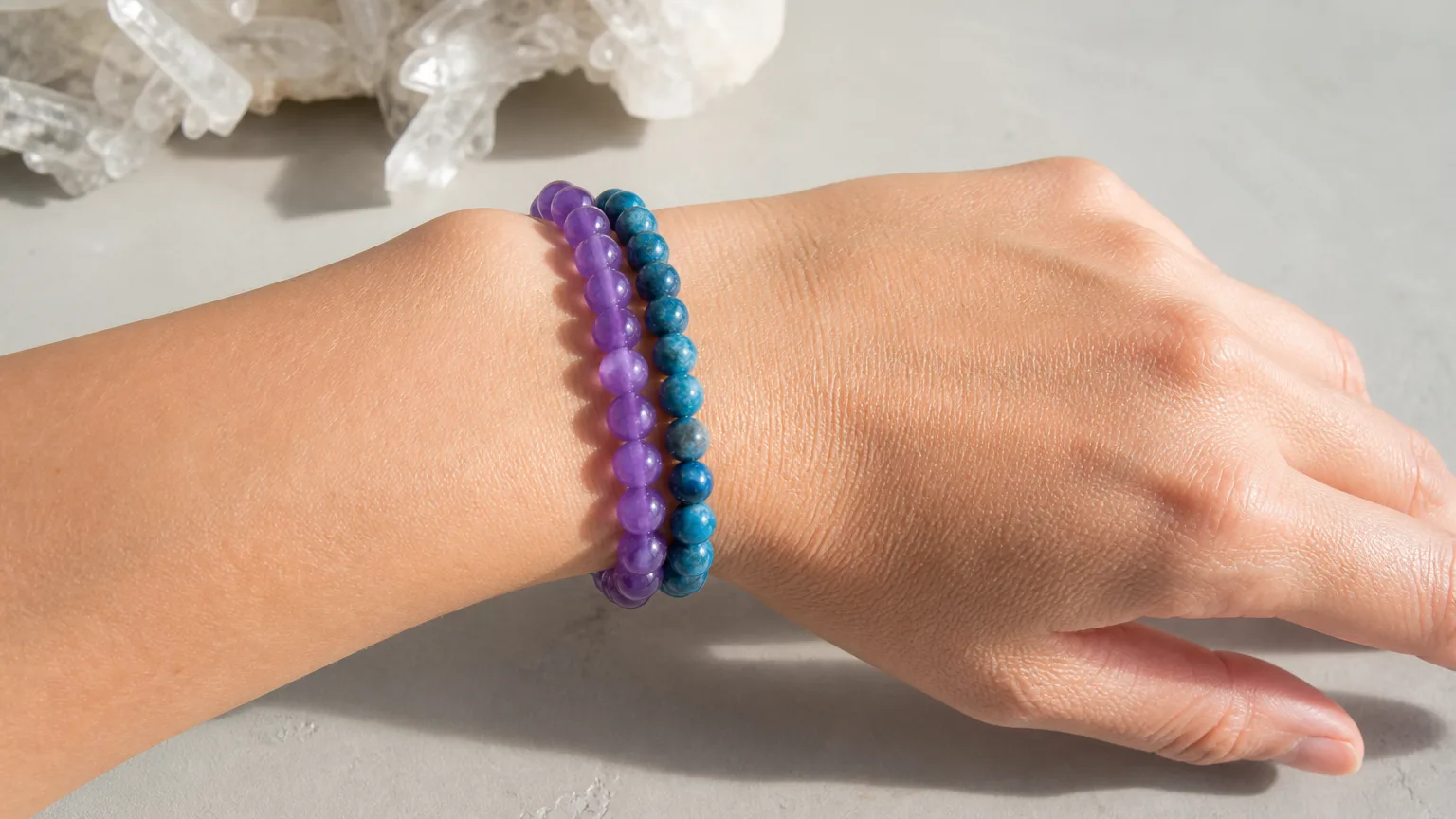
How to Use Amethyst and Apatite Together
Wear them
A common question is can I wear Amethyst and Apatite on the same hand? Yes — the shared third-eye link means the two are traditionally considered comfortable together. An Amethyst bracelet is the better everyday wearable. If you add Apatite, choose a pendant or a soft-fitting bracelet and avoid stacking it tightly against harder stones, because Apatite is softer (Mohs 5) and can scratch, chip, or dull over time. Many people prefer Amethyst on the wrist for calm and an Apatite pendant near the throat for expression.
Meditate
Hold Amethyst in one hand and place Apatite nearby — on a plate or the floor in front of you — rather than pressing it against the body. Five to ten minutes is enough for a simple ritual, especially if you’re new to working with these two stones. The aim is a calmer, more focused sit that still carries a thread of motivation into what you do next.
Crystal grid
Place an Amethyst cluster at the center to set a calm intent and Apatite points around it to represent expression and momentum. It’s a simple grid for creative work, communication, or focused projects — easy to set up on a desk or small table where you spend time making or planning.
Place in a room
An Apatite tower or palm stone on the desk keeps a workspace feeling motivated and expressive. An Amethyst cluster nearby brings a sense of calm and protection. Together they turn a home office or creative corner into a balanced space — many people start here when they want a steadier rhythm between making and winding down for the evening.
Caring for Amethyst + Apatite
Each stone has its own care needs:
- Amethyst: Water: Brief rinse safe · Sun: Avoid prolonged sun · Salt: Avoid salt water.
- Apatite: Water: Brief wipe safe · Sun: Sun-safe · Salt: Avoid salt water.
When in doubt, cleanse both with sound or moonlight — methods that are gentle across all stone types.
How to cleanse your crystals →
Shop Amethyst + Apatite
Every stone below is genuine, ethically sourced, and real — not dyed, not glass.
Bundle any 3 and save 20%.
Frequently Asked Questions
Can I wear Amethyst and Apatite together every day?
Many people do. If you’re new to combining stones, start with a few hours and notice how the pairing feels before making it a daily habit.
Can I wear Amethyst and Apatite on the same hand?
You can. Some wearers follow the tradition of keeping calming stones on the receiving (left) hand and active ones on the giving (right) hand, but it comes down to personal preference.
Can I sleep with Amethyst and Apatite?
You can keep them nearby while you sleep. Amethyst is often placed on the wrist or nightstand, while Apatite can rest on the nightstand or nearby.
How do I cleanse Amethyst and Apatite?
Amethyst: Water: Brief rinse safe · Sun: Avoid prolonged sun · Salt: Avoid salt water. Apatite: Water: Brief wipe safe · Sun: Sun-safe · Salt: Avoid salt water. When in doubt, sound or moonlight cleansing is gentle across all stone types.
Can I add a third stone to Amethyst and Apatite?
Yes — Clear Quartz is a neutral amplifier that bridges most pairings without competing. Add one stone at a time so you can notice each shift.
Related
- Amethyst Meaning
- Apatite Meaning
- How to Cleanse Crystals
- Amethyst and Selenite
- Amethyst and Lapis Lazuli
- Amethyst and Fluorite
- Amethyst and Lepidolite
- Crystal Compatibility Checker
Crystal meanings are shared for entertainment and spiritual practice. They’re not a substitute for professional medical or mental-health care.