
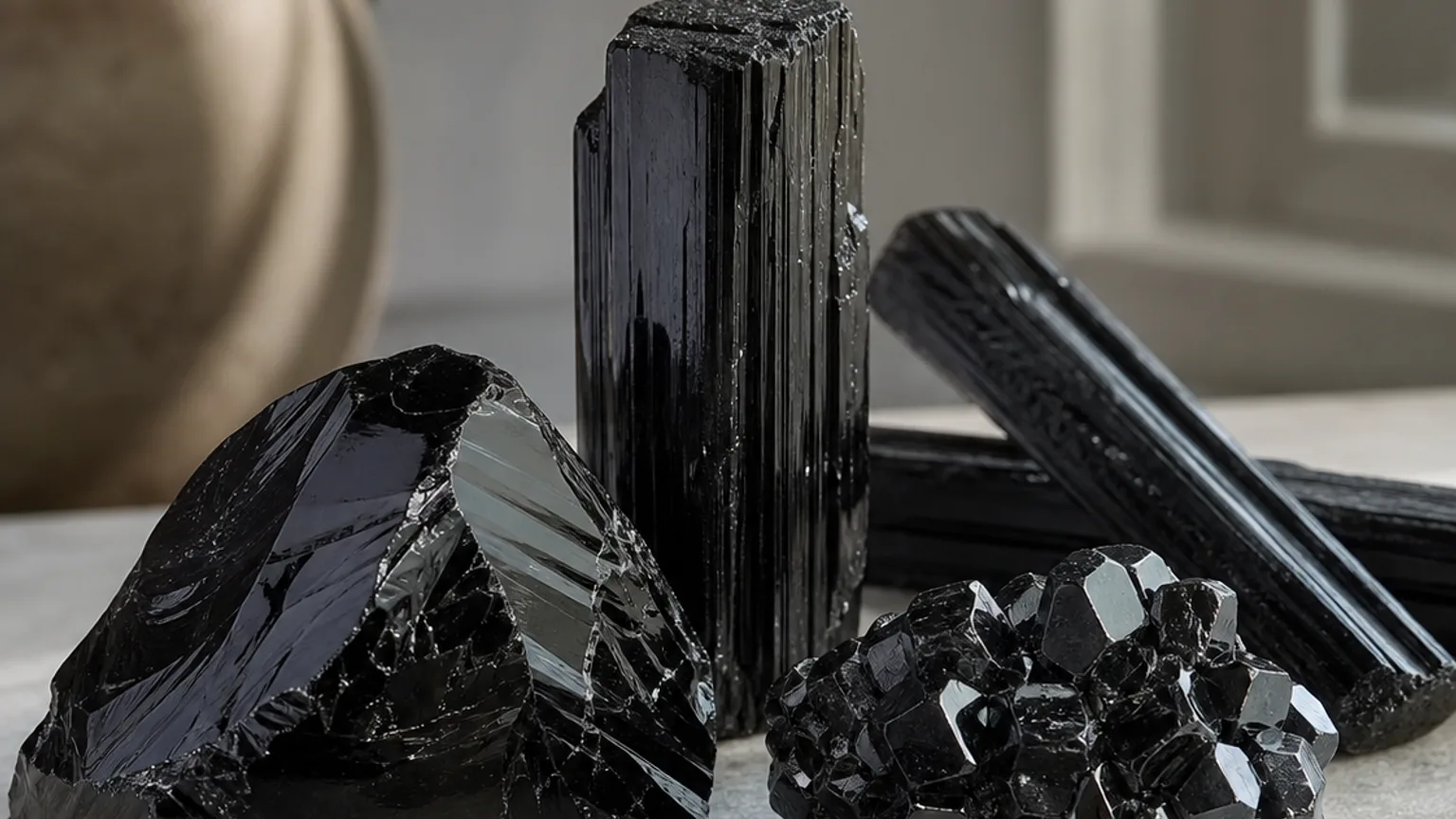
Best Black Crystals: Names, Meanings, Properties & Uses
Quick Answer: Best Crystals for Black
The best crystals for Black include Obsidian, Black Tourmaline, Hematite, traditionally used in mindfulness and spiritual practices. Crystal properties are complementary wellness tools, not medical treatments.
Understanding Black Crystals
Black is the color we reach for when life feels too loud. Across cultures it has stood for protection, stillness, and the unknown, the shade of fertile soil at night and the inside of a quiet cave. Black minerals tend to absorb light rather than reflect it, and people have long read that physical trait as a symbol of taking things in, holding them, and keeping the rest of the world at a distance.
Historically, black stones have traveled as amulets. Roman soldiers carried Hematite for courage, Aztec traders polished Obsidian into mirrors for divination, and medieval European households hung Tourmaline near doorways. The common thread was a wish to mark a boundary, between safe and unsafe, between self and other.
In modern crystal practice, black is the color people turn to for grounding and shielding. The deep tone is linked in color psychology to stability and composure, and many people say holding a black stone helps them feel more settled when stress or overthinking builds. Rather than adding energy, black minerals are usually described as absorbent and anchoring, a steady weight that reminds you to slow down, plant your feet, and decide what you let in.
Quick facts: Symbolism: Protection, grounding, mystery. Psychology: Absorbing negativity, boundary-setting. Associated chakra: Root/Earth Star, element: Earth.
Not sure which color is right for you? Try the Crystal Quiz ↗
How to Identify Black Crystals
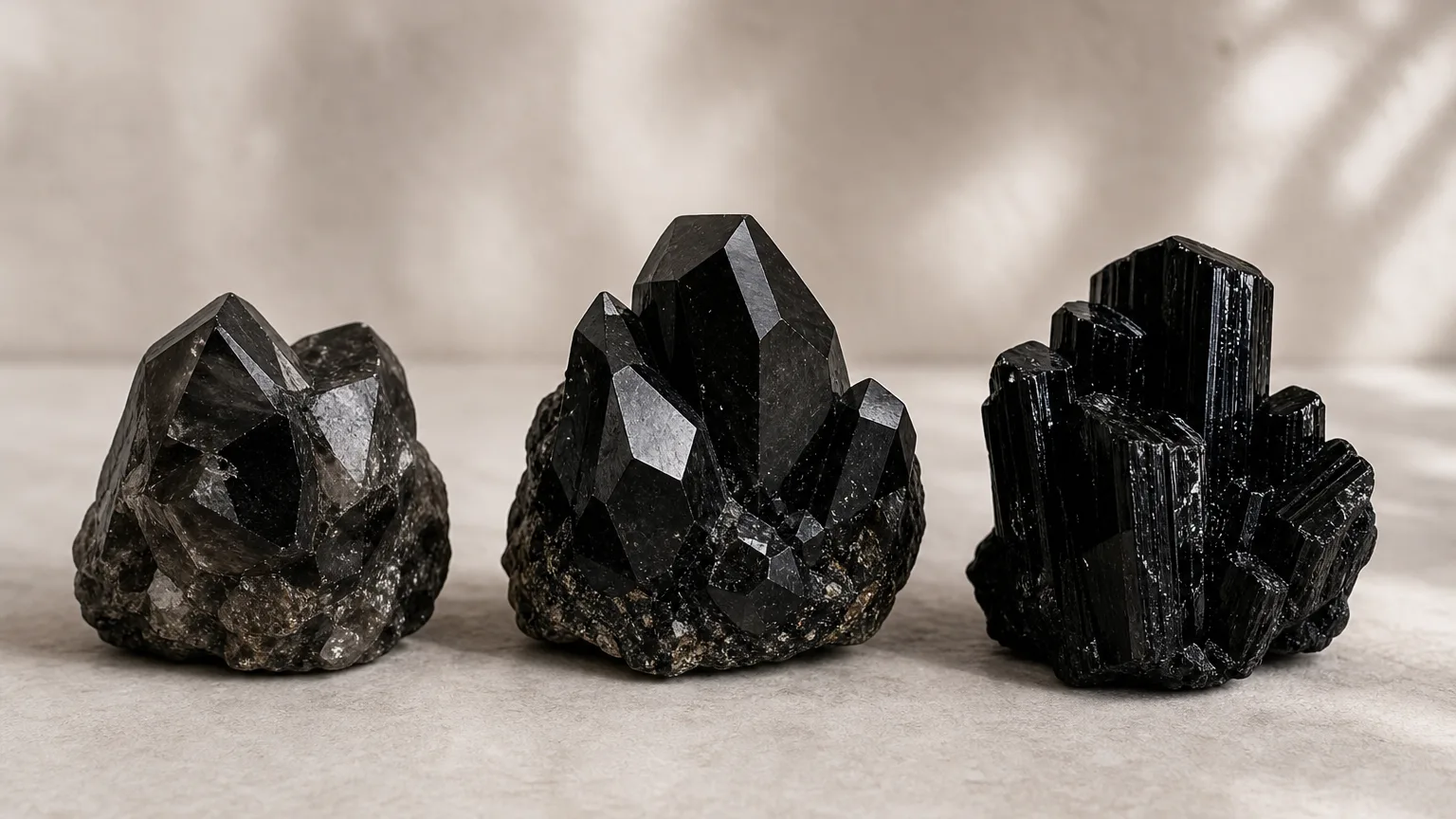
Black minerals can look similar at first glance, but a few simple checks will separate them. Begin with the surface texture: Obsidian is a natural volcanic glass with a glassy, conchoidal (shell-like) fracture and sharp edges. Hematite has a metallic to submetallic gleam and feels heavy for its size because of its iron content. Black Tourmaline grows in long striated columns with a dull to slightly resinous surface. Labradorite sits in a grey-black body but flashes blue, gold, or green when you turn it in the light, a play of color called labradorescence.
Opacity also helps. Apache Tears are translucent black, smoky brown when you hold them to a strong light, while Obsidian is fully opaque. Babingtonite tends toward dark green-black in prismatic crystals, and Alabandite can look brownish or greenish-black with a slightly oily sheen. Rhodonite is the easiest to tell apart, because it pairs pink-red with distinct black manganese veining.
A common mix-up is Hematite versus polished black Tourmaline or dyed howlite. Real Hematite leaves a red-brown streak when rubbed on unglazed porcelain and is noticeably heavier than look-alikes. Bear in mind that some black stones shift slightly under different lighting, so checking weight, streak, and texture together is more reliable than color alone.
9 Best Crystals for Black
Obsidian
Color: Black (also snowflake, rainbow, mahogany)
Meaning: Protection, grounding, mystery
Best for: Shadow work, Protection, Grounding
Chakra: Root, Third Eye
Element: Earth, Fire
Best way to use: Wear as jewelry
Affirmation: I face myself with honesty and stand firm in my own truth.
Obsidian is volcanic glass that cooled so fast it never formed crystals, leaving a smooth, mirror-dark surface with razor edges, born of fire and pressure. On this page its deep black tone carries the symbolism of the unseen: the place where shadow work begins, where you look at what you usually avoid. Traditionally tied to the root chakra and to a protective, shielding energy, it is often used as a personal mirror in meditation, a stone held when you want to sit with yourself without flinching. Many people keep it close during reflective practice as a way to stay grounded while examining difficult thoughts, treating it less as a quick fix than as a steady companion for honest self-care.
Black Tourmaline
Color: Black
Meaning: Protection, grounding, mystery
Best for: Protection, Grounding, Boundaries
Chakra: Root
Element: Earth
Best way to use: Wear as jewelry
Affirmation: I am protected, grounded, and at ease within my own space.
Black Tourmaline is a complex borosilicate mineral that forms in long, striated prisms, with iron and other metals giving it that dense, pitch-dark look and a slightly resinous surface. Here its blackness reads as a boundary, the classic stone placed at thresholds and worn against the skin when someone wants to feel shielded from tension and external pressure. Rooted in the root chakra and the earth element, it is often described in crystal practice as absorptive, drawing in negativity the way its dark surface draws in light. Many people carry it through demanding days or set it at a doorway, paired with slow breathing, as a small ritual of self-care that says: this space is mine.
Read full Black Tourmaline meaning →
Hematite
Color: Steel gray / black, metallic
Meaning: Protection, grounding, mystery
Best for: Grounding, Protection, Focus
Chakra: Root, Earth Star
Element: Earth
Best way to use: Wear as jewelry
Affirmation: I am steady, focused, and firmly rooted in the present moment.
Hematite is an iron oxide (Fe₂O₃), and its name comes from the Greek word for blood, because it streaks red on unglazed porcelain even though the stone looks metallic black. That heaviness, the way it pulls in your hand, is its signature trait on this page, the literal weight of iron turned into a symbol of grounding and composure. Linked to the root chakra and the earth element, it is traditionally used to anchor a scattered mind and bring attention back to the body. Many people hold it during a few slow breaths when overthinking builds, or wear it on the wrist, treating that cool weight as a quiet reminder to stay present and steady.
Labradorite
Color: Grey-black body with blue/gold/green flash
Meaning: Protection, grounding, mystery
Best for: Change, Intuition, Creativity
Chakra: Throat, Third Eye
Element: Water
Best way to use: Wear as jewelry
Affirmation: I trust my intuition and move through change with quiet confidence.
Labradorite is a feldspar (a sodium calcium aluminum silicate) whose grey-black body hides thin layers that scatter light into flashes of blue, gold, and green, an effect called labradorescence. In this black-crystal context it is the mysterious one, a dark surface that reveals hidden color only when you shift your angle, which is why it is traditionally linked to intuition, change, and uncovering what lies beneath the obvious. Often associated with the third eye and throat chakras, it is used in meditation as a stone for people moving through transitions. Many wear it when starting something new, paired with a moment of reflection, as a gentle prompt to trust the parts of themselves that are still taking shape.
Read full Labradorite meaning →
Rhodonite
Color: Pink-red with black veining
Meaning: Protection, grounding, mystery
Best for: Forgiveness, Heart work, Self-worth
Chakra: Heart
Element: Earth
Best way to use: Carry or hold in meditation
Affirmation: I release old wounds and treat myself with patient kindness.
Rhodonite is a manganese inosilicate, and the same manganese that paints its pink-red surface also creates the dark black veins threading through it, the very pattern that earns it a place on a list of black stones. Here those black lines read as grounded support beneath a tender color, which is why rhodonite is traditionally tied to the heart chakra and to forgiveness, the work of holding difficult feelings without being swept away. Many people hold it in meditation when working through old hurts, letting its solid, cool weight be an anchor for self-compassion. It is often used as a steady reminder that care for others and care for yourself can sit side by side.
acanthite
Color: Black, lead-grey
Meaning: Protection, grounding, mystery
Best for: Clarity, Reflective Energy, Calm
Chakra: Third Eye, Crown
Element: Ether
Best way to use: Wear, carry, or place in your space
Affirmation: I meet my thoughts clearly and choose what to keep.
Acanthite is a silver sulfide mineral (Ag₂S) that often forms as a dark, lead-grey to black crust; it is actually the stable low-temperature form of what miners once called argentite. Its near-black tone and mirror-like patches give it a reflective quality, which is why on this page it is read as a stone of clarity and calm reflection rather than action. Traditionally associated with the third eye and crown, it is used in meditation as a quiet surface to turn thoughts toward, a dark mirror for the mind. Many people keep it in a space where they sit to think, paired with slow breathing, as a small practice of noticing thoughts and choosing which ones to hold.
alabandite
Color: Black, dark brown, greenish-black, dark grey
Meaning: Protection, grounding, mystery
Best for: Grounding, Steady Strength, Vitality
Chakra: Root
Element: Earth
Best way to use: Place in your space
Affirmation: I move through my day with steady, unhurried strength.
Alabandite is a manganese sulfide (MnS) that shows up in deep black to greenish-black masses, sometimes with a slightly oily or submetallic sheen. On this page its solid, even color represents grounded endurance, the kind of quiet strength that holds a position rather than pushes forward. Linked to the root chakra and the earth element, it is traditionally used as a support stone for steady energy through long, demanding stretches. Many people place it in a workspace and pair it with a brief grounding pause, a few slow breaths with both feet on the floor, as a self-care habit that reconnects them to the body when the day starts to scatter their attention.
Read full alabandite meaning →
apache-tears
Color: Black (smoky brown in strong light)
Meaning: Protection, grounding, mystery
Best for: Grounding, Protection, Comfort
Chakra: Root
Element: Earth, Fire
Best way to use: Wear as jewelry
Affirmation: I let grief move through me and find comfort in small, steady things.
Apache Tears are rounded pebbles of obsidian, volcanic glass, usually bits of perlite that have weathered out into smooth black nodules that look opaque until you hold them to a strong light, where they glow smoky brown. Their name comes from a legend of grief, which is why on this page they carry a gentler reading of black, the color of comfort and release rather than hard protection. Traditionally tied to the root chakra and to earth and fire, they are often carried during loss or transition as a small, smooth object to close a hand around. Many people hold one during a slow breathing practice, using its rounded weight as a quiet anchor for difficult feelings.
Read full apache-tears meaning →
babingtonite
Color: Black, dark green-black
Meaning: Protection, grounding, mystery
Best for: Grounding, Protection, Strength
Chakra: Root
Element: Earth
Best way to use: Place in your space
Affirmation: I stand rooted and let external pressures move past me.
Babingtonite is a calcium iron manganese silicate mineral that forms short, stubby black to dark green-black prismatic crystals, often sitting in pale matrix, which makes its dark tone stand out sharply. Among black minerals it is one of the more grounded and unshowy, and on this page it is read as protective strength of the steady, structural kind, a stone that marks firm ground. Traditionally associated with the root chakra and the earth element, it is used as an anchor stone placed in a fixed spot rather than carried around. Many people set it near an entrance or a desk as a quiet boundary marker, paired with a moment of grounding breath before turning to the next task.
Read full babingtonite meaning →
How to Choose Black Crystals by Intention
Different black stones suit different needs. Use this matrix to match an intention with the stone that traditionally supports it.
| Intention | Best Crystals | Why |
|---|---|---|
| Protection & boundaries | Black Tourmaline, Obsidian, Babingtonite | Traditionally used to mark a clear edge between self and external pressure; often placed at entrances. |
| Grounding & focus | Hematite, Alabandite, Apache Tears | Dense, heavy minerals linked to the root chakra, used to settle a scattered mind and steady attention. |
| Comfort during grief or change | Apache Tears, Rhodonite, Labradorite | Softer, gentler readings of black, traditionally held during loss, transition, or heart work. |
| Clarity & reflection | Obsidian, Acanthite, Labradorite | Dark, mirror-like surfaces used as a focus for honest self-examination and intuitive work. |
| Steady strength over time | Alabandite, Hematite, Babingtonite | Iron and manganese minerals read as endurance, used for grounding through demanding stretches. |
How to Use Black Crystals
Black stones suit a few focused habits better than a long list of methods. These four cover most situations.
Carrying on the body
The simplest approach is to keep a small black stone with you through the day. A tumbled Black Tourmaline or a piece of Hematite in a pocket gives you something to touch when stress builds, a tactile cue to slow your breathing. Wearing black-crystal jewelry, like a Tourmaline bracelet or Obsidian pendant, keeps that grounding contact against the skin during demanding situations.
Home & workspace placement
Black minerals are traditionally placed where boundaries matter. Set a piece of Black Tourmaline near your front door, on a windowsill, or at the entrance of a room as a quiet marker between outside and inside. On a desk, a chunk of Hematite or a Babingtonite specimen acts as a grounding anchor during focused work, a visual prompt to plant your feet and return to the task.
Doorway & desk rituals
Pair placement with a short ritual. When you set a black stone by a doorway, take three slow breaths and picture the space as yours alone. At your desk, before starting work, rest your hand on the stone for a moment as a small act of self-care that separates the rush of the day from what you choose to focus on next.
Meditation
For grounding meditation, sit with your feet flat on the floor and hold a black stone, Obsidian, Hematite, or Apache Tears, in both hands or at the root chakra at the base of your spine. Breathe slowly and let the weight of the stone be an anchor for your attention. Even two or three minutes can help settle an overactive mind.
Care note: Cleanse black stones regularly by rinsing under cool running water (avoid salt water for Tourmaline and metals like Hematite) and drying them, then place them in moonlight or on a selenite plate. They are often described as absorbent, so a clearing habit keeps them feeling fresh.
Black Crystals for Boundaries and Protection
Boundaries are where black crystals do their most familiar work. When life feels porous, when other people’s moods or the noise of the day keep slipping through, a black stone offers a tangible way to say: this far and no further. The act itself, choosing a stone, placing it, touching it, becomes a small daily ritual of self-protection.
A morning desk boundary
Before you open messages or start work, set a Black Tourmaline or Babingtonite stone at the edge of your desk. Rest your hand on it for three slow breaths and set one simple intention for how you want the next hour to feel. Many people use this small pause to mark a mental line between rest and work, treating the stone as a physical stand-in for the boundary itself.
A bedside reflection ritual
At night, place Obsidian or Apache Tears on your bedside table and spend a minute holding it. Name one thing from the day you are ready to let go of, then set the stone down as a symbolic release. This quiet practice can help close the mental loop of overthinking before sleep, without forcing anything away.
An entrance marker
Place a black stone just inside your front door. When you come home, pause beside it for a breath and picture leaving the day’s outside pressure there rather than carrying it further in. It is a gentle, repeated act of self-care that turns an ordinary doorway into a small threshold of protection.
Black Crystals at a Glance
| Crystal | Best for | Chakra | Best way to use |
|---|---|---|---|
| Obsidian | Shadow work, honest reflection | Root, Third Eye | Hold in meditation or wear as jewelry |
| Black Tourmaline | Protection, boundaries | Root | Carry, wear, or place at a doorway |
| Hematite | Grounding, focus | Root, Earth Star | Hold during slow breathing or wear on wrist |
| Labradorite | Change, intuition | Throat, Third Eye | Wear during transitions or hold in meditation |
| Rhodonite | Forgiveness, heart work | Heart | Carry or hold during reflective meditation |
| Acanthite | Clarity, calm reflection | Third Eye, Crown | Wear, carry, or place where you sit to think |
| Alabandite | Steady strength, grounding | Root | Place in a workspace for endurance |
| Apache Tears | Comfort, grief release | Root | Hold in the hand during breathing practice |
| Babingtonite | Protective strength, anchoring | Root | Place near an entrance or on a desk |
FAQ
What are black crystals good for?
Black crystals are traditionally used for protection, grounding, and setting boundaries. Many people carry them to feel more settled when stress builds, place them at doorways as a boundary marker, or hold them in meditation to anchor attention. They are complementary wellness tools, not medical treatments.
What do black crystals mean?
Across cultures, black has symbolized protection, stillness, and the unknown. In crystal practice, black stones are often read as absorbent and anchoring, taking things in and keeping the rest of the world at a distance, which is why they are associated with the root chakra and the earth element.
What is the most powerful black crystal?
There is no single most powerful black crystal, since the right choice depends on your intention. Black Tourmaline is the most popular for protection, Obsidian is favored for reflection and shadow work, and Hematite is commonly chosen for grounding and focus.
What is the rarest black crystal?
Babingtonite and Alabandite are among the rarer black minerals on this list, found in fewer localities than Obsidian or Tourmaline. Rarity in crystals usually refers to how uncommonly a specimen forms in fine quality, not to any special property.
What crystal is shiny black and heavy?
A shiny black stone that feels unusually heavy is most likely Hematite, an iron oxide with a metallic gleam that streaks red on unglazed porcelain. Polished black Tourmaline can look similar but is lighter and shows striated column patterns.
What crystal is black with a blue or green flash?
That is Labradorite, a feldspar with a grey-black body that shows flashes of blue, gold, or green when turned in the light, an effect called labradorescence.
What crystal is black with pink or red veins?
That is Rhodonite, a manganese silicate whose pink-red surface is threaded with distinctive black manganese veins, making it easy to tell apart from solid black stones.
Are black crystals scientifically proven to protect you?
No. The protective effects associated with black crystals are traditional and experiential, not scientifically proven outcomes. Scientifically, black minerals vary widely in composition, from volcanic glass (Obsidian) to iron oxide (Hematite) to complex silicates (Tourmaline). Any sense of grounding or calm is a personal experience, often supported by the mindfulness practice of holding a stone and slowing your breath, rather than a measurable effect of the stone itself.