
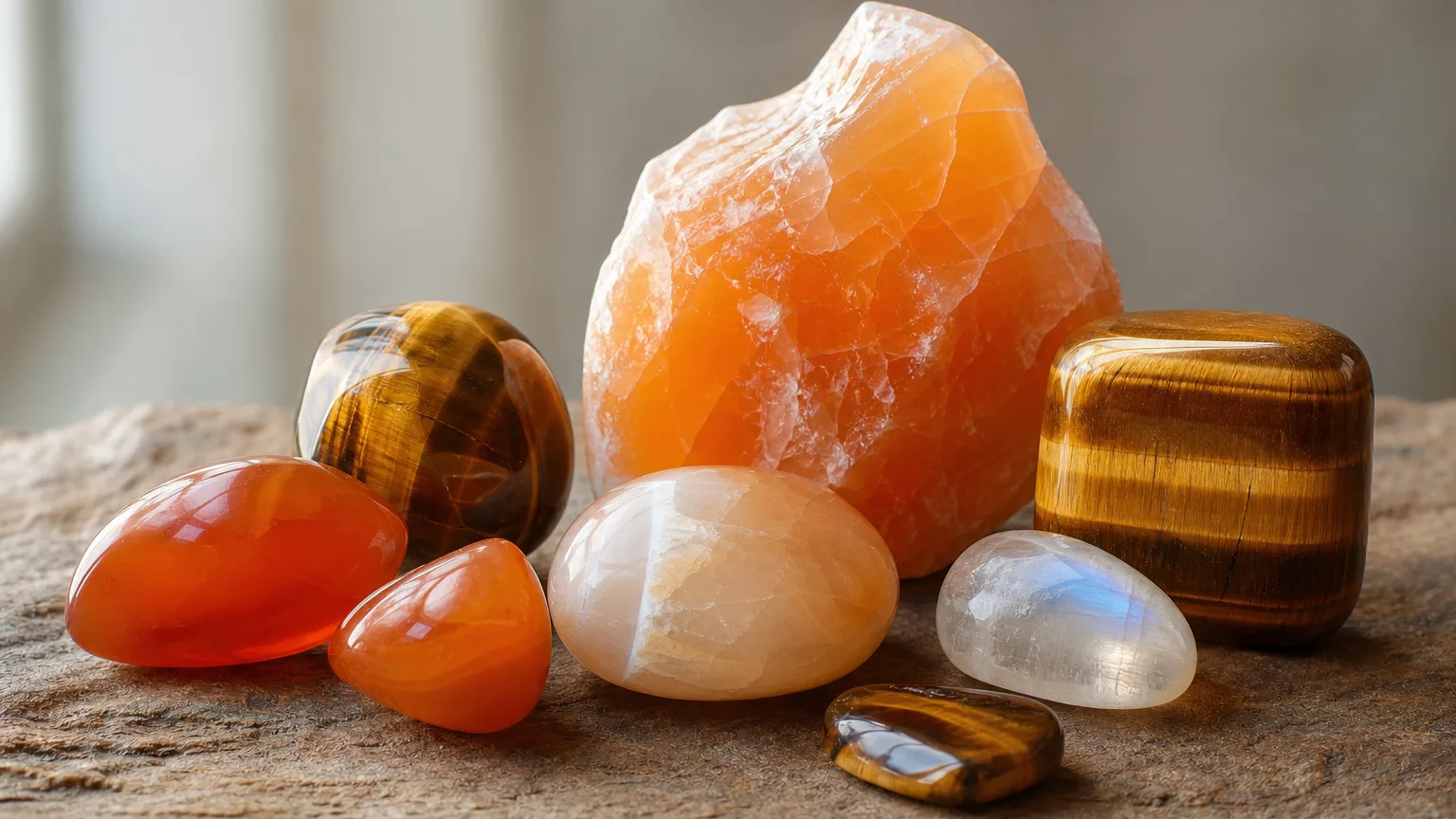
Best Sacral Chakra Crystals: Stones for Balance, Energy & Mindful Rituals
Quick Answer: Best Crystals for the Sacral Chakra
The best crystals for the Sacral Chakra include Tiger Eye, Carnelian, Moonstone, traditionally used in mindfulness and spiritual practices. Crystal properties are complementary wellness tools, not medical treatments.
Understanding the Sacral Chakra
The sacral chakra, or Svadhisthana in Sanskrit, sits in the lower abdomen just below the navel and is traditionally described as the body’s center of creativity, emotion, and pleasure. Where the root chakra below it is about stability and survival, the sacral is about what moves through you — feeling, sensing, creating, connecting. Many people picture it as a slow, warm current of water rather than a fixed point, which is one reason flowing stones like Carnelian and Moonstone are so often paired with it.
Across cultures the pelvic region has long carried a symbolic charge. Tantric and yogic traditions link it to the reproductive organs, kidneys, and the flow of desire; classical Western anatomy simply calls it the seat of the lower gut and hips. Either way, this is the area we tend to tighten when we feel guilty, criticized, or creatively blocked — and the area that softens when we feel safe enough to express ourselves.
In modern wellbeing language, the sacral chakra is often associated with emotional openness, healthy boundaries, and the kind of relaxed focus that lets a new idea take shape. You don’t have to accept the energy-center model to benefit from the framework — many people simply use it as a lens for noticing where they feel numb, where they feel stuck, and what kinds of supportive objects, movement, or color help them return to a more fluid state.
Quick facts: Sanskrit Svadhisthana · Position: Lower abdomen · Color: Orange · Element: Water. Balanced: Creative flow, emotional openness, healthy boundaries. Out of balance: Guilt, emotional numbness, creative blocks.
Not sure which chakra to focus on? Take the free Chakra Test ↗
12 Best Crystals for the Sacral Chakra
Œil-de-tigre
Chakra: Solar Plexus, Root, Sacral
Color: Golden brown (also blue/red)
Element: Fire
Idéal pour : Confidence, Willpower, Grounding
Best way to use: Carry or hold in meditation
Zodiac: Leo, Capricorn
Affirmation: I trust my instincts and move forward with steady courage.
Tiger Eye is a variety of quartz (SiO₂) whose gold-to-brown bands come from crocidolite fibers replaced by iron oxide, producing the silky chatoyant flash that shifts as you turn the stone. That warm metallic gleam reads to the eye as confidence and warmth, and the smooth polished surface feels grounding and substantial in the hand. Traditionally associated with the lower three chakras, it is often used as a steadying companion for the sacral center, helping transform shaky emotion into composed action. Many people keep a piece on their desk or in a pocket as a tactile anchor when starting something new — a small, tactile ritual that gently supports willpower and follow-through.
Cornaline
Chakra: Sacral, Solar Plexus, Root
Color: Orange, red-orange, reddish-brown
Element: Fire
Idéal pour : Confidence, Starting projects, Creative work
Best way to use: Wear as jewelry
Zodiac: Aries, Taurus, Virgo
Affirmation: I create freely and welcome pleasure without guilt.
Carnelian is a translucent chalcedony (microcrystalline SiO₂) colored by iron oxide in shades from peach to deep rust. The warm orange hue sits right on the sacral chakra’s traditional color key, and in color psychology orange is linked to warmth, sociability, and creative drive. Its glassy, slightly waxy surface feels smooth and bright against the skin. Long used as a talisman for courage and creative courage — Roman signet rings were carved from it — carnelian is often worn at the lower belly or wrist to support a sense of forward motion when motivation has gone flat. A simple practice is to hold it while naming one small thing you want to begin today.
Moonstone
Chakra: Third Eye, Crown, Sacral
Color: White/cream with blue-white sheen
Element: Water
Idéal pour : Intuition, Emotional balance, June birthstone
Best way to use: Wear as jewelry
Zodiac: Cancer
Affirmation: I move with my emotions instead of against them.
Moonstone is a feldspar whose layered structure scatters light into a soft blue-white glow called adularescence — a slow internal shimmer that genuinely seems to move as the stone turns. That cool, watery quality mirrors the sacral’s traditional water element, and the creamy tone offers a quieter counterpoint to bright orange stones. Across South Asian and Roman traditions it has been tied to lunar cycles and emotional tides, which is why it is so often chosen for hormonal or moody phases. Worn as a pendant or ring, it serves as a gentle self-care reminder to meet feelings with curiosity rather than bracing against them.
Citrine
Chakra: Solar Plexus, Sacral
Color: Yellow, golden-orange, brownish-yellow
Element: Fire
Idéal pour : Wealth, Confidence, Morning energy
Best way to use: Wear as jewelry
Zodiac: Aries, Leo
Affirmation: I welcome abundance and share it with an open heart.
Citrine is the yellow-to-orange variety of quartz (SiO₂), its color coming from trace iron heated within the earth (or, in much commercial material, by heat-treating pale amethyst or smoky quartz). Its golden-orange tones bridge the sacral and solar plexus centers, and warm yellows are linked in color psychology with optimism and outgoing energy. The stone has a clean glassy luster that feels light and cheerful in the hand. Traditionally called a merchant’s stone for prosperity, many people place citrine near a workspace or wear it in the morning to lift a flat, low-drive mood into something more sociable and generative.
Red Jasper
Chakra: Root, Sacral
Color: Brick red, terracotta, brown-red
Element: Earth
Idéal pour : Stamina, Focus, Stress relief
Best way to use: Wear as jewelry
Zodiac: Aries, Scorpio, Leo, Virgo
Affirmation: I am steady, patient, and quietly strong.
Red Jasper is an opaque chalcedony (SiO₂) colored brick-red by iron inclusions, with a dense, slightly waxy surface that feels solid and reassuring to hold. Where bright orange stones stimulate, red jasper steadies — making it useful when the sacral center feels overstimulated rather than blocked. The deep earthy red has long carried symbolism of endurance and grounded vitality across many cultures. Worn as a bracelet or placed on the lower abdomen during rest, it can support a simple slowing-down practice: a few minutes of focused breathing while feeling the weight of the stone, which many find helps ease mental spinning.
Read full Red Jasper meaning →
Bloodstone
Chakra: Root, Sacral, Heart
Color: Dark green with red spots
Element: Earth, Fire
Idéal pour : Courage, Vitality, Grounding
Best way to use: Wear as jewelry
Zodiac: Aries, Pisces
Affirmation: I act with courage even when I feel uncertain.
Bloodstone (heliotrope) is a dark green chalcedony (SiO₂) splashed with red iron-oxide spots, giving it a striking contrast that has fueled symbolism of courage and renewal for thousands of years. The green base is grounding while the red flecks suggest warmth and vitality, so the stone sits comfortably across the root, sacral, and heart centers. Its polish is glassy and cool, with surprising weight for its size. Traditionally carried as a talisman for bravery, bloodstone is often used as a pocket companion during demanding weeks — a tactile prompt to take the next small brave step rather than waiting for fear to pass first.
Read full Bloodstone meaning →
aegirine
Chakra: Root, Sacral, Solar Plexus
Color: Dark green to black
Element: Earth, Fire
Idéal pour : Protection, Boundaries, Breakthrough
Best way to use: Carry or hold in meditation
Zodiac: Aries, Scorpio, Capricorn
Affirmation: I release what no longer belongs to me and move on.
Aegirine is a sodium-iron silicate mineral that forms long, dark prismatic crystals in near-black to deep green, often found alongside other alkaline minerals in igneous rock. Its sharp, blade-like crystal habit and dark luster give it a distinctly protective feel that is hard to confuse with softer stones. Within the lower chakras it is often used to support healthy boundaries and the courage to clear outgrown patterns — useful when the sacral feels stuck in guilt or old stories. Held during meditation or placed near the lower body, it can anchor a simple letting-go practice of noticing and releasing tension on each exhale.
agate
Chakra: Root, Sacral
Color: Banded browns, greys, blues, oranges, whites
Element: Earth
Idéal pour : Grounding, Balance, Daily wear
Best way to use: Wear as jewelry
Zodiac: Gemini, Taurus
Affirmation: I stay balanced through the ups and downs of each day.
Agate is a banded form of chalcedony (SiO₂) built up in fine layers that record shifts in mineral content as the stone grows, producing the familiar concentric stripes in browns, greys, oranges, blues, and whites. Those layered bands give each piece a one-of-a-kind look while the surface stays smooth and waxy-cool. Because it is gentle and stable, agate is a favorite daily-wear stone for the lower chakras, often chosen when someone wants support without stimulation. Worn as a bracelet or kept on a bedside tray, it pairs well with a brief evening practice of laying the stone on the lower belly and taking five slow breaths.
agatized-coral
Chakra: Root, Sacral, Heart
Color: Grey, brown, pink, red, yellow (natural/dyed)
Element: Earth, Water
Idéal pour : Patience, Longevity, Grounding
Best way to use: Wear as jewelry
Zodiac: Taurus, Cancer
Affirmation: I trust the slow timing of my own growth.
Agatized coral forms when silica-rich groundwater gradually replaces an ancient coral skeleton with microcrystalline quartz over millions of years — preserving the original flower-like cellular pattern in stone. That blend of organic origin and mineral durability gives it a quiet symbolism of patience and long life, and it carries both the earthy weight of agate and a subtle water memory from its ocean origins, making it a natural fit for the sacral’s water element. Its texture is smooth and fossil-detailed, often in soft greys, pinks, and browns. Held or worn, it can support a slow-breathing practice for anyone learning to move at their own pace rather than rushing.
Read full agatized-coral meaning →
amber
Chakra: Sacral, Solar Plexus
Color: Yellow, Orange, Brown, Honey
Element: Fire
Idéal pour : Warmth, Protection, Comfort
Best way to use: Wear as jewelry
Zodiac: Leo, Aquarius
Affirmation: I carry warmth and light even on heavy days.
Amber is not a mineral but fossilized tree resin, often tens of millions of years old, with a warm honey-to-orange translucency that seems to hold light from within. Its color lands squarely in the sacral and solar plexus range, and its organic warmth has made it a comfort stone across Baltic and Mediterranean cultures for centuries. Light in weight and slightly warm to the touch, it feels gentle rather than dense. Many people wear amber as a necklace or pendant over the lower chest and belly as a soft, sun-colored reminder of warmth during stressful or low periods — a simple sensory cue to soften the body.
anglesite
Chakra: Root, Sacral
Color: Colorless, white, yellow, blue, green
Element: Earth
Idéal pour : Transformation, Grounding, Deep Protection
Best way to use: Wear, carry, or place in your space
Zodiac: Scorpio, Capricorn
Affirmation: I face change with a calm and grounded heart.
Anglesite is a lead sulfate mineral that forms transparent to pale-colored crystals with a notable brilliance and high density — it feels unexpectedly heavy for its size. Its clear-to-pale-yellow tones and prismatic clarity make it visually distinct from the opaque orange and red stones usually associated with the sacral, and it is often chosen for deeper, quieter protective work during periods of change. The cool glassy surface invites stillness rather than movement. Carried or placed in a small dish near the body, it can anchor a grounding practice of simply sitting with a transition — naming what is ending and what is beginning — without rushing to fix it.
augite
Chakra: Root, Sacral
Color: Dark green, black, brown
Element: Earth
Idéal pour : Grounding, Resilience, Endurance
Best way to use: Wear as jewelry
Zodiac: Capricorn, Scorpio
Affirmation: I stay steady and keep going, one step at a time.
Augite is a common pyroxene silicate mineral found in dark, blocky crystals ranging from deep green to black and brown — the kind of dark volcanic mineral that gives basalt its weight and grounding feel. Its dense, matte-to-submetallic surface reads as solid and unmovable, useful when the lower chakras need steadying rather than stimulation. Within the sacral center it is often used to build quiet resilience for long, demanding stretches. Worn as a bracelet or held briefly before a hard task, it can support a simple steadying ritual: one slow breath, one clear intention, then begin — a small pattern that turns endurance into something repeatable.
How to Choose by Your Sacral Chakra Need
Not every sacral issue is the same. Some days you want to open creative flow; other days the sacral feels overstimulated and you need to settle. Use this guide to match the stone to the need, not just to the chakra.
| Need | Best Crystals | Why |
|---|---|---|
| Waking up creative flow and motivation | Carnelian, Citrine, Amber | Warm orange-to-yellow tones traditionally associated with forward motion, sociability, and starting new projects. |
| Settling emotional intensity or mood swings | Moonstone, Red Jasper, Agate | Cooler or steadier stones often used to soften reactivity and bring a calmer, more even baseline. |
| Building confidence and courage to express yourself | Tiger Eye, Carnelian, Bloodstone | Stones long linked with steady courage, willpower, and turning shaky energy into composed action. |
| Setting boundaries and clearing old patterns | Aegirine, Bloodstone, Anglesite | Darker, more protective stones traditionally used for deep protection and supportive boundary-setting during change. |
| Grounding and endurance for demanding periods | Red Jasper, Augite, Agatized Coral | Dense, earthy stones often chosen for stamina, patience, and staying anchored under pressure. |
If several needs overlap, choose the stone that matches your strongest feeling today and pair it with a calmer grounding stone. There is no wrong answer — the goal is simply to notice what the sacral is asking for.
How to Use Sacral Chakra Crystals
How you use a sacral stone matters as much as which one you choose. Because this center sits in the lower abdomen, the body positions below all place attention in that area.
Wear it. A bracelet, ring, or pendant keeps the stone in your field all day. Carnelian, Moonstone, Citrine, and Amber are popular for jewelry because their warm or luminous colors are easy to live with. For sacral work specifically, a pendant that rests around the lower sternum or a stone carried at the hip line keeps the contact low in the body.
Meditate with it. Lie down and place the stone directly on the lower abdomen, about two fingers below the navel — the traditional location of Svadhisthana. Close your eyes and breathe slowly into that area for 5–10 minutes, imagining a warm orange glow that softens with each exhale. This is the most direct placement for sacral work and pairs well with Moonstone, Carnelian, or Red Jasper.
Place it in your space. Keep a sacral stone on your desk, bedside table, or near wherever you do creative work. Seeing it acts as a sensory cue to soften the belly and return to breath. Agatized Coral, Tiger Eye, and Agate work well as environmental pieces.
Use it during movement. Because the sacral is a water-and-movement center, stones combine beautifully with hip-opening yoga, dance, or a slow walk. Hold a Carnelian or place a Moonstone nearby while you move — the combination of tactile contact and pelvic motion is one of the simplest ways to shift a stuck mood.
Not sure which chakra to focus on? Take the free Chakra Test ↗
Beyond Crystals: Other Ways to Balance the Sacral Chakra
Crystals work best alongside simple, body-based practices. Because the sacral center is about flow, creativity, and pleasure, the most supportive habits are the ones that get energy moving through the hips and lower belly.
Dance. Five minutes of free movement to a favorite song — no choreography, no goal — is one of the fastest ways to wake the sacral. Let the hips lead. Many people find this more effective than seated meditation when they feel creatively flat.
Creative journaling. Stream-of-consciousness writing, doodling, or working with colors (especially oranges and warm tones) gives the creative center somewhere to go. Try a three-page morning brain-dump with a warm drink; the point is flow, not polish.
Hip-opening yoga. Poses like Pigeon, Bound Angle, and gentle lunges directly stretch the pelvic region where the sacral sits. Even ten minutes a day can release stored tension you didn’t realize you were carrying.
Water rituals. The sacral’s traditional element is water. A warm bath, a slow shower visualizing tension washing away, or simply spending time near a river or the ocean can all help reset an overstimulated or numb sacral center.
Orange foods. A meal built around orange produce — sweet potato, carrot, mango, pumpkin, papaya — is a small, grounding way to bring the sacral’s color into daily life. Pair it with mindful eating and you’ve covered color, body, and breath in one act.
None of these replace crystals — they work with them. A morning that pairs a Carnelian bracelet with ten minutes of hip-opening yoga and a warm orange-rich breakfast will feel very different from one that skips all three.
FAQ
Where do I place sacral chakra crystals on the body?
The traditional placement is the lower abdomen, about two fingers below the navel. Lie down, rest the stone flat on the skin, and breathe slowly into that area for 5–10 minutes. You can also wear stones as jewelry near the hips or lower belly.
How do I cleanse sacral chakra crystals?
Rinse them under cool running water (a nod to the sacral’s water element), then let them dry in indirect sunlight or moonlight for a few hours. Note: Selenite and Amber need gentler care — Selenite can dissolve in water, and prolonged bright sun can dull Amber’s color over time. Use sound, smoke, or a brief moonlight placement for those instead.
Which crystal is best for the sacral chakra?
There is no single best stone. Carnelian is the most popular starter choice because its warm orange color matches the sacral’s traditional hue and it supports motivation. Moonstone is favored for emotional balance, and Tiger Eye for adding grounded confidence.
What are the signs of an unbalanced sacral chakra?
Common signs people report include creative blocks, feeling emotionally flat or numb, low drive, guilt around pleasure, or swings between over-feeling and shutting down. These are normal human experiences — the chakra framework is just one way to notice and work with them.
Can I combine sacral crystals with other chakras?
Yes. Many sacral stones — Carnelian, Tiger Eye, Bloodstone — also work with the root and solar plexus, so a single piece can support more than one center. A common pairing is a sacral stone (Carnelian) with a grounding root stone (Red Jasper or Hematite) for stability underneath creative energy.
How often should I work with sacral crystals?
Daily, briefly, is better than a long session once a month. Five minutes of lying with a stone on the lower abdomen, or wearing a bracelet through a normal day, builds a steadier effect than occasional intense practice.
Are sacral chakra crystals scientifically proven to work?
No. Crystal healing is a complementary wellness and spiritual practice, not a medically proven treatment. There is no solid clinical evidence that crystals heal disease or rebalance the body. Their value for most people lies in mindfulness, sensory grounding, and the ritual of paying attention to how they feel — not in any demonstrated physical effect. Always consult a qualified healthcare professional for medical concerns.
Do sacral crystals have to be orange?
Orange is the traditional sacral color and a helpful guide, but it isn’t a rule. Moonstone, Bloodstone, and Aegirine are not orange yet are widely used for the sacral center because of their calming, protective, or watery qualities. Match the stone to the feeling you want to support, not just the color.