
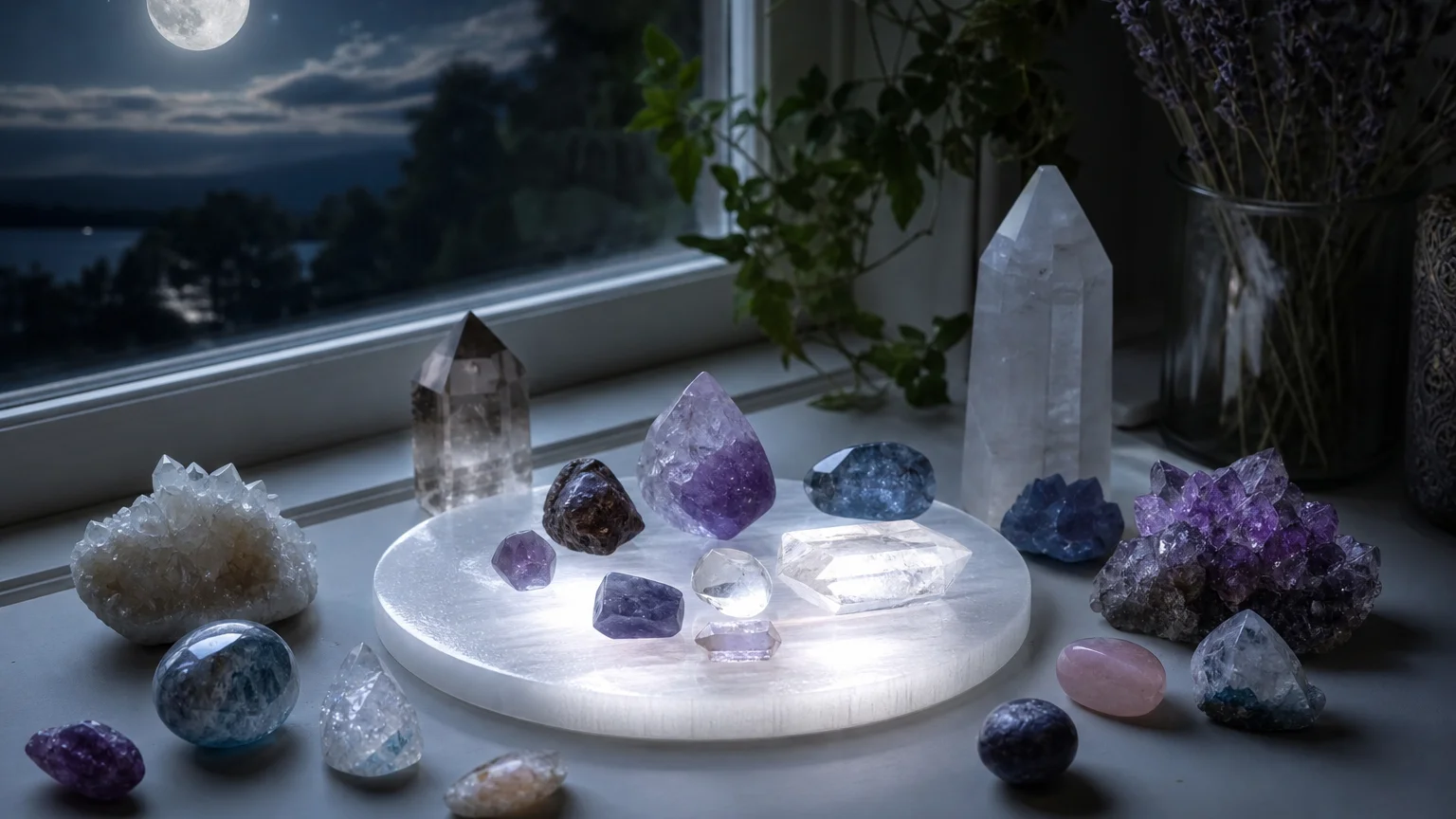
How to Charge Crystals: Meaning, Methods & When to Do It
Once a crystal is cleansed, the next question is how to keep it feeling “full.” Across many traditions, that second step is called charging — the ritual of replenishing a stone’s symbolic energy so it can continue in use. But just like cleansing, charging comes with a safety question that most guides gloss over: will this method damage my stone?
The single biggest rule of charging is also the simplest: cleanse first, charge second. You wouldn’t pour fresh water into a dirty glass, and the same logic applies here — a stone that still carries the residue of many hands isn’t ready to be “refilled.” Once it’s cleansed, the safest charging methods (moonlight, a selenite plate, sound) work for virtually every stone. Sunlight charging, on the other hand, is conditional: amethyst and rose quartz can fade in direct sun, so it’s reserved for sun-tolerant stones like citrine and clear quartz.
What you’ll find below: a clear explanation of what charging means (and how it differs from cleansing), six charging methods organized by safety, jewelry-specific tips for bracelets and necklaces, the mistakes to avoid, and answers to the questions buyers ask most. The goal is the same as cleansing — a mindful ritual that also happens to be good mineral care.
Quick Answer: How to Charge Crystals
The safest way to charge crystals is with one of four universal-safe methods: moonlight, a selenite plate, sound (a singing bowl or bell), or a crystal cluster. These work for virtually every stone because they involve no water, no salt, and no harsh chemistry — they replenish a stone’s symbolic energy without touching its physical structure.
- Safest universal methods: moonlight, a selenite plate, sound (singing bowl), or a crystal cluster — these work for virtually every stone, including jewelry.
- Before sunlight: not all crystals tolerate direct sun. Amethyst and rose quartz can fade; only sun-stable stones (citrine, clear quartz, tiger’s eye, black tourmaline) should go in sunlight, and even then, indirect or brief morning sun is safer.
- How long: from 5–10 minutes (sound) to overnight (moonlight or selenite) — see the method-by-method guide below.
One more thing before you start: cleanse first, charge second. Charging replenishes a stone’s energy, but it doesn’t clear what’s already there — so a quick cleanse (moonlight, selenite, sound, or smoke) comes first. If you’re unsure whether your stone can go in sunlight, default to moonlight or a selenite plate and skip the sun entirely. You can also check your stone’s sun tolerance in the Cleansing Timer and get a recommended charging method instantly.
What Does “Charging” a Crystal Mean?
The order matters more than people realize: cleanse first, charge second. Think of it like a cup. Cleansing empties the cup of whatever was in it before — the handling of miners, shippers, shopkeepers, previous owners. Charging is what you do next: refilling that now-empty cup with fresh water. If you skip the cleanse and go straight to charging, you’re pouring fresh energy on top of stale residue, and the stone never gets a clean starting point. So before any charging method below, make sure the stone has been cleansed first (see How to Cleanse Crystals).
So why charge at all? Across many traditions, a stone’s symbolic energy is thought to deplete over time — through heavy use, emotional intensity, or simply sitting untouched for long stretches. Charging is the ritual of restoring that “full” state so the piece can continue in use. Many people tie it to the lunar cycle (a full-moon recharge is the classic moment), others to milestones — the start of a new season, a difficult week, or whenever a stone starts to feel “dull” in the hand. The practice itself is simple: a pause, a placement, a deliberate act of care. Whether you read it as restoring energy or simply as a mindful monthly ritual, the goal is the same — keeping a meaningful object in good working order.
One distinction worth making clear early: charging is not the same as cleansing, and the two are often confused. Cleansing clears; charging replenishes. You do them in sequence, not interchangeably. Below is the focused comparison, with a fresh way to remember the difference — and a link to the full four-concept picture for anyone who wants it.
Charge vs Cleanse
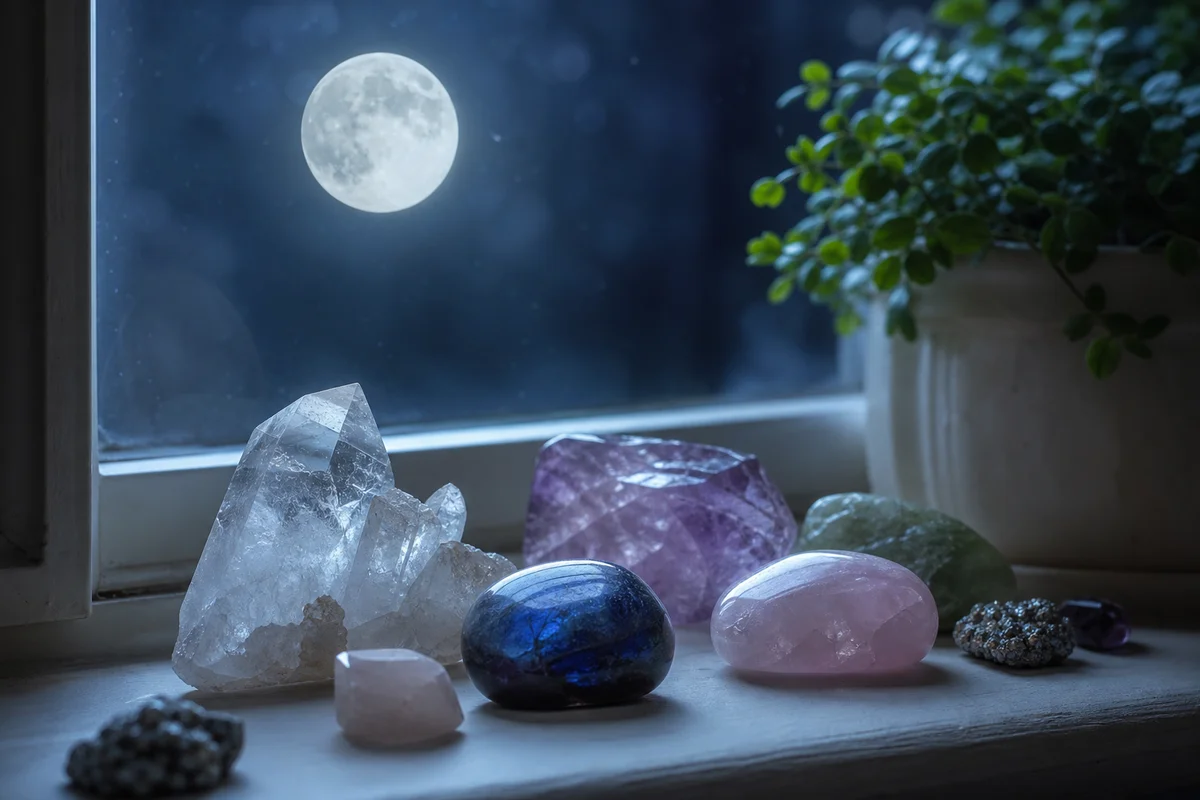
The cleanest way to tell charging and cleansing apart is the cup metaphor. Cleansing empties the cup; charging refills it. They’re a paired sequence, not alternatives — you cleanse to clear out the old, then charge to top up with the new. Running them in reverse (charging a stone that was never cleansed) is like refilling a cup without rinsing it first: the result is a mix, not a fresh start.
- Cleanse clears; charge replenishes. Cleansing resets a stone’s symbolic energy state; charging restores it afterward. Different jobs, done in sequence.
- The order is fixed: cleanse first, charge second. Charging on top of an uncleansed stone doesn’t give you a clean slate — it layers new on top of old.
- Frequency differs. Cleanse a new stone, monthly, or on the full moon; charge after cleansing, or whenever a stone feels “low.” A stone can be cleansed without charging, but charging ideally follows a cleanse.
For the full four-concept comparison (Cleanse, Charge, Activate, Program), see How to Cleanse Crystals, see How to Cleanse Crystals (full four-concept comparison).
How to Charge Crystals: 4 Methods (Ranked by Safety)
Not all charging methods carry the same risk. Below, six common methods are grouped into three tiers — from universal-safe (recommended for every stone, including jewelry) to higher-risk or niche methods that suit some situations but not others. The single safety axis that matters most for charging is sunlight: direct sun can fade color-sensitive quartz, so it sits in Tier 2. Read the tiers in order — if a Tier 1 method fits your situation, there’s rarely a reason to go further.
🟢 Tier 1 — Safest & Recommended for All Stones
最安全通用,新手首选 / 首饰无接触
🌙 Moonlight
What it does (tradition): The full moon is considered the most potent time to recharge a stone’s symbolic energy — a monthly refill tied to the lunar cycle.
How it works (practical): Moonlight is reflected sunlight at roughly 1/400,000 the intensity — gentle enough for every mineral, including color-sensitive stones that must avoid direct sun.
Best for: every stone — especially color-sensitive quartz (amethyst, rose quartz) that must avoid direct sun, and a first charge for a new piece. The full moon is the classic charging moment in many traditions.
Method-specific safety notes: Extremely low UV intensity vs direct sun (roughly 1/400,000); generally one of the safest light methods for all minerals.
Jewelry tip: 满月夜把手链/项链放窗台——整条charge不动,绳子/金属/石头都不受损(best no-contact charge for bracelets/necklaces)
Steps:
- Place crystals on a windowsill or covered porch at sunset
- Leave overnight (6–12 hours); the full moon is ideal
- Bring in before sunrise to avoid dew or direct sun
How long: Overnight (6–12 hours)
✨ Selenite Plate / Bowl
What it does (tradition): Selenite is widely considered self-cleansing and is said to keep stones placed on it ‘full’ — a passive overnight recharge.
How it works (practical): No chemical interaction — completely harmless. Handle gently, as selenite itself is soft (Mohs 2).
Best for: jewelry above all — bracelets, necklaces, and rings rest on the plate with zero water, salt, or handling. Also ideal for soft and porous stones that need a no-contact method.
Method-specific safety notes: No chemical interaction — completely harmless to other stones. The selenite itself is soft (Mohs 2); avoid dragging hard stones across its surface to prevent scratching.
Jewelry tip: 首饰专长:把手链/项链放selenite plate上过夜charge即可,零接触零风险
Steps:
- Place crystals on a selenite plate, bowl, or bar
- Leave 6+ hours or overnight
- Avoid dragging hard stones across the selenite surface
How long: 6+ hours (or overnight)
🔔 Sound (Singing Bowl / Bell)
What it does (tradition): Sustained sound vibrations are believed to restore a stone’s energy — a fast recharge for a whole collection.
How it works (practical): Sound waves are far too low-energy to affect any mineral’s structure — harmless to every stone.
Best for: when you need speed and have many pieces — a singing bowl or bell recharges an entire collection at once in minutes. A practical choice for soft stones where you’d rather avoid any handling.
Method-specific safety notes: Sound waves are far too low-energy to affect any mineral’s structure — harmless to every stone.
Jewelry tip: Works for an entire jewelry collection at once — no need to handle each piece.
Steps:
- Play a singing bowl, bell, or tuning fork near the crystals
- Continue for 5–10 minutes
- Works for your whole collection at once
How long: 5–10 minutes
🟡 Tier 2 — Conditional, Check Your Stone First
有条件,先查阳光耐受性
☀️ Sunlight (Indirect / Brief)
What it does (tradition): The sun’s energy is associated with vitality and warmth — a midday recharge for sun-tolerant stones.
How it works (practical): Direct sun can fade color-sensitive quartz (amethyst, rose quartz, citrine) and cause heat stress even in hard stones. Use indirect light or brief morning sun only.
Best for: only sun-stable stones (citrine, clear quartz, tiger’s eye, black tourmaline) — and even then, indirect or brief morning sun only. Never use direct sun on amethyst, rose quartz, or fluorite (color fades).
Jewelry tip: 避免把amethyst/rose quartz手链放阳光下charge——颜色会褪;改用moonlight或selenite plate
Steps:
- Confirm your stone tolerates sun (citrine, clear quartz, tiger’s eye, black tourmaline — NOT amethyst/rose quartz/fluorite)
- Place in indirect sunlight or brief morning sun (1–2 hours max)
- Never leave color-sensitive stones in direct sun
How long: Short indirect exposure
🔴 Tier 3 — Higher Risk / Niche, Use with Care
高风险/小众,谨慎使用
🌍 Earth Burial
What it does (tradition): Burying crystals returns them to the earth to absorb and restore energy — a deep grounding recharge.
How it works (practical): Soil moisture and organic acids can stain or etch soft, porous stones — always wrap in cloth first.
Best for: high-hardness raw stones (Mohs 7+) with no metal settings — a deep grounding ritual for those drawn to burying a stone in soil overnight. Wrap the stone in natural cloth first, and keep jewelry pieces away from this method.
Method-specific safety notes: Only high-hardness stones (Mohs 7+); soil moisture and organic acids can stain or etch soft, porous stones — always wrap in natural cloth first. No metal settings (soil moisture tarnishes/loosens them).
Jewelry tip: 玉石文化’返璞归真’ / 大地冥想 (瑜伽grounding语境) — only high-hardness stones (Mohs 7+), no metal settings; wrap in cloth first.
Steps:
- Wrap the stone in a natural cloth
- Bury in soil (garden or houseplant pot)
- Leave about 24 hours
- Brush off soil gently when done
How long: 24 hours (up to 3 days)
💎 Crystal Cluster
What it does (tradition): Resting a stone on a large crystal cluster (clear quartz or amethyst) is said to recharge it through the cluster’s collective energy.
How it works (practical): No chemical interaction — harmless to every stone. The cluster is a durable, passive charging base.
Best for: collectors who already own a large cluster — a passive, decorative charging base that also doubles as a display. Works for every stone with no risk.
Steps:
- Place a large clear quartz or amethyst cluster on a stable surface
- Rest smaller stones on or around the cluster
- Leave 24+ hours for a full recharge
How long: 24+ hours
Crystal Safety Quick Reference (Sun & Water Tolerance)
Which stones tolerate sunlight charging. When unsure, default to moonlight, selenite, or sound.
| Stone group (examples) | Water | Sun | Jewelry-safe | Quick note |
|---|---|---|---|---|
| Soft / porous / copper-bearing / water-reactive Selenite, Malachite, Calcite, Pyrite | ❌ avoid | ⚠️ indirect | ✅ (no-contact) | Dry / no-contact methods only — moonlight, selenite plate, sound, smoke |
| Color-sensitive quartz Amethyst, Rose Quartz, Fluorite | ⚠️ brief rinse | ❌ fades | ✅ | No direct sun (color may fade) — moonlight is the safer light method |
| Durable stones (Mohs 7+) Clear Quartz, Tiger’s Eye, Carnelian, Black Tourmaline | ✅ brief rinse | ⚠️ short indirect | ✅ | Durable but avoid prolonged soaking; for jewelry, selenite/moonlight still the gentlest default |
| All stones (universal safe) Any mineral | ✅ safe | — | — | The four universal-safe methods — use these when unsure of a stone’s tolerance |
💡 Not sure if your stone can go in sunlight?
Crystal Cleansing Timer → check its sun/water/salt safety, get the recommended charging method, and start a guided countdown.
Stones That Pair Naturally with Charging
Some stones come up again and again in charging conversations — a sun-tolerant favorite, a self-charging plate, a forgiving beginner piece. Below are six stones that each illustrate something useful about charging, with a note on which methods suit them. Every entry follows the same safety-first principle: when in doubt about sunlight, use moonlight or a selenite plate.
Citrine — The Sunlight-Charged Favorite
Citrine is the natural fit for sunlight charging — and one of the few color-stable quartz varieties that tolerates brief sun. Its warm color comes from iron and heat treatment rather than the irradiation that colors amethyst, so it’s far less prone to fading. For a citrine piece, a short stint in indirect morning sun is both a symbolic recharge and a gentle warmth. Just avoid prolonged direct sun even here (heat stress can affect any stone over time), and default to moonlight or a selenite plate if you’re unsure.
Citrine — Often associated with warmth and sunlight — a piece many enjoy as a bright accent in a collection. Color-stable (iron + heat) and sun-tolerant — the natural fit for sunlight charging, plus a warm bright accent in any collection. Safety note: Durable stone (Mohs 7) tolerates short indirect sunlight; avoid prolonged direct sun even for durable stones to prevent heat stress. Color (iron + heat) is more stable than amethyst but prolonged sun still not advised.
Read full Citrine meaning · Shop Citrine
Selenite — The Charging Plate Stone
Selenite is the charging plate stone — in tradition it’s considered self-cleansing, and it’s widely used as a plate or bowl to keep other stones “full.” Many people keep one selenite plate on the nightstand and rest their daily-wear pieces on it overnight, so charging happens passively while they sleep. The one rule: selenite itself is a soft form of gypsum (Mohs 2) and should stay dry. Never rinse it, never salt it. Moonlight and sound are its friends; water is not.
Selenite — A self-cleansing stone many use as a display plate to rest other pieces on — a practical care choice. Traditionally self-cleansing and used as a plate to recharge other stones — the natural mascot of the charging topic. Safety note: A soft form of gypsum (Mohs 2); can be damaged, scratched, or degraded by prolonged water exposure — keep dry. Self-cleansing in tradition; commonly used as a plate to rest other stones on.
Read full Selenite meaning · Shop Selenite
Clear Quartz — The Versatile Charger
Clear quartz is the versatile charger — durable at Mohs 7, sun-tolerant, and forgiving with any method. It charges well under moonlight, on a selenite plate, with sound, or in brief indirect sun. The only caution is to avoid prolonged direct sun (which can cause heat stress even in hard stones) and prolonged soaking. If you’re building a first collection and want one stone to learn the charging rituals on, clear quartz is the easiest choice.
Clear Quartz — A versatile piece collectors often describe as a neutral staple that pairs with any setting. Durable (Mohs 7), sun-tolerant, and a neutral staple — pairs with any charging method, beginner-friendly. Safety note: Durable stone (Mohs 7) tolerates short indirect sunlight; avoid prolonged direct sun even for durable stones to prevent heat stress. Brief water rinse safe; avoid prolonged soaking.
Read full Clear Quartz meaning · Shop Clear Quartz
Moonstone — The Lunar Charging Favorite
Moonstone is the lunar charging favorite — a stone many choose for its soft iridescent sheen and connection to moon-phase traditions. It’s a natural fit for moonlight charging, both symbolically and practically. Care-wise, moonstone sits at Mohs 6–6.5 with two perfect cleavages, so it asks for gentle handling: avoid rough treatment, prolonged soaking, and direct sunlight (which can dull the adularescent glow). A moonlit windowsill or a rest on a selenite plate treats it kindly.
Moonstone — A stone many choose for its soft iridescent sheen and connection to lunar ritual traditions. Soft iridescent sheen with a natural link to moon-phase charging traditions — differentiates from generic lists. Safety note: Mohs 6–6.5, two perfect cleavages — avoid rough handling and prolonged water/soaking. Indirect light preferred to protect the adularescent sheen.
Read full Moonstone meaning · Shop Moonstone
Amethyst — The Cautionary Example (Why Sun Safety Matters)
Amethyst is the cautionary example for sunlight charging — and including it here is deliberate. Its purple color comes from irradiation, and prolonged direct sunlight can fade it noticeably over time, turning a rich violet pale and washed out. For amethyst, use only moonlight, a selenite plate, or sound — never direct sun. If you remember one rule from this guide about charging, let it be: when a stone is color-sensitive, sunlight is off the table.
Amethyst — A stone many keep on their nightstand as part of a wind-down ritual before bed. Color fades with prolonged direct sunlight — the textbook case for why ‘check sun tolerance before sunlight charging’ is the headline message. Safety note: Color may fade with prolonged direct sunlight; indirect light or moonlight is the safer choice for color-sensitive stones. Durable (Mohs 7) but a color-sensitive quartz.
Read full Amethyst meaning · Shop Amethyst
Rose Quartz — The Bracelet Favorite
Rose quartz is the bracelet favorite — and like amethyst, it’s a color-sensitive quartz that must avoid direct sun. Its pink comes from titanium and manganese plus natural irradiation, and prolonged sunlight can fade it. For a rose quartz bracelet you wear daily, the gentlest charging method is a selenite plate overnight or a moonlit windowsill — no-contact, no risk to the color, and no stress on the cord.
Rose Quartz — A rose quartz bracelet many people wear as a daily reminder to be gentle with themselves. A common bracelet stone — wear as a daily reminder; needs no-contact charging (moonlight/selenite) to protect color from sun fade. Safety note: Color may fade with prolonged direct sunlight (titanium/manganese + irradiation color cause); indirect light or moonlight is the safer choice for color-sensitive stones.
Read full Rose Quartz meaning · Shop Rose Quartz
Explore more: Crystals for Anxiety · Shop Calm & Mindfulness
Common Mistakes to Avoid
Most charging mistakes come down to one thing: using sunlight on a stone that can’t take it. The five below are the ones we see again and again, and each one is easy to avoid once you know it. The fix is always the same — when in doubt about a stone’s sun tolerance, reach for moonlight or a selenite plate instead.
- Putting amethyst or rose quartz in direct sun to “charge.” Color-sensitive quartz fades with prolonged direct sunlight — a rich purple or pink turns noticeably paler over weeks and months. Fix: use moonlight or a selenite plate instead. Moonlight is reflected sunlight at roughly 1/400,000 the intensity, with no UV risk to any mineral.
- Charging a stone that was never cleansed. Charging on top of an uncleansed stone layers new energy on old residue — like refilling a cup without rinsing it. Fix: always cleanse first (moonlight, selenite, sound, or smoke), then charge. The two are a sequence, not interchangeable.
- Leaving a bracelet in direct sun all day. Even sun-tolerant stones can suffer heat stress with prolonged direct sun, and the cord or metal on a bracelet can degrade. Fix: for jewelry, skip sunlight entirely and rest the piece on a selenite plate or a moonlit windowsill overnight.
- Assuming “more sun = more charge.” Charging isn’t about intensity — a few hours of indirect light or an overnight on a selenite plate is plenty. Prolonged direct sun risks fading and heat stress without any added benefit. Fix: shorter, gentler exposures are safer and just as effective symbolically.
- Forgetting the full-moon cycle. The full moon is the classic charging moment in many traditions, but it’s easy to miss. Fix: tie charging to a monthly full-moon reminder — lay your stones and jewelry out the night of the full moon, and the rhythm takes care of itself.
💡 Not sure if your stone can go in sunlight?
Crystal Cleansing Timer → check its sun/water/salt safety, get the recommended charging method, and start a guided countdown.
Chargeing Crystal Jewelry (Bracelets & Necklaces)
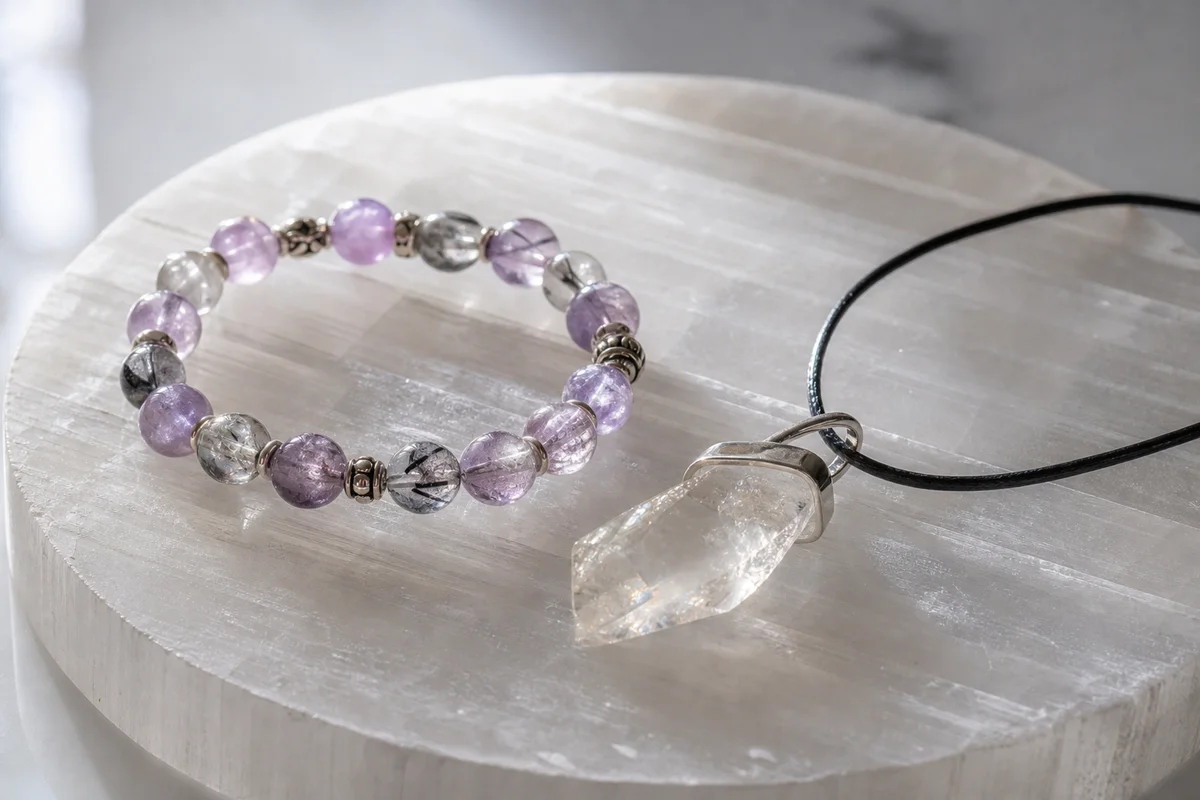
Most of this guide’s jewelry advice is already woven through the method sections above, so think of this as a quick recap. The short version: for any bracelet, necklace, or pair of earrings, the no-contact methods are your default. A selenite plate, a moonlit windowsill, or a singing bowl charges the whole piece — stone, cord, and metal — without exposing any of it to water, salt, or harsh sun. Save sunlight for loose, durable, sun-stable raw stones, and keep it away from anything with amethyst, rose quartz, elastic cord, or metal chain.
Quick jewelry tips:
- Which hand after charging? In many traditions, the non-dominant (receiving) hand is suggested for wearing a charged bracelet, since the dominant hand is seen as the giving side. Treat this as a personal ritual choice rather than a rule — what matters is that the piece feels intentionally yours.
- Full-moon windowsill. Once a month, lay your bracelets and necklaces on a windowsill under the full moon overnight (8+ hours). It’s the lowest-effort, lowest-risk charge in crystal care — no contact, no chemistry, no fading risk.
- A new bracelet’s first charge. When a new piece arrives, cleanse it first (to clear the handling of many hands), then charge it on a selenite plate or under the moon before its first wear. From there, a monthly full-moon cycle is usually enough for daily-wear pieces.
Frequently Asked Questions About Charging Crystals
How often should I charge my crystals?
Most daily-wear pieces benefit from a charge about once a month, often timed to the full moon — the classic charging moment in many traditions. You might also charge a stone after a period of heavy use, emotional intensity, or whenever it starts to feel “dull” in the hand. Stones that sit undisturbed on a shelf need it less often. There’s no fixed schedule — let the rhythm feel meaningful rather than compulsory.
What is the best way to charge crystals?
The best method for most people is moonlight or a selenite plate — both are universal-safe (they work for virtually every stone, including color-sensitive quartz and jewelry), require no sunlight, and involve no handling that could damage soft minerals. If you want speed, a singing bowl (sound) charges a whole collection in 5–10 minutes. Reserve sunlight for sun-stable stones you’ve confirmed can take it.
How long does it take to charge a crystal?
It depends on the method. Sound takes 5–10 minutes. Sunlight (for tolerant stones) is 1–2 hours of indirect or morning sun. Selenite needs 6+ hours, usually overnight. Moonlight asks for a full overnight (6–12 hours). Earth burial takes about 24 hours, and a crystal cluster needs 24+ hours. The Cleansing Timer can start a guided countdown for whichever method you choose.
How do I know when my crystals need charging?
The most common sign people describe is a stone that feels “dull” or less present in the hand — a subtle sense that it’s not as engaged as when you first got it. Others simply follow a rhythm: charge on the full moon, at the start of a new season, or after a period of heavy use. None of this is scientifically measurable (there’s no instrument that reads a stone’s “charge”), but as a mindful maintenance rhythm, “whenever it feels low or monthly, whichever comes first” works well for most people.
Which crystals can be charged in sunlight?
Only sun-stable stones — citrine, clear quartz, tiger’s eye, and black tourmaline are the common ones. Even then, use indirect sunlight or brief morning sun (1–2 hours), never prolonged direct sun. Never put amethyst, rose quartz, or fluorite in direct sunlight — their colors fade. When in doubt about a stone’s sun tolerance, use moonlight or a selenite plate instead; they work for every stone with zero fading risk.
Can I charge my crystal bracelet in sunlight?
Only if the bracelet is made of sun-stable stones (citrine, clear quartz, tiger’s eye, black tourmaline) — and even then, indirect or brief morning sun only. If the bracelet contains amethyst, rose quartz, or fluorite, sunlight will fade the stones over time. For most jewelry, the safer choice is a selenite plate overnight or a moonlit windowsill — they charge the whole piece without risking the color or stressing the cord and metal.
Do I need to cleanse before charging?
Yes — and it’s the recommended order. Cleanse first, charge second. Cleansing clears the residue of many hands; charging replenishes the stone afterward. Charging on top of an uncleansed stone is like refilling a cup without rinsing it — the result is a mix, not a fresh start. A quick cleanse (moonlight, selenite, sound, or smoke) followed by a charge gives you the cleanest outcome.
Is there scientific evidence that charging crystals does anything?
The honest answer has two parts. The safety guidance is real mineralogy — which stones tolerate sunlight is a matter of color stability and chemistry, and it’s well documented (amethyst and rose quartz fade in direct sun). The energy side is not scientifically established: there is no scientific evidence that crystals store, deplete, or release energy. Many people still find value in charging as a mindfulness ritual — a monthly pause to care for meaningful objects and reset intentions. The two can comfortably coexist; you don’t have to accept the energy premise to benefit from the practice.
Will charging damage my crystal?
It can, if you choose the wrong method — specifically, sunlight. Direct sun can fade amethyst, rose quartz, and fluorite, and prolonged sun can cause heat stress even in hard stones. The universal-safe methods (moonlight, selenite, sound, crystal cluster) will not damage any stone. When in doubt about sun tolerance, use those — and check your stone’s tolerance before anything else.
What is the difference between cleansing and charging?
Cleansing clears; charging replenishes. You do them in sequence: cleanse first (to reset the stone’s symbolic energy and clear the handling of many hands), then charge (to restore it to a “full” state). A stone can be cleansed without charging, but charging ideally follows a cleanse. Think of the cup metaphor — cleansing empties the cup, charging refills it. For the full picture across all four care concepts, see How to Cleanse Crystals.
Can I charge crystals on a new moon?
Yes — both moon phases work, but they carry different symbolism in tradition. The full moon is the classic charging moment, associated with fullness and completion. The new moon is associated with new beginnings and setting intentions, so some people prefer it for stones they’re programming with a fresh goal. Either works practically (moonlight is gentle at any phase); choose the phase that matches the intention behind the charge.
Crystal charging practices are based on spiritual traditions, symbolism, and personal mindfulness. There is no scientific evidence that crystals store, deplete, or release energy, but the safety guidance (which stones tolerate sunlight) is real mineralogy — and the reason a mindful ritual can coexist with caring for your stones.
💡 Not sure if your stone can go in sunlight?
Crystal Cleansing Timer → check its sun/water/salt safety, get the recommended charging method, and start a guided countdown.