
How to Meditate with Crystals: Steps, Stones & Practices
Meditating with crystals is one of the oldest ways to use them — and one of the simplest. Across Indian yoga, Tibetan Buddhism, and other contemplative traditions, holding or placing a stone during meditation is a way to give the mind a steady anchor: something tactile or visual to return to whenever attention drifts. The stone doesn’t “do” anything mystical; it serves as a focus object, much like a mala bead, a candle, or a worry stone. What makes the practice powerful is the meditation itself, which is well-studied for its benefits, with the stone as a gentle, grounding companion.
There are four common ways to meditate with crystals, and they range from the simplest (holding one stone in your hand) to the most structured (a seven-stone chakra body layout). Before any of them, it helps to cleanse your stones — a piece that’s been handled by many people can feel “busy,” and a quick cleanse gives you a clean starting point. Beyond that, the only “rule” is to choose stones you’re drawn to and a practice that fits your style. If you’re not sure where to start, a short body-scan or chakra test can point you to the energy centers that need attention.
What you’ll find below: four meditation practices, a seven-center chakra body layout guide, stones that suit meditation, tips for using a bracelet or necklace in practice, and answers to the questions beginners ask most. Whether you meditate for five minutes or twenty, the goal is the same — a focused, restful practice with a stone as your anchor.
Quick Answer: How to Meditate Crystals
The simplest way to meditate with crystals is to hold one stone in your receiving hand for 5–15 minutes, using the feel of the stone as an anchor for your attention. All four practices below — holding, body placement, surrounding grid, and gazing — are safe for every stone, since they involve no water, salt, or harsh chemistry.
- Four safe practices: hold a stone in your hand, place stones on the body (chakra layout), surround yourself with a simple grid, or gaze softly at a single stone — all safe for every stone.
- Before meditating: cleanse your stones first (a piece handled by many people can feel “busy”). For body-layout meditation, check each stone’s tolerance — soft stones like selenite (Mohs 2) should be handled gently and kept dry.
- How long: from 5–10 minutes (gazing or holding) to 10–20 minutes (body layout or grid) — start short and lengthen as you get comfortable.
One more thing before you start: cleanse your stones first. A quick cleanse (moonlight, selenite, sound, or smoke) clears the residue of many hands and gives you a clean starting point for practice. If you’re using soft stones like selenite in a body layout, handle them gently — and if you’re unsure what a stone can tolerate, check its safety in the Cleansing Timer before placing it on your body.
Why Meditate with Crystals?
So why meditate with crystals at all? The honest answer is that the stone is a focus object, not a source of energy. Meditation itself is well-studied for its benefits — reduced stress, improved focus, better sleep — and the challenge for many beginners is simply keeping the mind anchored. A stone gives the hands or eyes something to rest on: when the mind wanders (as it naturally does), the feel of the stone in your hand or the sight of it in front of you gives you a gentle place to return. It’s the same role a mala bead, a worry stone, or a candle flame plays — a tactile or visual anchor that makes focus easier.
This way of using stones has deep roots in Eastern contemplative traditions. In Indian yoga and Tibetan Buddhism, holding an object during meditation — a mala (prayer bead), a small stone, or a ritual object — is a long-established way to steady the mind. The seven-center chakra system, which underlies the body-layout practice below, comes from these same traditions, where each energy center is associated with a region of the body and a quality of attention. Trataka, the yogic practice of softly gazing at a fixed point (traditionally a candle), inspires the gaze meditation below. None of this requires you to accept the energy premise — the practices work as focus techniques regardless.
Before any of the practices, take a moment to prepare your stones. A piece that’s been sitting in a shop or handled by many people can carry a sense of “busyness,” and a quick cleanse — moonlight, a selenite plate, sound, or smoke — gives you a clean starting point. This isn’t about clearing “negative energy” in any literal sense; it’s about beginning your practice with stones that feel ready and intentional. See How to Cleanse Crystals for the full guide.
The crystal meditation practices below draw on two related Eastern traditions. The chakra system — the seven energy centers used in body-layout meditation — comes from Indian yoga and is central to Tibetan Buddhist visualization practices. Trataka, the yogic candle-gazing technique, inspires the open-eyed gaze meditation. And the simple act of holding a stone or bead during meditation echoes the use of mala beads in Hindu and Buddhist practice, where a tactile anchor steadies the mind. You don’t need to follow any of these traditions to benefit — the practices work as focus techniques for anyone — but understanding their roots gives the rituals meaningful context.
How to Meditate with Crystals: 4 Practices
🟢 4 Crystal Meditation Practices
4种水晶冥想练习
🤲 1. Hold a Stone in Your Hand
What it does (tradition): Holding a single stone in your receiving hand while meditating is the simplest crystal practice — the stone becomes a tactile anchor for your attention.
How it works (practical): No physical effect — this is a mindfulness technique (similar to holding a worry stone or mala bead) that gives the mind something to return to.
Best for: beginners and anyone who wants the simplest entry — a single tumbled stone or worry stone is all you need.
Jewelry tip: 手链转手掌石:worry stone替代——拇指拨珠替代手持单石
Steps:
- Sit comfortably and hold one stone in your receiving (non-dominant) hand
- Close your eyes and breathe slowly
- When your mind wanders, return your attention to the feel of the stone
- Continue for 5–15 minutes
How long: 5–15 minutes
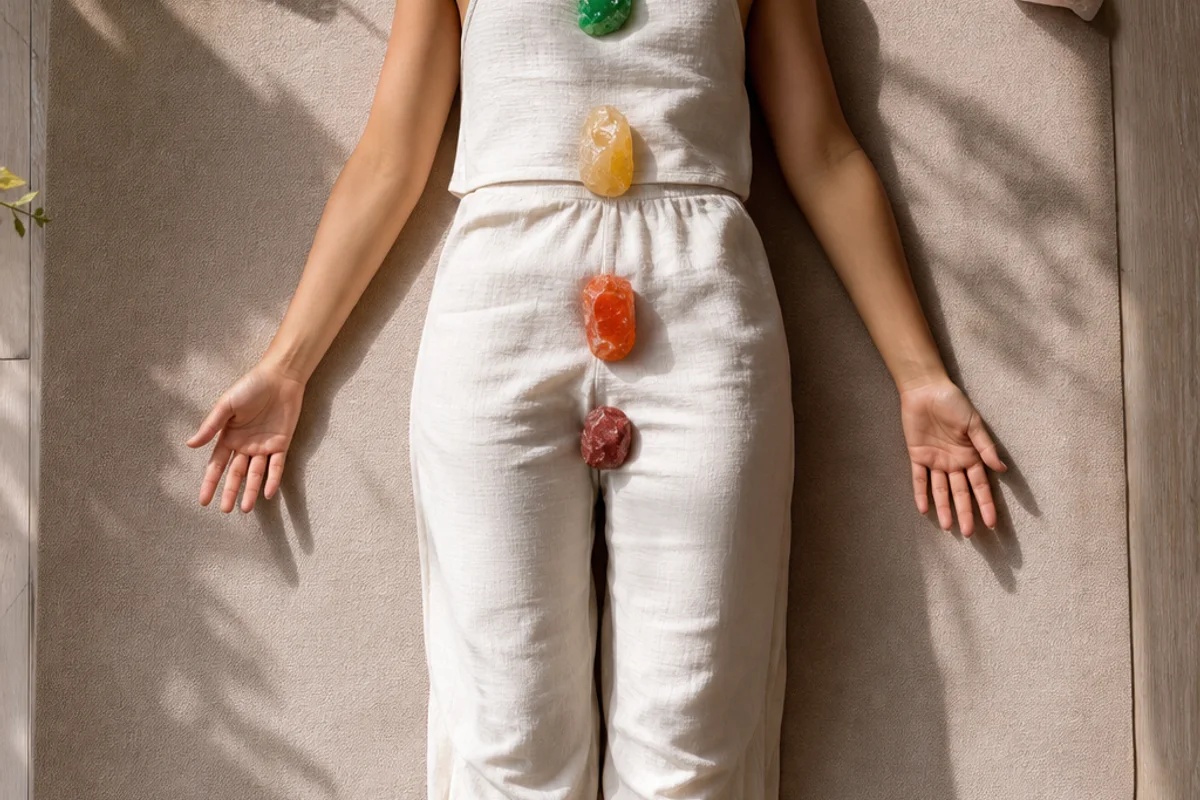
🌀 2. Place Stones on the Body (Chakra Layout)
What it does (tradition): Laying stones on the body’s seven energy centers (chakras) is a practice rooted in Indian yoga and Tibetan traditions — each center is associated with a region and a stone.
How it works (practical): No physical effect — this is a structured meditation that uses body placement as a focus, similar to yoga nidra or body-scan practices.
Best for: those who want a deeper, full-body practice — the seven-stone layout turns meditation into a structured ritual. Take our free Chakra Test first to see which centers to focus on.
Jewelry tip: 项链吊坠放心轮位置:佩戴的项链在heart center自然就位
Steps:
- Lie flat on your back in a comfortable space
- Place one stone at each of the seven centers (crown, brow, throat, heart, solar plexus, sacral, root) — see the body layout guide below
- Breathe slowly and rest for 10–20 minutes
- Remove the stones gently when done
How long: 10–20 minutes
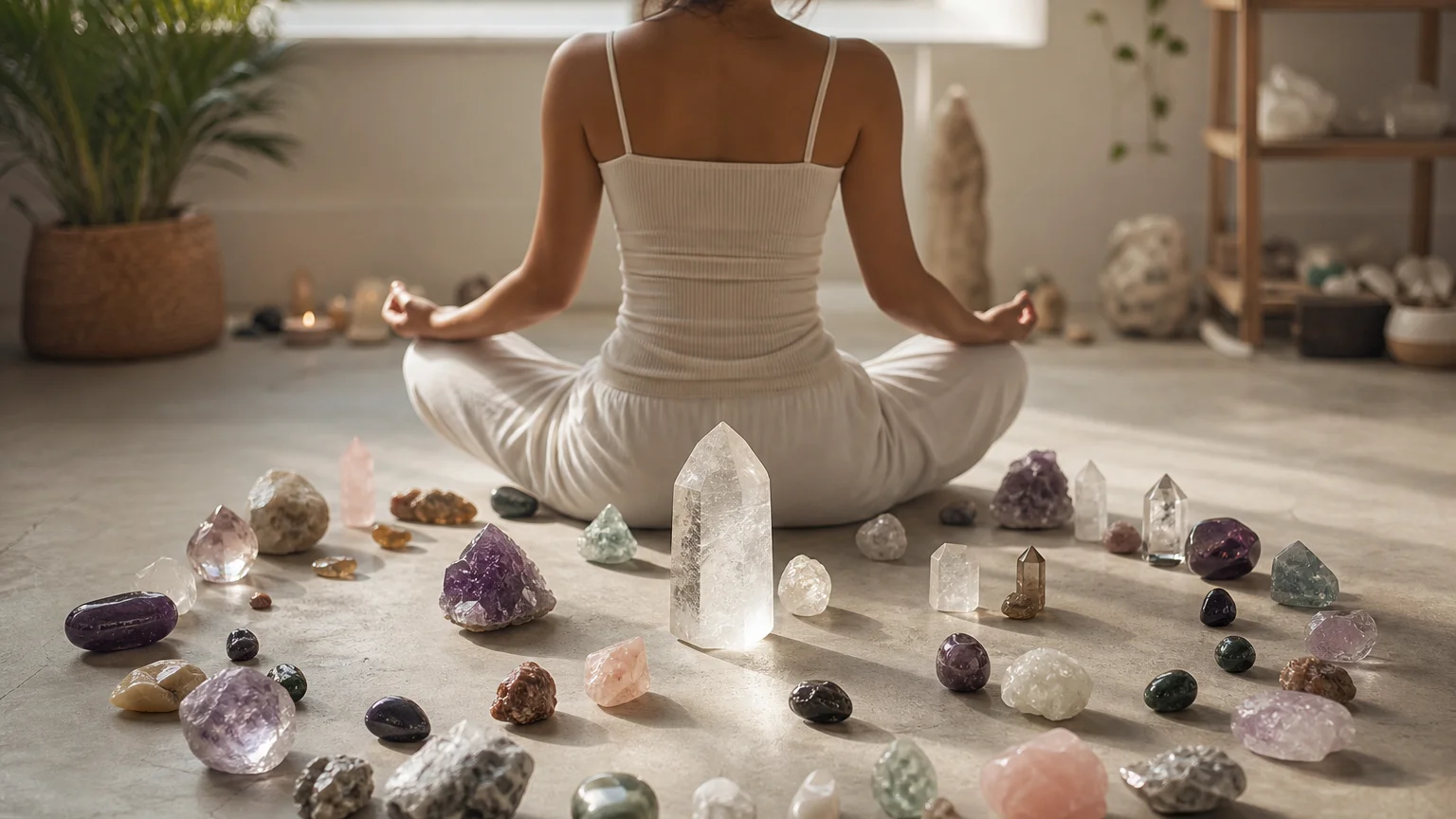
✨ 3. Surround Yourself (Simple Grid)
What it does (tradition): Placing several stones in a circle or pattern around you as you sit or lie within it is a simple crystal-grid meditation — the arrangement becomes the container for your practice.
How it works (practical): No physical effect — the grid is a spatial focus that helps define a dedicated meditation space.
Best for: those with a small collection who want a spatial, immersive practice — the grid defines a dedicated space without needing body placement.
Steps:
- Choose 4–8 stones and arrange them in a circle or simple pattern around your cushion or mat
- Sit or lie in the center
- Meditate with eyes closed for 10–20 minutes
- The arrangement marks the space as your practice area
How long: 10–20 minutes
👁️ 4. Gaze at a Stone (Trataka-Inspired)
What it does (tradition): Softly gazing at a single stone is inspired by trataka (a yogic candle-gazing practice) — the object becomes the steady focus for the mind.
How it works (practical): No physical effect — this is an open-eyed concentration practice; the stone’s surface gives the eyes a resting point.
Best for: those who find eyes-closed meditation difficult — an open-eyed gaze gives the mind a steady external anchor.
Steps:
- Place one stone at eye level, about an arm’s length away
- Sit comfortably and soften your gaze onto the stone
- Keep your eyes gently open, returning to the stone whenever they wander
- Continue for 5–10 minutes
How long: 5–10 minutes
The 7-Center Chakra Body Layout
The body-layout practice places one stone at each of the seven energy centers (chakras) while you lie flat. Rooted in Indian yoga and Tibetan traditions, each center is associated with a region of the body and a quality of attention. The layout below shows the seven centers, where to place each stone, and example stones for each — but the most meaningful version comes from knowing which centers you want to focus on. Not sure? Take the free Chakra Test first to see which of your centers need attention, then choose stones and a layout that match.
| Center | Position | Example stones |
|---|---|---|
| Crown | Top of head | Clear Quartz / Selenite |
| Brow (Third Eye) | Between eyebrows | Amethyst / Lapis Lazuli |
| Throat | Base of throat | Sodalite / Aquamarine |
| Heart | Center of chest | Rose Quartz / Green Aventurine |
| Solar Plexus | Upper abdomen | Citrine / Tiger’s Eye |
| Sacral | Lower abdomen | Carnelian / Moonstone |
| Root | Base of spine | Black Tourmaline / Hematite |
Not sure which centers to focus on? Take our free Chakra Test first. Take the free Chakra Test.
💡 Not sure which energy centers to focus on?
Chakra Test → see which of your seven centers need attention, then choose stones and a body layout that match.
Stones That Suit Meditation
Different stones suit different roles in meditation — held in the hand, placed at a specific center, or kept by the bed. Below are six stones that each illustrate something useful about meditating with crystals, with a note on how they’re commonly used. Every entry follows the same principle: choose a stone whose character suits the practice, and cleanse it before you begin.
Amethyst — The Meditation Classic
Amethyst is the meditation classic — the most common stone held in the hand or placed at the brow (third eye) during practice. Traditionally associated with calm and clarity, it’s a natural fit for a wind-down meditation before bed. For amethyst, remember the sun caution: it’s a color-sensitive quartz, so keep it out of direct sunlight during any cleansing prep. Held in the receiving hand or rested on the brow, it’s a gentle, forgiving stone for beginners.
Amethyst — A stone many keep on their nightstand as part of a wind-down ritual before bed. The most common meditation stone — held in the hand or placed at the brow (third eye) as part of a wind-down practice. Safety note: Color may fade with prolonged direct sunlight; indirect light or moonlight is the safer choice for color-sensitive stones. Durable (Mohs 7) but a color-sensitive quartz.
Read full Amethyst meaning · Shop Amethyst
Clear Quartz — The Clarity-Focus Stone
Clear quartz is the clarity-focus stone — versatile, durable, and a neutral anchor for any meditation. Held in the receiving hand, its smooth weight gives the mind something to return to whenever attention drifts. Because it’s neutral, it suits any practice: holding, body layout (often at the crown), grid, or gazing. For beginners who want one stone that works for everything, clear quartz is the easiest choice.
Clear Quartz — A versatile piece collectors often describe as a neutral staple that pairs with any setting. Versatile and durable — held in the receiving hand as a neutral focus anchor for any meditation. Safety note: Durable stone (Mohs 7) tolerates short indirect sunlight; avoid prolonged direct sun even for durable stones to prevent heat stress. Brief water rinse safe; avoid prolonged soaking.
Read full Clear Quartz meaning · Shop Clear Quartz
Rose Quartz — The Heart-Center Stone
Rose quartz is the heart-center stone — placed at the center of the chest in body-layout meditation, where the heart center sits. Traditionally associated with gentleness and compassion, it’s a forgiving stone for a heart-focused practice. For a daily-wear piece, a programmed rose quartz bracelet also doubles as a worry stone during seated meditation — thumb the beads as a tactile anchor. Keep it out of direct sun to protect the color.
Rose Quartz — A rose quartz bracelet many people wear as a daily reminder to be gentle with themselves. Placed at the heart center in body-layout meditation — a gentle, forgiving stone for beginners. Safety note: Color may fade with prolonged direct sunlight (titanium/manganese + irradiation color cause); indirect light or moonlight is the safer choice for color-sensitive stones.
Read full Rose Quartz meaning · Shop Rose Quartz
Selenite — The Crown-Center Stone
Selenite is the crown-center stone — placed at the top of the head in body-layout meditation, where the crown center sits. Traditionally associated with clarity and connection, it’s a meaningful stone for a crown-focused practice. The one caution: selenite is a soft gypsum (Mohs 2), so handle it gently when placing and removing it, and keep it dry. A plate or tumbled piece is easier to place than a raw wand for body layout.
Selenite — A self-cleansing stone many use as a display plate to rest other pieces on — a practical care choice. Placed at the crown (top of head) in body-layout meditation — handle gently (Mohs 2). Safety note: A soft form of gypsum (Mohs 2); can be damaged, scratched, or degraded by prolonged water exposure — keep dry. Self-cleansing in tradition; commonly used as a plate to rest other stones on.
Read full Selenite meaning · Shop Selenite
Black Tourmaline — The Root-Center Grounding Stone
Black tourmaline is the root-center grounding stone — placed at the base of the spine in body-layout meditation, where the root center sits. Traditionally associated with steadiness and grounding, it suits a grounding practice at the start or end of a long day. It’s durable and sun-stable, which makes it a forgiving stone for handling. For daily wear, a black tourmaline bracelet doubles as a grounding touchstone you can thumb during seated meditation.
Black Tourmaline — A popular choice for those who like a grounding touchstone during a busy workday. Placed at the root (base of spine) for grounding meditation — durable and sun-stable. Safety note: Durable stone (Mohs 7–7.5), sun-stable. Brief water rinse safe. Popular daily-wear stone (bracelets) — frequent contact with skin oils/sweat makes regular cleansing practical care, not just ritual.
Read full Black Tourmaline meaning · Shop Black Tourmaline
Moonstone — The Bracelet-as-Worry-Stone
Moonstone is the bracelet-as-worry-stone — a meditation bracelet you can thumb during seated practice, echoing the use of mala beads in Eastern traditions. Its soft iridescent sheen and link to lunar traditions suit an intuition-focused meditation. Handle it gently (Mohs 6–6.5, two cleavages) and keep it out of prolonged water and direct sun. Worn daily, it doubles as a mini-meditation reminder whenever you notice it.
Moonstone — A stone many choose for its soft iridescent sheen and connection to lunar ritual traditions. A meditation bracelet can double as a worry stone — thumb the beads during seated practice. Safety note: Mohs 6–6.5, two perfect cleavages — avoid rough handling and prolonged water/soaking. Indirect light preferred to protect the adularescent sheen.
Read full Moonstone meaning · Shop Moonstone
Explore more: Crystals for Anxiety · Shop Calm & Mindfulness
Common Mistakes to Avoid
Meditation mistakes are usually about expectations or setup rather than the stones themselves. The five below are the ones we see most often, and each one is easy to adjust. The underlying principle: meditation is a practice, not a performance, and the stone is an anchor, not a magic object.
- Expecting the stone to “do the work.” The stone is a focus object, not a source of calm — the benefit comes from the meditation itself. Fix: treat the stone as an anchor for your attention, and let the practice (breathing, focus, stillness) do the work. The stone makes focus easier; it doesn’t replace it.
- Skip the cleanse before meditating. A stone that’s been handled by many people can feel “busy,” and starting with an uncleansed piece can feel distracting. Fix: give your stones a quick cleanse (moonlight, selenite, sound) before practice, so you begin with pieces that feel ready and intentional.
- Handling soft stones roughly in body layout. Selenite (Mohs 2) and other soft stones can scratch or chip if placed or removed carelessly. Fix: handle soft stones gently during placement and removal — set them down lightly rather than dropping or dragging them.
- Forcing a long session too soon. Starting with a 30-minute body layout when you’re new to meditation often leads to restlessness rather than focus. Fix: start short (5–10 minutes) and lengthen as you get comfortable. A consistent short practice beats an inconsistent long one.
- Using too many stones at once. A seven-stone body layout is meaningful, but for a beginner, seven unfamiliar stones can feel cluttered rather than focused. Fix: start with one stone (held in the hand) and add more as you get comfortable. The chakra layout works best when you already know which centers you want to focus on.
Using Jewelry in Meditation
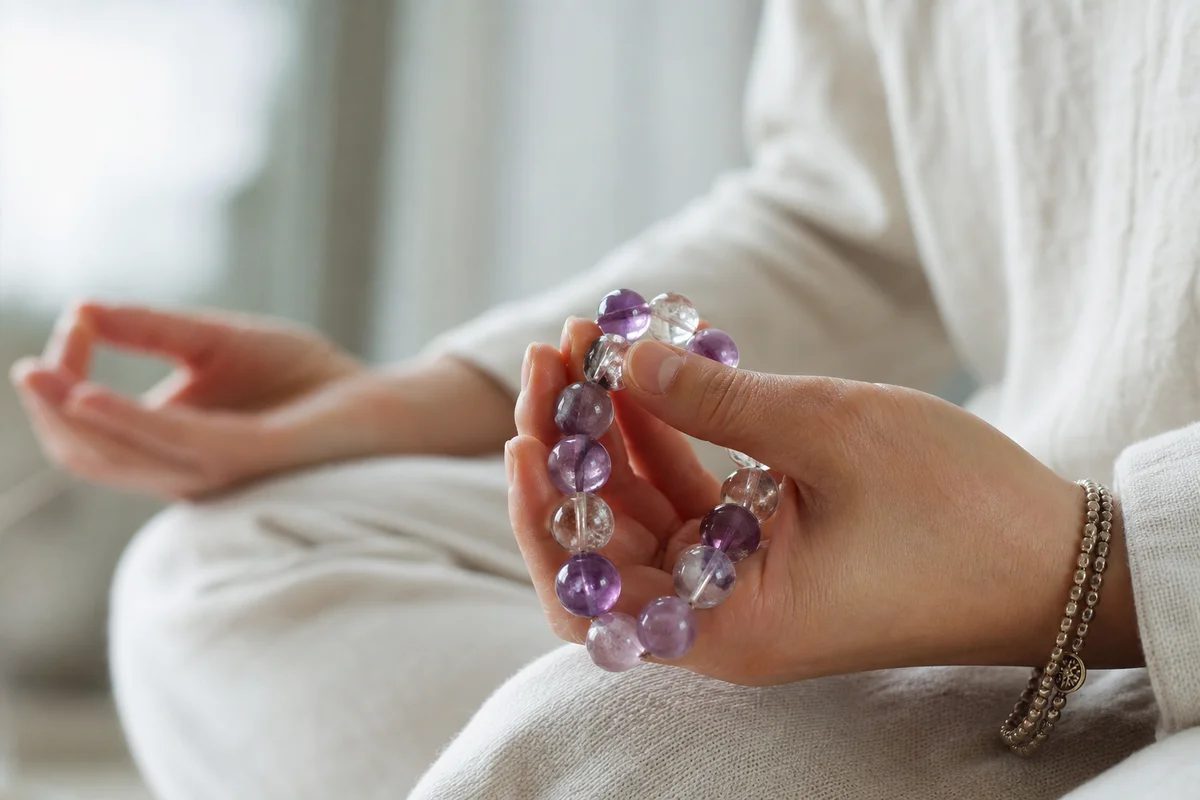
You don’t need loose stones to meditate — a bracelet or necklace works just as well as an anchor. The two easiest ways: use a bracelet as a worry stone (thumb the beads slowly during seated meditation, echoing the use of mala beads in Eastern traditions), or wear a necklace with a pendant at the heart center (where it naturally rests during practice). For daily wear, a meditation piece doubles as a mini-reminder whenever you notice it during the day.
- Bracelet as worry stone. During seated meditation, thumb the beads of a bracelet slowly — one bead per breath — as a tactile anchor. It’s the same role a mala bead plays in Hindu and Buddhist practice, and it gives the mind a steady rhythm to follow.
- Necklace at the heart center. A pendant necklace naturally rests at the center of the chest — the heart center in the chakra layout. During meditation, the weight and position of the pendant give you a built-in focal point without needing to place stones on your body.
Frequently Asked Questions About Meditating with Crystals
How do I meditate with crystals for beginners?
The simplest beginner practice is to hold one stone in your receiving (non-dominant) hand for 5–15 minutes. Sit comfortably, close your eyes, breathe slowly, and whenever your mind wanders, return your attention to the feel of the stone. That’s the whole practice. Before you begin, cleanse the stone (a quick moonlight or selenite reset) so you start with a piece that feels ready. As you get comfortable, you can explore body-layout, grid, or gaze meditation.
What is the best way to meditate with crystals?
The best method depends on your style. For most beginners, holding a single stone in the hand is the easiest entry — it’s simple, portable, and gives the mind a clear tactile anchor. If you want a deeper, full-body practice, the seven-stone chakra body layout (lying flat with one stone at each energy center) is more structured and immersive. If you find eyes-closed meditation difficult, gazing softly at a stone (inspired by the yogic trataka practice) gives the mind a steady external focus.
How long should a crystal meditation be?
Start with 5–10 minutes for holding or gazing, and 10–20 minutes for a body layout or grid. There’s no fixed duration — the goal is a focused, restful practice, not a specific length of time. A consistent short daily practice (5–10 minutes) tends to be more beneficial than an inconsistent long one. Lengthen the sessions as you get comfortable.
Which crystals are best for meditation?
The most common meditation stones are amethyst (held in the hand or at the brow, traditionally associated with calm), clear quartz (a neutral focus anchor for any practice), rose quartz (placed at the heart center), selenite (placed at the crown), and black tourmaline (placed at the root for grounding). Choose a stone whose character suits the practice — and remember that the stone is an anchor, not a source of energy.
Can I meditate with a crystal bracelet?
Yes — and a bracelet works beautifully as a meditation anchor. Thumb the beads slowly during seated meditation (one bead per breath), echoing the use of mala beads in Eastern traditions, or simply wear it and let the weight of the stones give your wrist a focal point. A daily-wear bracelet also doubles as a mini-meditation reminder whenever you notice it during the day.
Do I need to cleanse crystals before meditating?
It’s a good idea. A stone that’s been handled by many people can feel “busy,” and a quick cleanse (moonlight, a selenite plate, sound, or smoke) gives you a clean starting point. This isn’t about clearing “negative energy” in any literal sense — it’s about beginning your practice with stones that feel ready and intentional. See How to Cleanse Crystals for the full guide.
How do I place crystals on my body for meditation?
In a body-layout meditation, you lie flat and place one stone at each of the seven energy centers (chakras): crown (top of head), brow (third eye), throat, heart, solar plexus, sacral, and root (base of spine). See the seven-center layout guide above for the position and example stones for each. Before you begin, take the free Chakra Test to see which centers you want to focus on — then choose stones that match.
Is there scientific evidence that meditating with crystals does anything?
The honest answer: meditation itself is well-studied for its benefits (reduced stress, improved focus, better sleep), but there is no scientific evidence that crystals emit energy, open chakras, or produce any measurable effect. What does work is using the stone as a focus object — a tactile or visual anchor that makes meditation easier, much like a mala bead or a candle. The stone doesn’t add anything mystical; it simply gives the mind a steady place to rest. If you enjoy the ritual and it helps you meditate more often, that’s the real benefit.
Can crystal meditation help with anxiety?
Meditation in general is one of the most well-studied practices for reducing stress and anxiety, and many people find it helpful for that purpose. Using a crystal as a focus anchor doesn’t change the underlying meditation — it just gives the mind something to return to when it wanders, which can make the practice easier. If anxiety is a significant concern, meditation can be a helpful complement to (not a replacement for) professional support. See our Crystals for Anxiety guide for more.
What is a chakra body layout?
A chakra body layout is a meditation practice where you place one stone at each of the seven energy centers (chakras) while lying flat. Rooted in Indian yoga and Tibetan traditions, each center is associated with a region of the body (crown, brow, throat, heart, solar plexus, sacral, root) and a quality of attention. The layout turns meditation into a structured, full-body practice. Take the free Chakra Test first to see which centers to focus on.
Can I meditate with multiple crystals at once?
Yes — many people meditate with several stones at once. The simplest multi-stone practice is a surrounding grid: arrange 4–8 stones in a circle or simple pattern around your cushion or mat, and sit or lie within it. The most structured multi-stone practice is the seven-stone chakra body layout. For beginners, though, starting with a single stone is often easier — add more as you get comfortable and know which centers you want to focus on.
Crystal meditation is a personal mindfulness practice rooted in spiritual traditions like yoga and Tibetan Buddhism. There is no scientific evidence that crystals emit energy or open chakras, but meditation itself is well-studied for its benefits, and using a stone as a tactile anchor is a genuine focus technique that many people find helpful.
💡 Not sure which energy centers to focus on?
Chakra Test → see which of your seven centers need attention, then choose stones and a body layout that match.