The Decision Tarot Spread: Choosing Between Two Paths with Crystals
The Decision Tarot Spread: Choosing Between Two Paths with Crystals
When you’re torn between two real options, the worst thing a tarot spread can do is hand you an answer. The best thing it can do is show you the energy of each path, the thing you’re not seeing, and what your heart actually knows — so the choice you make is informed instead of reactive.
This 5-card two-path spread is the right tool for genuine forks: stay or leave, job A or job B, repair or release, take the offer or wait. It’s not a yes/no spread (use the Yes/No spread for that). It’s a comparison spread — it puts two paths side by side and asks you to see them clearly.
When to Use the Decision Spread
This is a fork-clarity spread for choosing between two named paths. Reach for it when:
- You’re genuinely weighing two options and feel stuck between them.
- Your head is arguing for one path and something else keeps pulling toward the other.
- You’ve made pro/con lists and they haven’t helped, because the real variables aren’t rational.
When to reach for something else: for a quick yes/no, the Yes/No spread is sharper. For a single decision path you want to trace end to end, the Situation-Action-Outcome spread. For a complex situation with many moving parts (not just two options), the Celtic Cross gives you more angles.
Important: If your decision involves medical treatment or investment choices, this spread can’t make that call — those belong with qualified professionals. The Decision spread is for life-direction choices (work, relationships, creative projects, geography, timing) where your own discernment is the real decider.
The 5 Positions of the Decision Spread
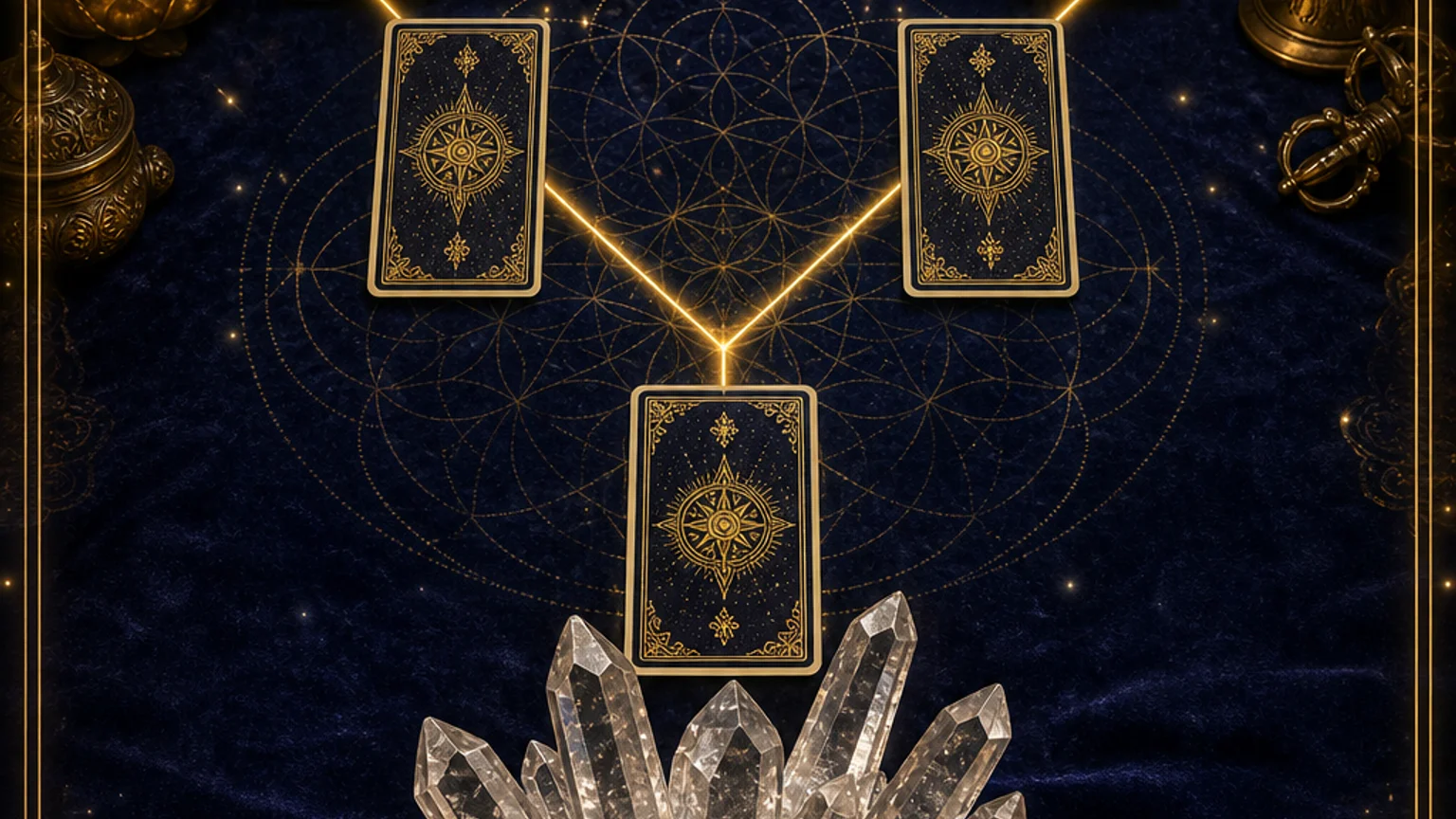
The layout is a fork: card 1 at the base, two cards branching up-left and up-right for the two paths, then two cards across the top for what you’re missing and what the heart knows.
Position 1 — The Decision
The core of what you’re actually deciding — which is often deeper than the surface question. You may think the decision is “take this job or stay,” and the card shows the real decision is “whether you’re willing to be visible” or “whether you’ll finally admit what you want.” A Major Arcana card here suggests the decision carries archetypal weight; the surface framing isn’t the whole story.
Read this card slowly. If you misread the decision itself, the two paths below will be miscalibrated.
Position 2 — Path A: If You Choose This
The energy of the first path — what choosing it would actually feel like and tend toward, in practice rather than in fantasy. This isn’t a prediction of what will happen on Path A; it’s a read on the texture and direction of that energy.
Upright cards suggest the path has flow; reversed cards suggest the path comes with internal friction or requires more inner work before it moves cleanly. Wands-heavy paths are initiative-driven; Cups-heavy paths are emotionally driven; Pentacles-heavy paths are practical and slow-building; Swords-heavy paths are intellectually or communicatively demanding.
Position 3 — Path B: If You Choose That
The energy of the second path, read the same way as Path A. The point of laying them side by side is comparison: which path’s texture matches what you actually want and can sustain?
Position 4 — What You Need to Know
The piece you’re not seeing — the blind spot, the missing information, the framing you haven’t considered. This card often reframes the whole decision. A Major here suggests the missing piece is significant; don’t rush past it.
Position 5 — The Heart’s Truth
What you deeply know, underneath the noise of arguments and fears. This is the quietest but often the most important card in the spread. The Heart’s Truth doesn’t override Path A or Path B — it tells you which inner voice is the one worth trusting. A reversed card here often signals the heart’s voice is being drowned out by anxiety, not that the heart is wrong.
Crystals for Each Position
Decision readings stir up a lot of pressure — you want an answer, which means you’re already invested. The crystals below are grounding cues to keep you steady enough to actually see the cards. They’re not charms to make the decision for you.
Position 1 (The Decision) — Clear Quartz
Seeing the real decision beneath the surface question requires clean seeing. Clear Quartz is a neutral, clarifying stone. Hold it on card 1 as a prompt: what am I actually deciding here, before I rush to A or B?
Position 2 (Path A) — Carnelian
Path A asks you to feel into a direction. Carnelian has a warm, action-supporting quality. Hold it on card 2 to sense the texture of Path A on its own terms — not whether it’s “better,” but what it would actually be like to walk.
Position 3 (Path B) — Aquamarine
Path B asks the same kind of sensing. Aquamarine has a cool, flowing quality traditionally associated with calm courage and clear communication. Hold it on card 3 to feel into Path B’s texture — again, on its own terms, not in competition.
Position 4 (What You Need to Know) — Amethyst
The blind spot card asks for inward listening. Amethyst supports that kind of reflection. Hold it on card 4 as a prompt: what am I refusing to see that the cards are pointing at?
Position 5 (The Heart’s Truth) — Rose Quartz
The heart’s voice is the quietest one in any decision. Rose Quartz on this position is a cue to listen with compassion rather than judgment — your heart’s truth, whatever it is, is information worth hearing before you choose.
How to Read the Decision Spread
- Name the two paths out loud before you draw. “Path A is staying. Path B is leaving.” Naming sharpens the reading.
- Lay the cards in the fork layout, with cards 2 and 3 side by side.
- Read Path A and Path B as textures, not verdicts. The question isn’t “which is better” — it’s “which texture can I actually sustain, and which matches who I’m becoming.”
- Then read the Decision (1) to see if the surface question matches the real one. If card 1 reframes the decision, you may need to redraw 2 and 3 with the truer question.
- Sit with the blind spot (4) longest. The information you’re missing often changes everything.
- End on the Heart’s Truth (5) with a real question: given everything I see, what does my heart actually know?
An Eastern Lens on the Decision Spread
The two paths map onto the Daoist 阴阳 (yin and yang) — but the insight isn’t “one is yang, one is yin.” It’s that both paths are always both: each contains a seed of the other, and the choice isn’t between light and dark but between two different shapes of whole.
- The Decision (1) is where the two are still undivided — the 元气 (yuan-qi, original energy) before it splits.
- Path A and Path B are the two modes of engagement — yang (active, outward, initiating) and yin (receptive, holding, conserving). Either can apply to either path; the spread shows you which mode each path asks of you.
- What You Need to Know (4) is the aspect of the situation that hasn’t yet been integrated — the piece still outside your awareness.
- The Heart’s Truth (5) is the 中 (zhong, the center) — the place that holds both paths and chooses from wholeness rather than from fear or desire alone.
This lens matters because it reframes the goal. The point isn’t to find the “right” path and avoid the “wrong” one. The point is to choose from the center — from the Heart’s Truth — instead of from anxiety or fantasy. The crystals on Path A (Carnelian, warm action) and Path B (Aquamarine, cool flow) help you feel each path on its own terms so the center can choose clearly.
Common Mistakes + Your Free Will
Treating Path A or Path B as “the right answer.” The cards don’t deliver right answers; they show you the energy of each path. The choice is still yours. If you read Path B as a Major and Path A as a Minor, that’s information about texture and weight, not a verdict.
Ignoring the Heart’s Truth because the head disagrees. Position 5 often names what you actually know but have been arguing against. The Heart’s Truth doesn’t always override the analysis — but dismissing it is usually a mistake.
Redrawing until you get the answer you wanted. If you keep redrawing because the cards aren’t confirming your preferred path, the spread has stopped being a tool and started being a wish-fulfillment device. Sit with the first honest draw.
Tarot spreads are a mirror for reflection, not a fixed forecast — the positions show energy, and you always have free will to choose your next step. For the Decision spread, the cards may point to the texture of each path, a blind spot, and the heart’s truth, but the actual choice — which path to walk — is entirely yours. The spread clarifies the field; it doesn’t choose for you.
FAQ
What if Path A and Path B look equally good (or equally bad)?
That’s information. Equal energy across both paths often means the decision isn’t really about which path — it’s about something the cards are pointing at in position 4 (the blind spot) or position 5 (the heart). Look hard at those two cards before deciding.
Can this spread make the decision for me?
No — and that’s deliberate. A spread that hands you a verdict also takes your agency. This one shows you the texture of each path, the missing piece, and what you deeply know, so the choice you make is conscious.
What if I’m choosing between more than two options?
This spread is built for two. For three or more, you can either run multiple Decision spreads (A vs B, then winner vs C) or use the 5-Card Advice spread, which handles a single situation more flexibly than a fork.
What if the decision is about a relationship, not a job?
The Decision spread works for any genuine fork — relationships, geography, creative projects, timing. For relationship-specific reads, you may also want the Relationship spread or Love spread to add texture.
Crystals turn this into a real ritual. Clear Quartz, Carnelian, Aquamarine, Amethyst, and Rose Quartz form a complete five-stone decision set. Browse aquamarine pieces here, or explore the full healing jewelry collection.
Related spreads: the Yes/No spread when the fork collapses to a binary, the Situation-Action-Outcome spread for tracing a single path, or the 5-Card Advice spread when the question isn’t really a fork.