

How to Cleanse Tarot Cards: A Beginner’s Guide with Crystals
How to Cleanse Tarot Cards: A Beginner’s Guide with Crystals
Most “how to cleanse tarot cards” guides read like a sage-smudging checklist — light the bundle, wave it around, done. The reason that approach feels hollow is that cleansing isn’t really about the smoke; it’s about using a small physical gesture to mark a fresh start. This guide walks through seven methods (most of which don’t involve sage at all), tells you when you actually need to cleanse, and shows how to make a crystal your deck’s long-term companion so the “fresh start” intention stays present between readings, not just during them.
Why Cleansing Trips Up Beginners
Three things tend to confuse people at the cleansing step.
First, the “must use sage” framing stops readers who can’t (or prefer not to) burn sage — whether for cultural-sustainability reasons, apartment rules, or asthma — from cleansing at all. There are at least six other methods that work just as well. Second, beginners often cleanse out of anxiety (“this reading felt heavy, I have to scrub the deck”), which turns cleansing into a fear ritual rather than a fresh-start gesture. Third, they cleanse once and never again — treating it as a one-off event rather than a small ongoing practice that keeps the deck feeling like yours.
The walkthrough below addresses all three. The crystal at the end isn’t there to “purify the deck’s energy” — it’s a long-term tactile companion that becomes the only cleansing method you’ll actually keep doing for years.
How to Cleanse Tarot Cards: A Step-by-Step Walkthrough
Step 1 — Smoke Cleanse (Sage, Palo Santo, Incense)
The classic method. Light the tip of a smudge stick (white sage, lavender, cedar), a stick of palo santo, or a piece of incense, let it flame and then blow it out so it smolders, and pass the deck slowly through the smoke a few times. Note that many readers today avoid white sage for cultural-appropriation and sustainability reasons — palo santo, lavender, sandalwood, copal incense, or plain cedar are all effective alternatives. If you can’t burn anything where you live, skip to the other six methods.
Step 2 — Moonlight (Full Moon Reset)
Place the deck on a windowsill or safe outdoor surface overnight during the full moon (or the night before). Moonlight is gentle, requires nothing from you, and is the easiest “set it and forget it” method. The common mistake is overthinking the lunar timing — full moon is the classic reset, but any night with clear moonlight works. You don’t need a perfect astrological window; you need a deck that sits in moonlight for a few hours.
Step 3 — Breath (Quick Reset Between Readings)
The fastest method. Hold the deck in both hands, take a slow breath in, and as you exhale, sweep your hand across the top of the deck with the intention of “fresh start.” Three breaths is plenty. This is the method professional readers use between querents — it takes ten seconds and signals to your body that the previous reading is closed and the next one is beginning.
Step 4 — Knocking / Tapping
Tap the deck firmly three times with your knuckle or the side of your hand. The traditional rationale is that the vibration “shakes loose” any leftover charge from the last reading; the practical effect is that the physical tap gives your body a clear “we’re starting over” cue. Three taps is the convention, but the number isn’t magic — the gesture is what matters.
Step 5 — Sound (Singing Bowl, Bells)
Ring a singing bowl near the deck, or pass a small bell over the cards a few times. The sustained tone of a singing bowl is particularly effective for a deep reset. If you don’t have either, a tuning fork, a chime, or even a clean hand-clap works on the same principle. Like knocking, this is a sound-based reset; the deck experiences a wave of vibration and you experience a clear “fresh start” cue.
Step 6 — Crystal Reset (Selenite or Clear Quartz)
Place a selenite wand or plate on top of (or under) the deck, and leave it there between readings. This is the method that becomes a habit, not a one-off — selenite sits with the deck permanently in its box or bag, so every time you put the deck away, the “fresh start” gesture happens automatically. Clear quartz works similarly. This is the only method that doesn’t require you to remember to do it; the crystal does the reminding.
Step 7 — Salt (Indirect Only — Never Direct)
Place a small bowl of salt near the deck inside an airtight container. Never sprinkle salt directly on the cards — salt is abrasive and hygroscopic and will damage cardstock over time. Indirect salt (salt in a bowl beside the deck, not touching) is a traditional long-reset method, useful if a deck has sat unused for months. Use fine sea salt or Himalayan salt; replace it every few months as it absorbs ambient moisture.
Crystals as Tactile Companions for Cleansing
The crystals below are not magic. They’re tactile companions — small physical cues that turn the cleansing gesture into a habit you’ll actually keep. The point isn’t to “charge the deck’s energy”; the point is to have a stone that says the deck is at rest, not in use.
Step 2 — Moonstone (Moonlight Companion)
Place moonstone beside the deck on the windowsill overnight during a moonlight reset. Moonstone’s traditional association with lunar receptivity is used here as: a “matched energy” companion — a small stone that resets alongside the deck rather than causing the reset. The feel of moonstone in the morning when you collect the deck is a tactile signal that the night’s rest is complete.
Step 6 — Selenite (The Long-Term Companion)
Rest the deck on (or under) a selenite wand or plate between readings, and leave it there. Selenite’s traditional association with clarity is used here as: a “the deck is at rest” signal — a physical cue that the deck is between uses, not mid-reading. This is the only cleansing method that becomes a daily habit rather than a monthly event; once selenite lives in your deck box, you never have to remember to cleanse again. For storage details, see our storing tarot cards guide.
An Eastern Lens on Cleansing
Cleansing maps onto two Eastern concepts read without the mystical overlay: fúchén, “dusting the dust” — a Daoist term for clearing what’s stale and kāiguāng, “opening the light” — a Buddhist practice of dedicating a sacred object through deliberate attention.
- — Clearing the stale. In Daoist practice, isn’t about the dust being “evil”; it’s about not letting the stale accumulate. The smoke, the moonlight, the breath, the tap — all are gestures. None of them “purify bad energy” in a supernatural sense; all of them are physical ways of saying I’m clearing what’s accumulated so I can start fresh.
- — Dedicating through attention. In serious Tibetan Buddhist practice, of a sacred object isn’t a magic spell cast on the object — it’s a deliberate ritual of attention by the practitioner that establishes how the object will be used. Cleansing your deck is the same: you’re not “charging” the deck, you’re telling yourself clearly this is a tool I will use with care.
In this framing, the ritual is for the practitioner, not the deck. The deck doesn’t need cleansing; you need the gesture of clearing. The selenite that lives in your deck box isn’t “purifying” anything — it’s the small daily that keeps your relationship with the deck from going stale.
Common Mistakes Beginners Make with Cleansing
Cleansing out of fear. If you’re scrubbing the deck because a “scary” card showed up, you’ve misunderstood the gesture. Cleansing marks a fresh start; it doesn’t undo a reading. Sit with the heavy card; cleanse when you actually want to begin again, not when you want to erase what came up.
Thinking you must use sage. You don’t. Palo santo, lavender, cedar, incense, breath, tapping, sound, moonlight, and selenite are all effective. If sage doesn’t work for you — for any reason — use one of the others. The cleansing happens through the gesture, not through one specific plant.
Damaging cards with direct salt. Sprinkling salt on the cards damages the cardstock. Salt only goes in a small bowl beside the deck, inside an airtight container, never directly on the cards.
One-and-done cleansing. Cleansing once when you get the deck and never again is like washing a shirt once and expecting it to stay clean. The selenite-in-the-box method exists precisely so you don’t have to remember; use it.
Over-cleansing. Cleansing the deck after every single card pull turns the practice into anxiety. Cleanse when the deck has been used hard, when you’re starting fresh, or as part of the selenite-in-the-box habit. Daily smoke-cleansing is overkill.
Shop Crystals for This Guide
Explore crystal jewelry and stones from our current collection.


Selenite Stone Set

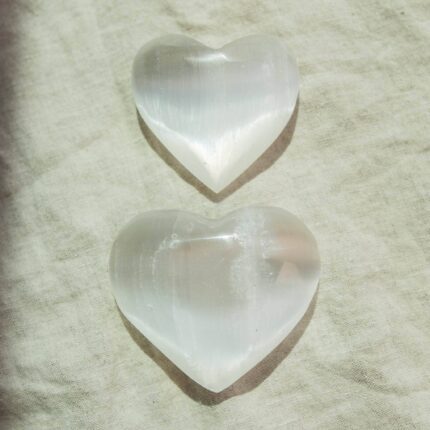
Selenite Heart


Selenite Worry Stone


Selenite Moon Bowl
FAQ
How often should I cleanse my tarot cards?
It depends on use. A deck you read daily benefits from the selenite-in-the-box method (continuous) plus a deeper reset (moonlight, sound, smoke) every few weeks. A deck that sat unused for months deserves a fuller cleanse before you start again. There’s no fixed schedule — cleanse when the deck feels stale or when you’re marking a fresh start.
Do I have to use sage to cleanse tarot cards?
No. Sage is one of at least seven effective methods. Palo santo, lavender, cedar, copal or sandalwood incense, moonlight, breath, knocking, sound, salt (indirect), and selenite all work. If sage isn’t available or appropriate for you, use any of the others.
Can I cleanse tarot cards with crystals?
Yes. Selenite and clear quartz are the two classic choices. Place selenite on or under the deck between readings; the deck rests on it permanently in its box. This is the most sustainable cleansing method because it requires no effort to maintain — the crystal lives with the deck.
Should I cleanse a brand new tarot deck?
Yes — but as a fresh-start gesture, not because the deck has “bad energy.” A new deck benefits from one cleansing pass (selenite, moonlight, smoke, or breath all work) as part of the opening ritual. See our first tarot deck guide for the full opening walkthrough.
Tarot is a tool for reflection, not a fixed forecast — the cards show energy and patterns, and you always have free will to choose your next step. Cleansing is a ritual of attention, not a fix — it signals “I’m showing up fresh,” but the clarity comes from you, not from the smoke or the stone.
Ready to give your deck a long-term companion? Selenite is the one crystal that becomes a permanent cleansing habit, and Moonstone is a beautiful moonlight companion. You can browse selenite pieces here, find amethyst in the shop, or explore the full crystal collection if you’d like to wear your companion stone.
Related guides to explore next: storing tarot cards for keeping your deck safe, first tarot deck for the opening ritual, tarot for beginners for the broader starting path, how to read tarot cards for the full reading walkthrough, and crystals for tarot cards for the full crystal pairings hub.