
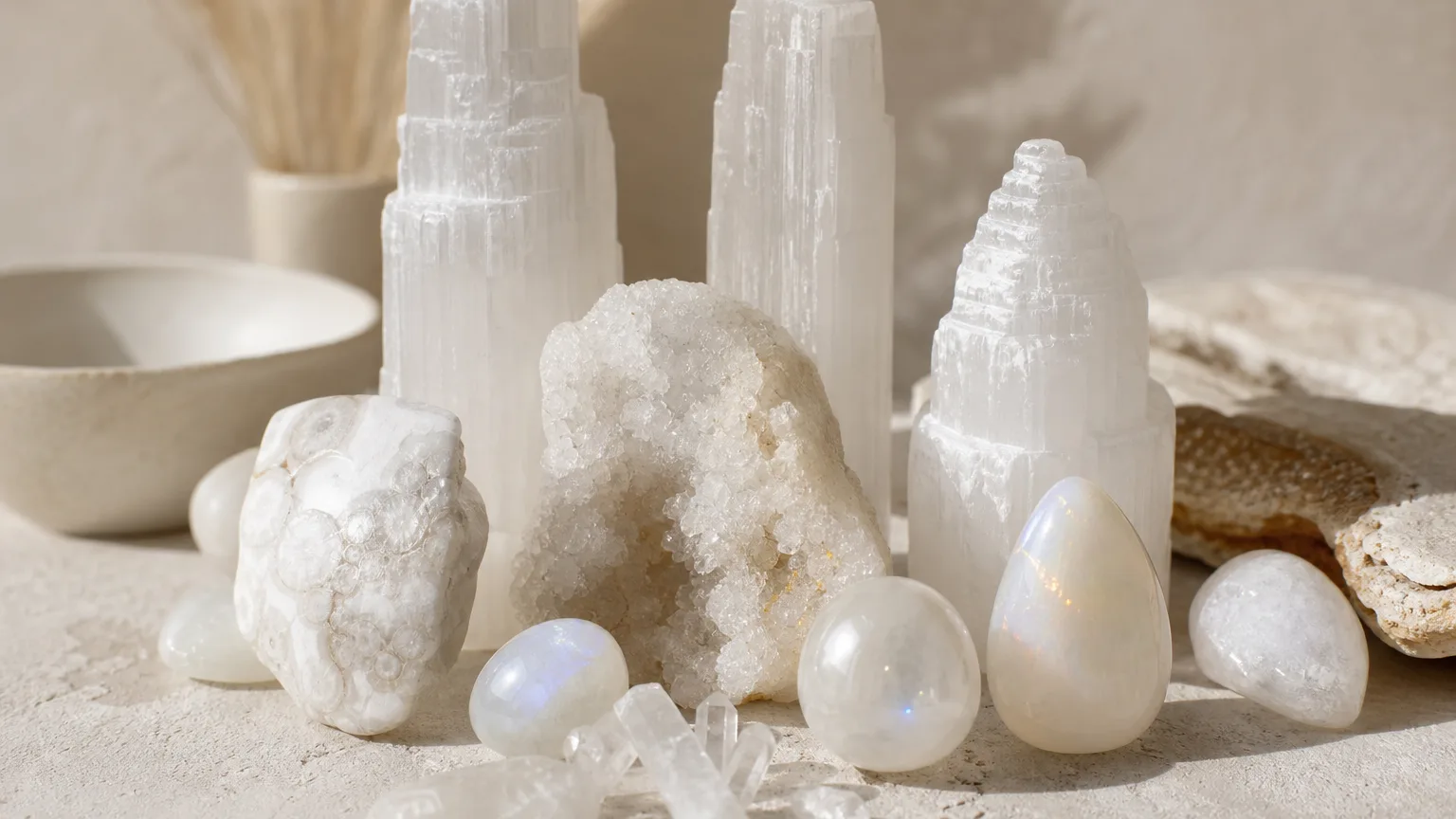
Best White Crystals: Names, Meanings, Properties & Uses
Quick Answer: Best Crystals for White
The best crystals for White include Selenite, Opal, Moonstone, traditionally used in mindfulness and spiritual practices. Crystal properties are complementary wellness tools, not medical treatments.
Understanding White Crystals
White is the color the eye reads as clean, open, and complete. Hold a piece of white Calcite up to the light and you are looking at a stone that scatters almost every wavelength back at you, which is why it reads as “everything at once” rather than one fixed mood. Across cultures, that full-spectrum quality made white the natural symbol for beginnings — a blank page, fresh snow, the first light of morning before color returns.
In mineral terms, white usually comes from microscopic inclusions, trapped water, or a fine network of cracks and bubbles that scatter light instead of absorbing it. The same physics gives clouds and sea foam their look. So when you reach for a white stone, you are quite literally holding a piece of captured light.
Crystal traditions lean into that reading. White stones are often associated with the crown chakra — the seat of clarity, perspective, and connection to something larger than the everyday self. They are used to clear space, mark a fresh intention, and quiet mental noise so the signal can come through. In color psychology, white reduces perceived clutter and supports focus, which is one reason minimalist studios and meditation rooms are so often painted in it.
Modern practice tends to treat white crystals as “reset” stones — pieces you reach for when a room feels heavy, a project feels stuck, or your thoughts need a clean slate. Used well, they ask a simple question: what would you like to begin?
Quick facts: Symbolism: Purity, clarity, new beginnings. Psychology: Cleansing, mental clarity, fresh start. Associated chakra: Crown, element: All.
Not sure which color is right for you? Try the Crystal Quiz ↗
How to Identify White Crystals
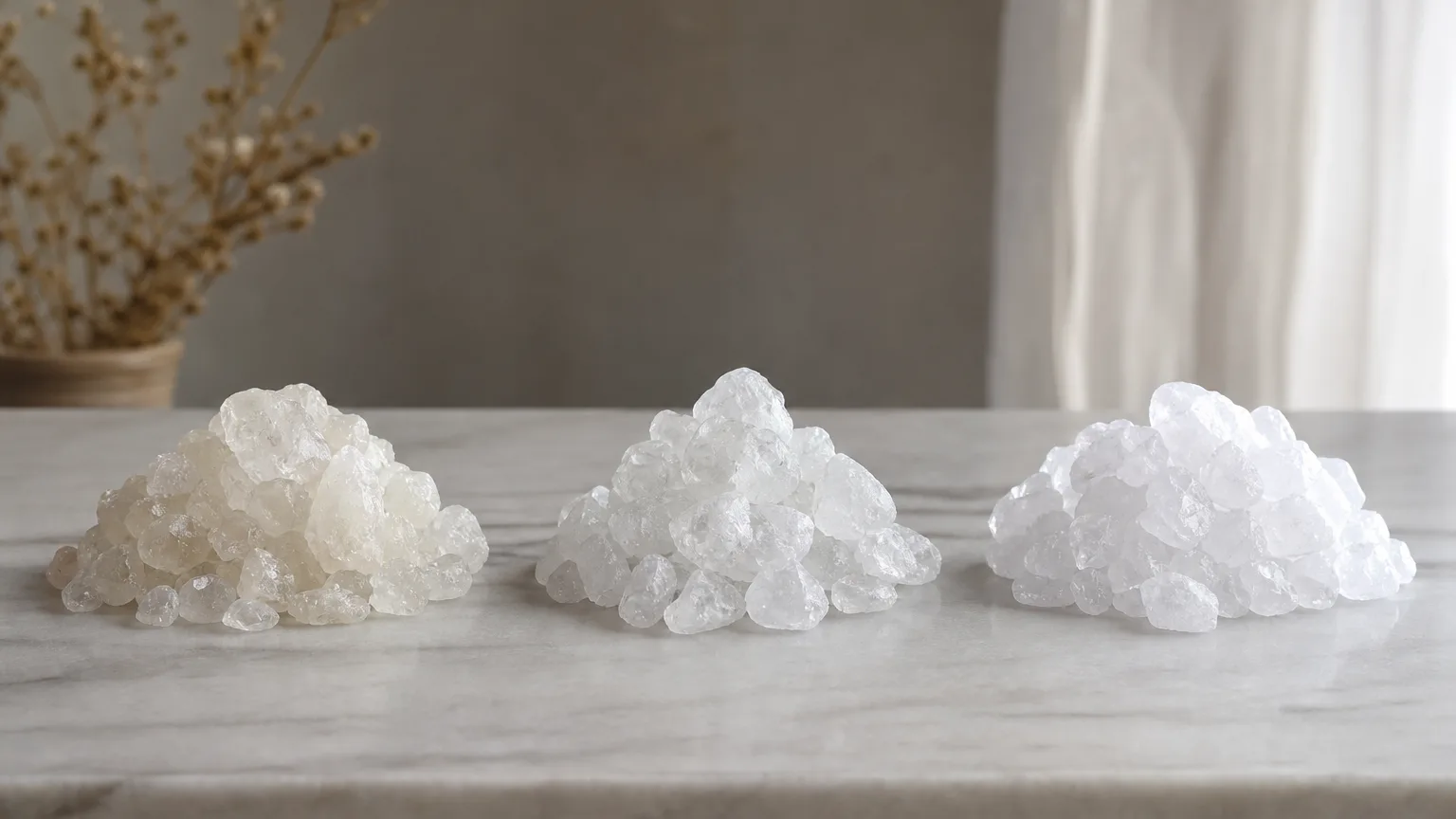
White stones are easy to recognize as a group but trickier to tell apart piece by piece. Most fall into one of four looks: luminous and translucent (Selenite, Anhydrite), opaque and chalky (white Calcite, Howlite), pearly with a moving sheen (Moonstone), or glassy with play-of-color (Opal). Luster is your fastest clue — glassy means silica, waxy or pearly often points to feldspar, fibrous and silky points to gypsum.
Texture helps too. Selenite has a striated, fibrous feel along one face and flakes into thin sheets; scrape it with a fingernail and it will mark easily (hardness 2). Moonstone shows a cool adularescent glow that drifts as you turn the stone. Opal flashes discrete patches of rainbow color with no underlying pattern, while common white chalcedony stays evenly milky.
A few look-alikes trip people up. Amazonite vs Turquoise — Amazonite reads pale blue-green and not true white, but is often confused with chalky turquoise matrix; turquoise is softer and waxy, Amazonite is harder and more glassy. Selenite vs Satin Spar vs Quartz — clear Quartz is hard (7) and cold to the touch, while Selenite is soft (2) and warm quickly. Moonstone vs Opalite — Opalite is a man-made glass with a uniform blue glow and no natural inclusions; real Moonstone has internal layers and a directional sheen.
Light also shifts things. Opal can look milky and lifeless under a bulb, then explode with color outdoors. Selenite gains a warm glow under low light and looks almost flat in direct sun. Always judge a white stone under both daylight and warm indoor light before you decide what it really looks like.
9 Best Crystals for White
Selenite
Color: White, pale, luminous
Meaning: Purity, clarity, new beginnings
Best for: Cleansing, Space clearing, Focus
Chakra: Crown, Third Eye
Element: Air
Best way to use: Carry or hold in meditation
Affirmation: I clear the old and welcome the new.
A gypsum mineral (CaSO₄·2H₂O, hardness 2), Selenite is named after Selene, the Greek moon goddess, for its soft lunar glow. Light travels along its fibrous crystals, giving a satin sheen that seems to come from inside the stone. Crystal workers often place it in a room to refresh the atmosphere, and many traditions suggest it can clear other stones simply by proximity. Holding a wand-shaped piece while breathing slowly gives the hands a focal point — a small, deliberate ritual for settling a racing mind and inviting a cleaner mental slate.
Opal
Color: White, black, fire — rainbow play-of-color
Meaning: Purity, clarity, new beginnings
Best for: Creativity, Inspiration, October birthstone
Chakra: All
Element: Water
Best way to use: Wear, carry, or place in your space
Affirmation: I welcome fresh ideas and new chapters.
Opal is hydrated silica (SiO₂·nH₂O) — up to 20% water locked inside a microscopic sphere structure that bends light into shifting rainbows. That play-of-color makes each stone genuinely one of a kind, a quality people have read as hope, originality, and possibility for centuries. White Opal in particular is linked to the crown as a stone of fresh starts and creative renewal. Carry one when you want to stay open to new ideas, or wear it as a gentle daily reminder that beginnings can arrive from anywhere.
Moonstone
Color: White/cream with blue-white sheen
Meaning: Purity, clarity, new beginnings
Best for: Intuition, Emotional balance, June birthstone
Chakra: Third Eye, Crown, Sacral
Element: Water
Best way to use: Wear as jewelry
Affirmation: I trust my own steady rhythm.
A feldspar variety, Moonstone gets its floating blue-white glow — called adularescence — from light scattering between thin internal layers of two different feldspar minerals. Named for that moonlight effect, it has long been tied to cycles, intuition, and new chapters. As a June birthstone it often marks transitions and life shifts. Held during quiet reflection, it offers a soft focal point for steadying emotions and listening to your own pace rather than the noise around you.
Lapis Lazuli
Color: Deep blue with gold and white
Meaning: Clarifying truth, honest voice, mental focus
Best for: Meditation, Communication, Focus
Chakra: Third Eye, Throat
Element: Air
Best way to use: Wear as jewelry
Affirmation: I speak my truth with quiet clarity.
Strictly a rock rather than a single mineral, Lapis Lazuli is mostly lazurite mixed with white Calcite veining and golden pyrite flecks — a night-sky look prized for over 6,000 years, from Afghan mines to Egyptian amulets. The white calcite running through it is what earns Lapis a place on a white-stone page: the bright veins carry the clearing, clarifying energy of white within the deep blue. Traditionally associated with honest communication and focused insight, it suits anyone who wants both depth and a clean, direct voice.
Read full Lapis Lazuli meaning →
alamosite
Color: White, grey, blue-grey, yellow
Meaning: Purity, clarity, new beginnings
Best for: Clarity, Structure, Focus
Chakra: Third Eye
Element: Air
Best way to use: Wear, carry, or place in your space
Affirmation: I bring order to scattered thoughts.
A rare lead silicate mineral (PbSiO₃), Alamosite forms delicate white to blue-grey crystals, first described from the Alamos region of Mexico. Its crisp, fibrous crystals catch light in a subtle silky way, and collectors prize it for its unusual structure. As a white stone it is often used as a focus object during study or detailed work — a physical anchor for the eyes when attention drifts, supporting steady concentration and a tidy, structured frame of mind.
analcime
Color: White, grey, pale pink/yellow
Meaning: Purity, clarity, new beginnings
Best for: Clarity, Mental Focus, Perception
Chakra: Third Eye, Crown
Element: Air
Best way to use: Wear, carry, or place in your space
Affirmation: I see situations as they truly are.
A zeolite-group mineral (NaAlSi₂O₆·H₂O), Analcime forms clean, symmetrical trapezohedral crystals that look almost cut rather than grown. That geometric clarity is exactly what people read into it — a stone linked to clear perception, sharper thinking, and an uncluttered view of a situation. Pale white to grey tones keep its look calm and neutral. Held during a moment of decision, it can serve as a simple reminder to slow down and look again before choosing.
anhydrite
Color: White, blue-white, grey, pale lilac
Meaning: Purity, clarity, new beginnings
Best for: Peace, Calm, Serenity
Chakra: Throat, Third Eye, Crown
Element: Air, Water
Best way to use: Wear as jewelry
Affirmation: I soften my shoulders and let go.
The anhydrous form of calcium sulfate (CaSO₄), Anhydrite is what Selenite becomes when its water content leaves. The blue-white variety, often called Angelite, carries the same calm, pearly softness many people reach for to settle a busy mind. Its layered structure gives a gentle, even glow rather than a sharp flash. Used as a quiet companion during evening wind-downs, it supports a slower breath and a kinder inner voice — a small support for letting the day go.
ankerite
Color: White, yellow, yellow-brown, brown
Meaning: Steady grounding, quiet endurance, rooted strength
Best for: Grounding, Steady Strength, Vitality
Chakra: Root
Element: Earth
Best way to use: Wear, carry, or place in your space
Affirmation: I stand firm and move at my own pace.
A carbonate mineral related to dolomite (Ca(Fe,Mg,Mn)(CO₃)₂), Ankerite appears in clean white through warm yellow-brown tones, with iron giving it that steady, grounded color. Among white stones it stands out for its earthy weight — a piece that feels substantial in the hand. Crystal traditions often use it as a stabilizing companion during long projects or recovery periods, a quiet reminder that steady effort, not sudden force, is what carries you through to the other side.
aragonite
Color: White, colorless, yellow, brown, green, blue
Meaning: Stability, patience, centered calm
Best for: Stability, Emotional balance, Patience
Chakra: Root
Element: Earth
Best way to use: Wear as jewelry
Affirmation: I stay centered when emotions rise.
A calcium carbonate polymorph (CaCO₃) — the same formula as Calcite but a different crystal shape — Aragonite often grows in branching “sputnik” clusters that look ready-made for a desk. Its white and warm-toned forms are traditionally used for grounding scattered energy and bringing patience to overwhelming days. Held during a few slow breaths, its sturdy weight offers a physical anchor, a small ritual for returning to yourself when feelings or circumstances pull in several directions at once.
How to Choose White Crystals by Intention
| Intention | Best White Crystals | Why this one |
|---|---|---|
| Cleansing a space or other stones | Selenite, Anhydrite | Soft, luminous stones traditionally used to clear energy and refresh a room. |
| New beginnings and fresh starts | Opal, Moonstone | Both carry “fresh chapter” symbolism across multiple traditions and birthstone lists. |
| Mental clarity and focus | Analcime, Alamosite, Selenite | Clean, structured crystals used as visual anchors for thinking and study. |
| Calm and emotional balance | Anhydrite, Moonstone, Aragonite | Steady, low-glow stones often reached for to quiet worry and steady moods. |
| Grounding and steady strength | Ankerite, Aragonite | Warm, earthy white tones with a substantial, stabilizing feel in the hand. |
| Honest communication | Lapis Lazuli | The white calcite veins inside deep blue carry clarifying, truthful energy. |
How to Use White Crystals
White stones are quiet workhorses — they suit daily rituals more than dramatic gestures. Four uses bring out their best.
1. Cleansing rituals. Selenite and Anhydrite are the natural picks here. Lay other stones on a Selenite slab or wand for a few hours, or sweep a Selenite wand through the air around a room in slow arcs, corner to corner, the way you might open a window to let stale air out. It is a small reset you can feel — the room reads lighter afterward.
2. Your meditation space. Place a piece of Analcime, Moonstone, or Selenite where your eyes naturally settle during sitting practice. A white stone gives the gaze a calm, low-stimulus anchor, which makes it easier to keep attention on the breath instead of chasing thoughts. Analcime’s clean geometry suits focus work; Moonstone’s soft glow suits reflective practice.
3. Bedside for the transition into sleep. A piece of Anhydrite (Angelite) or Moonstone on the nightstand is a popular bedside companion. Hold it for a minute while you set the day down — name one thing you want to release, one thing you want to begin tomorrow — then place it back and switch off the light. The ritual itself does as much as the stone.
4. A new-beginning ritual. On the first of a month, a birthday, a new job, or any fresh chapter, hold a white Opal or Moonstone and set one clear intention for what you want this next stretch to hold. Carry it for a week as a tangible reminder. Crystal traditions have used white stones this way for centuries precisely because white reads as a clean page.
Worn as jewelry, white stones keep their meaning close without effort — a Moonstone ring or Opal pendant works as an all-day, low-key touchstone.
White Crystals for Clarity, Cleansing, New Beginnings
White stones earn their place when life asks for a clean slate. Three scenes show where they help most.
Morning desk reset. Begin the workday by placing a Selenite tower at the corner of your desk and taking three slow breaths before opening your inbox. The simple act of clearing the space — physically and mentally — sets a tone of focus for whatever lands next. Many people reach for white stones when a project feels cluttered or stale, exactly because they read as “start here.”
Bedside reflection. At night, hold a piece of Anhydrite or Moonstone and do a brief mental sweep: name what went well, what you want to leave behind, and one thing you are reaching for tomorrow. Set the stone down and let the day close. This kind of small nightly ritual supports better emotional regulation than lying in the dark replaying the day.
A new-beginning ritual. When a chapter turns — a move, a new role, the start of a year, the end of a difficult stretch — sit quietly with a white Opal and say your intention out loud, even softly. Then carry the stone with you for the following week. Crystal traditions treat this as a way to “plant” a fresh start in something tangible, and the act of returning to the stone each day reinforces the choice you made.
In each case the white stone is less a magic object and more a physical anchor — something real to hold while your mind does the actual work of clearing and beginning again.
White Crystals at a Glance
| Crystal | Best for | Chakra | Best way to use |
|---|---|---|---|
| Selenite | Cleansing, space clearing | Crown, Third Eye | Sweep through a room, or place stones on a slab to clear them. |
| Opal | Creativity, fresh starts | All | Wear or carry during a new chapter; set intentions while holding it. |
| Moonstone | Intuition, emotional balance | Third Eye, Crown, Sacral | Wear as jewelry, especially during transitions. |
| Lapis Lazuli | Communication, focus | Third Eye, Throat | Wear at the throat for honest, clear expression. |
| Alamosite | Clarity, structure | Third Eye | Keep on the desk during detailed or study work. |
| Analcime | Perception, mental focus | Third Eye, Crown | Hold during decisions to slow down and see clearly. |
| Anhydrite | Peace, calm | Throat, Third Eye, Crown | Bedside for evening wind-down and letting go. |
| Ankerite | Grounding, steady strength | Root | Carry during long projects or recovery. |
| Aragonite | Stability, patience | Root | Hold during slow breaths when emotions run high. |
Shop Crystals for This Guide
Explore crystal jewelry and stones from our current collection.


Selenite Stone Set
Selenite Heart


Selenite Worry Stone


Selenite Moon Bowl
FAQ
What are white crystals good for?
White crystals are traditionally used for cleansing, clarity, and new beginnings. People reach for them to refresh a room, support focus during meditation, mark a fresh start, or quiet a busy mind at the end of the day.
What do white crystals mean?
Across many traditions white symbolizes purity, openness, and a clean page — so white stones are read as “reset” stones that clear what is finished and make space for what is next. They are commonly associated with the crown chakra.
What is the most powerful white crystal?
Selenite is the most commonly named choice for cleansing and clearing, both for itself and for refreshing other stones. “Power” here means usefulness for a specific purpose rather than any measurable effect.
What is the rarest white crystal?
Among the stones on this page, Alamosite is the rarest — a lead silicate known from only a few localities. Fine Opal with strong play-of-color is also rare and highly prized by collectors.
What crystal is white and glowing?
Selenite is the classic luminous white stone, with a soft satin glow from light moving along its fibers. Anhydrite (Angelite) has a similar pearly calm, and Moonstone shows a moving blue-white sheen called adularescence.
What crystal is white with rainbow colors?
White Opal. Its internal structure bends light into shifting patches of color known as play-of-color. Each stone shows a unique pattern, which is part of why no two Opals look alike.
How can I tell real Moonstone from Opalite?
Real Moonstone has internal layers and a directional sheen that drifts as you turn the stone. Opalite is man-made glass with a uniform blue glow, no natural inclusions, and often perfect clarity — a sign no natural stone shares.
Are the benefits of white crystals scientifically proven?
No. Crystal properties are part of wellness and spiritual traditions, not established science. The relaxation, focus, and calm many people report are consistent with mindfulness practices and the placebo response, but crystals are complementary tools rather than medical treatments. For health concerns, please consult a qualified professional.