
How to Shuffle Tarot Cards: A Beginner’s Guide with Crystals
How to Shuffle Tarot Cards: A Beginner’s Guide with Crystals
Most “how to shuffle tarot cards” tutorials treat shuffling as a pure hand skill — learn five grips, shuffle until it “feels right,” draw. The piece they miss is that shuffling is where your attention either settles or splinters, and a splintered shuffle tends to produce a splintered reading. This guide walks through the five main shuffle methods, the cue to stop, and how to handle jumpers and reversals — with a small crystal in your non-shuffling hand as a rhythm anchor so the shuffle becomes a breath-led practice instead of a mechanical chore.
Why Shuffling Trips Up Beginners
Three things tend to go wrong at the shuffle step, and most guides don’t name them.
First, beginners grip too tightly, treating the deck like it might escape — which tires your hand, crimps card edges, and keeps your whole body braced while you shuffle. Second, they shuffle while rehearsing the answer they want, so the cards get mixed but the mind doesn’t. Third, they get caught in “shuffle forever” syndrome — there’s no clear cue to stop, so they shuffle past the moment the cards were ready and end up drawing from a foggy, second-guessing headspace.
The walkthrough below is built around those three failure modes. The crystals aren’t there to “make the shuffle more accurate” — they’re tactile rhythm anchors that give your non-shuffling hand something to do besides tense up, while your breath sets the pace your hands follow.
How to Shuffle Tarot Cards: A Step-by-Step Walkthrough
Step 1 — The Overhand Shuffle
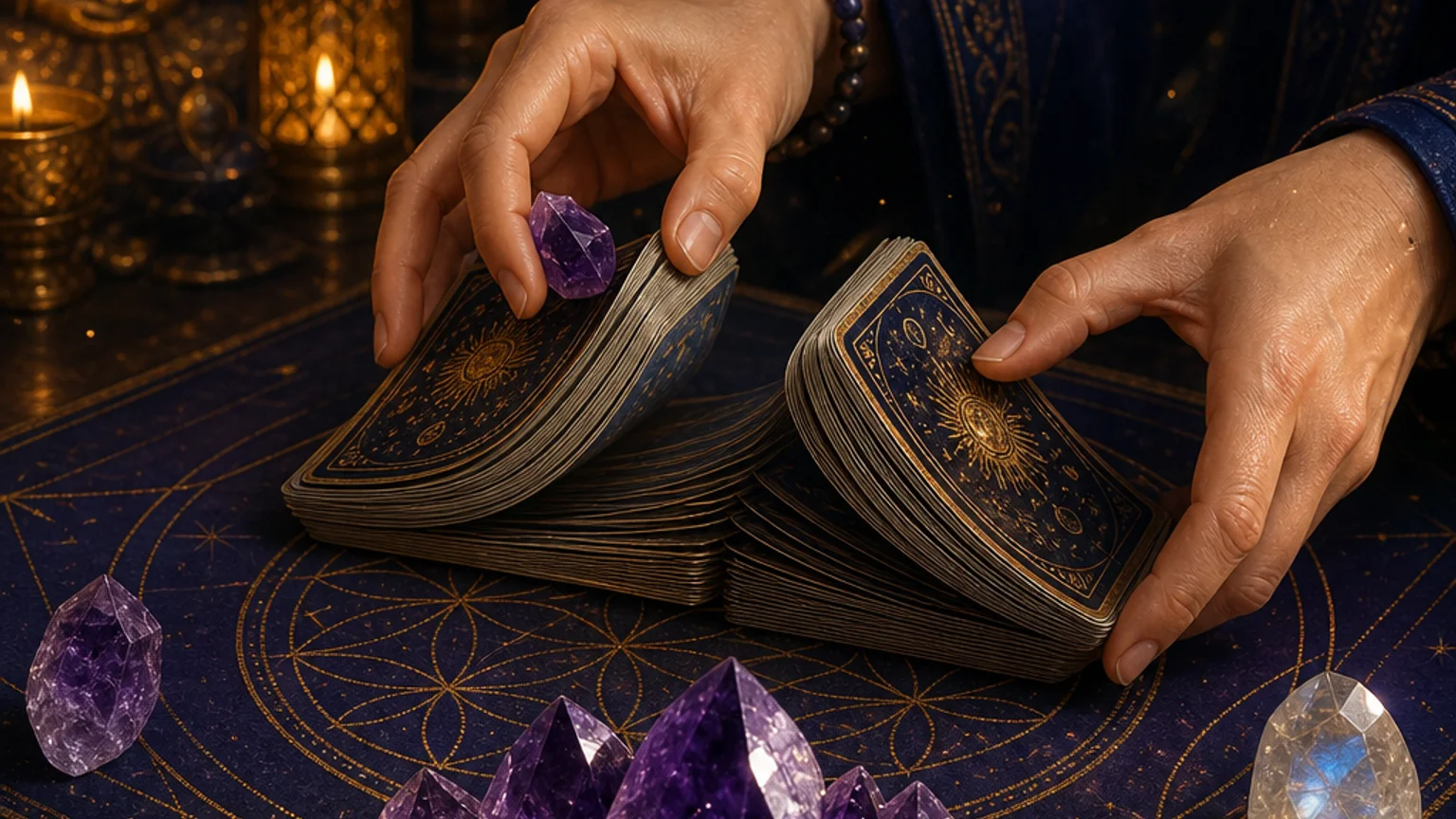
The overhand is the most common method: hold the deck in one hand, pull small packets off the back with the other, and let them fall into the front. It’s gentle on cards, easy on the hands, and naturally slow. Match the rhythm of the packets to the rhythm of your breath — a packet on each inhale, a packet on each exhale — and the shuffle becomes a breath-led practice rather than a race. The common mistake here is shuffling fast to “get through it”; slow the packets to your breath and the shuffle does its own work.
Step 2 — The Hand-Washing Method
When the overhand feels too controlled, try the “hand-washing” method: hold the deck loosely in both cupped hands and let the cards mingle like you’re washing them, with no fixed grip. This is the gentlest method and the one most beginners find intuitive once they relax their hands. The trade-off is that it’s harder to control which cards go where, and bent cards can flip. Use it when you want to loosen the grip; switch back to overhand when you want to draw.
Step 3 — The Riffle / Bridge
The riffle splits the deck in two, riffles the corners together, and (optionally) bridges them back into a stack. It’s fast and thorough, but it’s also the harshest shuffle on cards — and many larger or stiffer decks simply don’t riffle well. If your deck is new or has stiff cardstock, skip the riffle for the first few months until the cards loosen. There’s no prize for riffling; the goal is a mixed deck, not a flourish.
Step 4 — The Strip Shuffle
The strip shuffle pulls small sections off the front of the deck and drops them back at random intervals — often combined with the riffle as a “riffle + strip” compound shuffle used in casinos. It’s a useful technique to know, especially for thorough mixing, but it’s not required for a reading. Many readers never strip-shuffle and do perfectly fine work.
Step 5 — The Waterfall
The waterfall is the most flowing method: hold the deck vertical in one hand and let cards cascade down into the cupped other hand. It’s beautiful to watch and easy on cards, but it requires a deck that’s been broken in. New decks tend to clump rather than cascade. When it works, the cascade has a “let the cards fall without micromanaging” quality that some readers love for the moment just before the draw.
Step 6 — When to Stop
This is the step most beginners get wrong, because they’re looking for an external rule (“shuffle 7 times,” “shuffle until a card jumps out”). There is no fixed number. The cue to stop is internal: a small felt sense of “now” — often arriving as a full breath, a momentary pause in the hands, or a quiet internal yes. If you don’t feel it, keep shuffling; if you feel it but second-guess it, trust the first cue. The rule “shuffle until it feels done” only works if you actually stop the first time it feels done, instead of shuffling ten more times “to be sure.”
Step 7 — What About Jumpers and Reversals?
Jumpers are cards that fall or fly out during the shuffle. Some readers read them as a message; others tuck them back in. Both are valid — the only mistake is treating every jumper as an emergency. If a jumper feels meaningful, set it aside and notice it; if it just slipped, put it back.
Reversals happen when a card ends up upside-down in the spread. Whether to read them is a personal choice — there’s no rule. If you want reversals in your readings, let the cards fall however they fall; if you don’t, gently right any reversed cards as you lay the spread. For the full reframe on what reversals actually mean (they’re not bad — see our reversed tarot cards guide).
Crystals as Tactile Anchors for Each Step
The crystals below are not magic. They’re small rhythm anchors — tactile companions in your non-shuffling hand that give your fingers somewhere to land besides gripping the deck. Each is matched to the kind of attention that shuffle method asks for.
Step 1 — Amethyst (Overhand Rhythm)
Hold a small amethyst in your non-shuffling hand during the overhand. Amethyst’s traditional reflective quality is used here as: a slow-rhythm anchor — a small weight that reminds you to match the shuffle to your breath rather than racing through. If you notice your hands speeding up, the feel of the stone is a cue to slow back to breath pace. The overhand suits contemplative questions; amethyst helps keep the tempo contemplative.
Step 2 — Moonstone (Hand-Washing Softness)
Set a moonstone in front of you, or hold it loosely, while you do the hand-washing method. Moonstone’s traditional receptive quality is used here as: a “loosen the grip” anchor — a soft stone whose quality you match to your hand motion. The hand-washing method only works when your hands are relaxed; moonstone is a small prompt to soften rather than brace.
Step 5 — Labradorite (Waterfall Trust)
Hold labradorite briefly in your cupped hand just before the cascade. Labradorite’s traditional association with intuition is used here as: a “trust the cascade” anchor — a tactile prompt to let the cards fall without micromanaging where they land. The waterfall method fails the moment you try to control it; labradorite is a small reminder to release.
An Eastern Lens on Shuffling
The shuffle maps onto a Daoist breathing concept called tiáoxī — “regulating the breath,” which traditionally extends to “regulating any rhythm through the breath.” The principle is yǐ xī yù wù — let the breath lead the hands, not the hands lead the breath.
- The breath sets the pace. Match a packet of the overhand to each inhale and exhale, and the shuffle becomes a breath-led rhythm rather than a hand skill. The hands follow; the breath leads.
- The crystal is the qìkǒu — the breath-gate. In this framing, the stone in your non-shuffling hand is the place your attention lands while your hands work. It’s not “charging” anything; it’s the tactile point that keeps you breathing steadily while you shuffle.
This changes the shuffle from “mix the cards” to “arrive at the draw with a settled nervous system.” The cards are mixed either way; what changes is the state you’re in when you draw — and that state is what gives the spread room to show you something real.
Common Mistakes Beginners Make with Shuffling
Gripping the deck too hard. A white-knuckle shuffle tires your hand and keeps your body braced. Hold the deck loosely enough that cards can move; the deck is sturdier than you think.
Shuffling while rehearsing the answer. If you’re shuffling and silently chanting “please not the Tower, please not the Tower,” you’re not shuffling — you’re bargaining. Notice it, name it, and let the cards fall where they fall.
Endless shuffling. If you’re on shuffle number forty because you’re waiting for a card to “jump out,” you’ve missed the cue. Stop at the first internal “now,” even if it comes at shuffle seven.
Treating jumpers as omens every time. Some jumpers are messages; some are clumsy fingers. Read the meaningful ones; tuck back the rest. Treating every dropped card as a sign turns shuffling into anxiety.
Forcing reversals on or off without deciding. Pick a stance on reversals and stick with it for at least a season. Switching mid-reading muddies the practice. See our reversed tarot cards guide for the full picture.
Shop Crystals for This Guide
Explore crystal jewelry and stones from our current collection.


Amethyst Angel


Amethyst Anklet


Amethyst Mala


Amethyst Stone Set
FAQ
How long should I shuffle tarot cards?
There’s no fixed count. Most readers shuffle for somewhere between thirty seconds and two minutes, stopping at an internal cue — a full breath, a pause in the hands, a quiet “now.” If you don’t feel a cue, shuffle a bit longer; if you feel one and second-guess it, trust the first cue.
Is there a wrong way to shuffle tarot cards?
The only true wrong way is one that damages the cards (forcing a riffle on stiff new cardstock) or one that leaves you more anxious than when you started. Within those guardrails, the method that lets you draw with a clear head is the right one for you.
Why do cards fall out while shuffling?
Cards fall out for two reasons: physics (a loose grip, a stiff deck, an awkward angle) or as a felt cue. Distinguish between the two by feel — a card that “wants to come out” usually has a different quality than one that just slipped. Read jumpers that feel meaningful; tuck back the rest.
Should I read reversed cards or flip them upright?
It’s a personal choice. If you want the added nuance of reversals, let them fall however they fall. If reversals confuse you as a beginner, it’s perfectly fine to flip them upright for the first few months and add reversals later. See our reversed tarot cards guide for the full reframe.
Tarot is a tool for reflection, not a fixed forecast — the cards show energy and patterns, and you always have free will to choose your next step. How you shuffle is your fingerprint on the cards — there’s no “correct” method, only the one that lets you draw with a clear head.
Ready to try it with a rhythm anchor in hand? Amethyst for the overhand, Moonstone for the hand-washing method, and Labradorite for the waterfall form a small three-stone set that mirrors the shuffle itself — slow, soft, released. You can browse amethyst pieces here, find moonstone in the shop, oppure explore the full crystal collection if you’d like to wear your shuffle companion.
Related guides to explore next: how to read tarot cards for the full reading walkthrough, tarot for beginners for the broader starting path, how to cleanse tarot cards to keep your deck fresh, reversed tarot cards for the reversal reframe, and first tarot deck for choosing your deck.