
Labradorite and Moonstone Together: Benefits, Meaning + How to Use
Labradorite and Moonstone Together: Benefits, Meaning + How to Use
Quick Answer
Yes — Labradorite and Moonstone can be worn together (compatibility score: 100/100 — Excellent). They’re a long-standing pairing in crystal practice, and many people combine them for meditation and spiritual growth.
About Labradorite
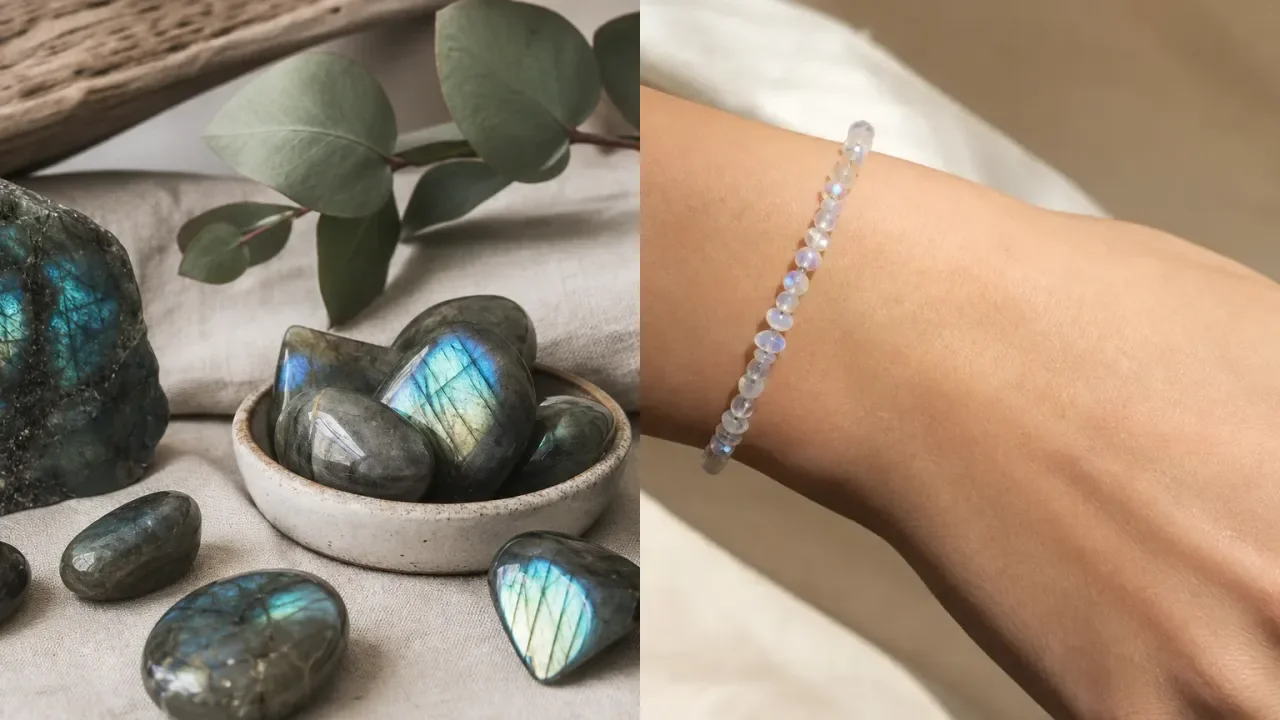
Labradorite is a grey-to-black feldspar famous for its flashes of blue, gold, and green — an optical effect called labradorescence. In crystal practice it’s traditionally associated with transformation, intuition, and protection, and it’s often linked with the Throat and Third Eye chakras. That makes it a popular choice for people moving through change, creative work, or inner exploration. Common forms include cabochon pendants, tumbled stones, palm stones, and rings.
Mineralogically, Labradorite is a plagioclase feldspar with the formula (Ca,Na)(Si,Al)₄O₈ and a Mohs hardness of 6–6.5 — durable enough for everyday jewelry like pendants and rings, as long as it isn’t heavily knocked. It tolerates a brief water rinse but should be kept away from salt water and harsh cleaners.
Labradorite Meaning → · Genuine, ethically sourced — not dyed, not glass.
About Moonstone
Moonstone is a milky white-to-cream feldspar known for its soft, floating blue-white sheen — an effect called adularescence. In crystal practice it’s traditionally associated with intuition, new beginnings, and calm, and it’s often linked with the Third Eye, Crown, and Sacral chakras. As June’s birthstone, it’s a perennial favorite for emotional balance and fresh starts. Common forms include cabochons, beads, pendants, and tumbled stones.
Mineralogically, Moonstone is a feldspar of intergrown orthoclase and albite, formula (K,Na)AlSi₃O₈, with a Mohs hardness of 6–6.5 — comparable to Labradorite, so it’s well suited to everyday pendants, bracelets, and rings. Like its partner, it tolerates a brief water rinse but should be kept away from salt water.
Moonstone Meaning → · Genuine, ethically sourced — not dyed, not glass.
Can You Wear Labradorite and Moonstone Together?
Practically: This is one of the easiest pairings to wear. Both stones are feldspars sitting at 6–6.5 on the Mohs scale, so they’re evenly matched in hardness and neither will quickly scratch or wear the other down in a shared bracelet or pendant stack. Both tolerate only a brief water rinse and should be kept away from salt water, so their care needs are nearly identical — there’s no “one is fragile, one is tough” mismatch to manage. Visually, Labradorite’s dark, flashing body makes a striking backdrop for Moonstone’s soft, luminous glow, so the pair looks cohesive whether set as a two-stone pendant or layered as bracelets.
Energetically: In crystal tradition, both stones are water-element and share the Third Eye chakra, the center most associated with intuition and inner seeing. Labradorite is often described as a stone of transformation and protective shielding, while Moonstone is valued for gentler emotional balance and new beginnings. Read together, they’re seen as a complementary “insight” pair — one brings the flash of recognition, the other holds steady while you sit with what came up.
Psychologically: Because the two share spiritual and new-beginnings intentions, they work well as a single ritual anchor — one intention (a fresh start, a contemplative practice) carried by two reinforcing stones instead of two competing ones. Many people reach for this pairing during transitions or when setting an intention for a new chapter.
These properties are traditionally associated with crystal practice; many people find the pairing supportive, though the effects are not established by modern research.

Benefits of Labradorite + Moonstone
Together, Labradorite and Moonstone cover six complementary strengths:
1. Sharpened Intuition & Inner Vision
Both stones are linked to the Third Eye chakra, the center traditionally associated with intuition and inner knowing. Used as a pair, they’re treated as a focused “insight” set — Labradorite is said to illuminate what’s hidden, and Moonstone to soften whatever surfaces so it’s easier to sit with. Many people reach for the combination during journaling, dream work, or any practice that calls for a quieter, more receptive mind.
2. Easier Passage Through Change
Both stones carry a new-beginnings intention, which is why this pairing shows up so often around life transitions — a move, a new job, a fresh chapter. Labradorite is traditionally used to support transformation, and Moonstone is associated with gentle emotional balance through the unfamiliar. Worn or held together, the pairing reads as forward momentum with a steadying hand on it.
3. Grounded Spiritual Practice
Both stones share a spiritual intention, and together they’re often used to deepen meditation and contemplative work. In crystal tradition, the combination protects the focus of a session while keeping the experience calm and emotionally even — a spiritual practice that feels open without becoming scattered. That’s a common reason this pair turns up on altars and in meditation kits.
4. Emotional Balance with Protective Backing
Moonstone is traditionally associated with calm and emotional equilibrium, and Labradorite carries a protective intention often described as an energetic shield. Paired, they suit moments when someone wants to stay emotionally open without feeling unguarded — a combination many reach for in social or high-pressure settings where the edges matter as much as the mood.
5. A Classic Feldspar Synergy
This is a pairing our site already recommends, and the mineral story backs it up: both are feldspars with the same Mohs hardness (6–6.5) and the same water-element affiliation. Even their signature looks come from the same family of phenomena — labradorescence in Labradorite, adularescence in Moonstone, both light-play inside layered feldspar. Practically, that means they wear evenly together in jewelry and need identical care, with no fragile-soft-stone mismatch to work around. For people who like a pairing to make sense both energetically and physically, this is one of the cleanest matches in the feldspar family.
6. A Calmer Wind-Down Companion
For evening routines, the two are often placed together as a wind-down pair — Moonstone on the nightstand for its calm, receptive quality, Labradorite nearby for a protective, settle-the-day feel. Many people use the setup to mark the transition from a busy day into a quieter evening, with or without a formal meditation practice. Think of it as a simple ritual anchor rather than a sleep aid; the effects are a matter of personal tradition, not clinical evidence.

How to Use Labradorite and Moonstone Together
Wear them
A common question is can I wear Labradorite and Moonstone on the same hand? Yes — both are water-element feldspars of the same hardness, so they’re traditionally considered comfortable together on the same wrist. A Labradorite and Moonstone bracelet, or a two-stone pendant, is an easy everyday pairing. Because both tolerate only a brief rinse and dislike salt water, take the bracelet off before swimming or showering to keep the polish intact.
Meditate
Hold Moonstone in one hand and set Labradorite on your lap, a mat, or an altar rather than stacking both in the palms. Five to ten minutes is enough for a simple session, especially if you’re new to working with these two. The aim is a calmer, more focused sit centered on intuition or a fresh intention — not any particular physical sensation.
Crystal grid
Place Moonstone at the center as the calm, receptive anchor and set Labradorite points or tumbled stones around it to mark a protective boundary. It’s a simple, classic grid for new beginnings, intuition, or a spiritual focus — easy to set up on a nightstand or small table and refresh whenever a new intention begins.
Place in a room
A Moonstone on the nightstand and a Labradorite palm stone beside it turn a bedroom or meditation corner into a calmer, more intentional space. Many people use this setup as part of an evening wind-down routine, and it’s also a popular pairing for a workspace during periods of change.
Caring for Labradorite + Moonstone
Each stone has its own care needs:
- Labradorite: Water: Brief rinse safe · Sun: Sun-safe · Salt: Avoid salt water.
- Moonstone: Water: Brief rinse safe · Sun: Sun-safe · Salt: Avoid salt water.
When in doubt, cleanse both with sound or moonlight — methods that are gentle across all stone types.
How to cleanse your crystals →
Shop Labradorite + Moonstone
Every stone below is genuine, ethically sourced, and real — not dyed, not glass.
Bundle any 3 and save 20%.
Frequently Asked Questions
Can I wear Labradorite and Moonstone together every day?
Many people do. If you’re new to combining stones, start with a few hours and notice how the pairing feels before making it a daily habit.
Can I wear Labradorite and Moonstone on the same hand?
Yes — both are water-element stones, so they’re traditionally considered comfortable together on the same wrist or in the same bracelet stack.
Can I sleep with Labradorite and Moonstone?
You can keep them nearby while you sleep. Labradorite is often placed on the wrist or nightstand, while Moonstone can rest on the nightstand or nearby.
How do I cleanse Labradorite and Moonstone?
Labradorite: Water: Brief rinse safe · Sun: Sun-safe · Salt: Avoid salt water. Moonstone: Water: Brief rinse safe · Sun: Sun-safe · Salt: Avoid salt water. When in doubt, sound or moonlight cleansing is gentle across all stone types.
Can I add a third stone to Labradorite and Moonstone?
Yes — Clear Quartz is a neutral amplifier that bridges most pairings without competing. Add one stone at a time so you can notice each shift.
Related
- Labradorite Meaning
- Moonstone Meaning
- How to Cleanse Crystals
- Labradorite and Black Tourmaline
- Moonstone and Opal
- Rose Quartz and Moonstone
- Labradorite and Kyanite
- Crystal Compatibility Checker
Crystal meanings are shared for entertainment and spiritual practice. They’re not a substitute for professional medical or mental-health care.