

Turquoise and Lapis Lazuli Together: Benefits, Meaning + How to Use
Turquoise and Lapis Lazuli Together: Benefits, Meaning + How to Use
Quick Answer
Yes — Turquoise and Lapis Lazuli can be worn together (compatibility score: 80/100 — Harmonious). They’re a time-honored pairing in crystal practice.
About Turquoise
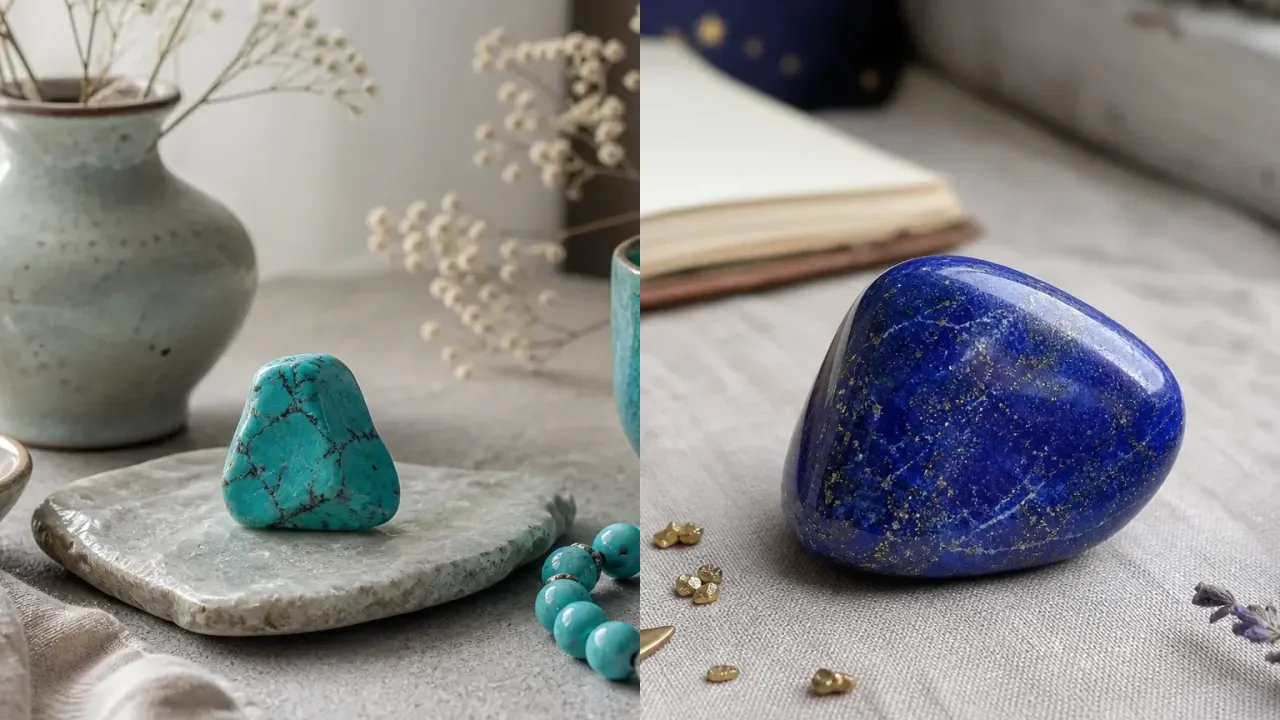
Turquoise is an opaque blue-to-green stone, traditionally associated with protection, communication, and friendship. In crystal practice it’s often linked with the Throat and Third Eye chakras, which is why people reach for it around honest self-expression, travel, and gifts between friends. It has a long history across Persian, Native American, and Egyptian traditions, and it’s still a classic December birthstone. Common forms include cabochons, beads, pendants, and inlay work.
Mineralogically, Turquoise is a copper aluminium phosphate (CuAl₆(PO₄)₄(OH)₈·4H₂O) with a Mohs hardness of 5–6. Softer than quartz. That puts it in pendant, earring, and occasional-bracelet territory, not heavy daily wear. It’s porous, so keep it away from water, salt water, and prolonged sun — it can fade or discolor.
Turquoise Meaning → · Genuine, ethically sourced — not dyed, not glass.
About Lapis Lazuli
Lapis Lazuli is a deep blue gemstone flecked with gold pyrite and white calcite, traditionally associated with wisdom, truth, and inner vision. In crystal practice it’s linked with the Third Eye and Throat chakras, which is why it turns up in meditation practice, focused communication, and contemplative work. Prized since ancient Egypt and traded along the Silk Road, it has a long heritage as a stone of royalty and scholarship. Common forms include bracelets, tumbled stones, cabochon pendants, spheres, and carved figures.
Mineralogically, Lapis Lazuli is a rock made of lazurite with calcite and pyrite, sitting at 5–5.5 on the Mohs scale. Close in hardness to Turquoise, and just as unsuited to rings that take knocks — cabochon pendants, beads, and display pieces are the better fit. Same care rules apply: keep it away from water, salt water, and prolonged sun to protect the surface and color.
Lapis Lazuli Meaning → · Genuine, ethically sourced — not dyed, not glass.
Can You Wear Turquoise and Lapis Lazuli Together?
Practically: Turquoise and Lapis Lazuli can be worn together, and they’re easier to pair than most soft-stone combinations because they share the same care cautions. Turquoise sits at 5–6 on the Mohs scale, Lapis at 5–5.5 — neither is a rugged everyday ring stone. Pendants, beads, and cabochon bracelets suit them both. Both need to stay away from water, salt water, and prolonged sun, so whatever routine protects one protects the other. No juggling two rule sets. Visually, the two blues play well together: sky-to-robin’s-egg against deep royal blue flecked with gold, which is why they read as a layered, cohesive stack.
Energetically: In crystal tradition, both stones are linked to the Throat and Third Eye chakras — the centers associated with truthful expression and inner vision — so together they’re seen as a “speak your truth with clarity” pair. Turquoise, an earth-element stone, is traditionally associated with protection and steady communication, while Lapis Lazuli, an air-element stone, is associated with wisdom, focus, and insight. The earth-and-air balance is one reason practitioners value this combination for journaling, honest conversations, and contemplative practice.
Psychologically: The two share communication and insight intentions, so they tend to pull in the same direction instead of competing. That makes them a clean ritual anchor — one intention (speaking honestly, or thinking clearly) backed by two stones that reinforce it. People often reach for the pair before a meaningful conversation, a creative session, or a few minutes of journaling.
These properties are traditionally associated with crystal practice; many people find the pairing supportive, though the effects are not established by modern research.
Benefits of Turquoise + Lapis Lazuli
Together, Turquoise and Lapis Lazuli cover six complementary strengths:
1. Clearer, More Honest Communication
Both stones are linked to the Throat chakra — the center traditionally associated with truthful self-expression. Combined, they’re often used when someone wants to speak more openly and feel heard. Turquoise is said to steady the nerves around speaking up; Lapis Lazuli is believed to help organize the thought before the words leave the mouth. People reach for this pair before a difficult conversation, a presentation, or a creative writing session.
2. Sharpened Insight & Inner Vision
Both stones are also linked to the Third Eye chakra, the center traditionally tied to intuition and discernment. Together they’re used to deepen contemplative work — Lapis Lazuli brings the focused inner vision, and Turquoise is said to keep that vision grounded and usable instead of abstract. For people who journal, meditate, or just want a clearer read on a situation, this is one of the more popular contemplative pairings.
3. Earth + Air Balance
The pair bridges two complementary elements: Turquoise carries steady, grounding earth energy, while Lapis Lazuli carries light, mobile air energy. In crystal tradition that mix is valued because it pairs grounded practicality with mental clarity — the idea and the follow-through in the same stack. People often use the combination when they want vision and the steadiness to act on it, with neither side drowning the other out.
4. Friendly Protection
Turquoise has a long heritage as a protection and friendship stone, and Lapis Lazuli was historically carried by travelers and scholars for safe passage and clear thinking. Worn together, they read as a gentle, wearable guard for daily life — lighter in feel than the black protection stones, which is why people who want a softer, more social form of protection pick this pair for work, travel, or meeting new people.
5. A Calm, Focused Mind
This is where the shared Third Eye link shows up in daily life. Lapis Lazuli is traditionally associated with concentration and clearing mental clutter, while Turquoise is said to add a steadying, friendly presence that keeps the focus from tipping into strain. Kept together on a desk or worn as a beaded bracelet through a busy workday, the two function as a quiet anchor — the kind of pairing people reach for between meetings, or during a few minutes of evening reflection, when a heavier single stone would feel like too much.
6. A Time-Honored Pairing
This is a pairing our site already recognizes, and the roots run deep. Both stones were prized in ancient Egypt and along the Silk Road, often set side by side in the same piece of jewelry. That long shared heritage is a big part of why the combination still feels natural today — two culturally intertwined blue stones, each backing up the other’s traditional themes of wisdom, protection, and truthful expression.

How to Use Turquoise and Lapis Lazuli Together
Wear them
A common question is can I wear Turquoise and Lapis Lazuli on the same hand? Yes — the shared Throat and Third Eye chakras mean the two are traditionally considered comfortable together. A beaded turquoise and lapis lazuli bracelet on the left (receiving) wrist is a popular everyday option, or wear one as a pendant and the other as beads. Because both stones are soft (Mohs 5–6), avoid stacking them tightly against harder gems, and remove them before washing hands, swimming, or showering.
Meditate
Hold Lapis Lazuli at the Third Eye (brow) and place Turquoise at the Throat (base of the neck) or in the receiving hand. Five to ten minutes is enough for a simple ritual, especially if you’re new to working with these two stones. The aim is a calmer, clearer mental state. Many people use this exact setup as a lead-in to journaling or contemplative practice — a few quiet minutes to settle, then pick up the pen.
Crystal grid
Place Lapis Lazuli at the center as the focus stone and surround it with smaller Turquoise pieces to set an intent around honest communication or insight. It’s a classic, simple grid for self-expression and clear thinking — easy to arrange on a desk, altar, or small table, and gentle enough to leave in place for a few days.
Place in a room
A Lapis Lazuli sphere or tower on the desk keeps a study or workspace feeling focused, while a piece of Turquoise nearby brings a steadying, protective presence. Together they turn a workspace, bedroom, or entryway into a calm, low-stimulation environment — many people start here when they want a clearer head for work or a more peaceful wind-down in the evening.
Caring for Turquoise + Lapis Lazuli
Each stone has its own care needs:
- Turquoise: Water: Avoid water · Sun: Avoid prolonged sun · Salt: Avoid salt water.
- Lapis Lazuli: Water: Avoid water · Sun: Avoid prolonged sun · Salt: Avoid salt water.
When in doubt, cleanse both with sound or moonlight — methods that are gentle across all stone types.
How to cleanse your crystals →
Shop Turquoise + Lapis Lazuli
Every stone below is genuine, ethically sourced, and real — not dyed, not glass.
Bundle any 3 and save 20%.
このガイドに登場するクリスタルを購入する
当店の最新コレクションから、クリスタルジュエリーやストーンをご覧ください。.


Peruvian Turquoise Anklet


Turquoise Howlite Tumbled Stone Set

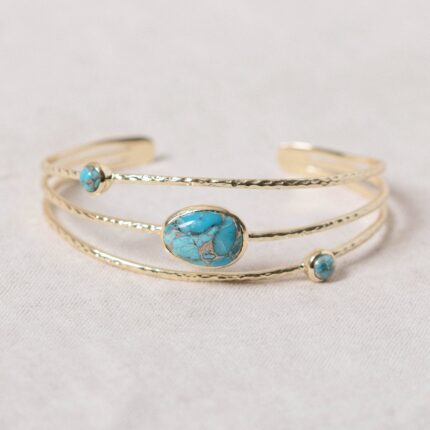
ターコイズとゴールドのブレスレット


Natural Peruvian Turquoise Hearts – AAA Premium Quality
Frequently Asked Questions
Can I wear Turquoise and Lapis Lazuli together every day?
Many people do. If you’re new to combining stones, start with a few hours and notice how the pairing feels before making it a daily habit.
Can I wear Turquoise and Lapis Lazuli on the same hand?
You can. Some wearers follow the tradition of keeping calming stones on the receiving (left) hand and active ones on the giving (right) hand, but it comes down to personal preference.
Can I sleep with Turquoise and Lapis Lazuli?
You can keep them nearby while you sleep. Turquoise is often placed on the wrist or nightstand, while Lapis Lazuli can rest on the nightstand or nearby.
How do I cleanse Turquoise and Lapis Lazuli?
Turquoise: Water: Avoid water · Sun: Avoid prolonged sun · Salt: Avoid salt water. Lapis Lazuli: Water: Avoid water · Sun: Avoid prolonged sun · Salt: Avoid salt water. When in doubt, sound or moonlight cleansing is gentle across all stone types.
Can I add a third stone to Turquoise and Lapis Lazuli?
Yes — Clear Quartz is a neutral amplifier that bridges most pairings without competing. Add one stone at a time so you can notice each shift.
関連情報
- Turquoise Meaning
- Lapis Lazuli Meaning
- How to Cleanse Crystals
- Amethyst and Lapis Lazuli
- Lapis Lazuli and Pyrite
- Turquoise and Citrine
- Selenite and Lapis Lazuli
- Crystal Compatibility Checker
Crystal meanings are shared for entertainment and spiritual practice. They’re not a substitute for professional medical or mental-health care.