ENFJ Tarot Card: Birth Card Meaning & Crystals
ENFJ Tarot Card: Birth Card Meaning & Crystals
Intro
You tested ENFJ, and somewhere between reading “The Protagonist” and the umpteenth article describing you as a natural inspirer, the question underneath the question surfaced: what does it actually mean to be wired to hold a community together — and where does holding-together turn into losing yourself in the holding?
Tarot answers that question differently than personality tests do. Where MBTI sorts you into one of sixteen boxes based on self-reported preferences, a birth card asks which archetype your cognitive wiring keeps returning to. For ENFJ, that pattern has a name, two pillars, and a long association with gathering people around shared meaning.
This article maps ENFJ to The Hierophant as your primary birth card and The Lovers as your growth card, walks through what each illuminates about your cognitive stack (Fe · Ni · Se · Ti), and suggests three crystals that serve distinct functions — the overall companion, the upright ally, and the growth invitation.
> MBTI is a registered trademark of The Myers-Briggs Company. This article is an independent framework based on Jungian cognitive functions (Ni/Ne/Si/Se/Ti/Te/Fi/Fe), offered for self-reflection and creative exploration — not affiliated with, endorsed by, or sponsored by The Myers-Briggs Company. Mapping decisions are our own editorial interpretation and do not represent official MBTI doctrine.
ENFJ at a Glance: The Protagonist
ENFJ sits in the Diplomats group, alongside INFJ, INFP, and ENFP. Your four-letter code is Extraverted · iNtuitive · Feeling · Judging, but the letters are the surface. The deeper structure is your cognitive stack:
- Dominant: Fe (extraverted feeling) — the function that reads and shapes the emotional weather of a group, naturally attuning to what people need to feel met
- Auxiliary: Ni (introverted intuition) — the long-arc vision of what the group could become, the pattern beneath the present moment
- Tertiary: Se (extraverted sensing) — present-moment situational reading, your tactical edge
- Inferior: Ti (introverted thinking) — the function of detached logical analysis, your developmental edge — the part of you that either matures into “what’s actually true here, regardless of how it lands” or avoids the truth in favor of harmony
The nickname “The Protagonist” is shorthand for someone who naturally becomes the person a group orients around — naming what we’re really about, holding the shared meaning, lifting the room. The question a tarot birth card answers is which archetype this cognitive configuration keeps returning to — and for ENFJ, that archetype is the figure between the pillars, in the formal role, hands raised in blessing.
Your Birth Card: The Hierophant
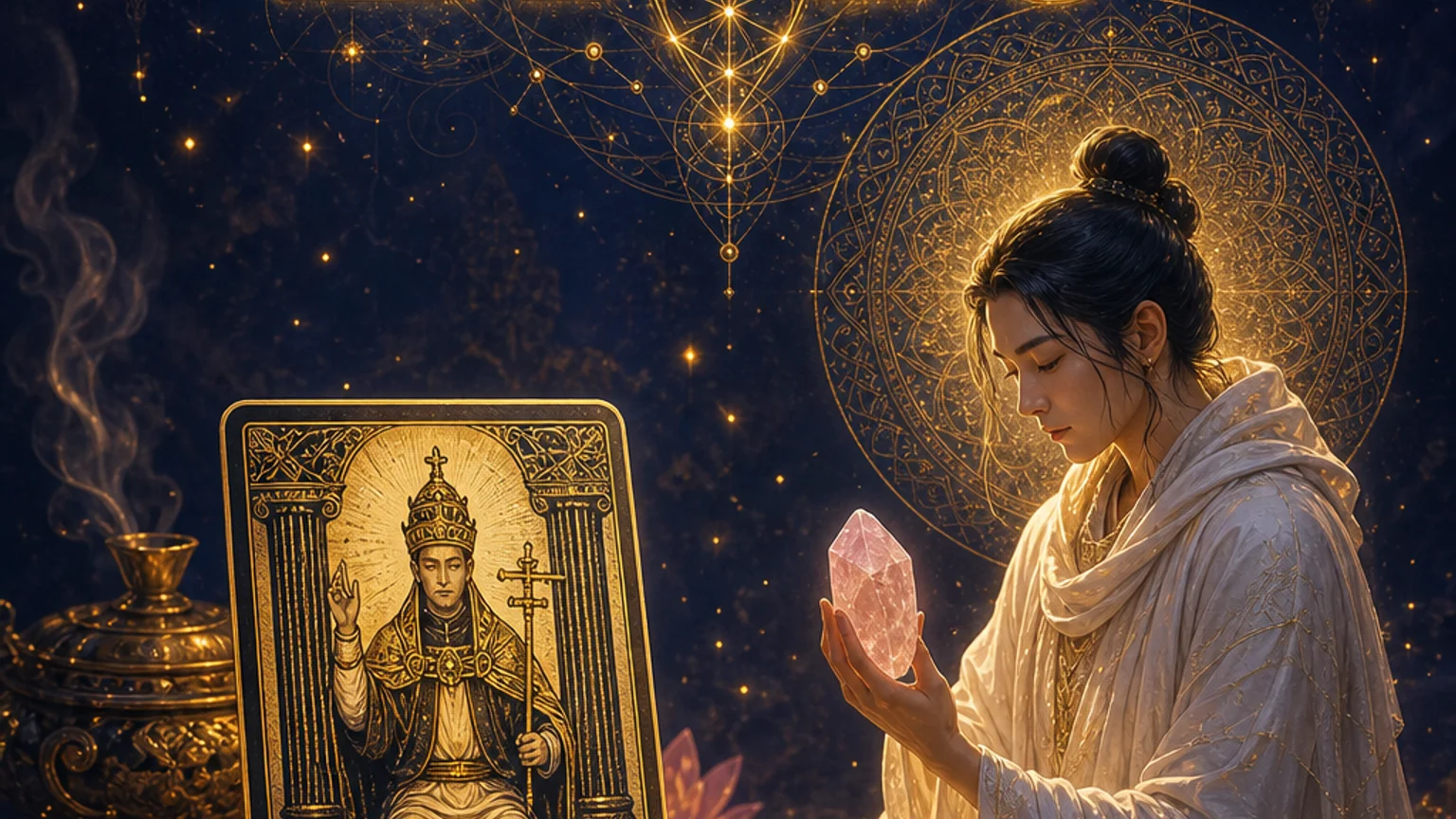
The Hierophant’s archetype is The Teacher. In the Rider-Waite image, a figure in formal vestments sits between two pillars, two acolytes kneel before him, his hand raises a blessing. The pillars aren’t decoration — they’re the load-bearing image. The Hierophant is the lineage-holder: the one who stands at the threshold of a tradition and passes on its meaning to those who have come to learn.
Here is where most “ENFJ tarot card” articles collapse the work. They map ENFJ to The Hierophant because “both are teachers,” and stop there. The pairing is where the work begins. Two types share this card (ENFJ and ISFJ), and the why differs. ISFJ’s Hierophant is sourced in Si’s preservation of inherited tradition — keeping what has always been done. Yours is sourced in Fe-Ni’s visionary gathering — calling a community around a shared meaning that pulls them toward a future.
Why The Hierophant Aligns with ENFJ’s Fe-Ni Dominance
Your dominant Fe is the function that reads and shapes the emotional weather of a group. You walk into a room and you know — immediately, in the body — what people are feeling and what they need to feel met. Your auxiliary Ni supplies the long-arc vision: what this group could become, what shared meaning would pull them forward. The Hierophant between the pillars, hands raised in blessing, is the image for exactly this: the figure who names the shared meaning and gathers the group around it.
This is why your warmth isn’t the same as people-pleasing, even though outsiders often conflate the two. The Hierophant’s psychological lens for ENFJ is conformity vs autonomy — the line between naming a meaning that genuinely gathers people and imposing a meaning that asks them to conform. ENFJs live this distinction viscerally in the Fe-Ti axis. Your gathering instinct isn’t performance; it’s the conviction that people need shared meaning to thrive, and that someone has to name it. The danger isn’t that you’ll fail to gather. The danger is that you’ll gather people around a meaning that isn’t actually yours.
Three Concrete Manifestations of Hierophant Energy in ENFJ
- You name the shared meaning before anyone else does. What the group is really about, what this moment calls for, what we’re building toward — you articulate it, and the room rearranges itself around your articulation.
- You hold the formal role, even when no one assigned it. The mentor, the convener, the one who blesses and initiates. You step into the threshold-role naturally, sometimes without noticing.
- You gather by long-arc vision. Where other gatherers hold the room in the present, you gather toward a future — the person the group could become, the meaning that hasn’t fully landed yet.
Myth vs Reality
Myth: The Hierophant means ENFJs are conformist or dogmatic.
Reality: The Hierophant describes what your Fe builds — shared meaning that gathers — not whether you impose it dogmatically. The healthiest Hierophants in the lineage were reformers who named a meaning that liberated people, not ones who enforced conformity. The card describes your cognitive rhythm — read the room, name the meaning, gather the people — not a verdict on your relationship to tradition.
Myth: The Hierophant reversed means you’ve failed at leadership.
Reality: The shadow side isn’t failure; it’s the invitation to notice when gathering has tipped into over-accommodation. More on that in the shadow section.
Your Growth Card: The Lovers
The Lovers’s archetype is The Choosers — the card shows a man and a woman beneath an angel, the card of conscious value-alignment. Where The Hierophant gathers the group around shared meaning, The Lovers asks what you yourself actually choose — beyond what the group needs, beyond what harmony demands.
For ENFJ, The Lovers is the growth card — the archetype your inferior Ti reaches toward when Hierophant energy has over-matured into over-accommodation. The mapping logic is precise: where Fe (dominant) reads and meets the group’s need, *Ti (inferior) eventually asks “but what do I think is true, regardless of how it lands?”* The Lovers’s two figures beneath the angel is the image for exactly this — the conscious choice that aligns your inner truth with your outer action, even when it costs harmony.
The growth invitation surfaces when you’ve over-invested in The Hierophant’s gathering. ENFJs under stress — particularly in a Fe-Se loop — can stay in the gathering mode long after their own truth has gone underground. The Lovers appears at that moment with a quiet prompt: what do you actually choose? Not what the room needs. What you.
Three Concrete Growth Steps (Next 7–30 Days)
- Articulate one position the group hasn’t asked for. Not as rebellion — as honesty. The Lovers asks you to say one true thing this week that you would have softened last month, in service of the group rather than against it.
- Name one gathering you’ve been over-accommodating. ENFJs under Hierophant overload tend to lose their own preference in the room’s. Lovers energy asks you to re-enter one room as a chooser, not just a gatherer.
- Make one decision based on Ti analysis, not Fe impact. Pick one issue where you’ve been avoiding the logical conclusion because of how it would land, and follow the logic. Ti develops through use.
The growth card isn’t a destination. It’s the direction of travel when the primary card’s shadow has been sitting too long in the driver’s seat.
The Shadow Side: Reversed Hierophant
The Hierophant reversed, in an ENFJ reading, points to three distinct shapes of reversal — not a single “bad” meaning, but three specific patterns to recognize.
Shape 1: Fe-Se Loop (Over-Accommodation Mode)
When Fe and Se loop without Ni’s long-arc check, you can slide into a pattern where every room gets the version of you it wants — charming, present, adaptable — but the long-arc vision has gone underground, and underneath the warmth there’s a growing sense of having lost contact with your own center. The felt sense is “everyone likes me,” but the cognitive mechanism is the gathering has replaced the choosing. The growth invitation isn’t to become cold; it’s to let Ni back into the loop — what is the long arc here, and does the current gathering serve it?
Shape 2: “For Their Sake” as Self-Evasion
Ti is your inferior function, which means asking “what do I actually think is true, regardless of how it lands” is developmentally expensive. The shadow move is to use “I’m doing this for them” as cover for avoiding your own position. The Hierophant’s blessing, in this shape, isn’t service — it’s a vantage point that hides the blesser’s own need.
Shape 3: The Guru’s Rigidity
This is the shadow where the gathering has hardened into a worldview — “I know what people need, they should listen to me, the tradition I’m naming is the right one.” The growth edge here isn’t to stop teaching; it’s to notice when the teaching has become a defense against being taught — when the Hierophant role protects you from the vulnerability of being a learner again.
The reversed reading is not a bad omen. It’s the card’s way of asking whether the gathering is still serving the people or has started substituting for your own truth. The integration path runs straight into The Lovers’s domain — the conscious choice that includes your own voice.
ENFJ in Relationships
In intimate relationships, ENFJs bring the same gathering depth they bring to communities — which is the gift and the friction. Your alone time isn’t negotiable; it’s where you reconnect with your own center, integrate, and stay whole. A partner who reads your gathering as needing-nothing will trigger your guru’s rigidity (shadow shape 3); a partner who reads it as the rhythm that makes your care sustainable gets the fullness of what you offer.
Three patterns to notice:
- You read your partner’s needs before they name them, which is genuine care — and can also become a way of avoiding your own. Naming this rhythm early (“I see what you need, and I also have a need here”) prevents months of one-sided gathering.
- You hold high standards for relational depth, which can land as criticism if delivered without warmth.
- You express care through meeting needs — anticipating, gathering, blessing. This is genuine love in ENFJ dialect; learning to also let your partner give to you, without reading it as a sign you’ve failed, is the growth work.
None of this predicts whether a specific relationship will succeed. It names the shape of the dynamic so you can choose it consciously.
ENFJ at Work
The workplace is where ENFJ cognitive wiring is most often deeply effective — and most often stretched thin. Your Fe-Ni combination is built for work that requires reading people, articulating shared meaning, and leading toward a long-arc vision. You thrive in roles that give you relational depth, meaning, and a mission worth gathering people around.
Three patterns to notice:
- You see the shared meaning before the org chart does. This means you’ll often spot the cultural pattern, the unspoken need, the vision that could gather people. The growth work is translating that vision into Ti-checkable logic — what’s actually true, beyond what would land well.
- You prefer depth over breadth. A role that asks you to gather many shallow rooms will drain you faster than one deep community three times as long.
- You lead through gathering and vision — naming the shared meaning, lifting the room, holding the long arc. This is honest leadership; the growth edge is learning that some decisions require Ti analysis, not just Fe resonance.
This isn’t a forecast for your career. It’s a description of how your type tends to interact with work — so you can choose roles and environments that fit your wiring rather than fight it.
ENFJ on the Growth Path
The growth path for ENFJ is, in many ways, the integration of the inferior Ti — the function of detached truth that pure Fe can quietly bypass. This isn’t about becoming cold. It’s about completing the cognitive stack so the meaning you gather people around is accountable to what you actually think is true.
Three threads of growth work:
- Truth practices. Anything that forces you to articulate what you actually think, beyond what would land well. Ti develops through being asked and answered.
- Solitude practices. Taking one room per week where you don’t gather — you sit, you reflect, you reconnect with your own center. Ni develops through being allowed to revise the vision without an audience.
- Embodied presence. Fe lives in the room; the growth path includes anything that brings you back to your own body — long walks, weightlifting, time in nature. Se develops through grounded use.
The growth path isn’t linear. It’s about rounding out the stack so the Hierophant’s blessing and the Lovers’s choice work together rather than in tension.
Crystals for ENFJ
Three crystals map to the ENFJ birth card configuration, each serving a distinct function. These are not “lucky stones for your type” — they are tactile anchors for specific cognitive moves, chosen because their traditional associations align with the work each part of your stack is doing.
Rose Quartz — The Overall Companion (Fe × Hierophant Nurturing)
Rose Quartz carries the heart-open warmth The Hierophant’s blessing demands in mineral form. For ENFJ, it aligns with dominant Fe — the function that reads and meets the group’s need. The traditional heart-chakra and Venus associations map to exactly the kind of warm gathering Fe performs when it’s serving the people.
How to use it: Hold Rose Quartz for five minutes before a gathering — a class, a meeting, a hard conversation. It’s a physical reminder that the gathering is in service of the people, not in service of being seen gathering.
쇼핑: Rose Quartz meaning · Shop search
Lapis Lazuli — The Upright Ally (Ti × Truth)
Lapis Lazuli supports the Ti-driven truth-articulation that your inferior Ti brings when it’s time to say what’s actually true regardless of how it lands. Across Persian, Egyptian, and Buddhist traditions, Lapis is the stone of wisdom and truth — a tactile anchor for the teacher who names the real thing, not just the gathering thing.
How to use it: Place Lapis on your desk during decisions where truth is more important than harmony — the conversation where you have to disagree, the meeting where you have to name the pattern. It’s a tactile cue to let Ti back into the room.
쇼핑: Lapis Lazuli meaning · Shop search
Carnelian — The Growth Invitation (Se × Lovers Choice-in-Action)
Carnelian activates the Se-driven choice-in-action that The Lovers growth card invites — the courage to act on what you choose, beyond what the room wants. Where the first two crystals support the gathering and the truth, Carnelian is the one that asks what choice gets made today, in the body.
How to use it: Carry Carnelian on the day you’ve scheduled a Lovers move — the conversation where you say what you actually choose, the decision you make on Ti logic. It’s a tactile reminder that the truth has been named; now it gets lived.
쇼핑: Carnelian meaning · Shop search
ENFJ: An Eastern Lens
The Tibetan Buddhist tradition has a name for what healthy ENFJs do when they gather a community. It’s called *lineage transmission (chuánchéng) — the structured passing-on of meaning from teacher to student to community, across generations. A lama isn’t inventing the dharma when he teaches; he’s holding a meaning that predates him and passing it on in a form that serves the people in front of him*. The Hierophant between the pillars, hands raised in blessing, is doing exactly this.
This is the Eastern frame that resolves the warmth-vs-truth tension at the heart of ENFJ and The Hierophant. Your gathering instinct isn’t performance; it’s a recognized practice with a name , a lineage, and a truth clause (Lovers’s choice). The question isn’t whether to gather — it’s whether your gathering is accountable to a truth that goes deeper than what the room wants to hear.
The deeper principle is (zhōng zhèng — “centered and upright,” from the Confucian lineage). The teacher who has doesn’t gather people around himself; he gathers them around the meaning, and then steps back when the meaning has landed. ENFJs who master this don’t become less warm; they become the kind of warm that doesn’t need to be the center — the Hierophant who can disappear into the blessing.
The crystal tradition aligns here too. Lapis Lazuli across Persian, Egyptian, and Buddhist lineages is the stone of wisdom, truth, and the teacher’s role — the stone that adorned the pharaoh’s death mask and the Buddha’s blue pigment in Tibetan thangka. The function isn’t metaphysical; it’s the same function a teacher’s robe serves: a tactile, visible reminder that the role is larger than the person filling it. When an ENFJ holds Lapis before a hard truth-telling, the stone isn’t changing the mind; it’s anchoring the question “what is true here, beyond what would gather?” — the question the Lovers card asks.
None of this is “Eastern traditions view crystals as energy amplifiers” — that’s the universal filler sentence. The actual Eastern frame for ENFJ is specific: your gathering is a recognized practice with a name , a centered-upright principle , and a truth clause (the Lovers’s choice). The crystals are anchors, not engines.
Shop Crystals for This Guide
Explore crystal jewelry and stones from our current collection.


Om Mani Padme Hum Copper Ring


Om Namah Shivay Mantra Copper Bangle


Fair Trade Astamangala Copper Bangle
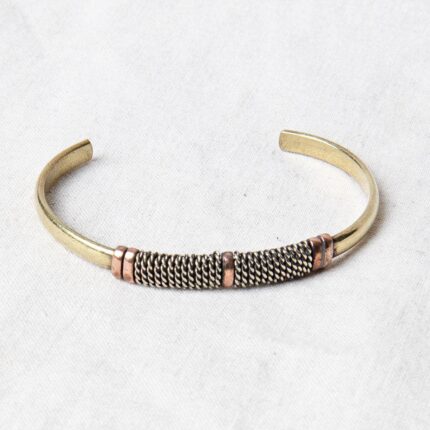

Tibetan Handcrafted Copper Bracelet
FAQ: ENFJ Tarot Card
1. What tarot card is ENFJ?
ENFJ’s primary birth card is The Hierophant — the archetype of The Teacher who gathers a community around shared meaning. The mapping aligns ENFJ’s dominant Fe (extraverted feeling) with The Hierophant’s psychological lens of conformity-vs-autonomy. ENFJ’s growth card is The Lovers, which represents the Ti-driven conscious choice that Fe’s gathering eventually requires.
2. Why is The Hierophant the birth card for ENFJ?
The alignment runs deeper than “both are teachers.” ENFJ’s dominant Fe reads and shapes the emotional weather of a group; auxiliary Ni supplies the long-arc vision the gathering pulls toward. The Hierophant between the pillars, hands raised in blessing, is the image for exactly this. Two types share this card (ENFJ/ISFJ), but the why differs: ENFJ’s Hierophant is sourced in Fe-Ni’s visionary gathering, ISFJ’s in Si-Fe’s preservation of inherited tradition.
3. What is the growth card for ENFJ?
The Lovers. The logic: where Fe (dominant) reads and meets the group’s need, Ti (inferior) eventually asks “but what do I actually think is true, regardless of how it lands?” The Lovers’s two figures beneath the angel is the image for exactly this — the conscious choice that aligns inner truth with outer action. The growth invitation surfaces when gathering has over-matured into over-accommodation.
4. What does reversed Hierophant mean for ENFJ?
In an ENFJ reading, reversed Hierophant isn’t a bad omen — it points to three specific patterns: Fe-Se loop (over-accommodation), “for their sake” as self-evasion (Ti inferior bypass), and the guru’s rigidity (teaching hardened into defense against learning). The growth invitation is to notice whether the gathering is still serving the people or substituting for your own truth.
5. Which Jungian archetype is ENFJ?
ENFJ aligns with the Teacher/Hierophant archetype on the primary axis and the Lovers/Chooser on the growth axis. Jung’s framework of cognitive functions — which MBTI is built on — describes Fe as extraverted feeling, the judging function that reads and shapes the emotional weather of a group.
6. What are the best crystals for ENFJ?
Three crystals serve distinct ENFJ functions: 로즈 쿼츠 (overall companion, supporting Fe’s warm gathering), 라피스 라줄리 (upright ally, supporting Ti’s truth-articulation), and 카넬리안 (growth invitation, supporting Se-driven choice-in-action). These are anchors for specific cognitive moves, not “lucky stones.”
7. How does the Eastern perspective view ENFJ?
The Tibetan Buddhist tradition recognizes ENFJ-style gathering as chuánchéng, lineage transmission — the structured passing-on of meaning across generations. Confucianism’s zhōng zhèng, centered and upright describes the teacher who gathers around the meaning, not around himself. Lapis Lazuli across Persian/Egyptian/Buddhist lineages is the stone of wisdom and the teacher’s role — a tactile anchor for “what is true here, beyond what would gather?”.
8. Is the ENFJ tarot mapping official MBTI?
No. MBTI is a registered trademark of The Myers-Briggs Company, and this mapping is our independent editorial interpretation based on Jungian cognitive functions (Fe/Ni/Se/Ti). It is not affiliated with, endorsed by, or sponsored by The Myers-Briggs Company, and does not represent official MBTI doctrine. The mapping is offered as a self-reflection framework, not a personality diagnosis.
Explore More
- Tarot card meanings: The Hierophant · The Lovers
- Related Diplomats types: INFJ · ESFJ · ENTJ (same Fe dominant / Diplomats group)
- Crystal meanings: 로즈 쿼츠 · 라피스 라줄리 · 카넬리안
- Find your own MBTI birth card: MBTI Tarot Tool
- All MBTI × Tarot articles: MBTI Tarot Hub
> Tarot birth cards and crystals are mirrors for self-reflection, not personality diagnoses or fixed forecasts. The cards name the shape of the patterns your cognitive wiring keeps returning to — what you do with that naming is your free will.