ENFP Tarot Card: Birth Card Meaning & Crystals
ENFP Tarot Card: Birth Card Meaning & Crystals
Intro
In the consulting room, an ENFP arrives carrying The Fool differently than other types do. The session opens with a vivid story about a person they met on the bus Tuesday, branches into three new projects they’re considering, opens a tab on a city they’re thinking of moving to, and lands — briefly, brilliantly — on a question about whether any of these threads is actually the work, or whether the work is something they haven’t tried yet. The card lands on the table between you, and within ten minutes you’ve been offered four genuinely compelling interpretations of it, two of which the ENFP will probably act on before next week. The work begins — but the work, for ENFP, isn’t narrowing the field. It’s recognizing that the field-narrowing has to happen, that it forecloses, and that this is the growth.
Tarot answers the question underneath the question for ENFP differently than personality tests do. MBTI tells you that you are The Campaigner; a birth card asks which archetype your cognitive wiring keeps returning to when nobody is watching. For ENFP, that archetype is the figure standing at the cliff’s edge, eyes on the sky, about to step. The cliff isn’t decoration — it’s the load-bearing image. The Fool is the one who begins, again and again, because the beginning is the mode.
This article maps ENFP to The Fool as your primary birth card and The Star as your growth card, walks through what each illuminates about your cognitive stack (Ne · Fi · Te · Si), and suggests three crystals that serve distinct functions — the overall companion, the upright ally, and the growth invitation.
> MBTI is a registered trademark of The Myers-Briggs Company. This article is an independent framework based on Jungian cognitive functions (Ni/Ne/Si/Se/Ti/Te/Fi/Fe), offered for self-reflection and creative exploration — not affiliated with, endorsed by, or sponsored by The Myers-Briggs Company. Mapping decisions are our own editorial interpretation and do not represent official MBTI doctrine.
ENFP at a Glance: The Campaigner
ENFP sits in the Diplomats group, alongside INFJ, INFP, and ENFP. Your four-letter code is Extraverted · iNtuitive · Feeling · Perceiving, but the letters are the surface. The deeper structure is your cognitive stack:
- Dominant: Ne (extraverted intuition) — the function that perceives possibility and connection everywhere, the engine that won’t stop generating new beginnings
- Auxiliary: Fi (introverted feeling) — the inner value system that asks “is this true for me?” of every possibility Ne generates
- Tertiary: Te (extraverted thinking) — the function that, when developed, helps you execute one of the possibilities
- Inferior: Si (introverted sensing) — the function of routine, precedent, and follow-through, your developmental edge — the part of you that either matures into sustained commitment or avoids the staying
The nickname “The Campaigner” is shorthand for someone who treats every encounter as the opening scene of a possible new chapter, and brings to it the full fire of someone who believes this chapter could matter. The question a tarot birth card answers is which archetype this specific cognitive configuration keeps returning to — and for ENFP, that archetype is the figure at the cliff’s edge, the small bundle on a stick, eyes on the sky.
Your Birth Card: The Fool
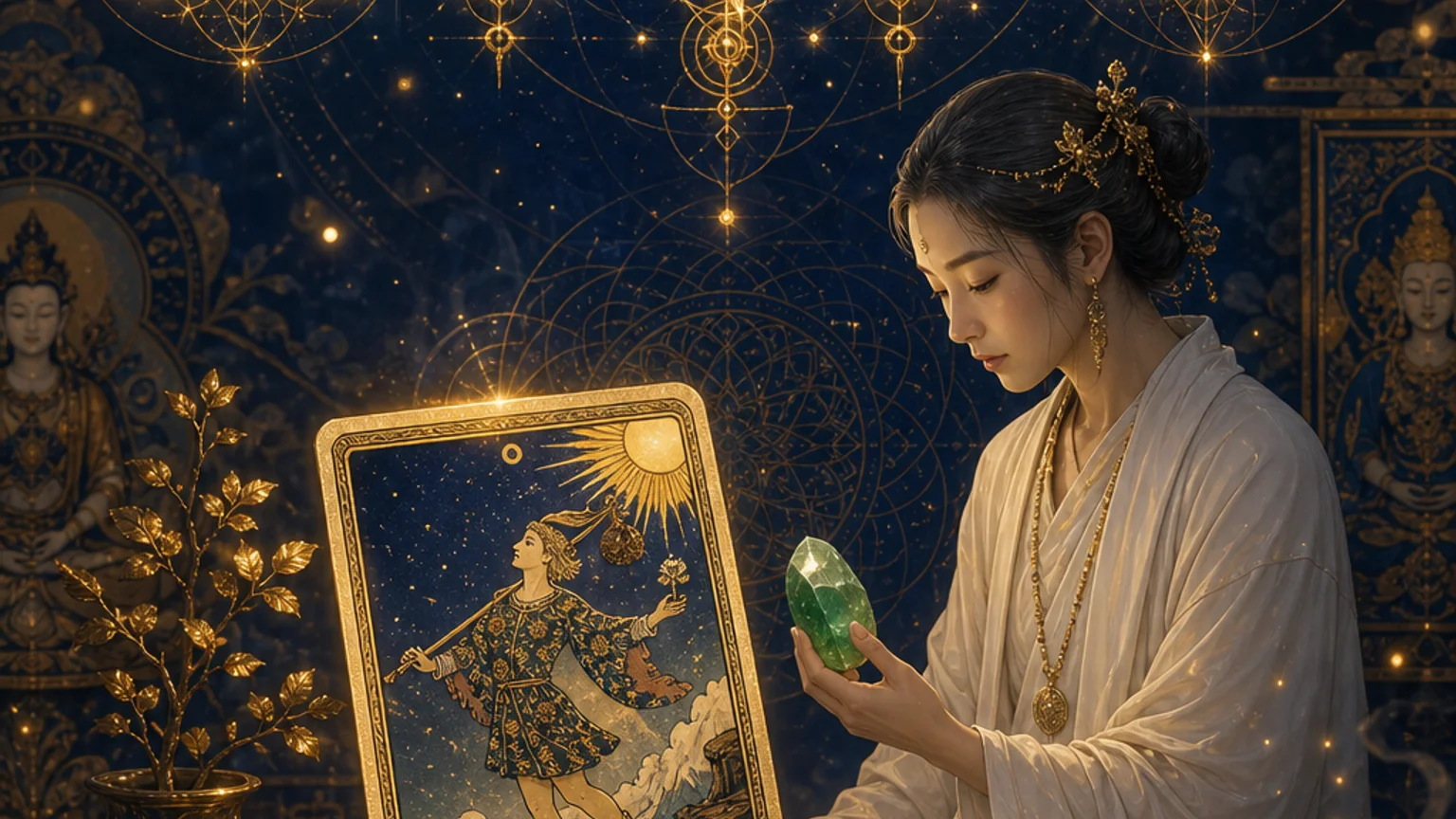
The Fool’s archetype is The Innocent Pioneer. In the Rider-Waite image, a young figure stands at the edge of a cliff, eyes raised to the sky, a small bundle on a stick over one shoulder, a small dog yapping at their heels. The Fool is about to step. The cliff isn’t decoration — it’s the load-bearing image. The Fool is the one who steps without having mapped the landing, because the step itself is the mode, and the small bundle is the proof that they’ve packed light enough to step.
Here is where most “ENFP tarot card” articles get it wrong. They map ENFP to The Fool because “both are spontaneous,” and stop there. The pairing is where the work begins. Three types share this card (ENFP, ESTP, ESFP), and the why differs. ESTP’s Fool is sourced in Se-Ti’s action-experimentation — leap and read the data. ESFP’s Fool is sourced in Se-Fi’s present-moment sparkle — leap because the moment asked. Yours is sourced in Ne-Fi’s possibility-exploration — leap because the next chapter might be the chapter, and Fi has checked that the chapter is true for you.
Why The Fool Aligns with ENFP’s Ne-Fi Dominance
Your dominant Ne is the function that does its best work at the cliff’s edge. While other functions are deepening expertise in what is, Ne is perceiving what could be — branching possibility, registering the new chapter in every encounter, treating each introduction as the opening scene of something. The Fool standing at the cliff with eyes on the sky is the image for exactly this: the orientation toward what’s next, the willingness to step before the landing is mapped.
Your auxiliary Fi supplies the value-check. Where Ne generates the possibility, Fi asks “is this true for me?” — and the answer determines whether you step. The Fool’s small bundle is the image for exactly this: you’ve packed only what fits your values; the rest is left behind. ENFPs live this combination viscerally in the Ne-Fi axis. Your beginnings aren’t recklessness; they’re the natural byproduct of perceiving more possibility than the room and having checked it against an inner compass that’s more discerning than outsiders assume.
This is why your spark isn’t the same as chaos, even though outsiders often conflate the two. The Fool’s psychological lens for ENFP is openness to experience — the conviction that the next chapter could be the chapter, and that holding the chapter at arm’s length to “be realistic” is its own kind of risk. The danger isn’t that you’ll leap. The danger is that you’ll never stay anywhere long enough for any of the chapters to become a book.
An Anonymous Client Vignette (Illustrative, Not Predictive)
S., 31, an ENFP and a community organizer, sat with The Fool after she had launched four new initiatives in six months and was sketching the fifth. She was genuinely lit up by the new project — it was true to her values, it would help people, it was hers — and, in the same breath, aware that none of the previous four had been sustained past the launch, that her team was exhausted, and that the pattern was becoming her reputation. Both facts were true at once. The Fool wasn’t forecasting whether the fifth project would succeed — it was naming the gap between the brilliance of the beginning and the question of the staying, the gap Ne-Fi dominance naturally creates when Te and Si haven’t yet done their commitment work. The work wasn’t to predict; it was to ask the question she’d been circling for six months: which one of these chapters actually deserves to become a book?
That’s what a birth card does. It doesn’t tell you what will happen. It names the shape of the tension you keep returning to, so you can work with it consciously rather than reenact it blindly.
Three Concrete Manifestations of Fool Energy in ENFP
- You see the new chapter before the page has turned. Where others see one event, you see the opening of a possible arc — and you bring to it the full energy of someone who believes the arc could matter.
- You hold the possibilities as all genuinely possible. This isn’t indecision; it’s the Ne instinct that any of them could be true, combined with the Fi discernment that asks which ones are true for you.
- You retreat to begin again. Under stress, your instinct isn’t to deepen what exists — it’s to find the next chapter, the new opening, the possibility that hasn’t been tried. This is the Fool at the cliff, again.
Your Growth Card: The Star
Before the shadow, the growth steps — because the most useful question for an ENFP reading isn’t “what’s my shadow” but “how do I stay without losing the spark”, and The Star answers that first.
The Star’s archetype is The Hopeful — the figure who kneels by the water after the tower has fallen, pouring from two vessels, one into the pool and one onto the land. Where The Fool leaps into the next chapter, The Star commits one true direction — a hope specific enough to walk toward, sustained through time.
For ENFP, The Star is the growth card — the archetype your Te and Si reach toward when Fool energy has over-matured into infinite beginnings. The mapping logic is precise: where Ne (dominant) generates the chapters, Te (tertiary) commits one to structure, and Si (inferior) sustains the commitment over time. The Star’s two vessels are the image for exactly this — the inner vessel (the value-charged possibility Ne-Fi has chosen) and the outer vessel (the lived commitment that walks toward it, day by day).
The growth invitation surfaces when you’ve over-invested in The Fool’s infinite cliff. ENFPs under stress — particularly in a Ne-Te loop — can stay in the beginning mode long after one of the chapters has clearly earned the staying. The Star appears at that moment with a quiet prompt: one chapter, walked. Pick one. Pour.
Three Concrete Growth Steps (Next 7–30 Days)
- Pick one chapter to walk for ninety days. Not forever — ninety days. The Star’s hope is specific and time-bound; it doesn’t require you to commit your whole life, only to commit one thread long enough to see what it becomes.
- Build one daily structure that sustains the walk. ENFPs under Fool overload tend to underbuild structure, because structure feels like it would kill the spark. Star energy asks you to invent one small daily structure that holds the chapter — a writing hour, a check-in, a metric — and let the structure carry the spark when the spark runs low.
- Have the conversation that names the staying. The chapter has been beginning for months; the staying hasn’t been named. Tell one person which one you’re walking, and let them ask you about it in ninety days.
The growth card isn’t a destination. It’s the direction of travel when the primary card’s shadow has been sitting too long in the driver’s seat.
The Shadow Side: Reversed Fool
The Fool reversed, in an ENFP reading, points to three distinct shapes of reversal — not a single “bad” meaning, but three specific patterns to recognize.
Shape 1: Ne-Te Loop (Reckless Beginning)
When Ne and Te loop without Fi’s value-check, you can slide into a pattern where every new chapter gets launched without the discerning question of whether it’s true for you. The felt sense is “I’m building momentum,” but the cognitive mechanism is the beginnings have replaced the values. The growth invitation isn’t to slow down indefinitely; it’s to let Fi back into the loop — is this chapter actually mine, or is it the room’s enthusiasm wearing my face?
Shape 2: “I’m Still Exploring” as Staying-Avoidance
Si is your inferior function, which means sustaining one commitment past the honeymoon is developmentally expensive. The shadow move is to use “I’m still exploring my options” as cover for avoiding the uncomfortable act of staying. The Fool’s cliff, in this shape, isn’t adventure — it’s a defensive perma-leap that prevents any chapter from becoming a book.
Shape 3: The Spark’s Cynicism
This is the shadow where the Fool’s openness has hardened into a worldview — “everything is possible, so nothing is worth committing to, depth is overrated.” The growth edge here isn’t to become rigid; it’s to notice when the cynicism is protecting a fear that staying will reveal you weren’t actually that good rather than serving the openness.
The reversed reading is not a bad omen. It’s the card’s way of asking whether the beginning is still serving your life or has started substituting for it. The integration path runs straight into The Star’s domain — the act of picking one chapter and walking it.
ENFP in Relationships
In intimate relationships, ENFPs bring the same beginning-fire they bring to everything — which is the gift and the friction. Your alone time isn’t negotiable; it’s where you reconnect with your values, integrate, and stay whole. A partner who reads your spark as needing-no-anchor will trigger your spark’s cynicism (shadow shape 3); a partner who reads it as the rhythm that makes your care renewable gets the fullness of what you offer.
Three patterns to notice:
- You communicate in cascades, not bullet points, which can feel overwhelming to a partner who processes linearly. Naming this rhythm early (“I’m sending a cascade; you don’t have to respond to all of it”) prevents months of misread intensity.
- You hold high standards for authenticity and growth, which can land as criticism if delivered without warmth.
- You express care through possibility — seeing what your partner could become, naming the chapter they’re afraid to begin, holding the vision of who they are becoming. This is genuine love in ENFP dialect; learning to also stay with your partner in the un-dramatic middle of their chapter is the growth work.
None of this predicts whether a specific relationship will succeed. It names the shape of the dynamic so you can choose it consciously.
ENFP at Work
The workplace is where ENFP cognitive wiring is most often both deeply generative and quietly exhausted. Your Ne-Fi combination is built for work that requires seeing possibility, articulating what could be, and bringing people toward the next chapter. You thrive in roles that give you range, meaning, and a mission worth your beginning-fire.
Three patterns to notice:
- You see the next chapter before the org chart does. This means you’ll often spot the re-invention, the new direction, the vision that could pull people forward. The growth work is translating that vision into Te-checkable execution — what would it take to actually ship this, in detail?
- You prefer starting over maintaining. A role that asks you to run an existing process will drain you faster than one that asks you to invent the next chapter.
- You lead through vision and authenticity — naming what’s possible, igniting the room, holding the value-charge. This is honest leadership; the growth edge is learning that some chapters need staying, not just beginning.
This isn’t a forecast for your career. It’s a description of how your type tends to interact with work — so you can choose roles and environments that fit your wiring rather than fight it.
ENFP on the Growth Path
The growth path for ENFP is, in many ways, the integration of the inferior Si — the function that sustains a commitment past the honeymoon. This isn’t about becoming a different person. It’s about completing the cognitive stack so the chapters you begin actually become books.
Three threads of growth work:
- Staying practices. Anything that forces you to remain in one chapter past the spark — a project shipped past the honeymoon, a place lived in for a year, a relationship sustained through the boring middle. Si develops through being used.
- Structuring practices. Taking one possibility per month and committing it to Te-structure — a plan, a metric, a deadline. Te develops through small executions, not large visions.
- Embodied presence. Ne lives in the next-moment; the growth path includes anything that brings you into this moment — long walks, weightlifting, time in nature. Si develops through presence, not projection.
The growth path isn’t linear. It’s about rounding out the stack so the Fool’s step and the Star’s walk work together rather than in sequence.
Crystals for ENFP
Three crystals map to the ENFP birth card configuration, each serving a distinct function. These are not “lucky stones for your type” — they are tactile anchors for specific cognitive moves, chosen because their traditional associations align with the work each part of your stack is doing.
Green Aventurine — The Overall Companion (Ne × Fool Leap)
Green Aventurine carries the leap-quality The Fool’s step demands in mineral form. For ENFP, it aligns with dominant Ne — the function that perceives possibility and leaps into the next chapter. The traditional “stone of opportunity” association maps to exactly the kind of openness to what the new chapter holds Ne performs when it’s well-checked by Fi.
How to use it: Hold Green Aventurine for five minutes before a new beginning — a project, a conversation, a city. It’s a physical reminder that the leap is the mode, and that the leap is in service of the chapter, not in service of escaping the last one.
Shop: Green Aventurine meaning · Shop search
Citrine — The Upright Ally (Te × Manifestation)
Citrine supports the Te-driven execution that your tertiary Te brings when it’s time to ship one of Ne’s possibilities. Where Aventurine supports the leap, Citrine supports the follow-through — the structure that turns a possibility into a shipped thing.
How to use it: Carry Citrine on the day you’ve scheduled a Star move — the writing hour, the launch, the hard conversation that ships the chapter. It’s not an “enhancement”; it’s a tactile cue to keep Te in its executing role rather than drifting back into Ne’s branching.
Shop: Citrine meaning · Shop search
Moonstone — The Growth Invitation (Si × Staying)
Moonstone supports the Si-driven staying that your inferior Si tends to avoid — and aligns with The Star growth card’s invitation to walk one chapter over time. Where the first two crystals support the leap and the ship, Moonstone is the one that asks what gets sustained past the honeymoon, in the daily middle.
How to use it: Place Moonstone on your desk during the un-dramatic middle of the chosen chapter — the hundredth day, the writing hour that doesn’t sparkle, the check-in that’s routine. It’s a tactile reminder that the chapter is becoming a book, even when the book feels boring.
Shop: Moonstone meaning · Shop search
ENFP: An Eastern Lens
The Mahayana Buddhist tradition has a name for what healthy ENFPs do at the cliff’s edge. It’s called (chū fā xīn — “beginner’s mind” or more precisely “the first arising of the awakened heart,” bodhicitta), and it refers to the moment the aspiration toward awakening first arises — fresh, full of possibility, before it has been tested by sustained practice. The tradition is unambiguous: this moment is precious. Without it, no path begins. And — the tradition is equally unambiguous — without sustained practice, the moment dissipates and the path never walks.
This is the Eastern frame that resolves the spark-vs-staying tension at the heart of ENFP and The Fool. Your beginning-fire isn’t recklessness; it’s a recognized contemplative value with a name (/bodhicitta), a lineage, and a staying clause (Star’s walk). The question isn’t whether to leap — it’s whether your leaping has a structure that lets one of the chapters become a book, or whether it has hardened into a defensive perma-leap with no staying.
The crystal tradition aligns here too. Clear Quartz across Buddhist and Taoist lineages is the stone of clear original mind — the mala bead that anchors attention to the beginner’s-heart beneath the cascade. The function isn’t metaphysical; it’s the same function a breath-anchor serves in meditation. When an ENFP holds Clear Quartz (or its companion stones) during a sustained-walk session, the stone isn’t changing the mind; it’s anchoring the question “what did I originally intend here, before the cascade?” — the question that turns the leap into a chapter and the chapter into a book.
The Taoist principle (dà dào zhì jiǎn — “the great way is simple”) adds another layer. ENFPs who master this don’t become less open; they become the kind of open that walks one road deeply — the Fool whose small bundle has finally been set down in one place, and who discovers that the place, walked deeply, was itself the chapter.
None of this is “Eastern traditions view crystals as energy amplifiers” — that’s the universal filler sentence. The actual Eastern frame for ENFP is specific: your beginning is a recognized practice with a name , a staying clause (the Star’s walk), and a simplicity principle . The crystals are anchors, not engines.
Shop Crystals for This Guide
Explore crystal jewelry and stones from our current collection.


Om Mani Padme Hum Copper Ring


Om Namah Shivay Mantra Copper Bangle


Fair Trade Astamangala Copper Bangle
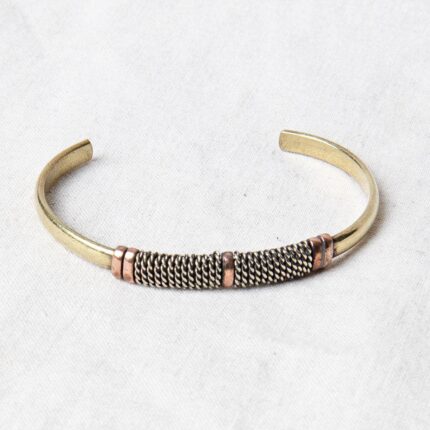

Tibetan Handcrafted Copper Bracelet
FAQ: ENFP Tarot Card
1. What tarot card is ENFP?
ENFP’s primary birth card is The Fool — the archetype of The Innocent Pioneer standing at the cliff’s edge, eyes on the sky, about to step. The mapping aligns ENFP’s dominant Ne (extraverted intuition) with The Fool’s psychological lens of openness to experience. ENFP’s growth card is The Star, which represents the Te/Si-driven sustained walk that Ne’s infinite beginnings eventually requires.
2. Why is The Fool the birth card for ENFP?
The alignment runs deeper than “both are spontaneous.” ENFP’s dominant Ne does its best work at the cliff’s edge, perceiving the next chapter before the page has turned; auxiliary Fi supplies the value-check that asks “is this chapter true for me?” Three types share this card (ENFP/ESTP/ESFP), but the why differs: ENFP’s Fool is sourced in Ne-Fi’s possibility-exploration, ESTP’s in Se-Ti’s action-experimentation, ESFP’s in Se-Fi’s present-moment sparkle.
3. What is the growth card for ENFP?
The Star. The logic: where Ne (dominant) generates the chapters, Te (tertiary) commits one to structure, and Si (inferior) sustains the commitment over time. The Star’s two vessels are the image for exactly this — the inner vessel (the value-charged possibility) and the outer vessel (the lived commitment that walks toward it). The growth invitation surfaces when Fool energy has over-matured into infinite beginnings.
4. What does reversed Fool mean for ENFP?
In an ENFP reading, reversed Fool isn’t a bad omen — it points to three specific patterns: Ne-Te loop (reckless beginning without Fi check), “I’m still exploring” as staying-avoidance (Si inferior delay), and the spark’s cynicism (openness hardened into “nothing is worth committing to”). The growth invitation is to notice whether the beginning is still serving your life or substituting for it.
5. Which Jungian archetype is ENFP?
ENFP aligns with the Fool/Innocent Pioneer archetype on the primary axis and the Star/Hopeful Seeker on the growth axis. Jung’s framework of cognitive functions — which MBTI is built on — describes Ne as extraverted intuition, the perceiving function that scans reality for possibility and connection.
6. What are the best crystals for ENFP?
Three crystals serve distinct ENFP functions: Green Aventurine (overall companion, supporting Ne’s leap), Citrine (upright ally, supporting Te’s execution), and Moonstone (growth invitation, supporting Si’s staying). These are anchors for specific cognitive moves, not “lucky stones.”
7. How does the Eastern perspective view ENFP?
The Mahayana Buddhist tradition recognizes ENFP-style beginning as chū fā xīn, the first arising of bodhicitta — a precious moment of beginner’s heart, valued and also tested by sustained practice. Taoism’s dà dào zhì jiǎn, the great way is simple describes the mature form: the openness that walks one road deeply. The staying clause is the Star’s walk.
8. Is the ENFP tarot mapping official MBTI?
No. MBTI is a registered trademark of The Myers-Briggs Company, and this mapping is our independent editorial interpretation based on Jungian cognitive functions (Ne/Fi/Te/Si). It is not affiliated with, endorsed by, or sponsored by The Myers-Briggs Company, and does not represent official MBTI doctrine. The mapping is offered as a self-reflection framework, not a personality diagnosis.
Explore More
- Tarot card meanings: The Fool · The Star
- Related Diplomats types: ENTP · INFP · ESFP (same Ne dominant / Diplomats group)
- Crystal meanings: Green Aventurine · Citrine · Moonstone
- Find your own MBTI birth card: MBTI Tarot Tool
- All MBTI × Tarot articles: MBTI Tarot Hub
> Tarot birth cards and crystals are mirrors for self-reflection, not personality diagnoses or fixed forecasts. The cards name the shape of the patterns your cognitive wiring keeps returning to — what you do with that naming is your free will.